
German Castle Documentaries
These German castle documentaries take one castle or palace at a time, from the Allgäu to the vineyard terraces of Potsdam, and ask where the story visitors hear there comes from. A castle said to have ruined a king, a reformer who vanished behind its walls, a ruin that is still a ruin, a famous name on a hill south of Darmstadt: each film starts from the claim and asks what holds it up.
Each block below sets the scene, poses the film’s question and names the kind of evidence it goes looking for, but stops short of the answer, which is the film’s to give. Every film links a written guide on this site, and each block ends with one thing to look for when you go. The films are narrated in English by synthetic voices; the research, the script, the sourcing and the edit are human.
The Films
Neuschwanstein: The Castle That Ruined a King
Neuschwanstein stands near Schwangau and Füssen in the Allgäu, a castle in the medieval manner that Ludwig II of Bavaria did not live to see finished. Inside, the Throne Hall, hung with a chandelier four meters high, rises like a church through the third and fourth floors, and in its northern apse a throne was to stand in place of an altar; after the king’s death it was never made. One floor down, the rooms were never finished at all, and today they hold a shop, a cafeteria and a multimedia room.
The film’s title makes a claim about a castle and a king. Did a building ruin a king? To find out, the film reads Ludwig’s own letter to Wagner about rebuilding an old castle ruin near the Pöllat gorge, the designs a Munich scene painter drew for a castle that did not yet exist, and the psychiatrists’ verdict of 1886.
Read: the Neuschwanstein Castle guide; on the guided tour, look for the empty northern apse of the Throne Hall.
Luther Vanished Into Wartburg Castle and Remade a Language
The Wartburg stands south above Eisenach, in Thuringia, and the Wartburg Foundation counts its twelfth-century Palas among the finest and most completely preserved Romanesque secular buildings north of the Alps. In the Palas, Moritz von Schwind’s fresco of 1855 shows the Singers’ Contest, and the inscription beneath it gives the contest a place and a date: this hall, on July 7, 1207. Schwind gave the figures faces from the recent past and from his own day, with Goethe and Schiller as youths and Liszt as Wolfram von Eschenbach.
Two famous stories are told here: the contest, and the inkpot Martin Luther is said to have hurled at the devil after he vanished here in 1521. Which of them hold, the film asks, and which century built the walls you walk past? Its witnesses are a chronicle, the rings of the hall’s oak beams, a letter Luther sent his prince, and a painter’s protest to his patron.
Read: the Wartburg Castle guide; after the Palas tour, look for the whale vertebra in the Lutherstube, where visitors were carving their names into the wooden walls as early as 1580.
Eltz Castle Isn’t “Untouched.” It Was Bombarded for 5 Years.
Eltz stands in the Eltz Forest near Münstermaifeld, in a side valley of the Moselle in northern Rhineland-Palatinate, and walkers reach it on a path of about two and a half kilometers from the Ringelsteiner Mühle at Moselkern. Its houses, where three branches of one family lived side by side, ring a single courtyard and were built over five centuries. Parts of the first castle still stand, among them the Romanesque lower stories of the keep called Platteltz and four stories of its Romanesque hall inside the Kempenich houses. In the Rübenach houses, a lower hall built in 1311 holds Lucas Cranach the Elder’s Madonna with Child and Grapes.
The film starts from a word it hears in nearly every video about Eltz: untouched. It asks how far that word holds, and goes looking in an emperor’s deed, the treaty the three branches signed to share one castle, a visiting writer’s account of a gate he found shut, and a nineteenth-century count’s letters about what not to rebuild.
Read: the Eltz Castle guide; on the guided tour, the Knights’ Hall of 1520, where all three branches met under its original oak ceiling.
Heidelberg Castle: Germany Chose to Keep It Broken
On the north flank of the Königstuhl, the red sandstone ruins of Heidelberg Castle rise above the old town and the Neckar valley, and the Bergbahn funicular stops at Schloss station. In the courtyard, the façade of the Ottheinrichsbau still stands, but look through its empty upper windows and you see sky; the façade’s original statues are now kept in the halls for their protection, where special tours show them up close. Below, half of the Gesprengter Turm, the blown-up tower, still lies in the ditch, much as a commander reported it in 1693.
Ask why Heidelberg Castle is a ruin and nearly everyone gives the same answer: the French, in the Palatinate war of the late seventeenth century. The film asks a different question: why is it still a ruin today? It goes to an American humorist’s travel book, a French émigré’s drawings of every wall, and a pamphlet about the castle’s future.
Read: the Heidelberg Castle guide; from the castle courtyard, look up at the Ottheinrichsbau’s empty upper windows.
Frankenstein Castle: Mary Shelley Never Came Here
A few kilometers south of Darmstadt, on the northernmost foothills of the Odenwald, Frankenstein Castle lies in the municipality of Mühltal in Hesse. What stands is a ruin with a nineteenth-century layer: Grand Duke Ludwig III of Hesse and by Rhine had its two towers restored according to the taste of the time; the tower of the inner castle was heightened in 1892, after his death. From the ruin of the inner castle the view runs far west over the Rhine plain. Couples marry in the late-Gothic chapel, restored around 1850.
Its name is one every reader of fiction knows, and the claim that brings people up the hill is that the castle gave Mary Shelley her story. The film puts two questions to that claim: what holds it up, and when did it first appear? It reads the travel book Mary Shelley published about her journey of 1814, the novel itself, a medieval charter, and a radio broadcast for American soldiers.
Read: the Frankenstein Castle guide, and from the ruin of the inner castle, the long view west over the Rhine plain.
Hohenzollern Castle: Built in 1867 to Look Ancient
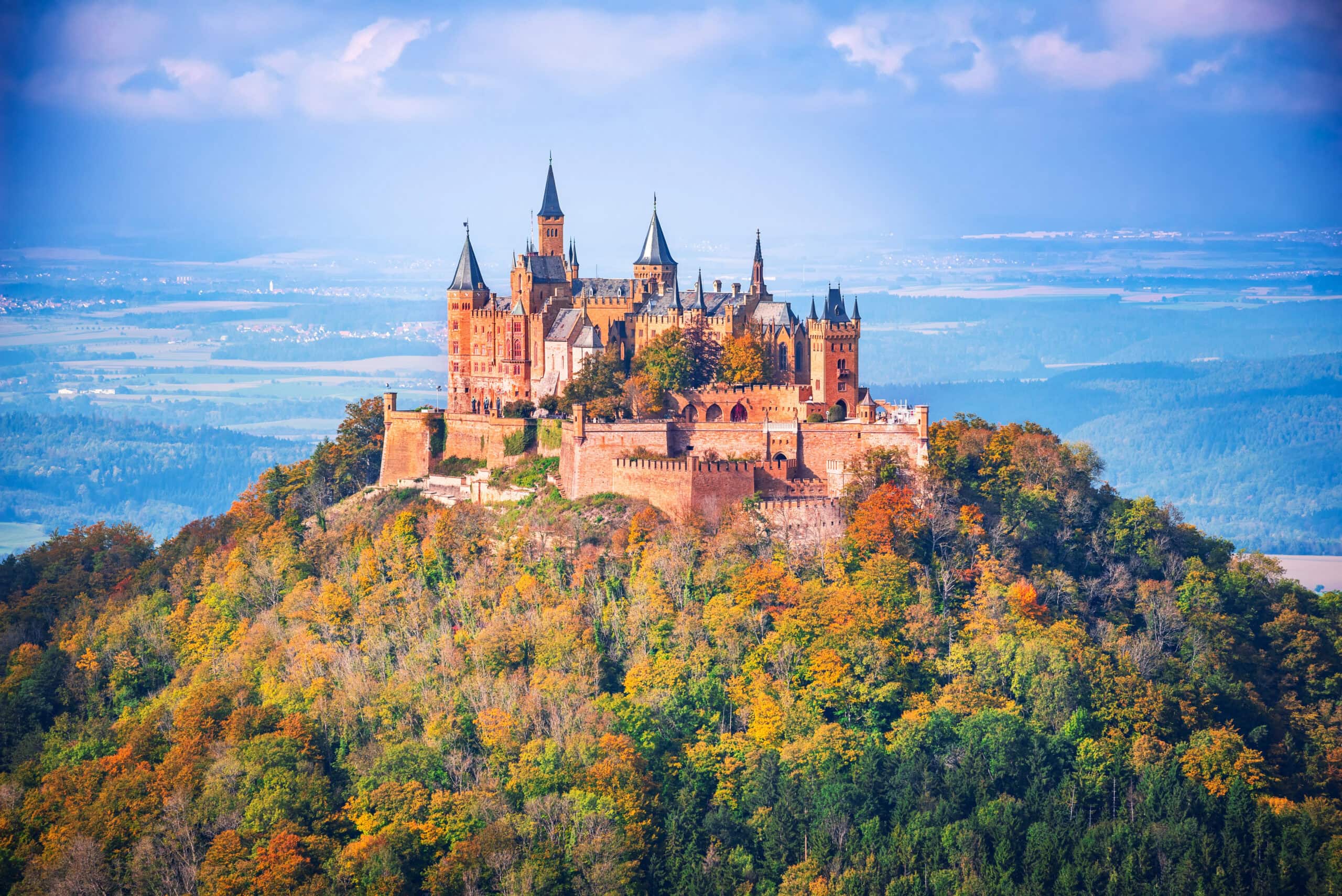
Hohenzollern Castle stands on the Zoller above the town of Hechingen; a bus runs from Hechingen station to the castle car park, and from there a steep path or a shuttle bus goes up to the castle. It is a horseshoe-shaped castle of several stories behind a ring of bastions, and the way in climbs a spiral ramp designed by the fortress architect Moritz von Prittwitz. Inside, the former castle kitchen now holds the treasure chamber. Even the woods are part of the story: the hillside was reforested with 92,000 beech trees only after the present castle was finished.
What was a castle like this built to say, and to whom? That is the film’s question, and its evidence is a king’s letter about a sunset he watched from the bastions as a young man, the motto cut over the gate, the praise that chroniclers gave a castle on this summit, and the morning in 1978 when the mountain shook.
Read: the Hohenzollern Castle guide, and on the way up, the spiral ramp Prittwitz designed in front of the castle.
Nymphenburg Palace: The King Who Fell for a Fake
In the west of Munich, Nymphenburg Palace keeps a gold-and-white room with stucco overdoors on the first floor of its south pavilion. Once a small dining room, it holds King Ludwig I’s Gallery of Beauties, painted almost entirely by Joseph Stieler and made for the Festsaalbau of the Munich Residenz. Stieler painted women from all classes of society, not only ladies of the court; one the palace singles out is Helene Sedlmayr, a shoemaker’s daughter. Elsewhere in the palace, Ludwig II, whose unfinished castle opens this page, was born in 1845, in a bedchamber that still keeps its original furnishings.
Then there is Lola Montez, whom the palace’s own room text calls a “Spanish” dancer, with the word Spanish in quotation marks. Why are the marks there, and who was the woman in the portrait? The film follows the trail through London newspapers of 1843, the king’s notes to his painter, and a line written on the back of a canvas.
Read: the Nymphenburg Palace guide; on the palace route, room 15, the gold-and-white former dining room in the south pavilion.
Sanssouci Palace: Frederick the Great Waited 205 Years
Sanssouci Palace sits above its vineyard terraces in Sanssouci Park, Potsdam, part of a UNESCO World Heritage Site, and its rooms keep their original eighteenth-century decoration. Frederick the Great’s grave lies on the highest terrace, where he wished to be buried, and visitors leave potatoes on the slab in every season. Behind the palace stands the Historic Windmill, with a visitor center beside it, and a miller is the hero of the story the film calls the most-told on the hill.
The king chose his own resting place on this terrace. The film asks why it took so long for anyone to do as he asked, and whether the story of the miller who stood up to the king is true. It reads the king’s own written orders for his burial, a miller’s petition, and the long road his coffin traveled, by way of a church, a bunker and a salt mine.
Read: the Sanssouci Palace guide, and on the highest terrace, the king’s grave, where potatoes lie on the slab.
Beyond the Films
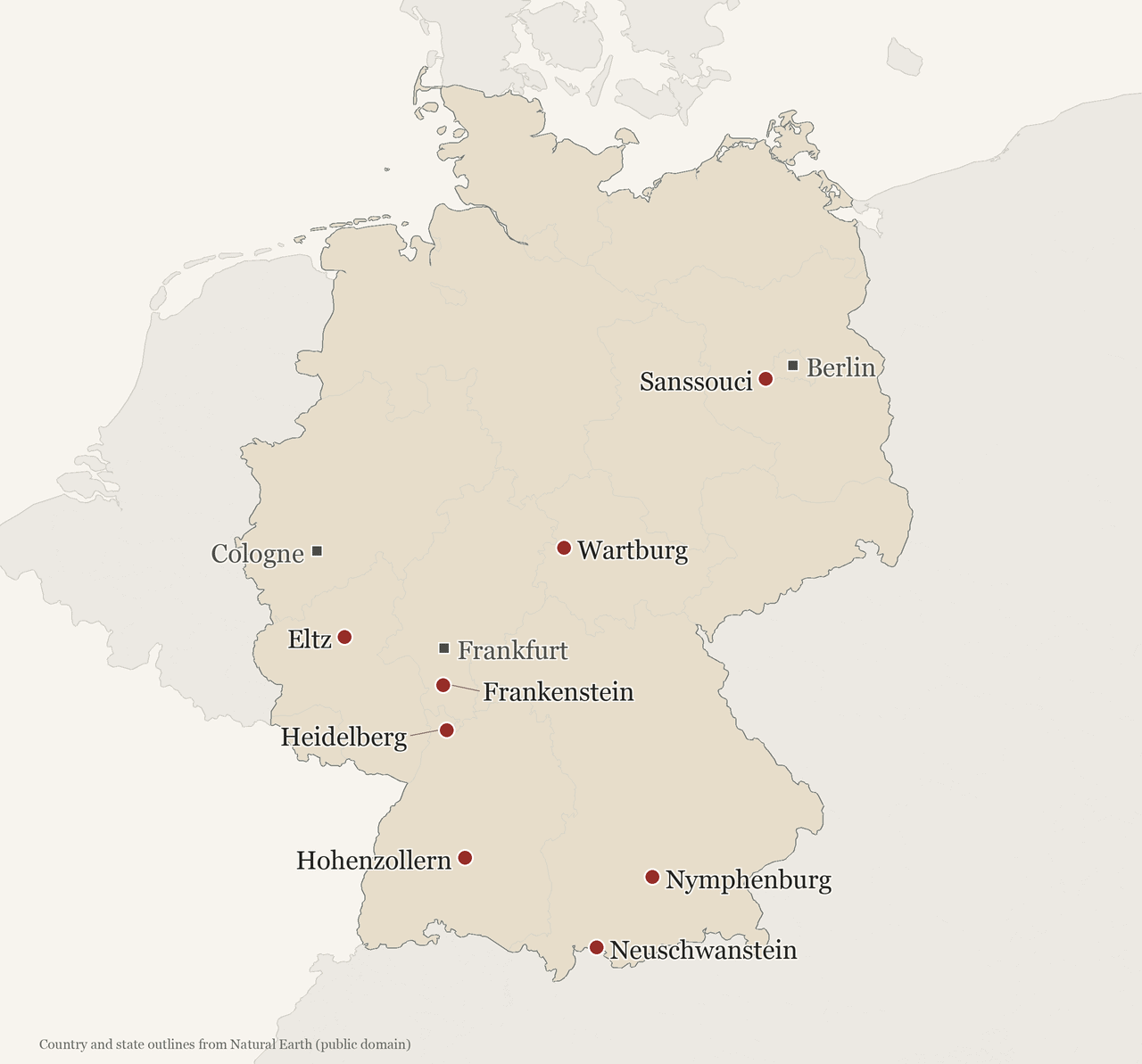
To plan a visit rather than watch one, start with our selection of Germany’s castles, which sets out what to see and how the regions fit together; each film’s written guide carries the practical detail. Three regional guides fit some of them into a trip: Neuschwanstein and Nymphenburg in the Bavaria guide, the Wartburg in the Thuringia guide and Sanssouci in the Berlin and Brandenburg guide. The films from France and Scotland, the way the series is made and a suggested place to start are on the castle documentaries index.
Principal Sources
- Bayerische Schlösserverwaltung. “Neuschwanstein Castle: How to get there.” neuschwanstein.de.
- Bayerische Schlösserverwaltung. “Neuschwanstein: Throne Hall.” neuschwanstein.de.
- Bayerische Schlösserverwaltung. “Neuschwanstein: Tour of the castle.” neuschwanstein.de.
- Bayerische Schlösserverwaltung. “Neuschwanstein Castle: Idea and History.” neuschwanstein.de.
- Bayerische Schlösserverwaltung. “King Ludwig II: Biography.” neuschwanstein.de.
- Bayerische Schlösserverwaltung. “Nymphenburg: Raum 15.” schloss-nymphenburg.de.
- Bayerische Schlösserverwaltung. “Nymphenburg Palace: Room 15.” schloss-nymphenburg.de.
- Bayerische Schlösserverwaltung. “Nymphenburg Palace: Room 20.” schloss-nymphenburg.de.
- Bayerische Schlösserverwaltung. “Nymphenburg Palace: How to get there.” schloss-nymphenburg.de.
- Burg Eltz. “Home page.” burg-eltz.de.
- Burg Eltz. “The Castle.” burg-eltz.de.
- Burg Eltz. “History.” burg-eltz.de.
- Burg Hohenzollern. “Castle History.” burg-hohenzollern.com.
- Burg Hohenzollern. “Your way to the Castle.” burg-hohenzollern.com.
- Franz, Eckhart G. “Ludwig III.” Neue Deutsche Biographie 15 (1987), 397-398. deutsche-biographie.de.
- Staatliche Schlösser und Gärten Baden-Württemberg. “Heidelberg Castle.” schloss-heidelberg.de.
- Staatliche Schlösser und Gärten Baden-Württemberg. “How to find us.” schloss-heidelberg.de.
- Staatliche Schlösser und Gärten Baden-Württemberg. “Ottheinrichsbau.” schloss-heidelberg.de.
- Staatliche Schlösser und Gärten Baden-Württemberg. “Der Pfälzische Erbfolgekrieg.” schloss-heidelberg.de.
- Staatliche Schlösser und Gärten Hessen. “Burg Frankenstein.” schloesser-hessen.de.
- Staatliche Schlösser und Gärten Hessen. “Frankenstein Castle.” schloesser-hessen.de.
- Stiftung Preußische Schlösser und Gärten Berlin-Brandenburg. “Sanssouci Palace: Retreat on the Vineyard.” spsg.de.
- Stiftung Preußische Schlösser und Gärten Berlin-Brandenburg. “Kartoffeln am Grab: Zum Tod Friedrichs des Großen in Sanssouci am 17. August 1786.” spsg.de.
- Wartburg-Stiftung. “Anreise.” wartburg.de.
- Wartburg-Stiftung. “UNESCO Welterbe.” wartburg.de.
- Wartburg-Stiftung. “Das Sängerkriegsfresko von Moritz von Schwind.” wartburg.de.
- Wartburg-Stiftung. “Der Walwirbel in der Lutherstube.” wartburg.de.
- Wartburg-Stiftung. “Geführter Rundgang.” wartburg.de.
Image credits. Hero, Hohenzollern Castle on its mountain cone in autumn: Photo: ecstk22 / Adobe Stock; Locator map: own work; country and state outlines from Natural Earth, public domain. Freely licensed images are resized to fit; otherwise unaltered.