
Dolbadarn Castle
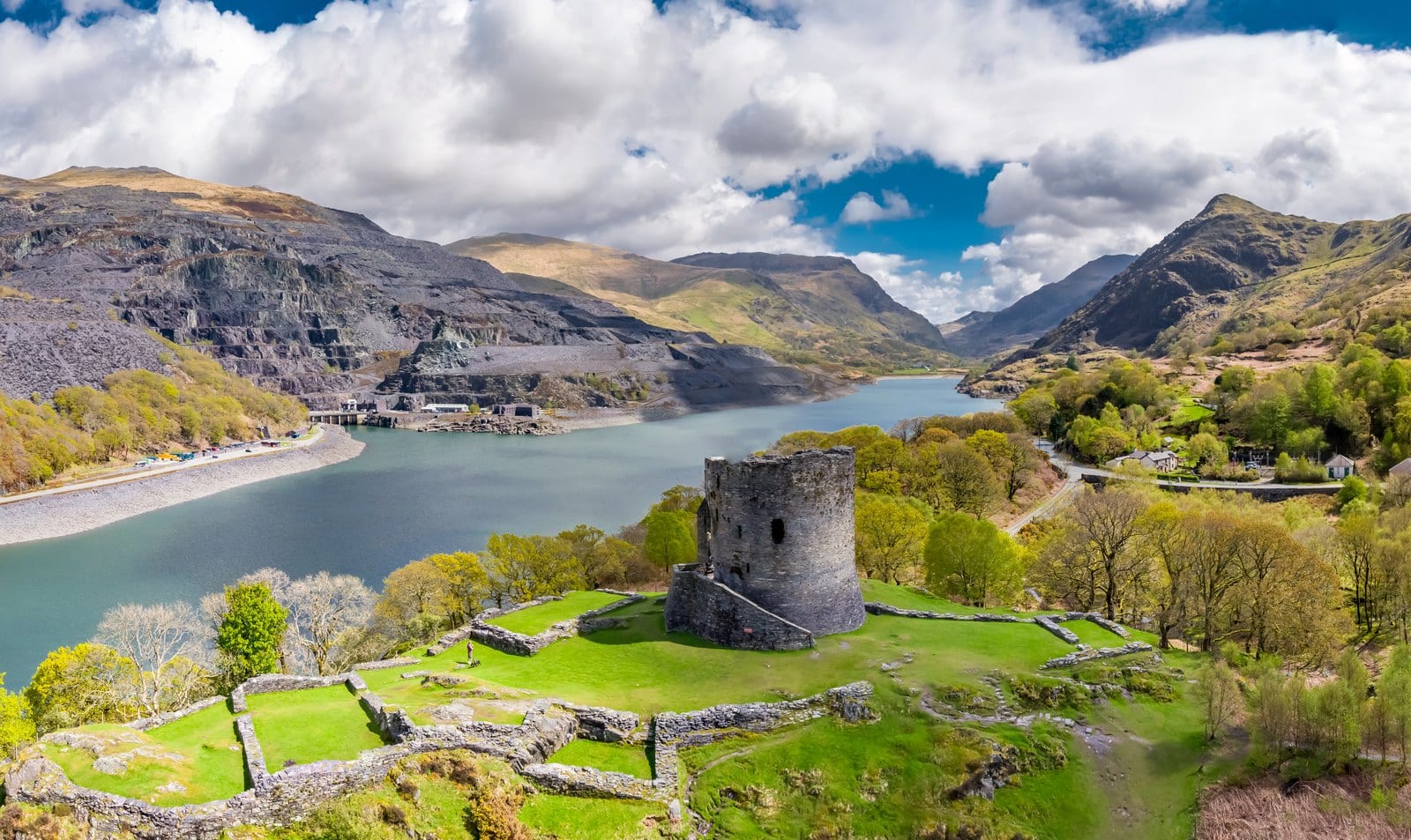
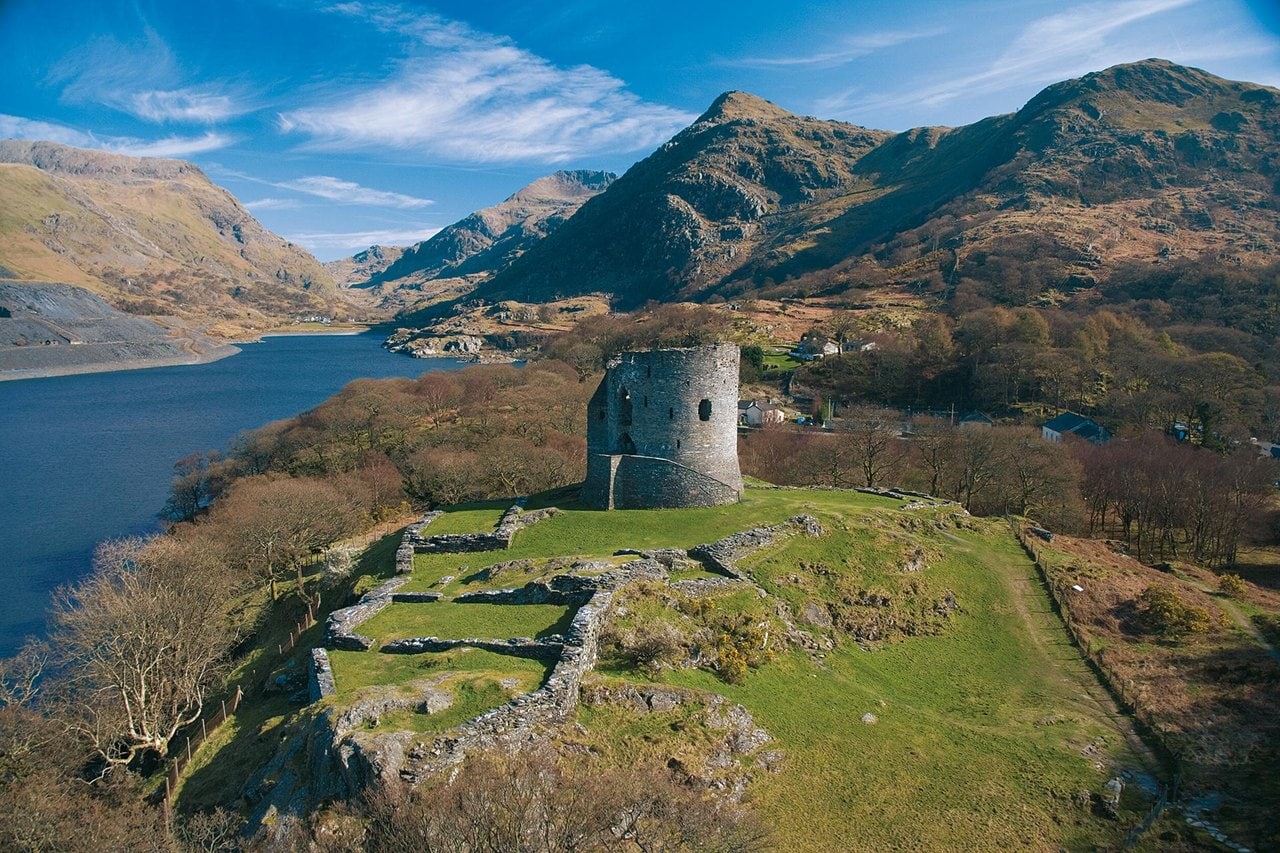
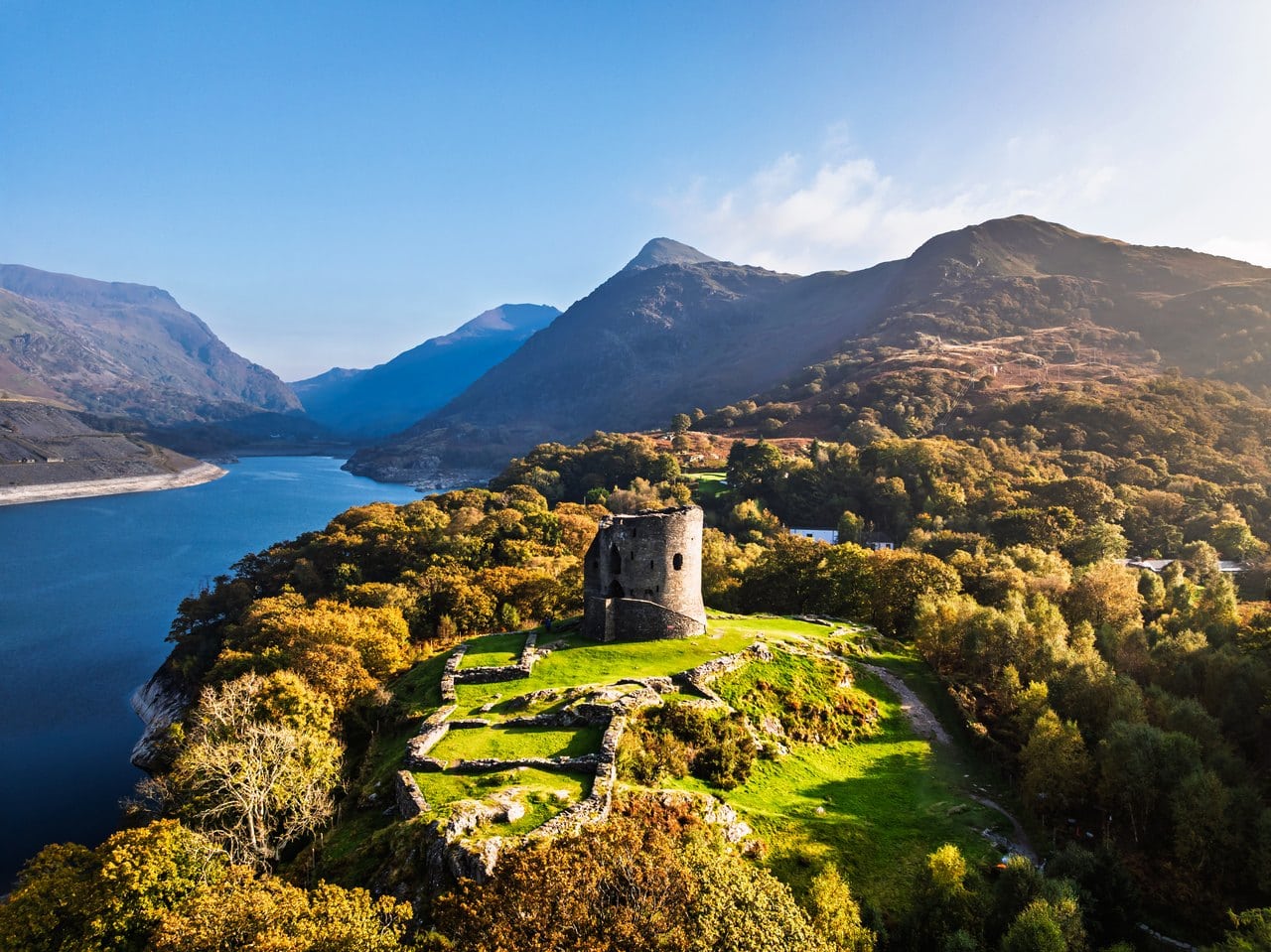
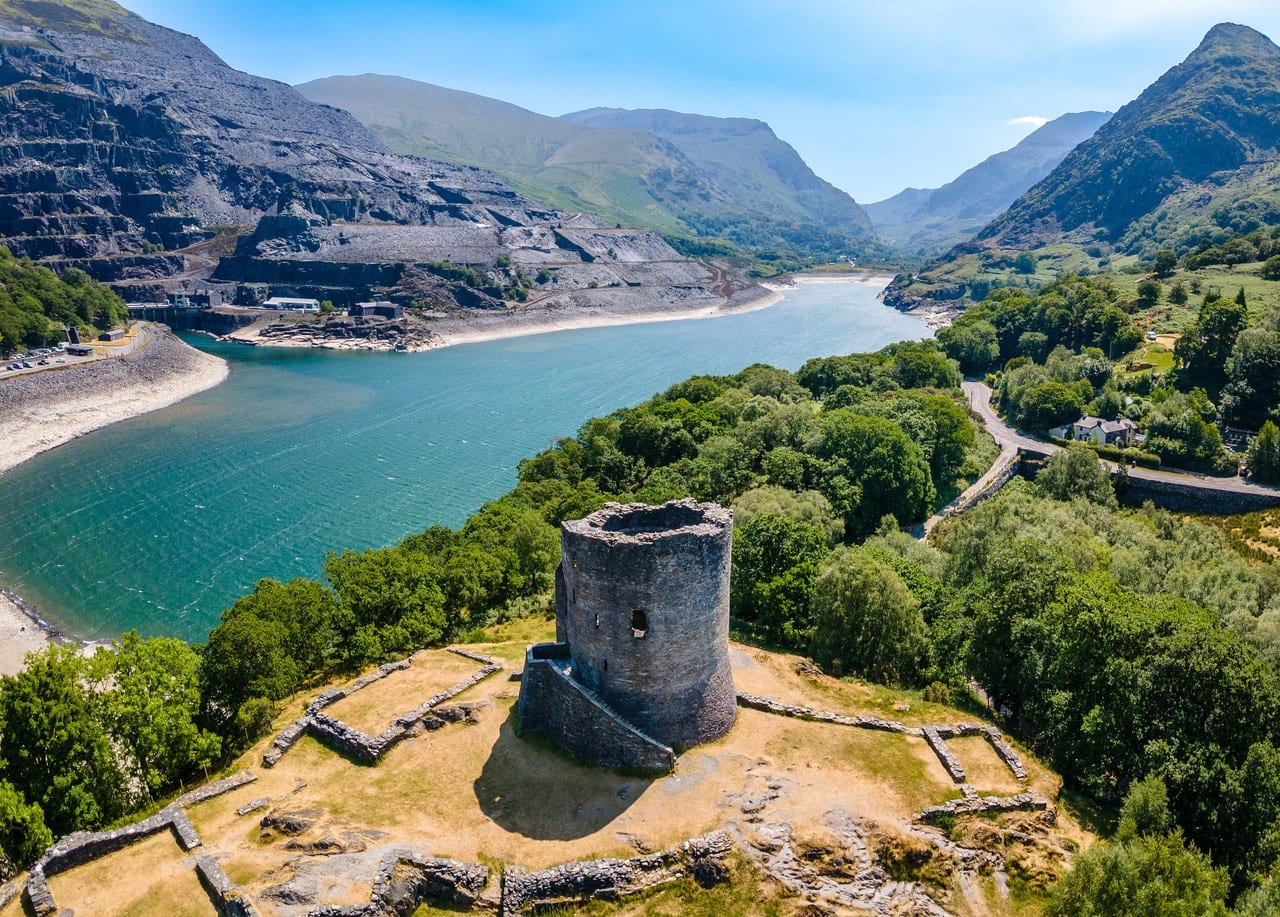
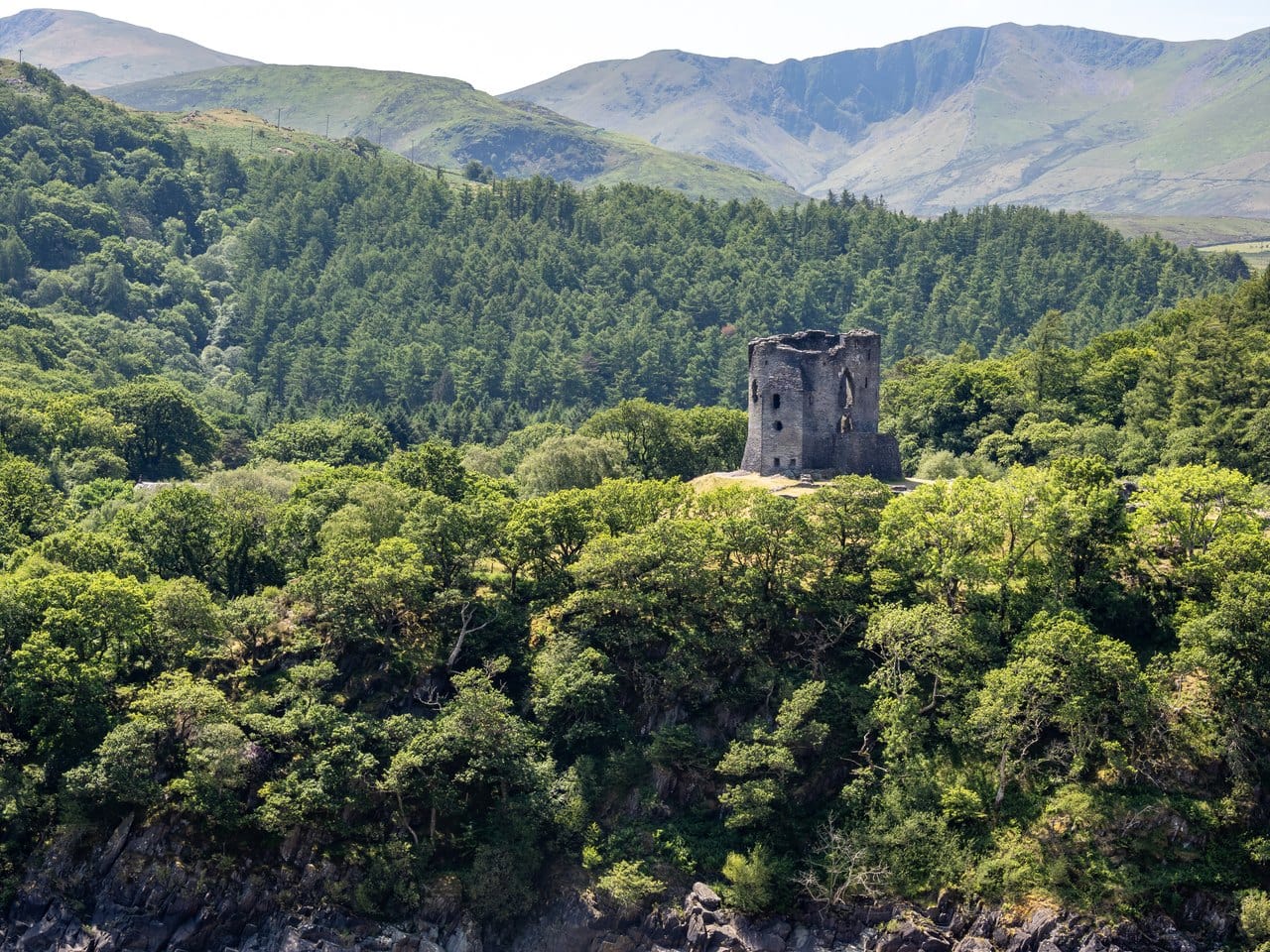
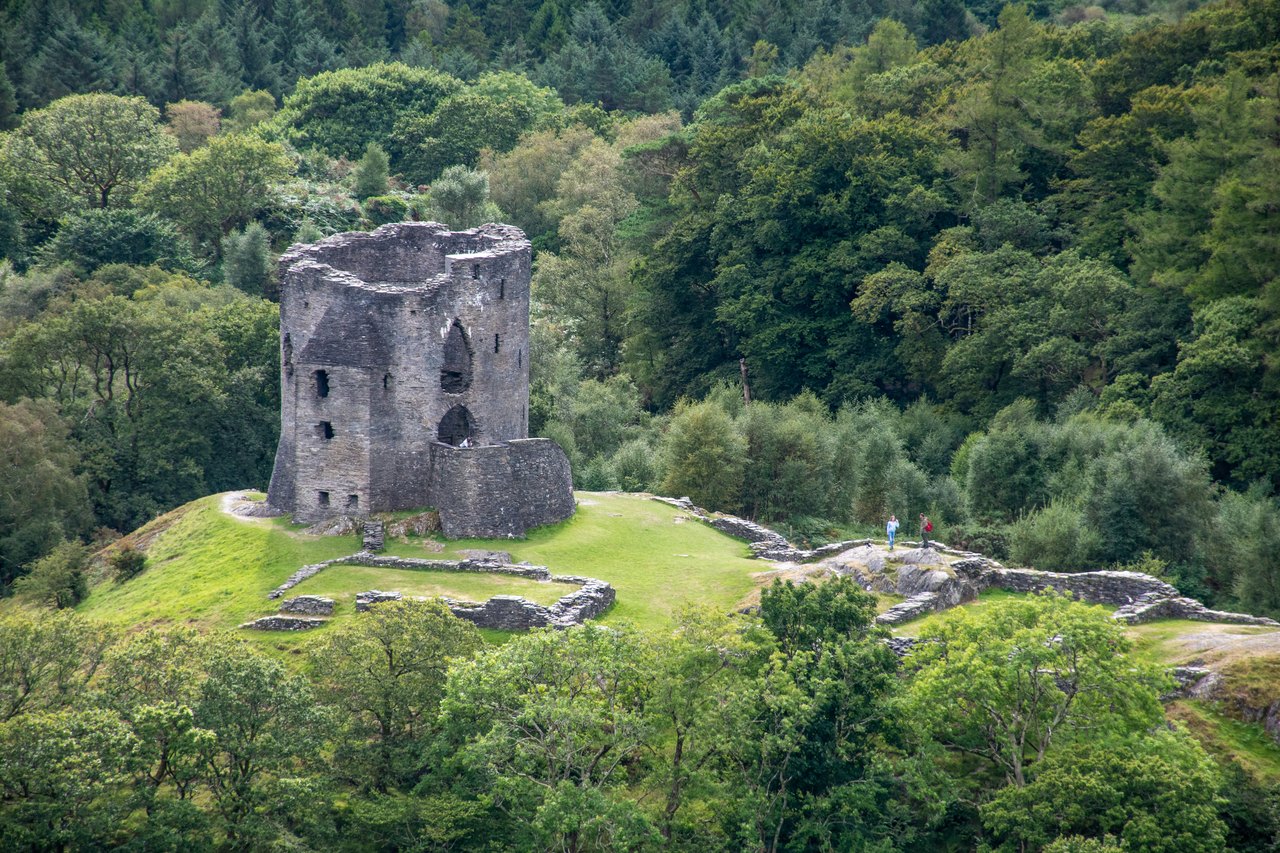
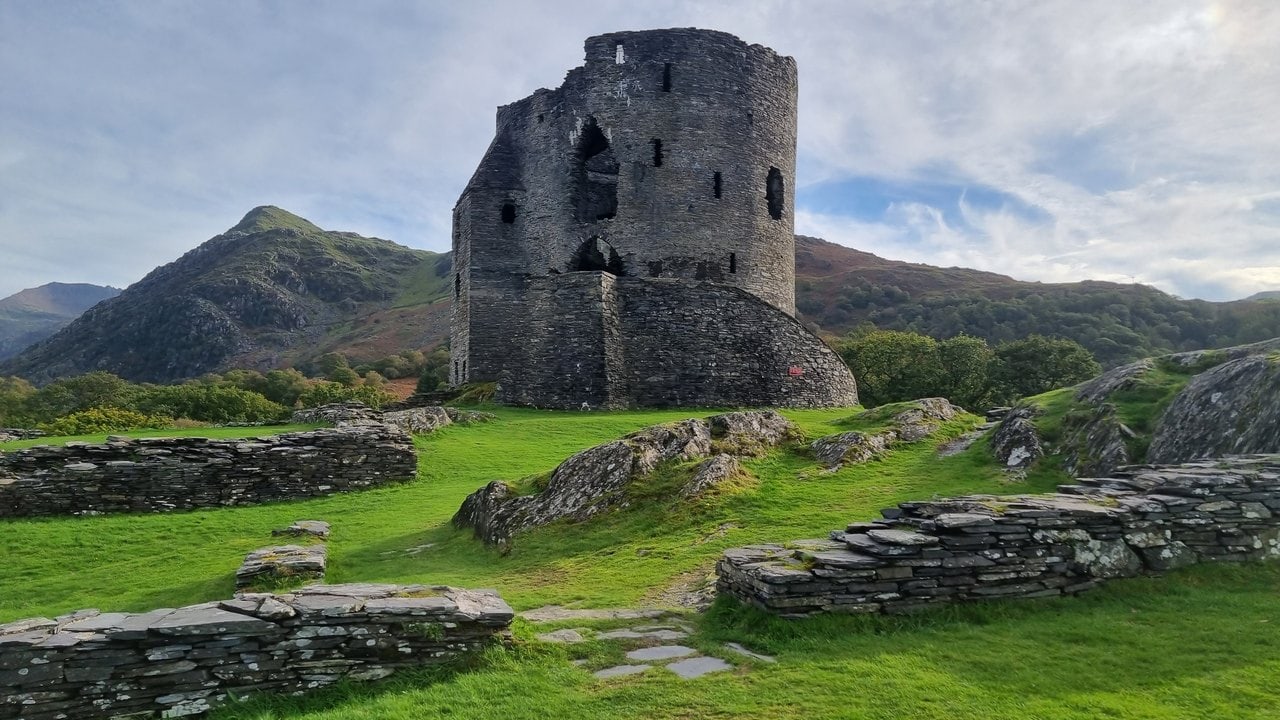
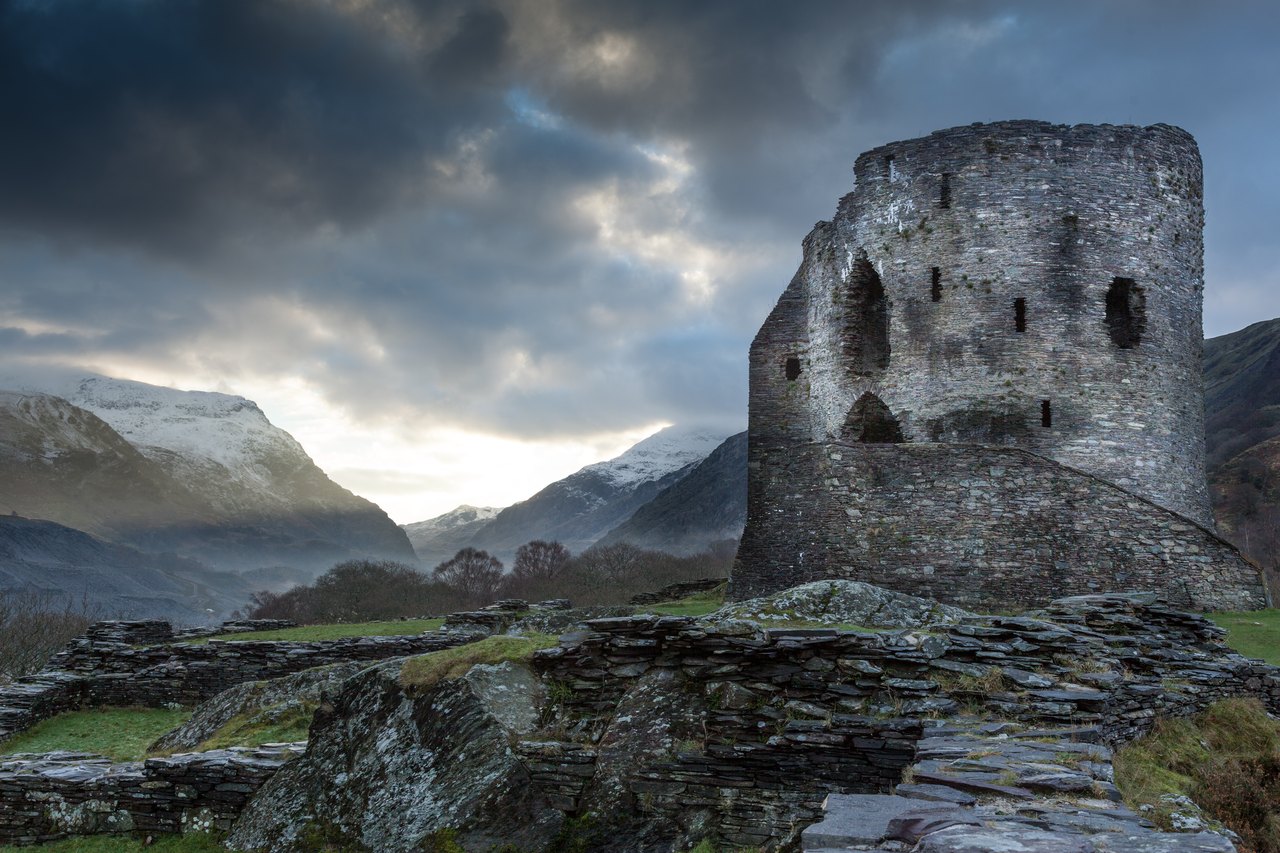
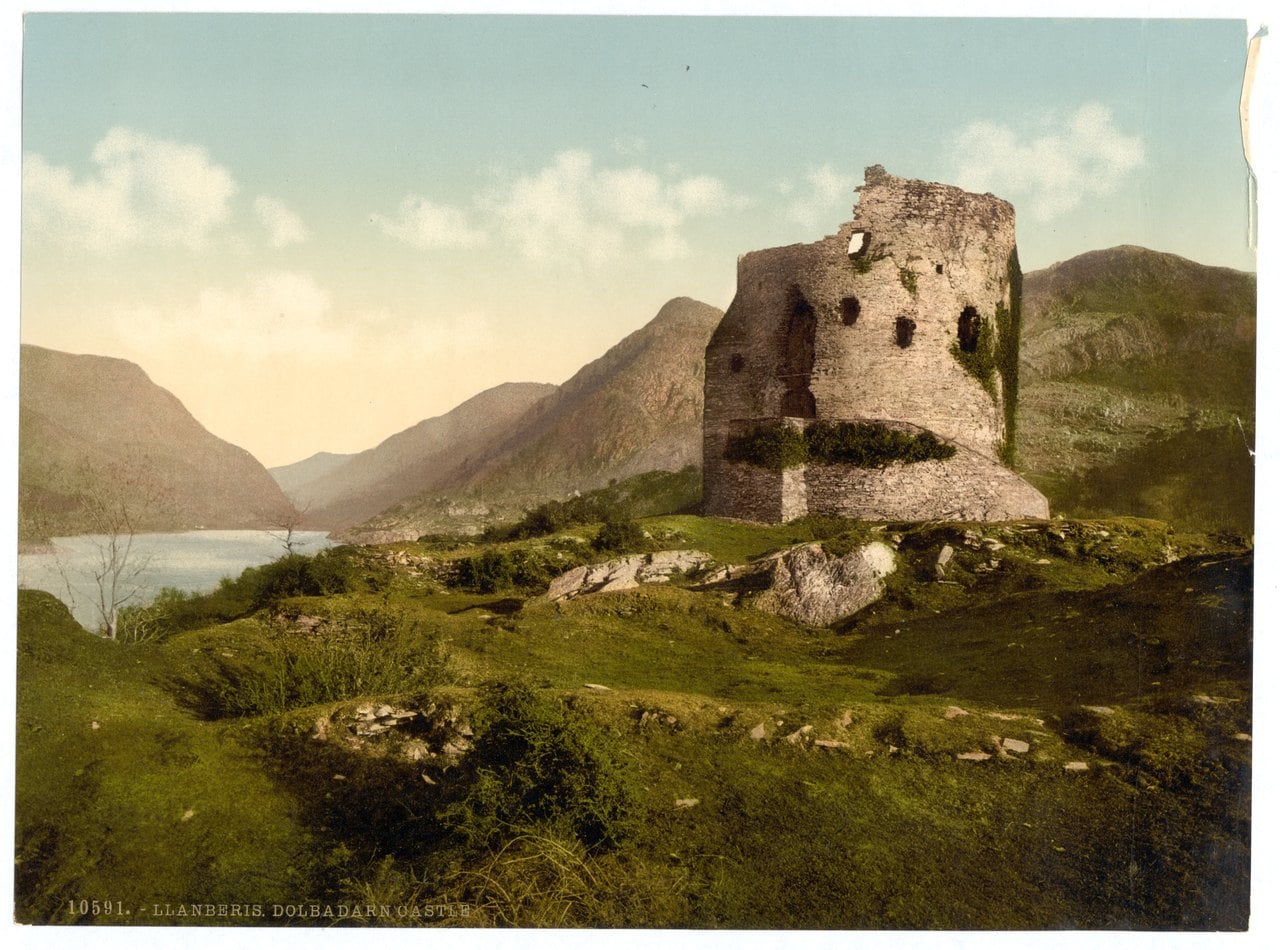
Dolbadarn Castle stands on a rocky ridge between two lakes, Llyn Padarn and Llyn Peris, at the foot of the Llanberis Pass in Eryri (Snowdonia), half a mile southeast of the village of Llanberis. Castell Dolbadarn, to give it its Welsh name, is a native-built castle of the princes of Gwynedd, and Cadw, the Welsh Government’s historic environment service, which cares for it, says it was most likely built by Llywelyn ap Iorwerth (Llywelyn the Great), who died in 1240. What survives is a single round tower of mortared stone, roofless but tall, and the low, fragmentary walls of the enclosure attached to it.
Its written history is short. A tradition places the imprisonment of Owain Goch, brother of Llywelyn ap Gruffudd (both were grandsons of Llywelyn ap Iorwerth), in its tower, and Cadw’s scheduling record calls that probable rather than proven. English forces took the castle in 1283, probably in May, in Edward I’s war of 1282-83. Five centuries later J. M. W. Turner made it the subject of a painting he exhibited at the Royal Academy in 1800, with a verse about the captive Owain, and a Turner scholar has noted how far the painted tower outgrows the real one. Those are three separate layers: what the stones and the records establish, what tradition says, and what the painters made of it.
Quick Facts
| Location | Llanberis, Gwynedd, Wales; on a rocky ridge between Llyn Padarn and Llyn Peris, at the foot of the Llanberis Pass, beside the A4086 |
|---|---|
| Native name | Castell Dolbadarn |
| Built | Late 12th or early 13th century (Cadw); round tower dated to the 1230s in Cadw’s scheduling record; official accounts disagree on whether tower or enclosure came first |
| Built for | Most likely Llywelyn ap Iorwerth (Llywelyn the Great), prince of Gwynedd (Cadw) |
| Architectural style | Native Welsh castle: a mortared round tower (keep) and an attached, unmortared stone enclosure |
| Castle type | Masonry castle: round tower and walled enclosure on a rock ridge |
| Condition | Ruin: round tower roofless, its timber floors gone (beam sockets remain), about 15 m high by Cadw’s figures; enclosure walls fragmentary; twentieth-century entrance steps |
| Owner / managed by | In the care of Cadw |
| Designations | Scheduled monument CN066; Grade I listed building 21854 |
| Nearest town & station | Llanberis, 0.8 km (1/2 mile); nearest mainline station Bangor, 14.5 km (9 miles) (Cadw) |
| Open to public | Yes, all year |
| Official website | Cadw: Castell Dolbadarn |
History
A Native Castle at the Foot of the Llanberis Pass
Cadw describes Dolbadarn as a castle that “stood watch over the strategic route inland from Caernarfon to the upper Conwy Valley.” Its scheduling record for the site adds that the castle controlled the main routeway through the Llanberis Pass, “and also guarded the economically important cattle pastures of the area.” That record groups it with Dolwyddelan and Castell y Bere as three castles begun by Llywelyn ap Iorwerth to defend the passes into Snowdonia.
Its builder and its date are attributions rather than records. Cadw dates the castle to the late 12th or early 13th century and names Llywelyn ap Iorwerth as its most likely builder, while its scheduling record dates the round tower to the 1230s, late in Llywelyn’s life. The reason for the hedging is plain from the old Ministry of Works guide to the castle, written by C. A. Ralegh Radford, which put it bluntly: “The story of Dolbadarn is lost. The castle is mentioned in no document earlier than the English conquest.” Its early history has to be read from the building itself.
Owain Goch, 1255-1277
In 1255 Llywelyn ap Gruffudd defeated his brothers Owain and Dafydd at the battle of Bryn Derwin. The chronicle of the princes, Brut y Tywysogion, gives the outcome in two sentences: “before the end of one hour, Owain the Red was taken, and David fled …”, and “then Owain the Red was imprisoned …”. Owain the Red is Owain Goch, and the chronicle names no castle. It does record the end: about the feast of St. Andrew in 1277, Owain was “released from the prison of Llywelyn, by the command of the king,” meaning Edward I, whose army would take Dolbadarn in 1283.
Dolbadarn’s claim to the prisoner rests on later sources, and the official ones choose their words carefully. Cadw’s scheduling record says: “It is probable that this tower was where Llywelyn ap Gruffudd kept his brother, Owain ap Gruffudd imprisoned for two decades, from 1255 to 1277.” A Cadw booklet is a degree more careful: “Llywelyn ap Gruffudd is said to have kept his brother, Owain ap Gruffudd (d. about 1282), imprisoned there for two decades.” The Royal Academy, which owns Turner’s painting of the scene, goes further and calls the location of the imprisonment “now disputed.”
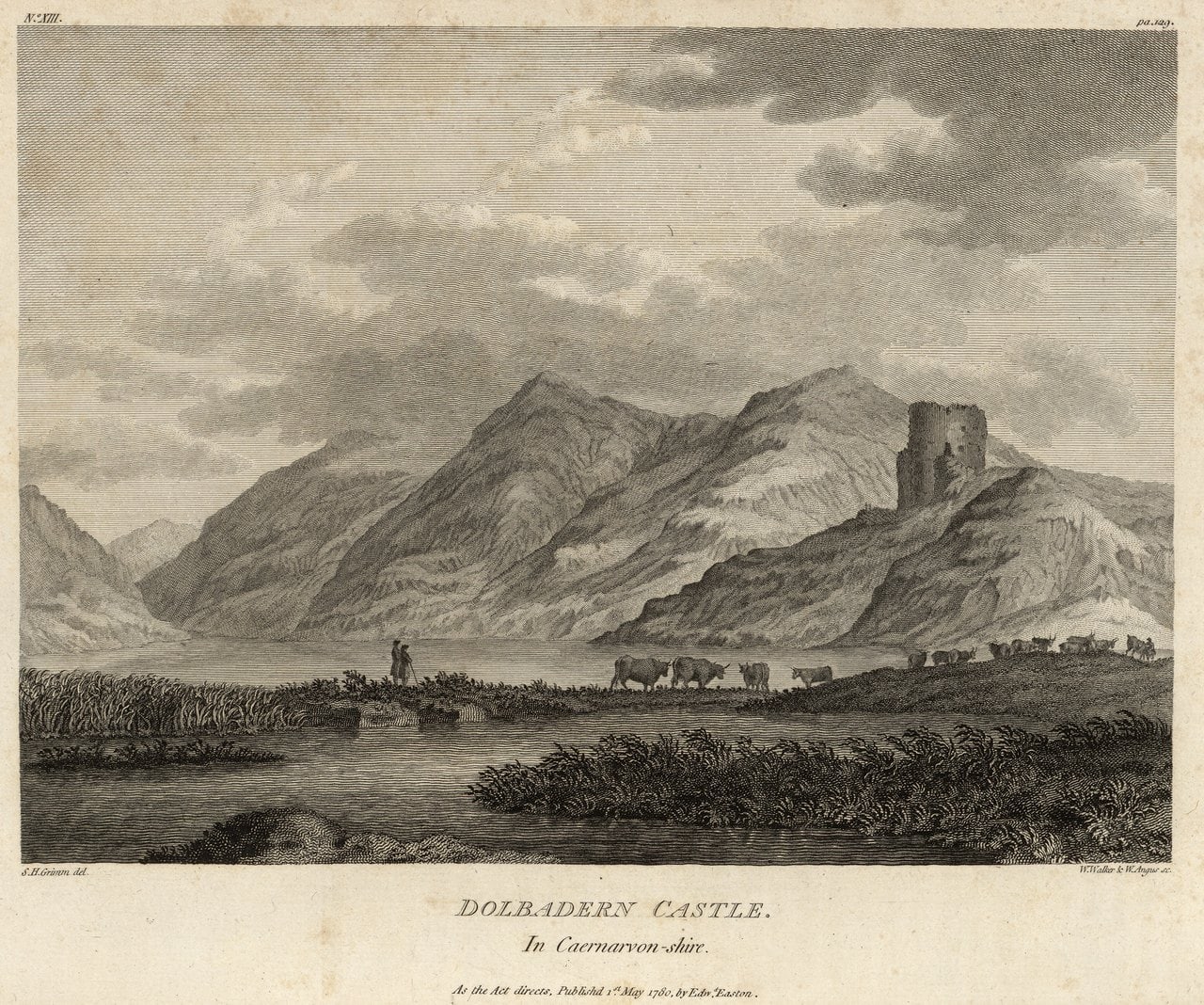
The nearest thing to a contemporary witness does not settle it. Cadw’s booklet quotes a poem of the time by Hywel Foel ap Griffri, lamenting Owain’s captivity, which opens on him as “A man who is in the tower, long a guest”; the line names a tower, not a castle. The Royal Commission’s 1960 inventory of Caernarvonshire notes that Dolbadarn is “nowhere mentioned in the native chronicles, nor by the bards of the age of independence.” The tradition is at least as old as the late 1530s, when John Leland, touring Wales, described “Dolebaterne on a rok bytwixt 2. linnys” and added: “There is yet a pece of a toure, wher Owen Gough, brother to Lleulen, last prince, was yn prison.” Leland states it flatly, some two and a half centuries after the event. Thomas Pennant, in 1781, recorded the prison without naming a prisoner: “This seems to have been built to defend the pass into the interior parts of Snowdonia; and it was likewise used as a state prison.” Richard Warner, who walked through Wales in August 1797, named him: “Owen Goch, the unsuccessful rebel, and opponent of his brother Llewellyn, being taken prisoner by the prince, languished twenty years within its walls …”.
The Fall of Dolbadarn, 1283
In Arnold Taylor’s account of the war, Llywelyn ap Gruffudd was killed near Builth in December 1282, and by 18 January the English capture of Dolwyddelan Castle “had opened the way through the Conwy valley, the Llanberis Pass and the Vale of Ffestiniog …” Edward I himself reached Conwy on or about 14 March, and “the construction of Conwy Castle was begun immediately.” Castell y Bere fell on 25 April, and Dolbadarn was taken soon after, “probably sometime in May,” which in Taylor’s words “denied Llywelyn’s brother, Dafydd (d. 1283), his last remaining stronghold.”
Dafydd, the brother who had fled from Bryn Derwin in 1255, was still dating letters at Llanberis, which Taylor identifies with Dolbadarn, on 2 May 1283, styling himself Princeps Wallie et dominus Snaudonie, Prince of Wales and Lord of Snowdon. Cadw’s scheduling record says that, once in English hands, the castle was soon supplanted by Edward I’s new fortification at Caernarfon “and so was partially dismantled and abandoned.” After the conquest, timber was taken from Dolbadarn for Edward I’s new castles; Cadw’s listing record says some of it went to Caernarfon in 1284.
Manor, Ruin and Monument
In 1352 a survey of the commote, printed as the Record of Caernarvon (Caernarvon is an older spelling of Caernarfon), still has tenants paying yearly dues toward the works of the manor of Dolbadern. Those dues paid for the manor’s upkeep, which is not the same thing as a castle still in use. Radford drew more from the same record: it “reflects the arrangements in force under the last native princes,” he wrote, and “shows that, at that date [under those princes], Caernarvon had been largely eclipsed in importance, as the tenants of the surrounding district of Arfon Is Gwyrfai contributed to the maintenance of the manor of Dolbadarn and not to the older centre.” Cadw’s scheduling record says little is recorded of the castle after the early fourteenth century, and passes on only a suggestion that Owain Glyndŵr used it to hold captives around 1400.
Today the castle is protected as a scheduled monument and as a Grade I listed building. Llyn Peris, below the castle, is one of the two lakes the Dinorwig pumped-storage power station uses for water power and storage, a scheme fully commissioned in 1984. Across Llyn Peris rise the benched galleries of the Dinorwig slate quarry, which the Royal Commission’s record lists as part of the Slate Landscape of Northwest Wales World Heritage Site; on Cadw’s published boundary data, Dolbadarn itself lies just outside the boundary.
Architecture
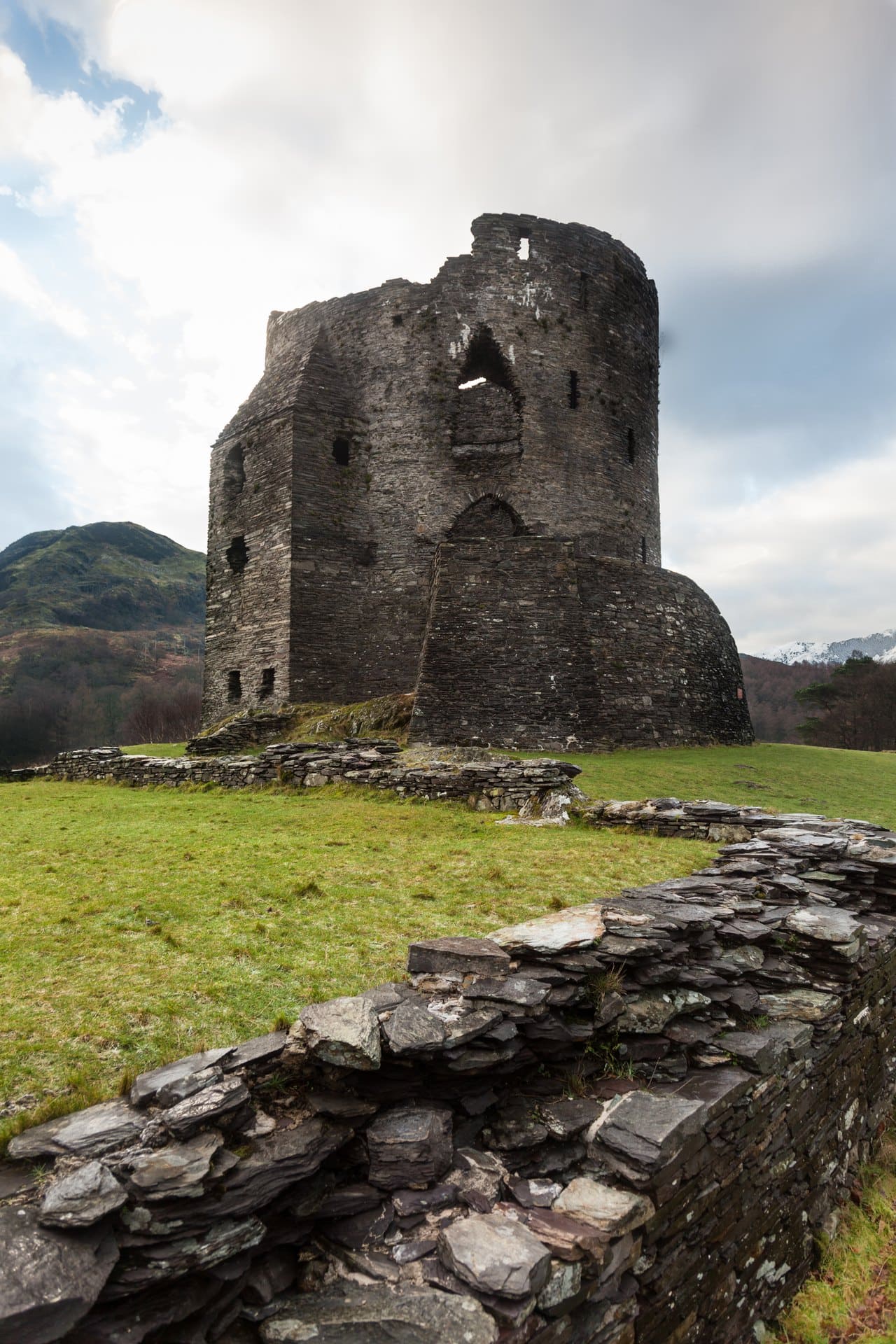
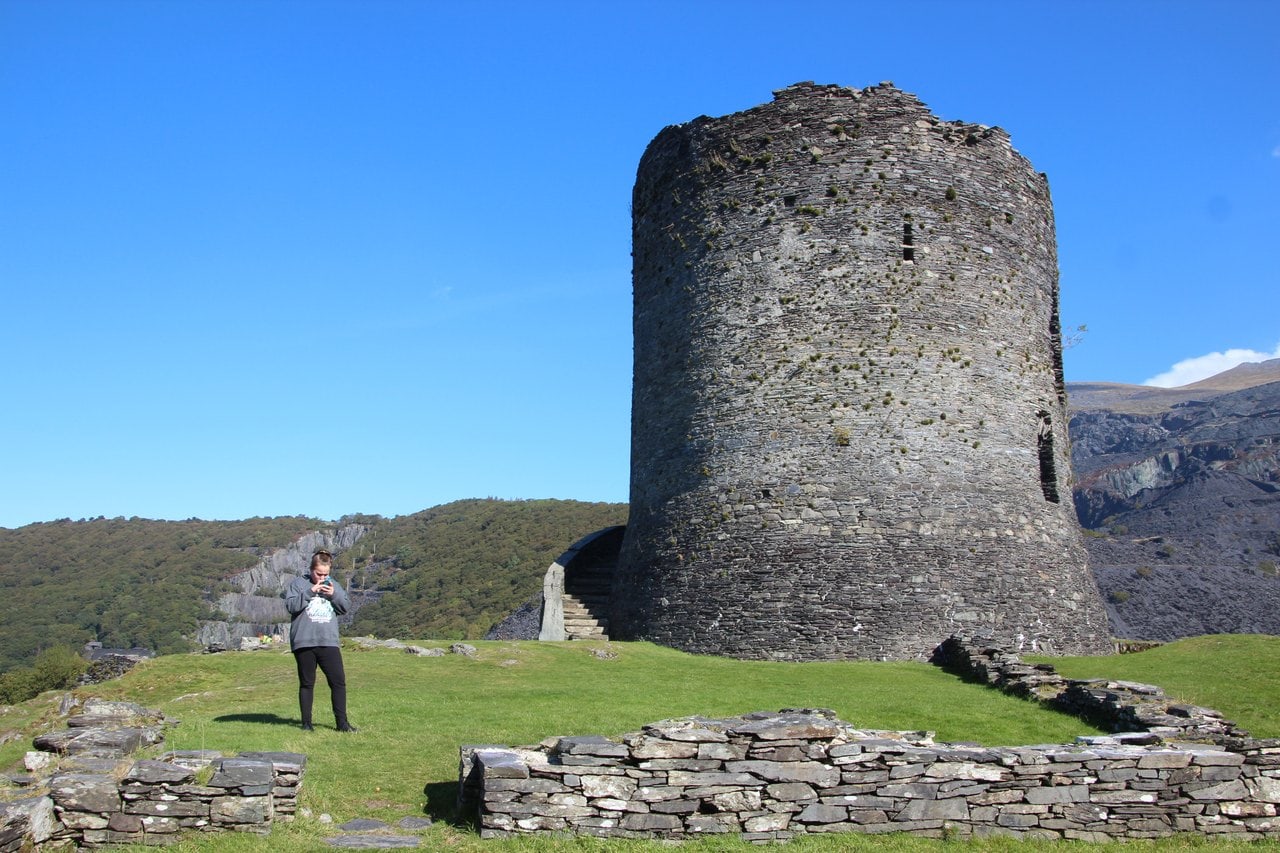
Two kinds of building make up Dolbadarn. Cadw contrasts the sturdy round tower with the unmortared slate slabs of the enclosure’s curtain walls, and the Royal Commission’s 1960 inventory describes a tower “of mortared masonry” beside the ruins of an attached courtyard “of apparently dry stone walling,” both built of local slate and grit.
The Round Tower
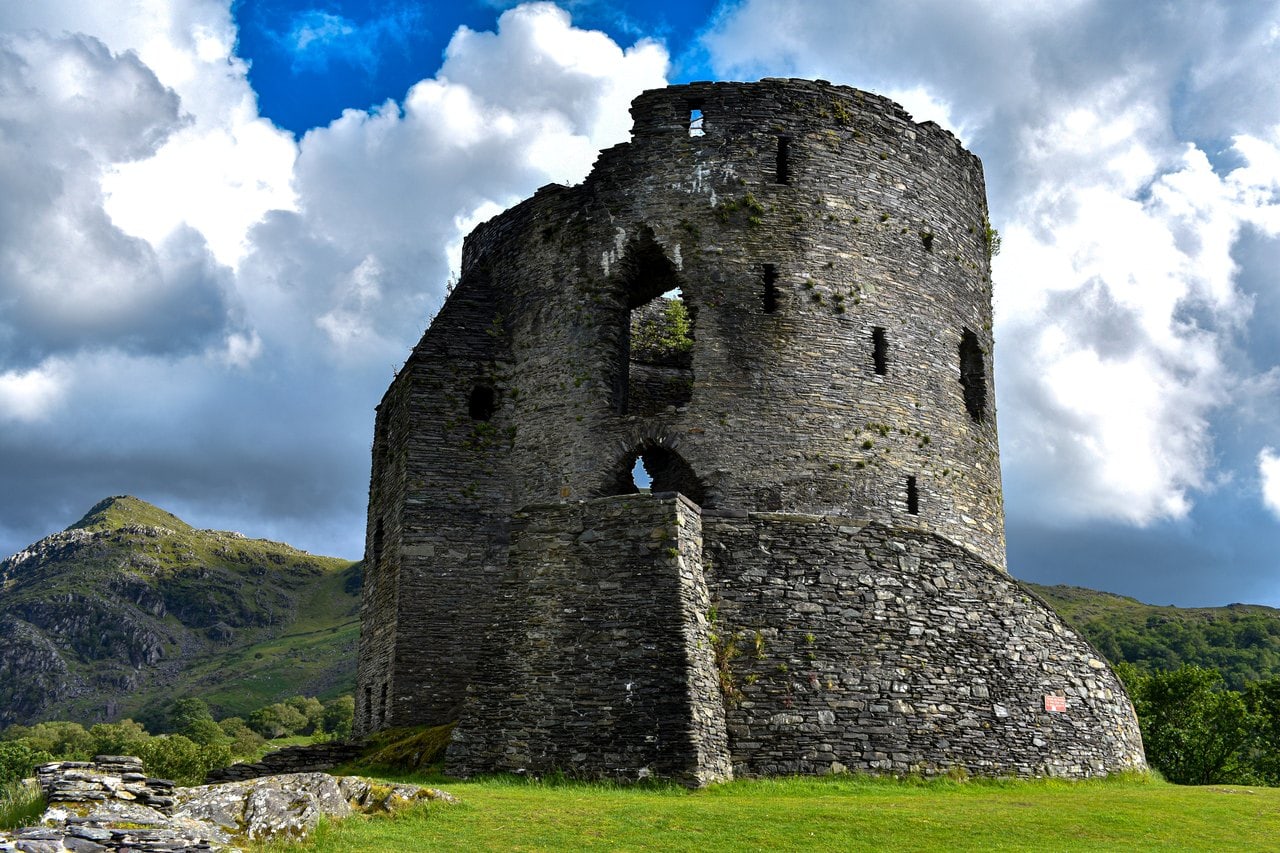
Cadw calls it a round tower; its listing record calls it a keep. It stands about 15 m (50 ft) high, by Cadw’s figures, with walls about 2 m thick; other official records give a lower height. It rises from a natural rock outcrop. B. H. St. J. O’Neil, in his official HMSO introduction to the castles of England and Wales, noted that the round keeps of Monmouthshire and the neighboring parts of Herefordshire and Breconshire were all built on mottes, artificial earth mounds.
Cadw looks to the same border country for the design. Its place page says the tower’s design “was probably inspired by that of similar fortresses built by Llywelyn’s rivals in the borderlands of the southern Marches,” and a Cadw booklet names Skenfrith, Tretower and Bronllys, all in southeast Wales, as examples. In plan the tower is round rather than D-shaped, and it is the D-shaped form that Cadw, writing about Dolwyddelan, calls characteristic.
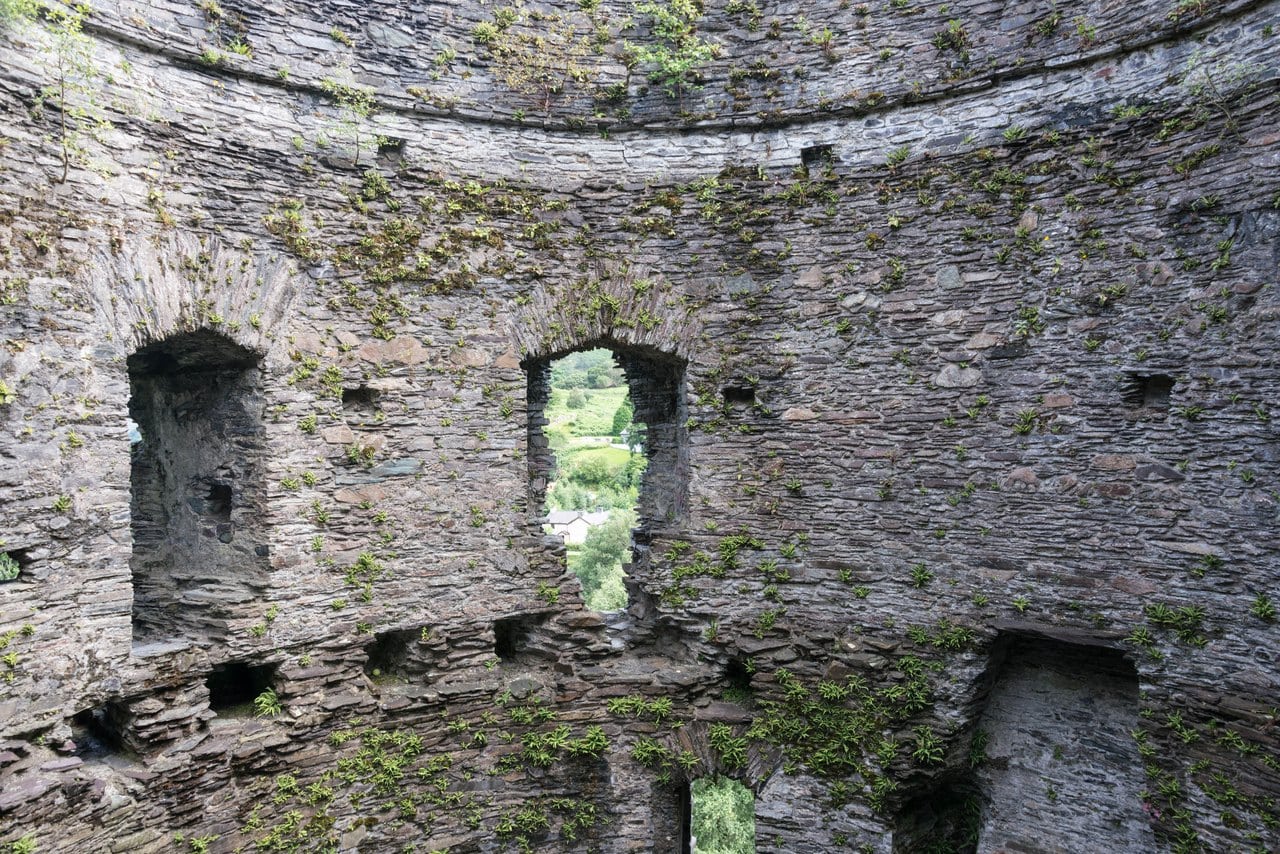
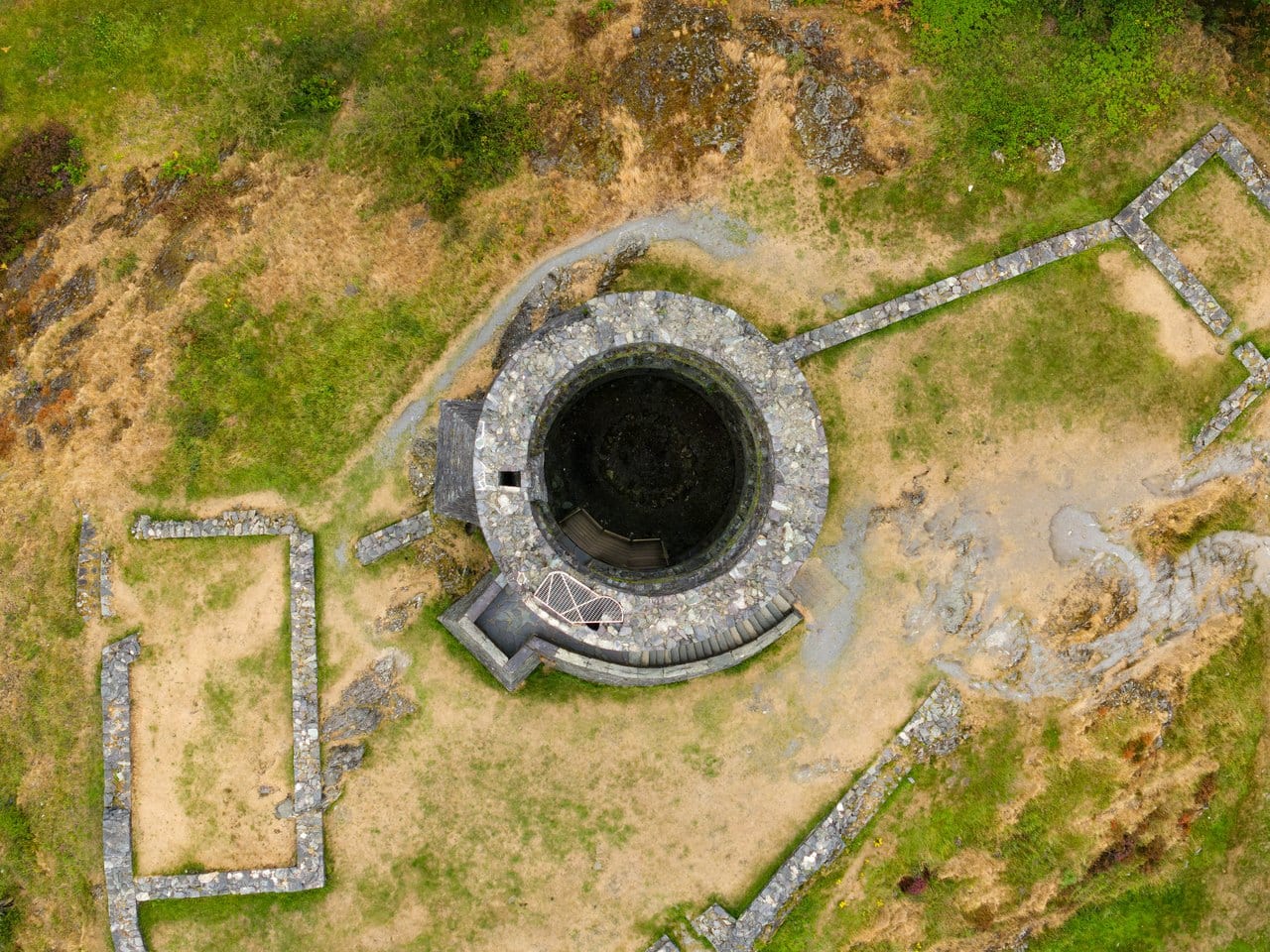
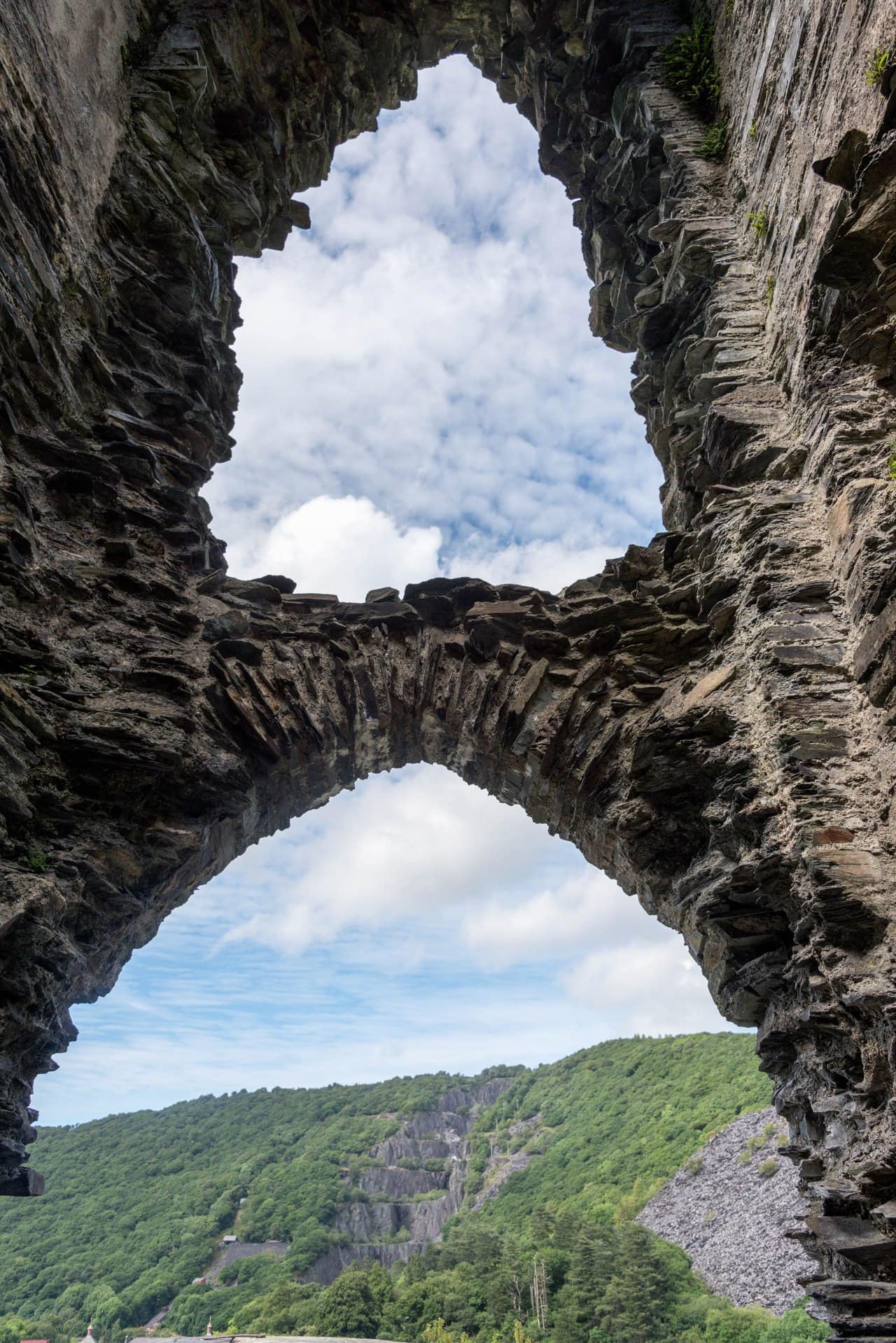
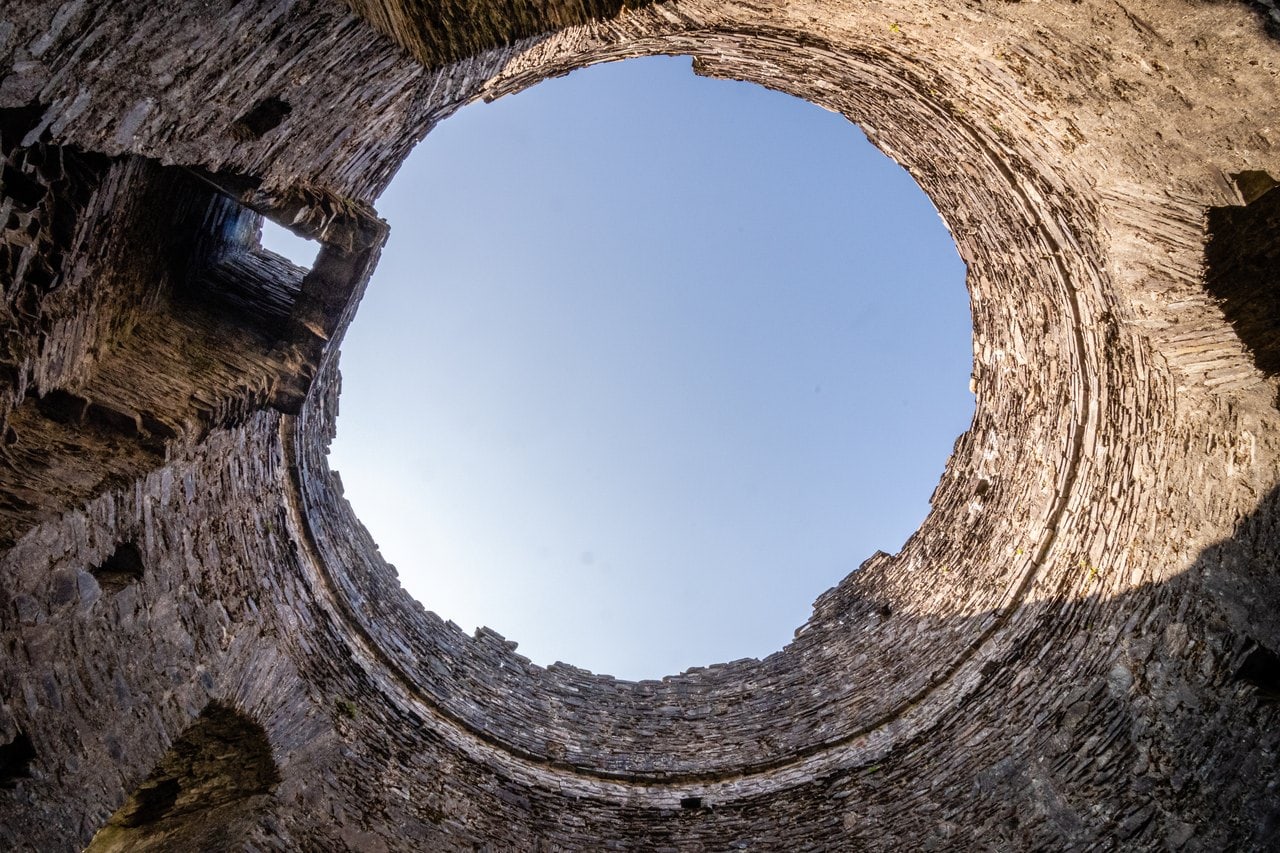
Inside, the tower is roofless and its timber floors have gone. The remains of two large fireplaces survive, with empty sockets for the joists and beam ends of its two main floor levels. Cathcart King, in his history of the castles of England and Wales, singles it out among the castles the Welsh built: “exceptionally, it has three storeys, linked by newel-stairs, and a portcullis at its first-floor door.” Its basement, though, was reached by a ladder, Cadw’s scheduling record says.
The Way In: Doorway, Portcullis and Stair
The original entrance is on the northwestern side, under a steeply pointed arch, with another pointed arch directly above it (Cadw’s listing record). Cadw’s scheduling record explains: “Its first-floor entrance was originally reached by a timber stair and, unusually, the doorway was defended by a portcullis.” King, writing of the castles the Welsh built, put the rarity more strongly: “the portcullis is very rare. Only at the doorway of Dolbadarn can we be sure of one.”
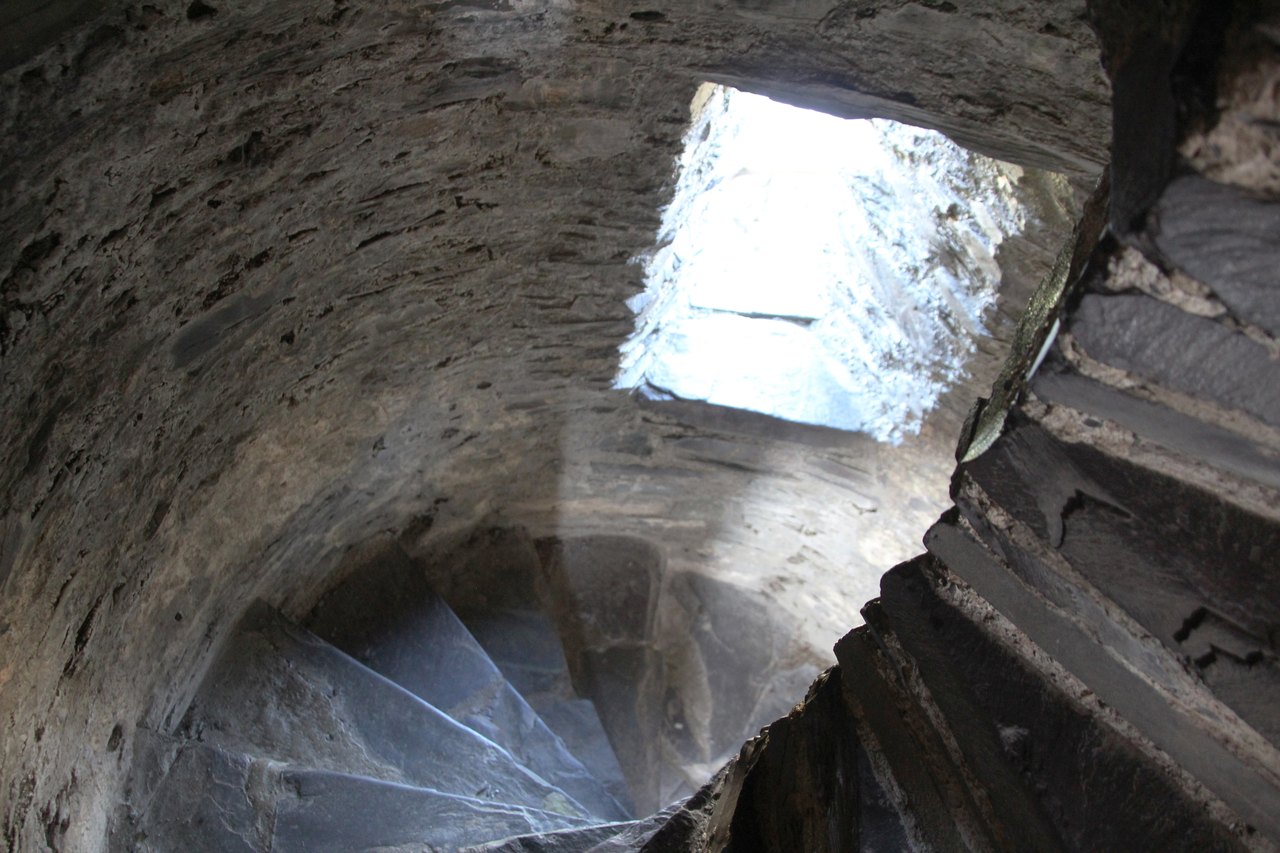
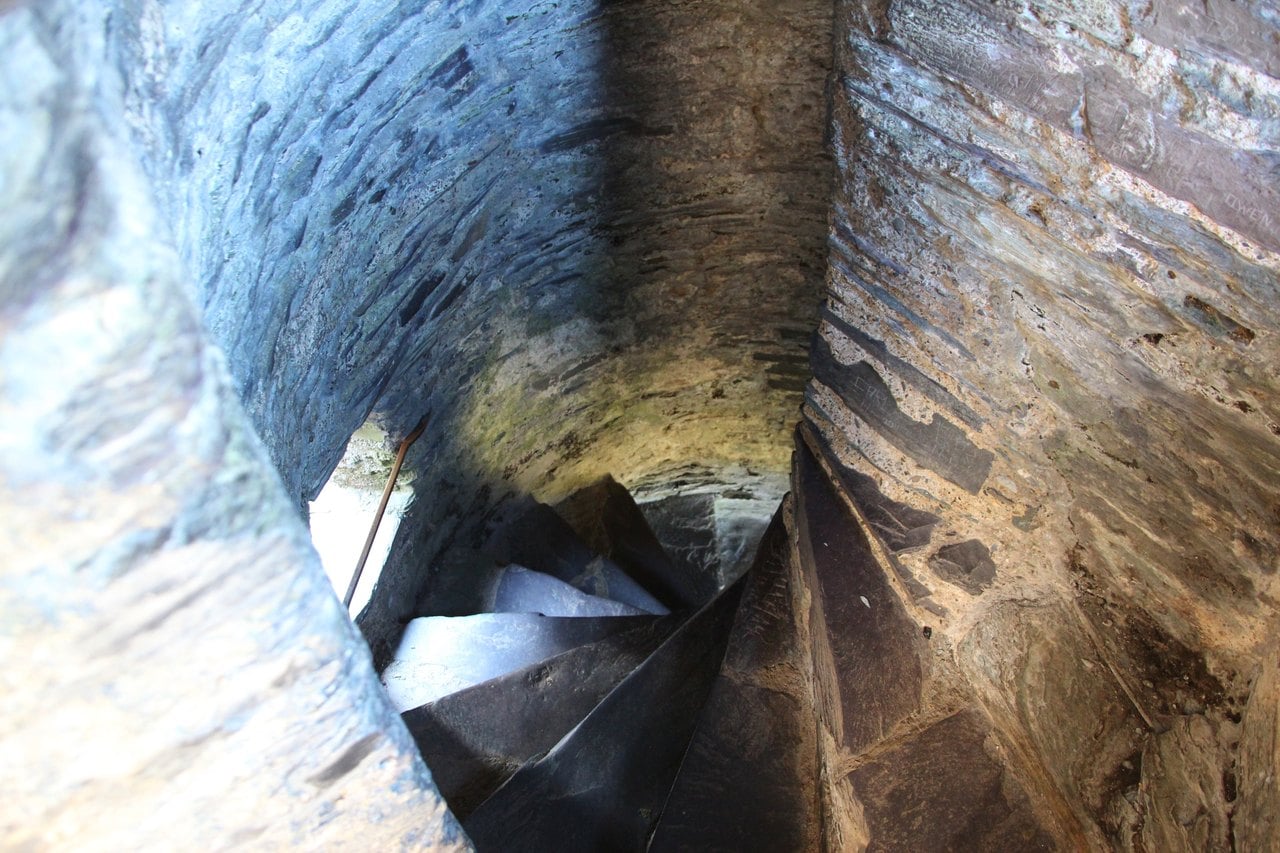
To the left of the entrance, the listing record describes “a well-preserved lean-to garderobe tower,” a latrine turret, and to the right a series of narrow windows that marks the position of the internal spiral stair. That stair climbs to the second floor and the roof, and in Cadw’s description its spiral reverses direction halfway up.
The Enclosure, and Which Came First
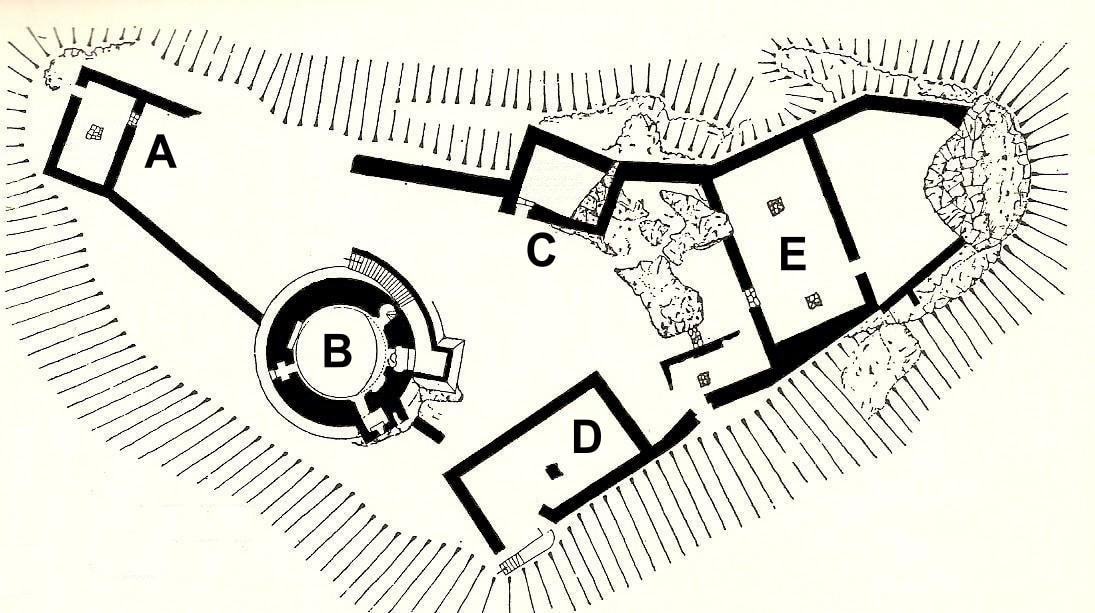
Cadw’s scheduling record describes the enclosure as “a simple curtain wall enclosing the summit of the rock, within which there were a number of rectangular structures, including a hall, with walls up to 1m thick.” Radford’s guide adds a rectangular tower in the center of the west side, “of which only the base remains,” and judges that it, with “probably other buildings, which can be traced within the circuit,” is “also later than the curtain and should date from the same period as the great tower.” Today the enclosure survives as low, fragmentary ruins. When Radford wrote, “Much of the circuit is still covered with fallen debris, and no detail is visible …”.
Which came first, enclosure or tower, is a question four official accounts answer in three different ways. Two of them make the unmortared enclosure the earlier work. Cadw’s scheduling record calls the unmortared curtain “the earliest work” and the tower “a later addition dating from the 1230s.” Radford agreed: “The masonry is of two dates, both older than 1284,” and he judged that the curtain’s plan and character “suggest a date in the second half of the twelfth or the early years of the thirteenth century.” The tower, he wrote, “was added in the thirteenth century, probably by Llewelyn Fawr who died in 1240.”
The Royal Commission’s 1960 inventory was not convinced. It allowed that the courtyard “could conceivably be earlier, possibly of the late 12th century, but it seems too slight a work to have been designed without the round tower and is more likely to be contemporary with it or nearly so, their dissimilarity perhaps being due to division of the work between local men and a master mason from another region.” Cadw’s listing record reverses the order altogether: “The curtain wall and outbuildings, of which only fragmentary ruins survive, post-date the keep and may have been added by the English.” They cannot all be right.
What Is Twentieth-Century Work
The wide flight of stone steps up to the entrance is twentieth-century work, according to Cadw’s listing record; the original approach was a timber stair. G. T. Clark, in 1884, wrote that Dolbadarn “has an exterior stair of stone, which, however, may be an addition”; neither Clark nor the listing record says whether the twentieth-century flight rebuilt that stair or replaced it. A handrail has been provided on those main entrance steps, and Cadw’s safety notes add that “Guardrails have been installed to prevent access to any areas of the site that we have deemed as dangerous or to prevent falls in specific areas.”
Dolbadarn and the Painters
Turner’s Sketches, 1798-1799
“Turner sketched Dolbadarn Castle on trips to Wales in 1798 and 1799 in his North Wales, Hereford Court and Dolbadarn sketch books,” the Royal Academy’s catalogue entry records. One of those books, the Dolbadarn Sketchbook of 1799, is in Tate’s collection as part of the Turner Bequest (number XLVI). Tate’s sheets from these tours include views of the castle from Llyn Padarn, from the east and from below, and a 1798 view from Dolbadarn towards the Pass of Llanberis.
Turner’s Royal Academy Painting
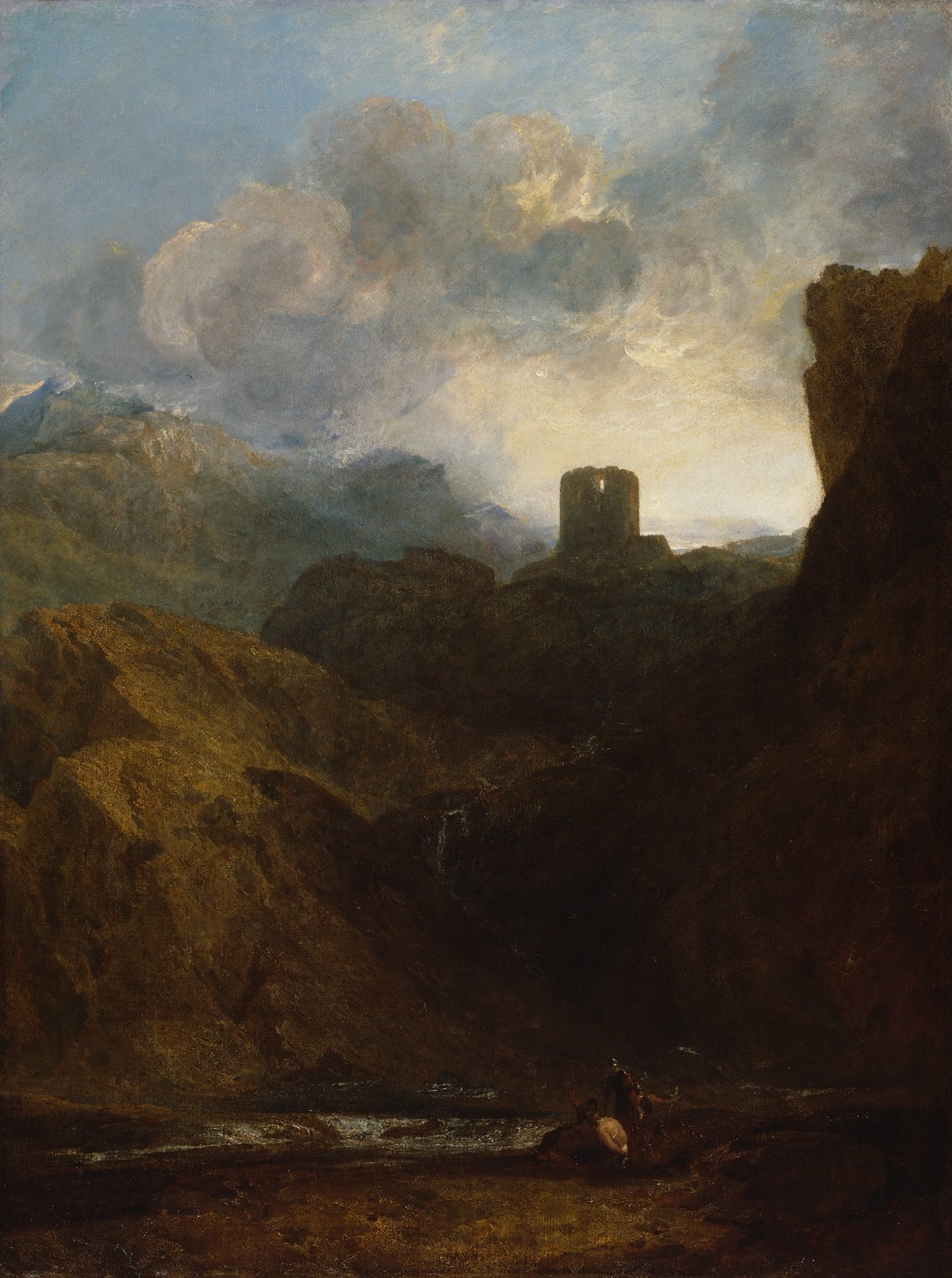
At the Royal Academy’s exhibition of 1800, number 200 in the catalogue was Dolbadern Castle, North Wales, by “W. Turner, A.” He had been elected an Associate of the Academy the previous November. The catalogue printed five lines of verse beside the entry:
How awful is the silence of the waste,
Where nature lifts her mountains to the sky.
Majestic solitude, behold the tower
Where hopeless OWEN, long imprison’d, pin’d,
And wrung his hands for liberty, in vain.
The lines appear in the catalogue, not on the canvas, and they are generally attributed to Turner himself. Andrew Wilton’s catalogue entry for Tate puts it this way: “These lines are generally considered to be Turner’s own, and are therefore his earliest published composition.” The Royal Academy’s entry records that the Turner scholar Eric Shanes questions that assumption.
When Turner was elected a full Royal Academician in 1802, he offered the Academy’s Council a choice of two pictures as his Diploma Work, and the Council approved Dolbadern Castle unanimously. In 1854, after Turner’s death, it was shown at the British Institution as Landscape with Banditti, the figures having been mistaken for bandits.
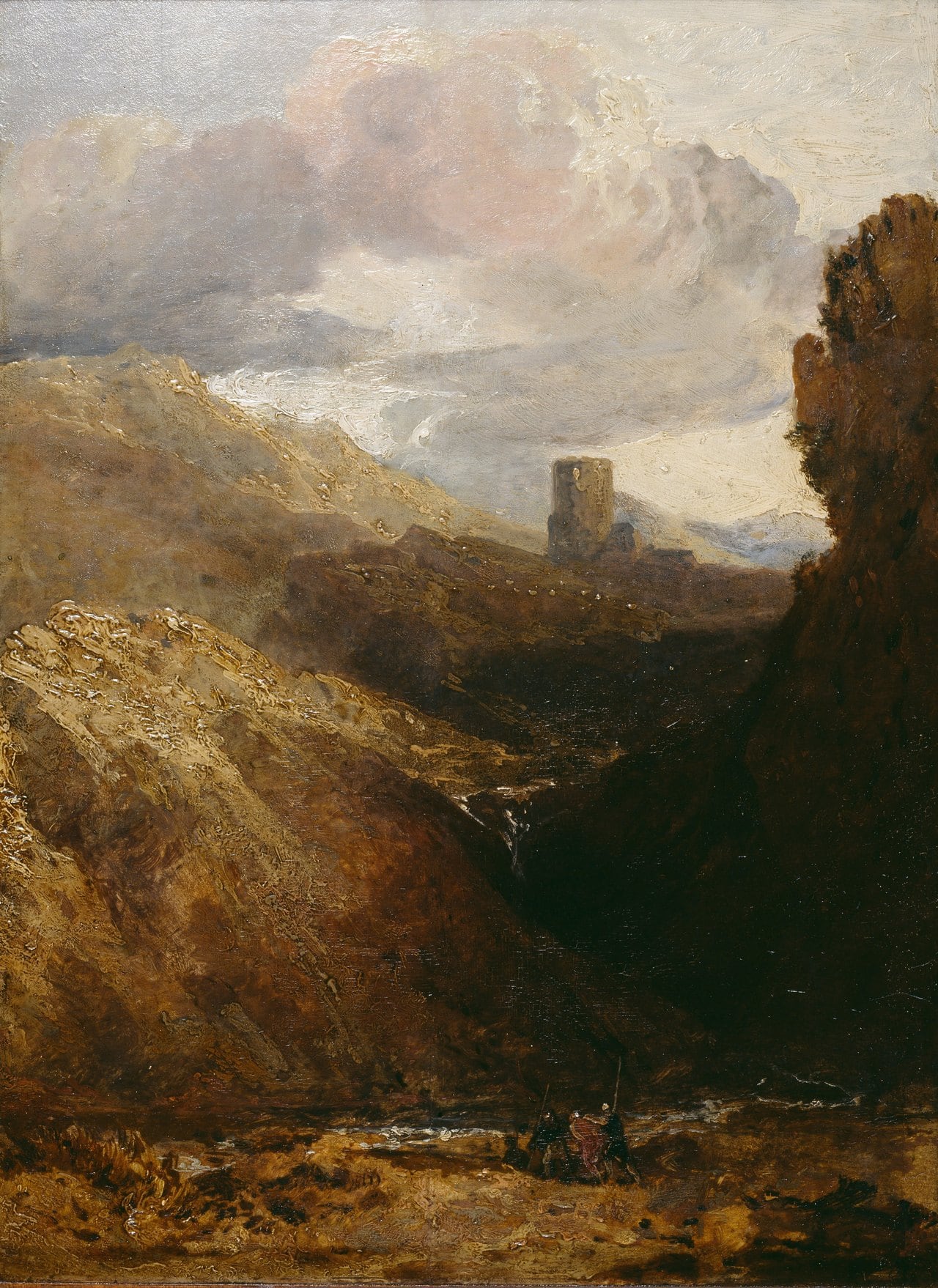
A small oil study for the painting, once in the collection of Munro of Novar and sold in 1867, is now in the National Library of Wales.
What Turner Changed
The Royal Academy’s entry reports Eric Shanes’s comparison: “compared to topographical reality, Turner considerably heightened the tower and the mountains, increasing the dominance of the castle and narrowing the valley.” The same entry adds, “It seems that the studies and the painting combines sketches that were made from several different viewpoints.”
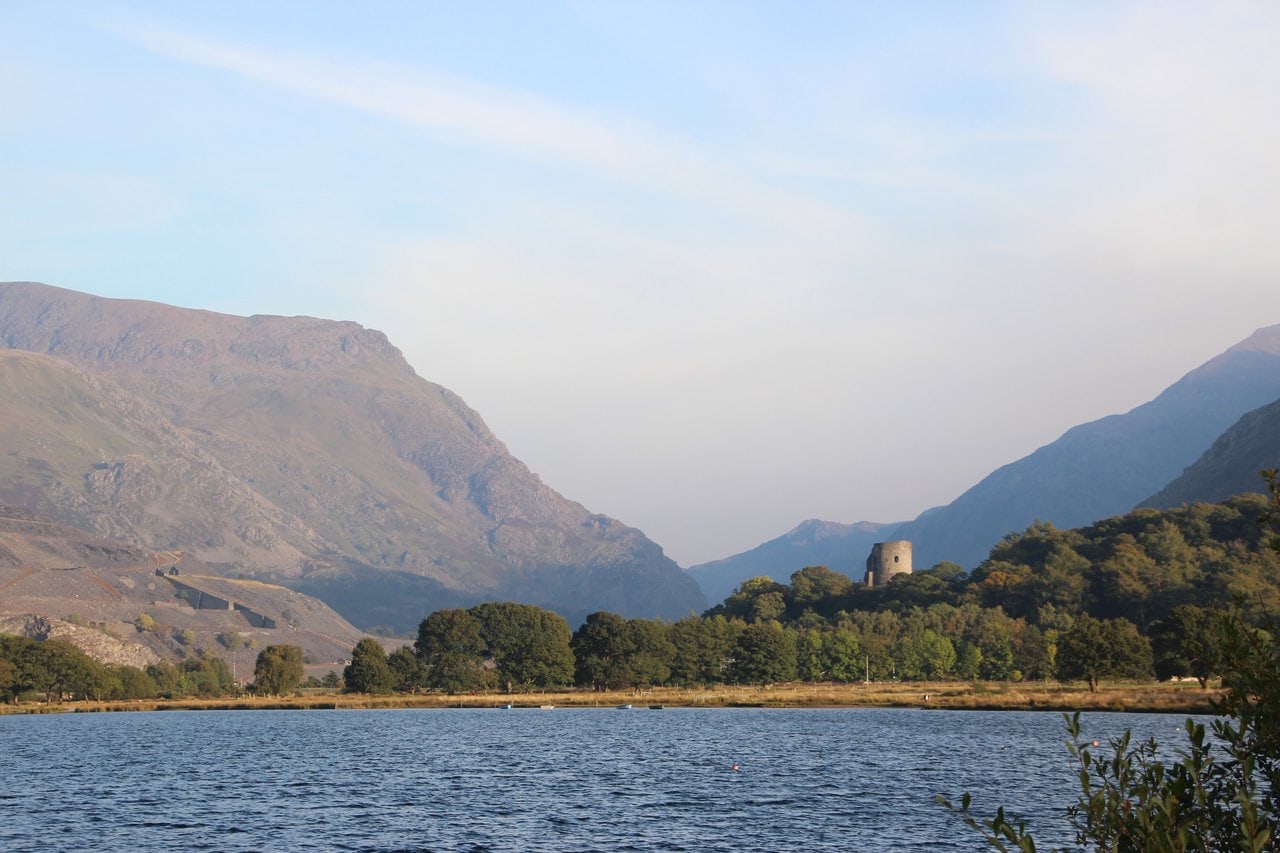
Turner also mixed his centuries. Shanes points out an anachronism “of a type common in Turner’s work”: Owain and his captors are shown in the thirteenth century, but the castle appears mainly in its ruined eighteenth-century state. In the foreground Shanes identifies four figures, “two soldiers standing guard over a kneeling prisoner whose wrists are bound behind him, and another seated figure who is pointing at the castle.” Andrew Wilton has described the picture as painted “in the boldly sublime language of Richard Wilson,” who had painted Dolbadarn before him.
Richard Wilson and Cotman
Richard Wilson painted Llyn Peris and Dolbadarn Castle in the early 1760s; versions are in Melbourne (National Gallery of Victoria, about 1760-1763) and in Cardiff (Amgueddfa Cymru, about 1762, per the Yale Center for British Art). Yale’s comment on the Cardiff picture is pointed: “Here, Wilson quite deliberately set the ruined fortress in an Italianate landscape.” Dolbadarn was a painter’s subject decades before Turner arrived, though no source used here records whether he knew Wilson’s picture.
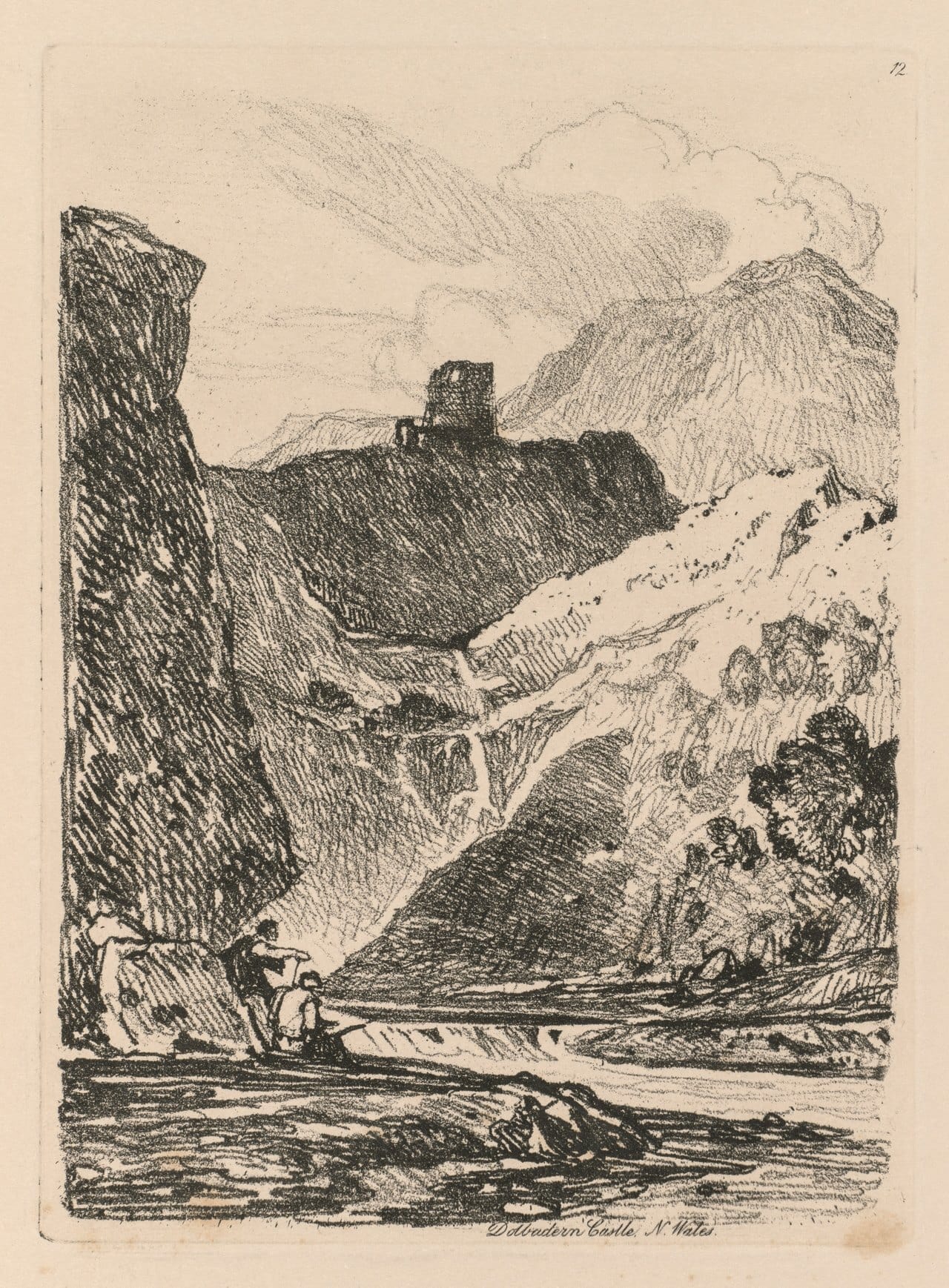
John Sell Cotman took it up later. Plate 12 of his Liber Studiorum, Dolbadern Castle, Llanberris Lake, North Wales, is a softground etching of 1838 that sets the tower on a cliff-top above a rushing stream.
Visiting Dolbadarn Castle
List the 3 castles on this map
- Dolbadarn Castle — Gwynedd, Wales
- Conwy Castle — Conwy County Borough, Wales
- Caerphilly Castle — Caerphilly County Borough, Wales
Opening hours, admission and parking are in the Admission table below.
Getting there
The castle stands half a mile (0.8 km) southeast of Llanberis. Cadw points drivers to a local authority pay-and-display car park across the road from the castle; for GPS navigation, Cyngor Gwynedd’s own car-park record gives that car park’s postcode as LL55 4TY. From there, in Cadw’s words, “The site is approximately a 10-25-minute walk from where you park your car along farm tracks, which can be muddy, uneven and slippery during poor weather conditions.”
The Snowdon Mountain Railway runs from its own Llanberis Station in the village, but the nearest mainline station is Bangor, 9 miles (14.5 km) away by Cadw’s figure; National Rail lists it as Bangor (Gwynedd). From Bangor the S2 Sherpa bus runs to Llanberis, the Eryri National Park Authority says, and from Caernarfon the S1; the Sherpa’r Wyddfa network’s timetable has the S2 leaving from Bangor train station and both buses calling at Llanberis Interchange, in the village. Check Traveline Cymru for current times.
Admission
| Item | Detail |
|---|---|
| Admission to the castle (Cadw) | Free |
| Opening (Cadw’s year, 1 April – 31 March) | Open all year, during reasonable daylight hours |
| Parking (council car park, not Cadw) | Pay and display, by cash or the PayByPhone app (Cyngor Gwynedd); fee set by the council |
Checked against Cadw and Cyngor Gwynedd on 10 October 2026; confirm before traveling.
Suggested route
The farm track from the car park climbs. As Cadw puts it, “The route up to the monument becomes steeper as you reach the castle. You will be required to follow a natural path to the steps of the castle.” Before climbing them, walk the slate footings of the enclosure, which once held a hall and other rectangular buildings, and look at the tower from outside: the garderobe turret to the left of the doorway, and the narrow windows of the stair to the right.
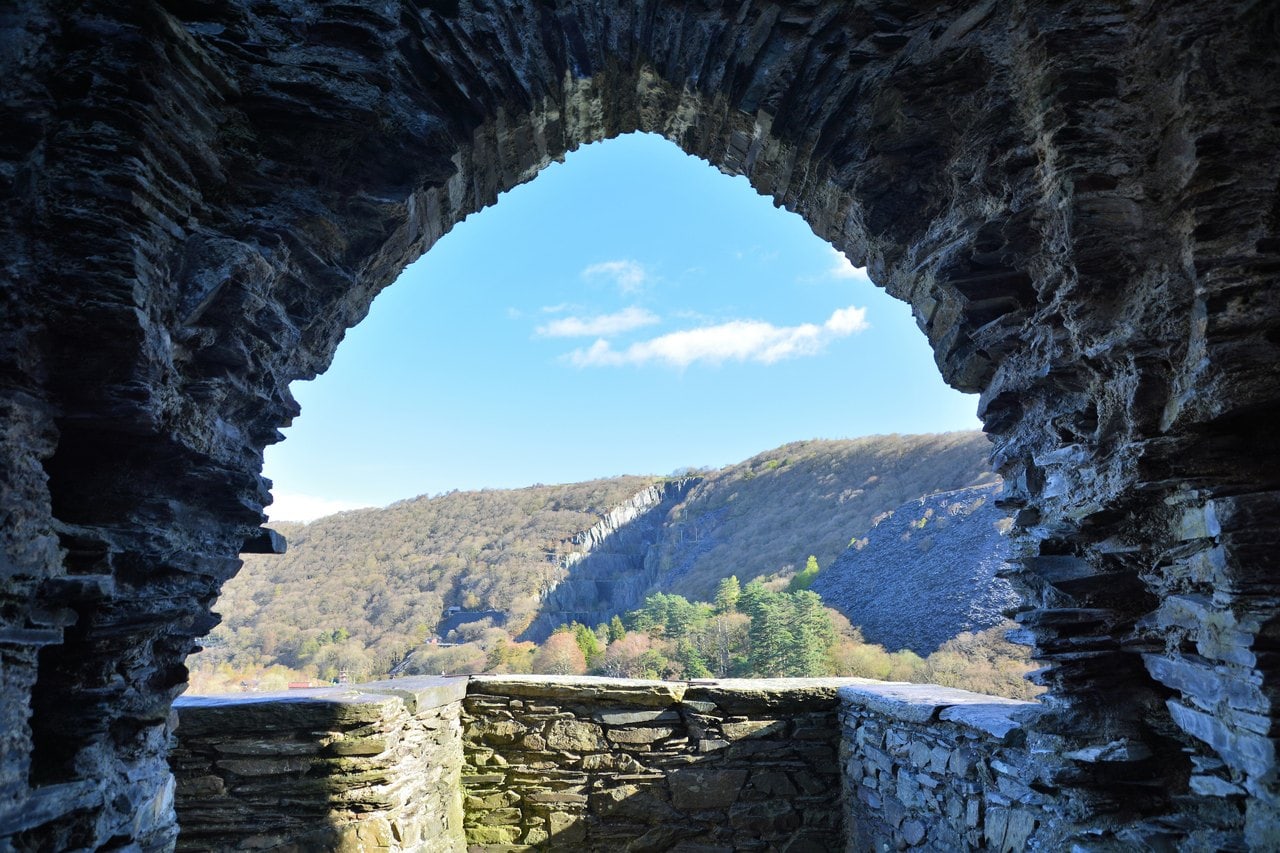
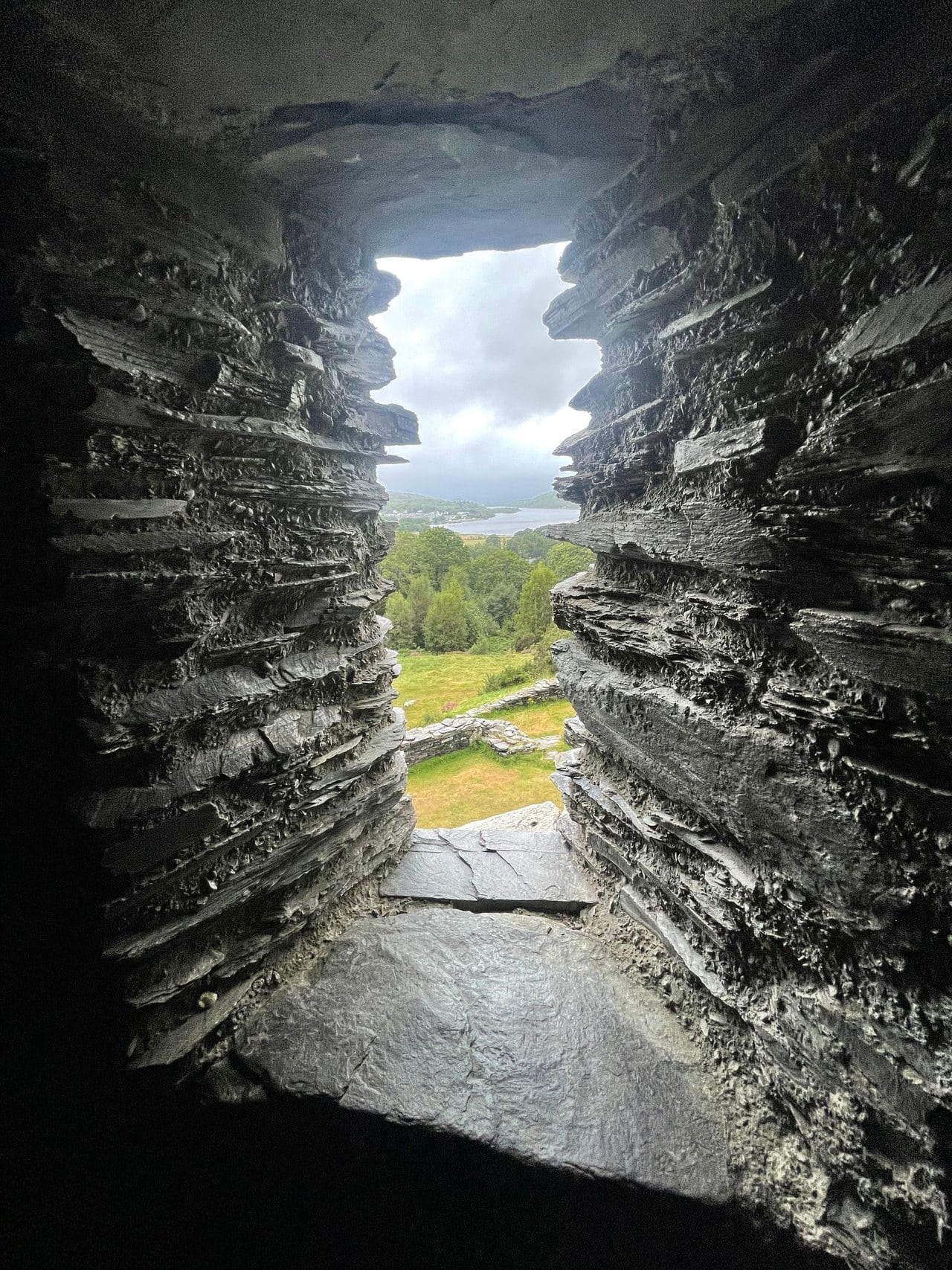
Then take the steps to the doorway, the castle’s original first-floor entrance, where the portcullis once worked. Inside the drum, look up at the sockets for the vanished floors and the two fireplaces, and look back out through the doorway, whose pointed arch frames the wooded hillside opposite and its gray slate tips. Then follow the spiral stair as far as it goes. From its crag the castle looks up the valley toward the Pass of Llanberis, the view Turner drew from Dolbadarn in 1798, and down it over Llyn Padarn.
Photography
Personal photography is welcome. Cadw’s filming page puts it simply: “If you are an individual who wants to film or take photos at our sites for your own, personal use with just a camera and no additional equipment or dressing then go ahead!” Commercial photography needs Cadw’s permission. Drones are another matter: Cadw “does not currently allow recreational drones to take off or land on Cadw property.”
For viewpoints, Turner’s own sheets at Tate are a guide: they are titled for views of the castle from Llyn Padarn, from the east and from below. Do not expect to find the painting’s view on the ground; the Painters section above explains why.
Accessibility
Cadw rates the site Level 3, Moderate, for walking difficulty and terrain. Beyond the farm tracks and the natural path, the historic stone at the base of the entrance steps “can be difficult to navigate when wet,” Cadw notes, and a handrail runs up the steps. Inside, “Lighting inside the monument relies upon natural lighting levels and may be dimmer during poor weather. A single ruinous staircase will lead you to the top of the monument, which itself requires access to steps.” Cadw also warns that the castle may be exposed to high winds.
For somewhere to stay, hotels in Llanberis on Booking.com lists places in the village, and Dolbadarn Castle tours on GetYourGuide shows what that platform offers for the castle.
Some links on this page are affiliate links, which means StoneKeep Atlas may earn a small commission, at no extra cost to you, if you book through them.
More Views of Dolbadarn Castle
Common Questions
How old is Dolbadarn Castle, and who built it?
Cadw dates the castle to the late 12th or early 13th century, and its texts word the attribution in different ways. Its place page calls Llywelyn ap Iorwerth the most likely builder; a Cadw booklet says the castle “was probably constructed by Llywelyn ap Iorwerth in the last decades before his death in 1240.” The uncertainty is old. In 1781 Thomas Pennant wrote, “The founder is unknown to me; but it was evidently a Welsh prince.”
Who looks after Dolbadarn Castle?
Dolbadarn Castle is in the care of Cadw, which looks after the monument and keeps it open to visitors all year. Two designations protect it. It is a scheduled monument, number CN066, and it was listed Grade I in 1999, as listed building 21854.
Where do you park for Dolbadarn Castle, and how long is the walk?
Use the council’s pay-and-display car park on the opposite side of the road; the parking fee is the council’s, not Cadw’s. Cadw allows 10 to 25 minutes on foot from there, on farm tracks that turn muddy in wet weather, with a steeper final stretch up to the castle steps. Dogs can come too, within a limit Cadw spells out: “Dogs on short leads welcome to access ground floor levels of the site.”
Where is Turner’s painting of Dolbadarn Castle?
Turner’s Dolbadern Castle, North Wales belongs to the Royal Academy of Arts and is in its collection in London as his Diploma Work, object 03/1383. The Academy’s record describes it as oil on canvas, 1194 mm x 902 mm. A much smaller oil study for the picture belongs to the National Library of Wales. If you plan a trip to see either one, check with the institution first.
What are some interesting facts about Dolbadarn Castle?
Two are easy to miss. When the North Wales Hydro Electric Power Bill went through the Lords in 1973, the Earl of Listowel told the House that a clause added to the bill gave protection to “among other places, Dolbadarn Castle …”. Dolbadarn also led Turner into experiment: in a watercolor study of another composition of the castle, Tate’s catalogue records, he mixed his pigment with “flour or some other thickening agent.”
Was Owain Goch imprisoned at Dolbadarn Castle?
The chronicle that records his capture at Bryn Derwin never says where he was held. Cadw’s scheduling record calls this tower the probable place, and the Royal Academy treats the location as disputed. After his release in 1277, the chronicle says, Owain obtained from his brother “the cantrev of Lleyn, with his full consent.”
Beyond Dolbadarn Castle
Conwy Castle, which Edward I began in 1283 in the same campaign that took Dolbadarn, is the guide to read next: a king’s castle to set beside this prince’s tower. Caerphilly Castle in south Wales, begun in 1268 by Gilbert de Clare against Llywelyn ap Gruffudd, shows the same prince’s war from a Marcher lord’s side. Three castles this guide names are also Cadw places to visit: Dolwyddelan and Castell y Bere, which the scheduling record groups with Dolbadarn as castles begun by Llywelyn ap Iorwerth, and Caernarfon, where some of Dolbadarn’s timber went in 1284. In Llanberis itself, Padarn Country Park’s four walking routes start from its Gilfach Ddu car park, and its Woodland Walk passes the remains of inclines and winding houses that moved the Dinorwig quarry’s slate. For the wider questions this guide leaves alone, our article on the oldest castle in the world takes up the competing claims to age, and our article on the country with the most castles weighs how many Wales has.
Conclusion
Dolbadarn Castle is a native-built castle of the princes of Gwynedd, a mortared round tower beside the unmortared remains of an enclosure. Most of what is said about it carries a qualifier. Cadw names Llywelyn ap Iorwerth as its most likely builder; the official records disagree on whether tower or enclosure came first; and the imprisonment of Owain Goch in its tower is a tradition that Cadw’s scheduling record calls probable and the Royal Academy calls disputed. Two facts are firm. The English took it in 1283, probably in May, denying Dafydd ap Gruffudd what Taylor calls his last remaining stronghold. And in 1800 Turner exhibited the painting in which, as Eric Shanes observed, he heightened the tower and narrowed the valley; it became his Diploma Work in 1802. The real tower stands lower, on its rock between two lakes at the mouth of the Llanberis Pass.
Principal Sources
- Brut y Tywysogion, or The Chronicle of the Princes. Ed. John Williams ab Ithel. Rolls Series, 1860. archive.org
- Cadw. “About us.” cadw.gov.wales
- Cadw. “Cadw Drone Policy.” cadw.gov.wales
- Cadw. “Castell Dolbadarn.” Place page. cadw.gov.wales
- Cadw. “Filming and Photography.” cadw.gov.wales
- Cadw. “Find a place to visit.” cadw.gov.wales
- Cadw. Listed Building 21854, Dolbadarn Castle. Full Report. cadwpublic-api.azurewebsites.net
- Cadw. “More about Castell Dolwyddelan.” cadw.gov.wales
- Cadw. Scheduled Monument CN066, Castell Dolbadarn. Full Report. cadwpublic-api.azurewebsites.net
- Cadw. The Castles of the Lords and Princes of Wales. Booklet (PDF). cadw.gov.wales
- Cadw. “World Heritage Sites in Wales – WHS – Site Boundary.” DataMapWales. datamap.gov.wales
- Cathcart King, D. J. The Castle in England and Wales: An Interpretative History. London: Croom Helm, 1988 (1991 printing read). archive.org
- Clark, G. T. Mediaeval Military Architecture in England. Vol. I. London: Wyman, 1884. archive.org
- Cleveland Museum of Art. John Sell Cotman, Liber Studiorum: Plate 12, Dolbadern Castle, Llanberris Lake, North Wales, object 2014.692.m. clevelandart.org
- Coflein (RCAHMW). “Dinorwic Slate Quarry.” NPRN 40538. coflein.gov.uk
- Coflein (RCAHMW). “Dinorwig Pumped-Storage Hydro-Electric Power Station; Electric Mountain, Llanberis.” NPRN 408885. coflein.gov.uk
- Cyngor Gwynedd. “Car parks,” with the council’s linked car-park map (Llanberis record). gwynedd.llyw.cymru
- Ellis, Henry, ed. The Record of Caernarvon. 1838. archive.org
- Eryri National Park Authority. “Snowdon Sherpa.” eryri.gov.wales
- Hansard (House of Lords). “North Wales Hydro Electric Power Bill,” 11 December 1973. api.parliament.uk
- Leland, John. The Itinerary in Wales of John Leland. Ed. Lucy Toulmin Smith. London: Bell, 1906. archive.org
- National Gallery of Victoria. Richard Wilson, Llyn Peris and Dolbadarn Castle (c. 1760-1763). ngv.vic.gov.au
- National Rail. “Bangor (Gwynedd) (BNG).” nationalrail.co.uk
- O’Neil, B. H. St. J. Castles: An Introduction to the Castles of England and Wales. HMSO, 1954 (1960 impression read). archive.org
- Parc Padarn (Padarn Country Park). “Explore.” parcpadarn.cymru
- Pennant, Thomas. The Journey to Snowdon. 1781. archive.org
- Radford, C. A. Ralegh. Dolbadarn Castle, Caernarvonshire. Ministry of Works, n.d. Bound in the Library of Congress volume “X Collection 160A”. archive.org
- Royal Academy of Arts. The Exhibition of the Royal Academy, M.DCCC. The Thirty-Second. London, 1800. archive.org
- Royal Academy of Arts. J. M. W. Turner, Dolbadern Castle, North Wales (1800), object 03/1383. royalacademy.org.uk
- Royal Commission on the Ancient and Historical Monuments of Wales. An Inventory of the Ancient Monuments in Caernarvonshire, Vol. II: Central. HMSO, 1960. archive.org
- Sherpa’r Wyddfa. Timetable for services S1-S4 (English). sherparwyddfa.wales
- Snowdon Mountain Railway. snowdonrailway.co.uk
- Tate. “Dolbadarn Sketchbook,” J. M. W. Turner, 1799 (Turner Bequest XLVI). tate.org.uk
- Tate. “View from Dolbadarn towards the Pass of Llanberis,” J. M. W. Turner, 1798 (D01387). tate.org.uk
- Taylor, A. J. “The King’s Works in Wales, 1277-1330.” In H. M. Colvin, ed., The History of the King’s Works, vol. I. London: HMSO, 1963. archive.org
- Taylor, Arnold. Caernarfon Castle and Town Walls. 6th ed. Cadw, 2004.
- Warner, Richard. A Walk through Wales, in August 1797. Bath, 1798. archive.org
- Wilton, Andrew. “Study for the Composition of ‘Dolbadern Castle, North Wales’ c.1799-1800.” Catalogue entry, 2013, in J.M.W. Turner: Sketchbooks, Drawings and Watercolours, Tate Research Publication. tate.org.uk
- Yale Center for British Art. Wilson in Wales: “Llyn Peris and Dolbadarn Castle.” interactive.britishart.yale.edu
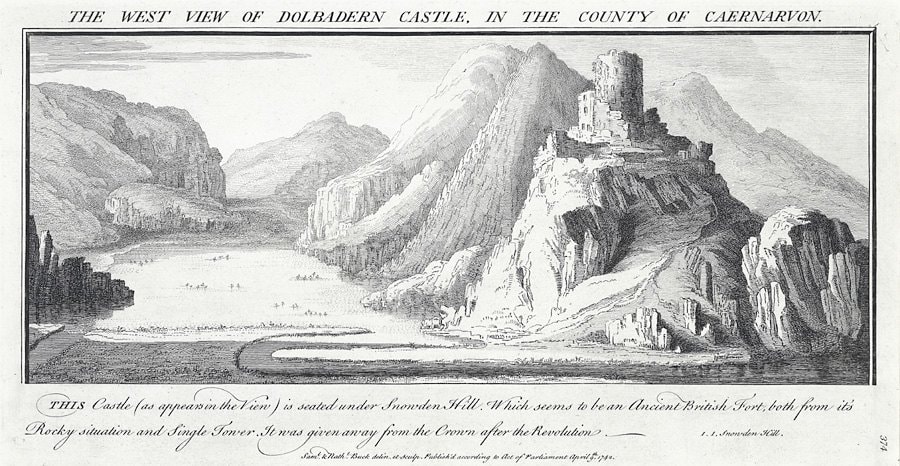
Image credits. Hero, the castle from the air: Photo: Lukassek / Adobe Stock; the round tower from the enclosure: Photo: Lee / Adobe Stock; the Bucks’ west view, 1742: Samuel and Nathaniel Buck, public domain, via National Library of Wales; Grimm’s view, published 1780: Samuel Hieronymus Grimm and W. Walker and W. Angus, public domain, via National Library of Wales; the enclosure from the air (Cadw): Photo: Cadw, Open Government Licence v1.0. Contains public sector information licensed under the Open Government Licence v1.0; the inside of the round tower: Photo: annapimages / Adobe Stock; the spiral stair in the tower: Photo: Takver (John Englart), CC BY-SA 2.0; plan, 1954: Plan: B. H. St. J. O’Neil, HMSO 1954, public domain; slate walling and the tower: Photo: Garry Platt, CC BY 2.0; Turner’s Dolbadern Castle, 1800: J. M. W. Turner, Royal Academy of Arts, London, public domain; Turner’s oil study, National Library of Wales: J. M. W. Turner, National Library of Wales, public domain; the tower at the mouth of the pass, from across the water: Photo: Takver (John Englart), CC BY-SA 2.0; Cotman’s Liber Studiorum plate, 1838: John Sell Cotman, Cleveland Museum of Art, CC0; the steps to the tower doorway: Photo: Takver (John Englart), CC BY-SA 2.0; the castle from the air in autumn: Photo: Maciej Olszewski / Adobe Stock; the castle from directly above: Photo: whitcomberd / Adobe Stock; the tower above the lake: Photo: estivillml / Adobe Stock; the tower above its wooded crag: Photo: estivillml / Envato Elements; the view out of the tower doorway: Photo: Susanne / Adobe Stock; the doorway and upper opening from inside: Photo: annapimages / Adobe Stock; straight up inside the tower: Photo: Johan / Adobe Stock; looking down the spiral stair: Photo: Takver (John Englart), CC BY-SA 2.0. Source: Castle Dolbadarn ruins, Llanberis (21696562269), Wikimedia Commons; a window embrasure in the tower: Photo: Wirestock / Adobe Stock; the knoll and enclosure from above: Photo: Christopher Keeley / Adobe Stock; slate wall footings before the tower: Photo: Dunja / Adobe Stock; the tower in winter: Photo: Garry Platt, CC BY 2.0. Source: Dolbadarn Castle, Just above Llyn Peris in Llanberis (16156431945), Wikimedia Commons; the tower at night: Photo: Christian / Adobe Stock; photochrom, 1890-1900: Photochrom print, Library of Congress, public domain. Source: Dolbadarn Castle, Llanberis, Wales-LCCN2001703500, Wikimedia Commons. Freely licensed images are resized to fit; otherwise unaltered.