
Château de Villandry
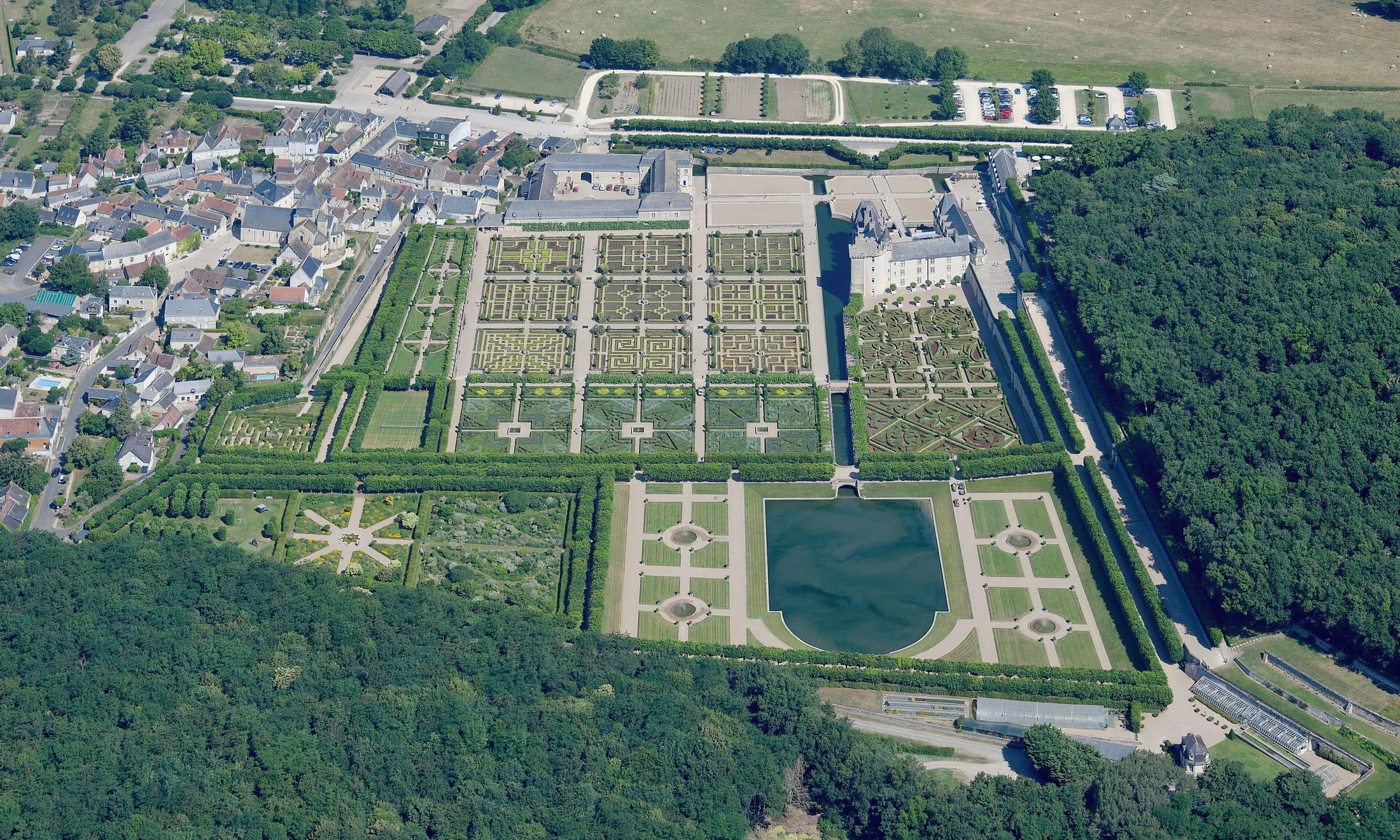
Where the Cher slips toward its meeting with the Loire, a short drive west of Tours, the Château de Villandry shows one of the gentler faces of the French Renaissance. It does not crown a cliff or rise straight from the water like its celebrated neighbors. It rests low on the valley floor, three pale wings of tuffeau stone opening toward the river, and it drew 370,000 visitors in 2025, on the estate’s own count, placing it among the most visited of the Loire châteaux, for a reason that has almost nothing to do with the house. They come for the gardens: the ornamental kitchen garden read like a canvas from the terrace above, the clipped box parterres that diagram the moods of love, the still mirror of the water garden on its upper level.
A paradox sits at the center of Villandry, and it is worth stating plainly. This was the last of the great Renaissance châteaux raised along the Loire, and among the most restrained. Its famous gardens are not a sixteenth-century survival at all; they are a careful twentieth-century re-creation, conjured back into being by a Spanish doctor who abandoned medicine to do it. Villandry is loved less for what lasted here than for what was imagined back into existence.
Quick Facts
| Location | Villandry, Indre-et-Loire (37), Centre-Val de Loire, France |
| Built | From 1532; completed c. 1536 |
| Builder | Jean Le Breton, finance secretary to François I |
| Style | French Renaissance |
| Setting | Cher valley floor, near the Cher–Loire confluence, about 15 km west of Tours |
| Famous for | Its re-created Renaissance formal gardens: the decorative potager, water garden, and ornamental parterres |
| Earlier history | Site of the medieval fortress of Colombiers; the Peace of Colombiers (1189) |
| Heritage status | Classé Monument Historique (1934); UNESCO World Heritage, Loire Valley (2000); Jardin Remarquable (2004) |
| Owner | The Carvallo family (privately owned since 1906) |
| Visiting | Gardens open year-round (except 25 Dec); château seasonal |
| Coordinates | 47.3399° N, 0.5143° E |
| Official site | chateauvillandry.fr |
Colombiers and the peace of 1189
Long before the gardens, there was a fortress named Colombiers. A castle on this spot is recorded in 1084, held by Geoffroy le Roux, the first lord whose name has come down to us, and for the next several centuries it guarded a stretch of the Touraine that great houses fought to control. Its one survivor is the square keep, a tower of bare tuffeau that still anchors the southwest angle of the courtyard. Heritage records place its original construction in the twelfth century, with substantial modification in the fourteenth; the official Monuments Historiques notice dates the surviving fabric to the fourteenth century, which has left travel writers repeating one century or the other as though they were rivals rather than two chapters of the same tower’s life.
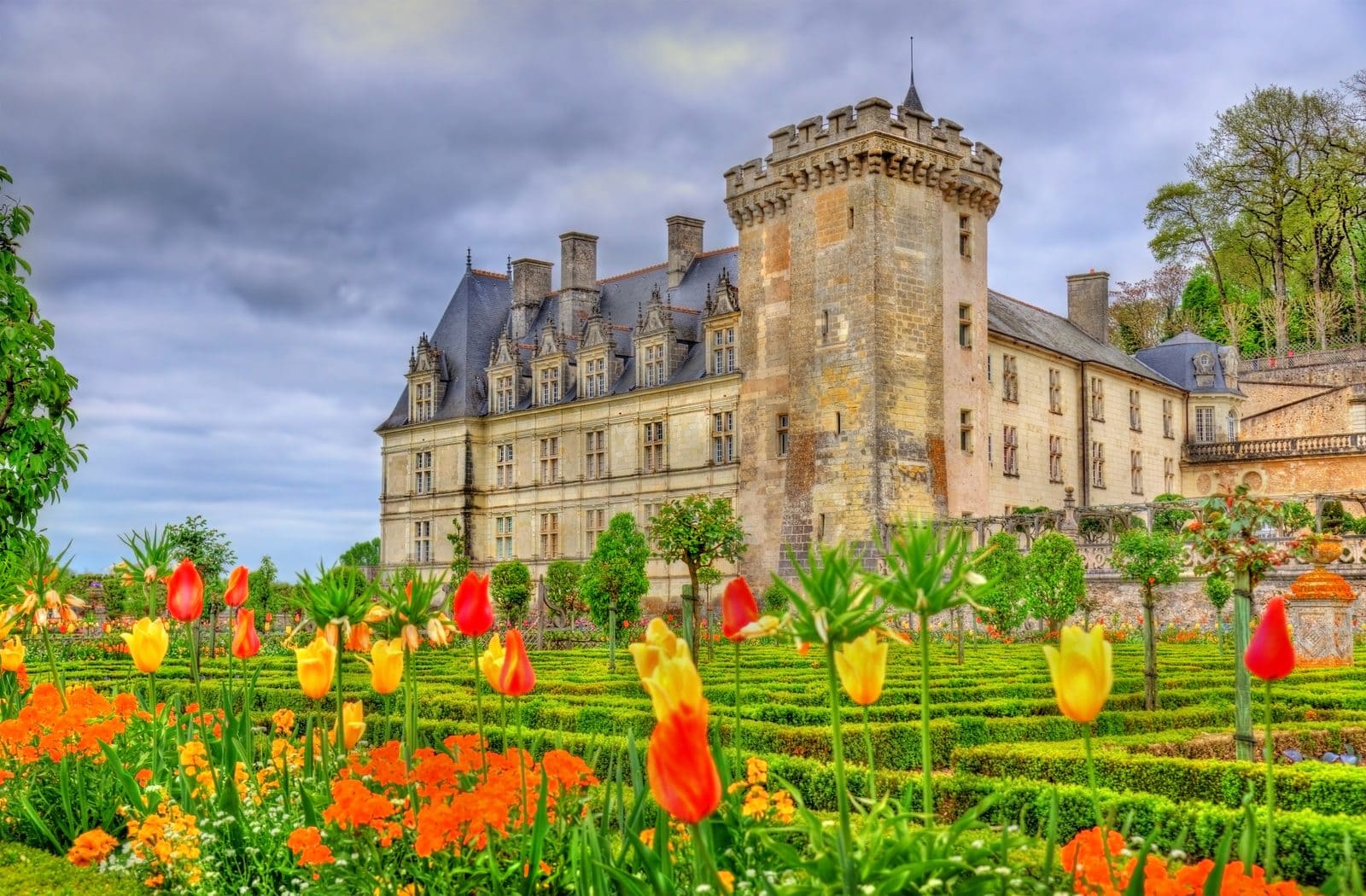
The keep earned its place in national memory on July 4, 1189. There, the aging Henry II of England, harried and outmaneuvered, submitted to Philip II Augustus of France in the agreement remembered as the Peace of Colombiers. Henry’s own son Richard, soon to be the Lionheart, stood among the victors as Philip’s ally. Two days later Henry was dead at Chinon. Historians more often file the settlement under the Treaty of Azay-le-Rideau, and the tradition that it was signed inside the Colombiers keep belongs to the estate, not to the documentary record. What is not in doubt is that a Plantagenet king’s last surrender was sealed in this corner of the valley, within sight of a tower that still stands.
Far more than one tower was at stake that day. Philip Augustus had spent his reign prying loose the sprawling Angevin holdings that gave the English kings more of France than the French crown itself, and the surrender at Colombiers marked a decisive turn in that long contest. Touraine and the wider Loire would slide steadily into the Capetian orbit over the decades that followed. For a modest fortress on the valley floor, it was a brush with the largest politics of the age, and it lent the later château a pedigree no garden could supply.
Jean Le Breton and the last great château of the Loire
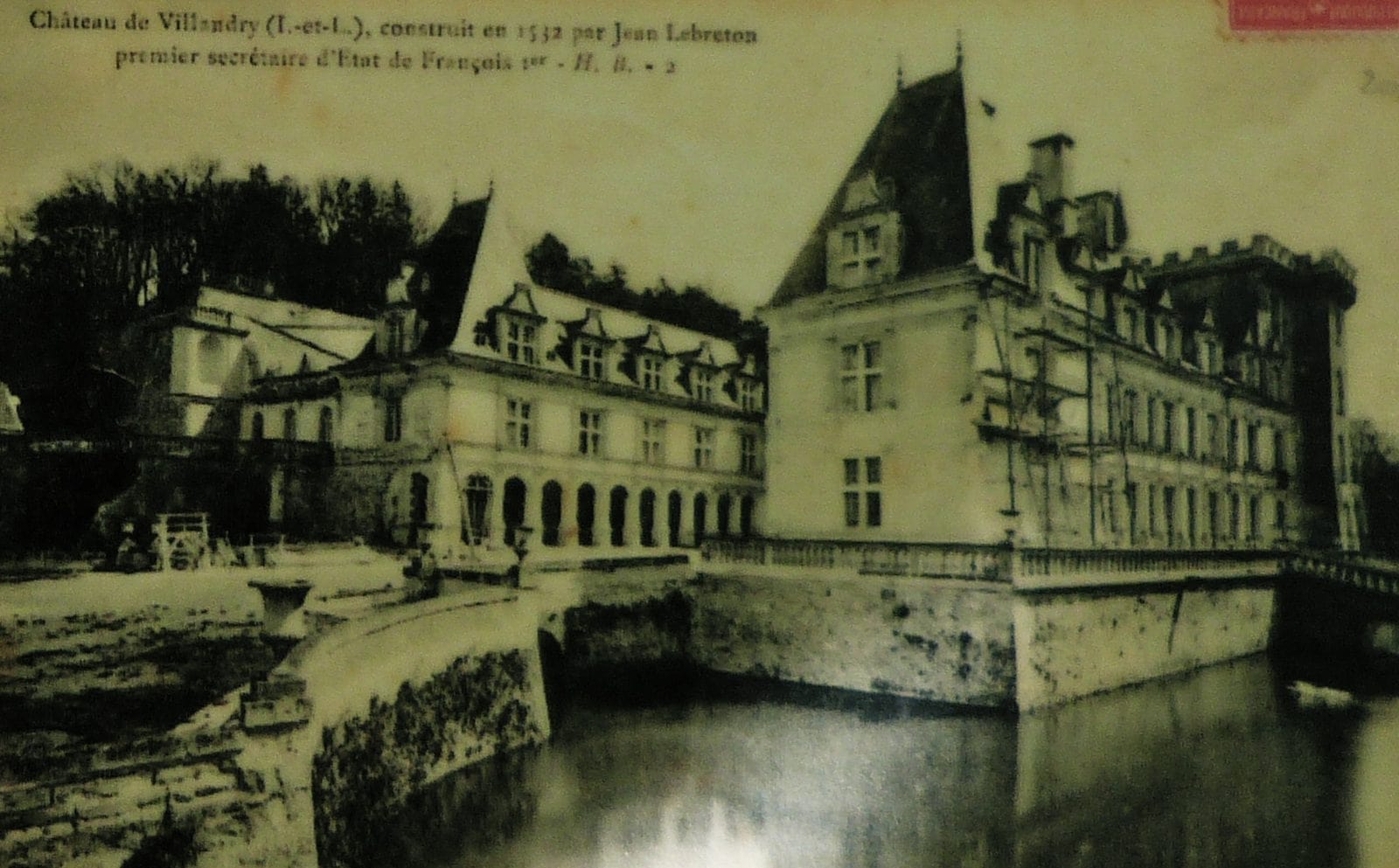
The Renaissance arrived at Colombiers with a royal administrator in a hurry to impress. Jean Le Breton, finance secretary to François I and superintendent of the king’s vast works at Chambord, bought the castellany on March 4, 1532. He had the medieval fortress pulled down, sparing only the keep, and on its footprint he raised the elegant house we see today, complete within about four years; François I came to inspect the near-finished building in January 1536. Le Breton knew the new architecture intimately from Chambord, and at nearby Villesavin he built himself a smaller version of the same ideas, sometimes called a model for Villandry.
Villandry is routinely called the last of the great Renaissance châteaux of the Loire, and the claim holds. By the 1530s the wave of building that produced Amboise, Blois, Chambord, and Chenonceau was cresting; Le Breton’s house gathered those lessons and set them down on the valley floor one final time. The estate kept the old name, Colombiers, for another century. Only in 1639 was it formally renamed Villandry, after a separate Le Breton property, and the villagers are called Colombiens to this day.
A horseshoe open to the valley
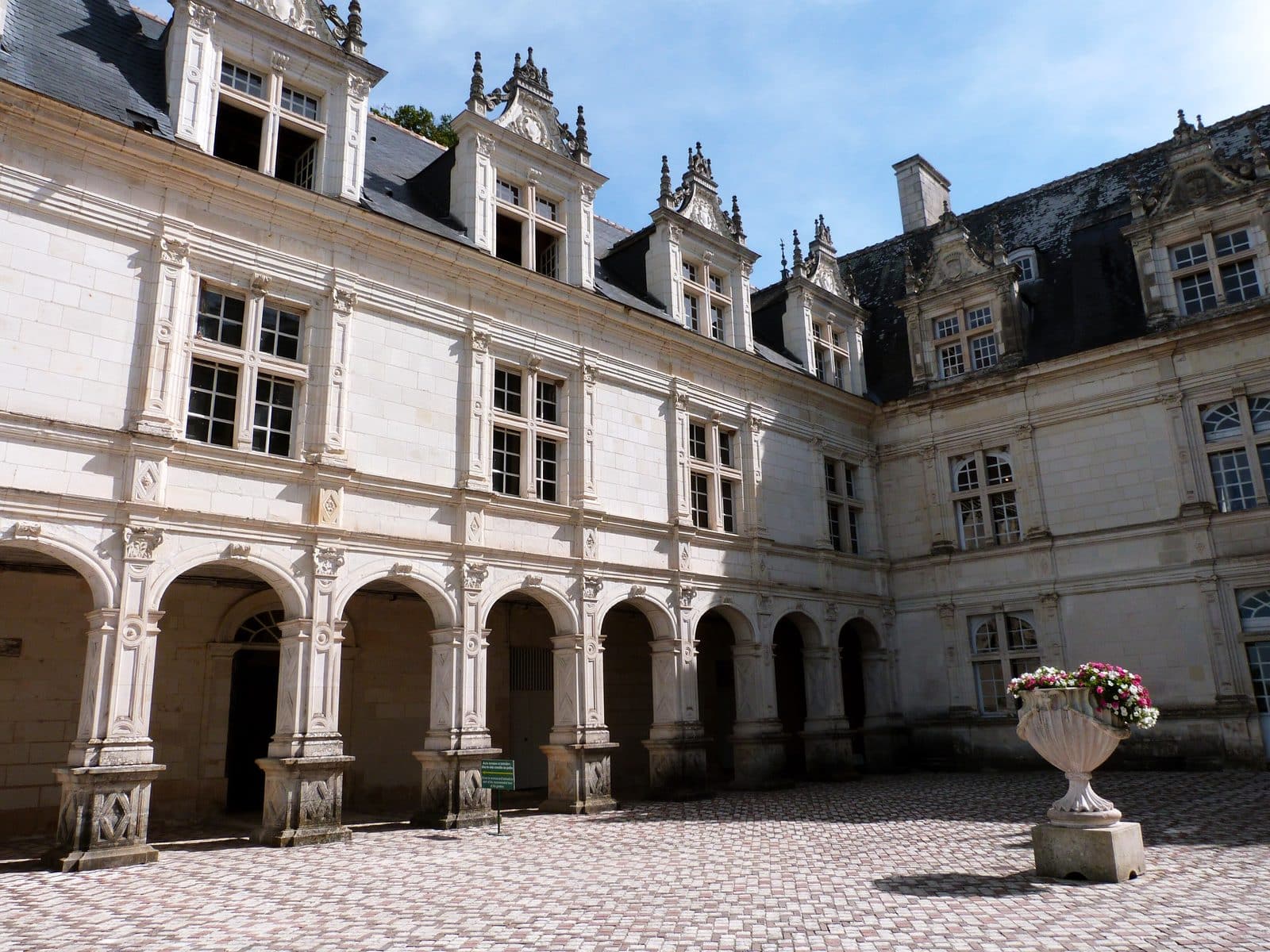
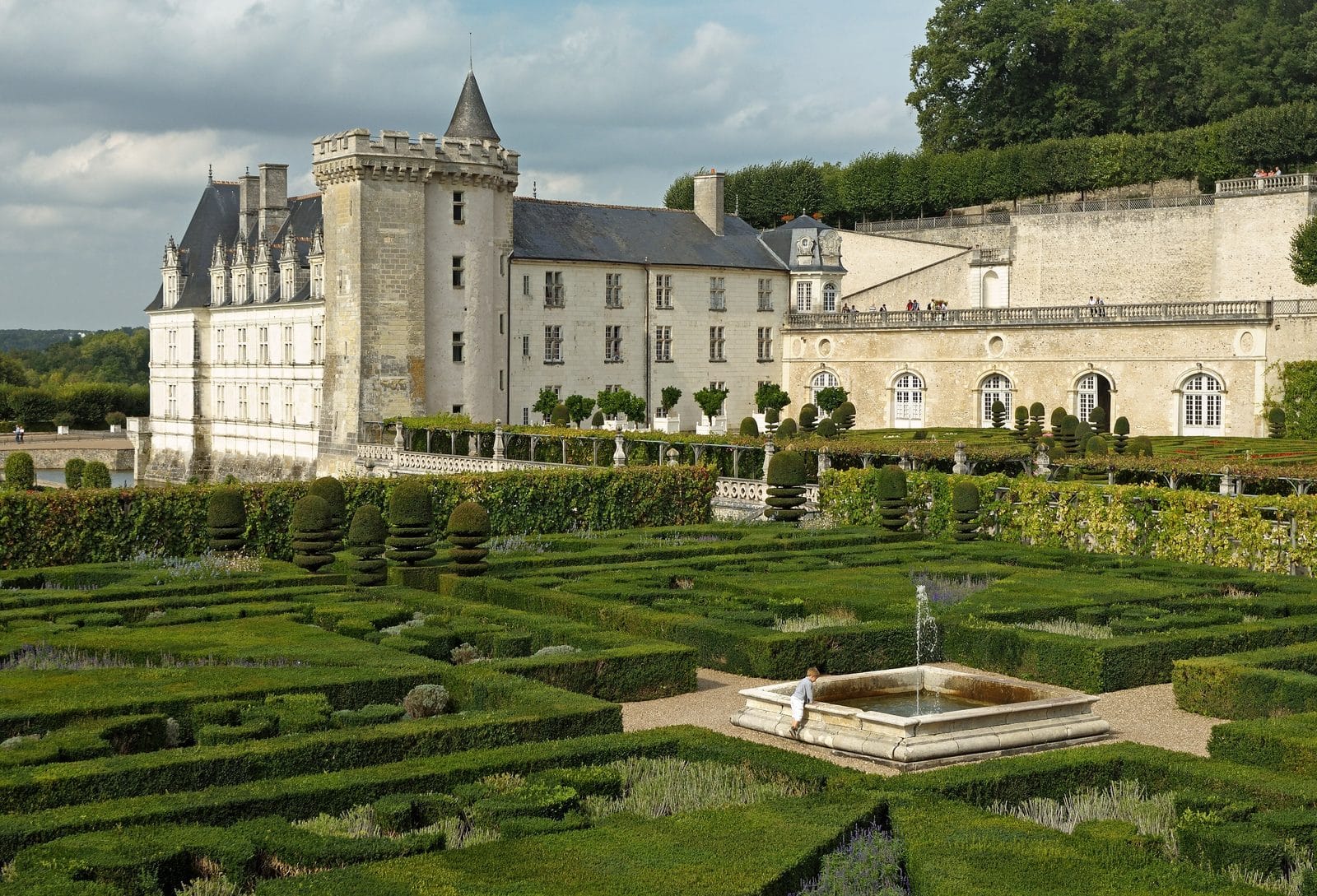
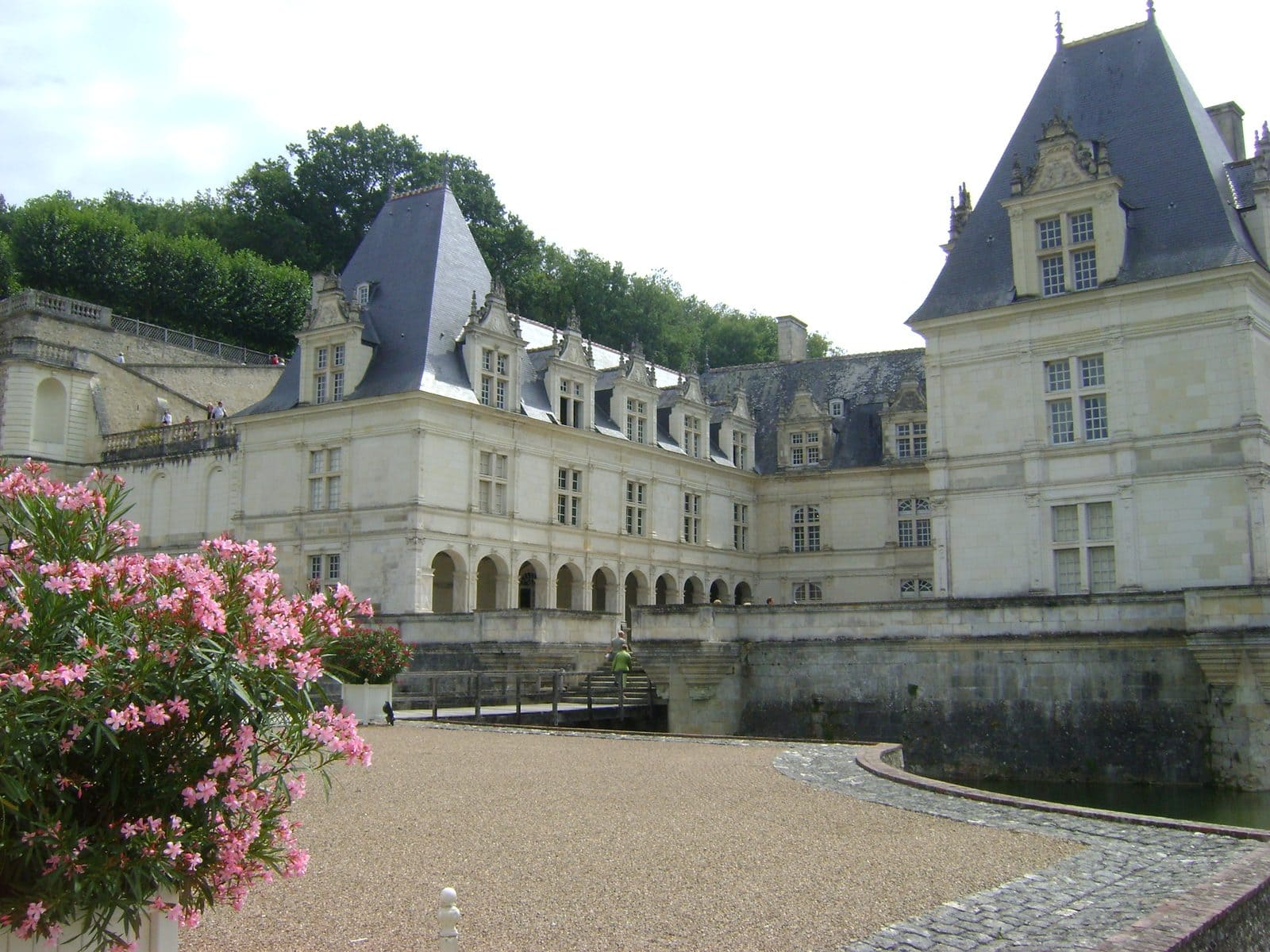
Le Breton’s plan broke with the defensive habits of the older Loire castles. Three wings stand in a horseshoe around an open courtyard, the cour d’honneur, with no fourth range to close it off and no serious fortification at all. The arms of the U open outward toward the valley and the Cher, so that the house seems to welcome the landscape rather than guard against it. The medieval keep, folded into one wing, is the single reminder of the stronghold that came before.
The materials are the familiar grammar of the Loire: light tuffeau stone that takes carving cleanly, steep slate roofs, ground-floor galleries set on basket-handle arches, tall mullioned windows framed by pilasters, and sculpted dormers bearing Le Breton’s coat of arms. A moat, once filled with water and crossed by a drawbridge, still rings the main court. Architectural historians tend to read Villandry as a sober design, more French in temper than the Italianate flourish of some of its neighbors, a reading that suits the building though it remains interpretation and not settled record.
From Castellane to a Bonaparte: the château reshaped
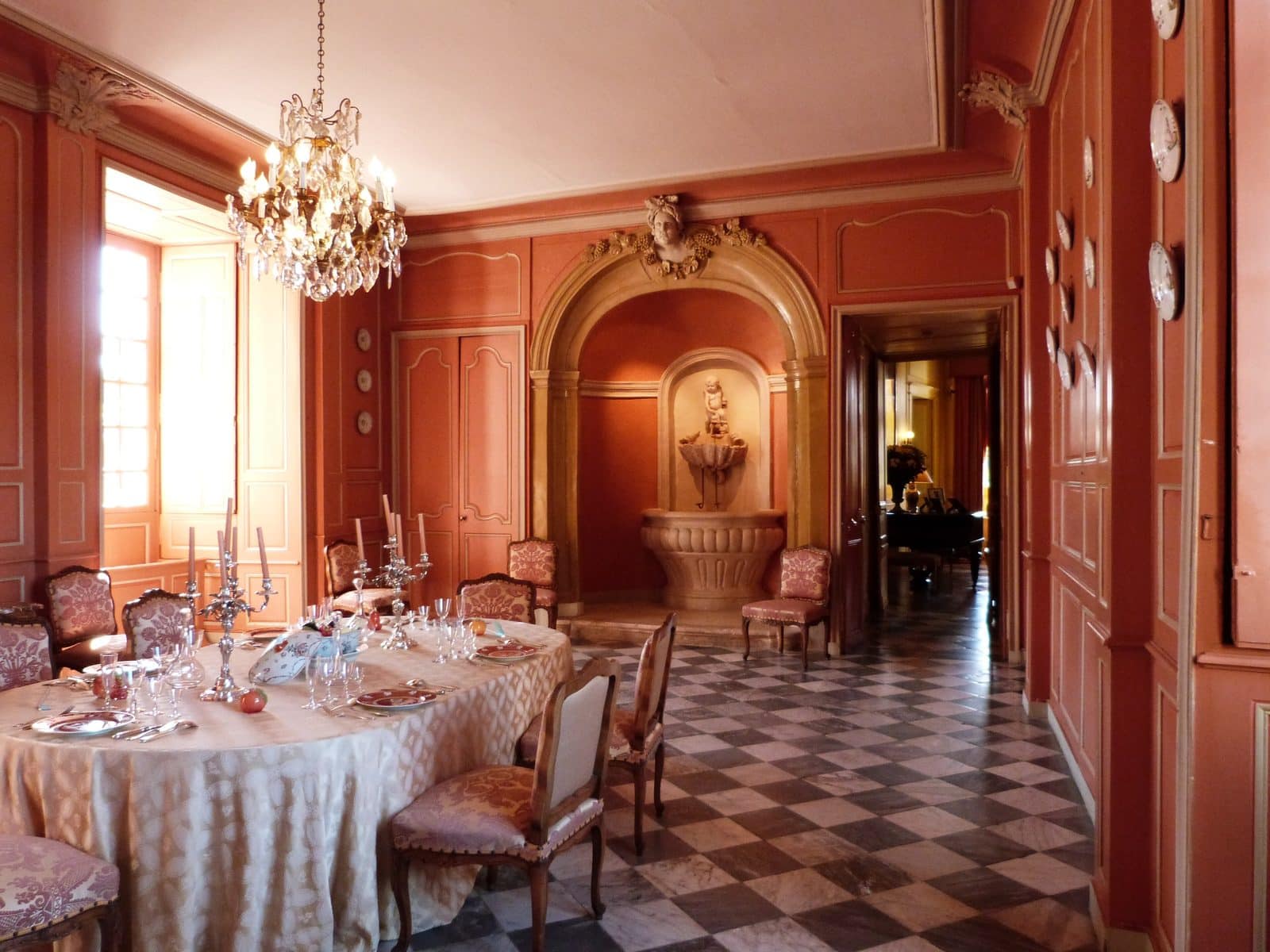
The Le Breton family held Villandry until 1754, when the estate passed to Michel-Ange de Castellane, a Provençal nobleman who had served Louis XV as ambassador to the Ottoman court at Constantinople. Castellane bought the château on July 23, 1754 and set about making it comfortable for an eighteenth-century household. He raised the seigneury to a county in 1758, added the outbuildings with their Mansart roofs, and recast the interiors in the lighter Louis XV manner; the salmon-paneled dining room with its little fountain dates from his years. He died at Villandry in 1782.
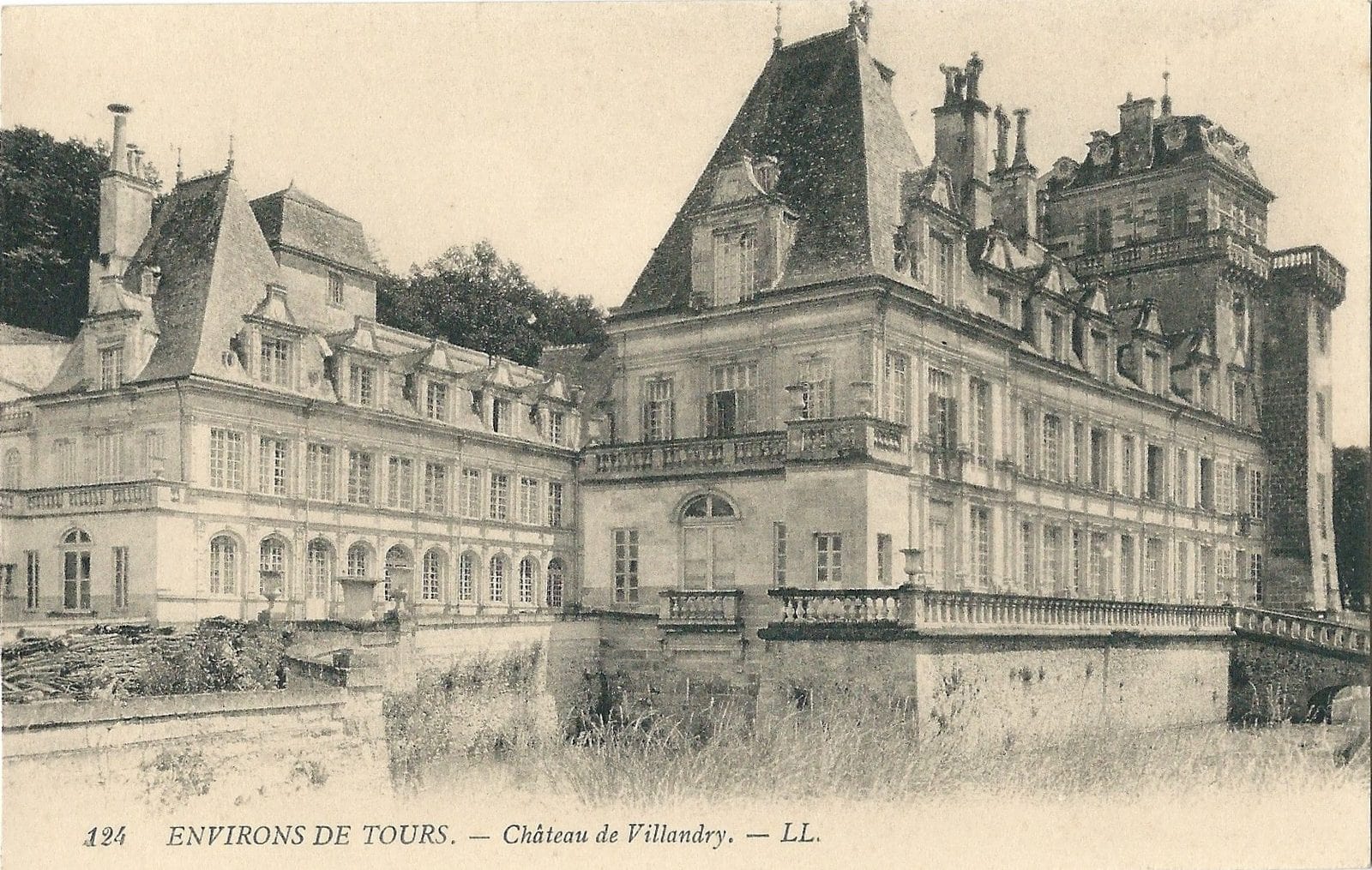
The Revolution scattered the estate from the Castellanes. Confiscated and then sold in 1791, Villandry passed through the hands of the financier Gabriel-Julien Ouvrard and, in the Napoleonic years, to the emperor’s brother Jérôme Bonaparte, who acquired it after Napoleon settled Ouvrard’s debts. From around 1817 the property belonged to the Hainguerlot family, who held it until 1897 and, in the fashion of the nineteenth century, swept away the formal beds and remade the grounds as an English landscape park. By the time it changed hands again, the Renaissance gardens were a memory under lawn and winding paths.
Decline and rescue: the Carvallo restitution
In 1906 Villandry found the steward who would define it. Joachim Carvallo, born in 1869 at Don Benito in the Spanish region of Extremadura, had trained as a physician and come to Paris to work in the laboratory of the Nobel laureate Charles Richet. There he met and married Ann Coleman, an American heiress from Pennsylvania, and when her fortune freed him from the lab, he turned the whole of it toward a single object. The couple bought the run-down château and gave their lives to its restoration.
Carvallo’s real ambition lay outside the walls. Between 1908 and 1918 he set out to recover the lost Renaissance gardens, working not from survivals, of which there were none, but from old engravings, monastic plans, and the surviving cadastral records. The result, in the precise language of the Monuments Historiques, is a conjectural restitution of a sixteenth-century French garden: an informed re-creation rather than a relic. That distinction is the truest thing about Villandry, and it takes nothing away from the achievement. Carvallo also founded La Demeure Historique in 1924, the first association of private owners of historic French houses, and opened his monument to the public in an age when such places stayed shut. Villandry has stayed in the family ever since. Henri Carvallo, Joachim’s great-grandson, runs it today as owner and director, which makes it one of the rare major Loire châteaux still held by the family that saved it.
The gardens of Villandry
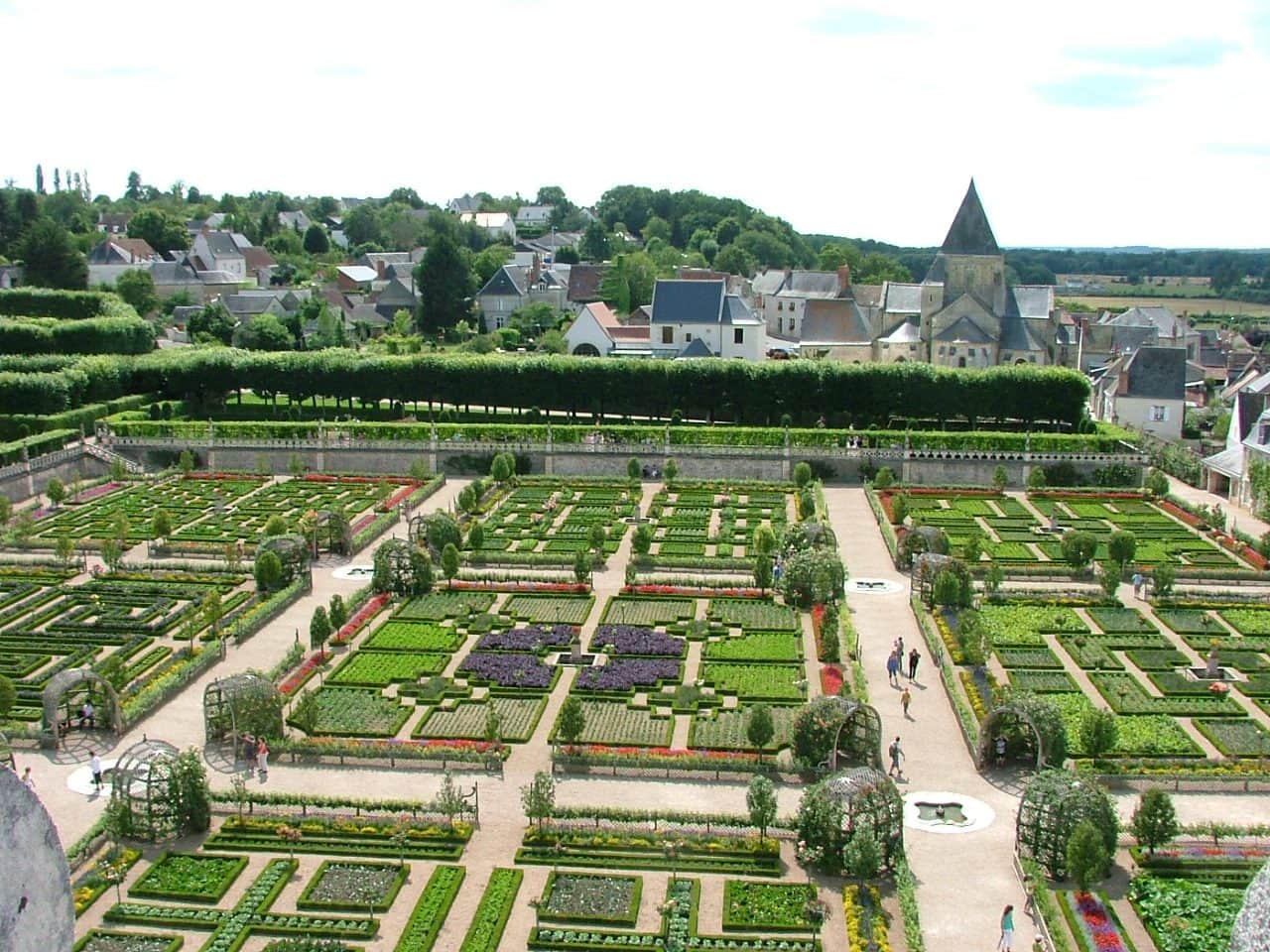
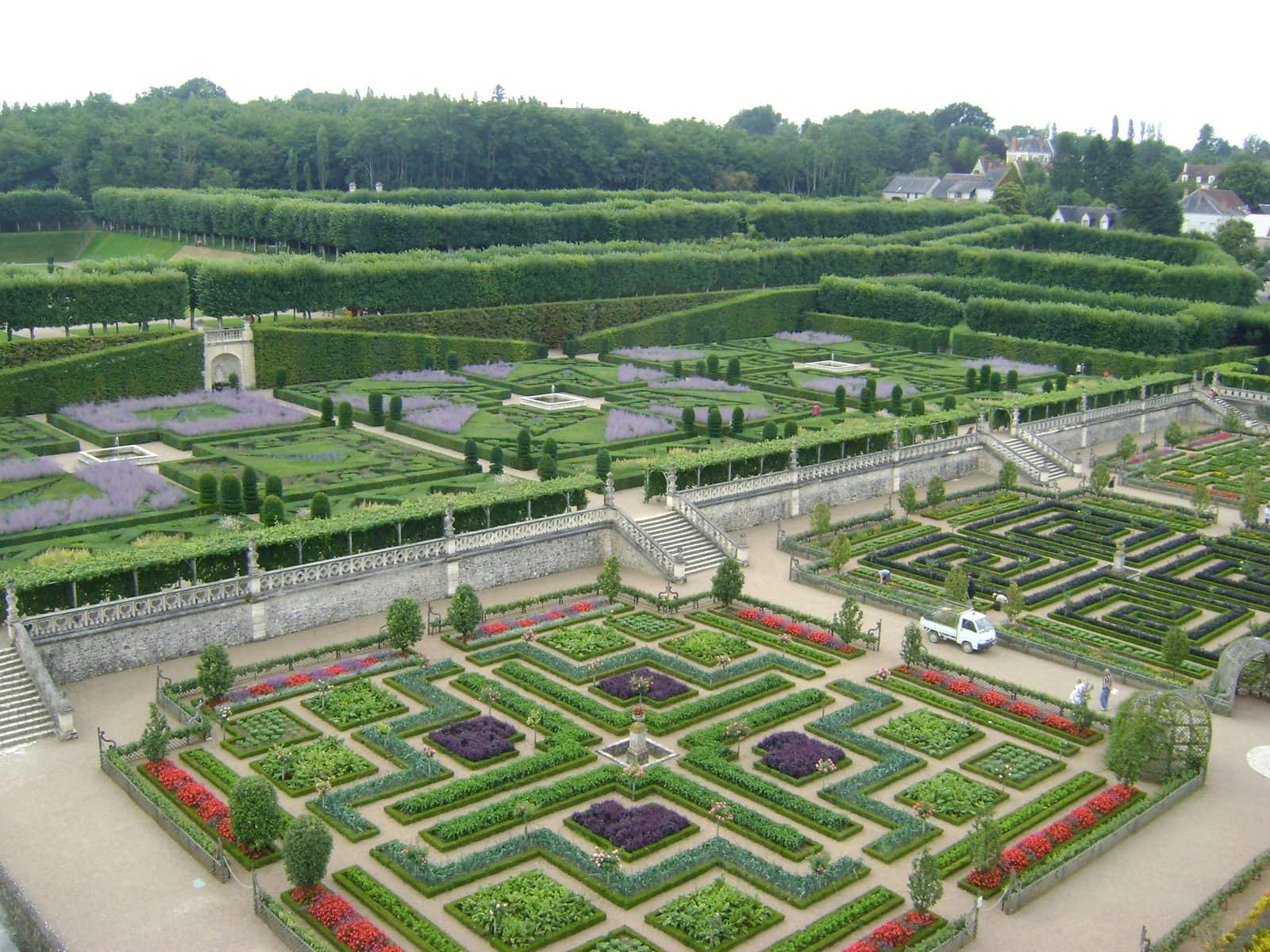
This is what the crowds climb the keep terrace to see. The gardens fall away below the house in descending levels, a layered composition of water, ornament, and produce that reads, from above, like a single vast design laid on the valley floor. Carvallo arranged them so that the visitor reads them downward, from the calm of the water to the busy geometry of the kitchen beds.
The model he reached back to was the Renaissance garden as the sixteenth century understood it, a form that married the orderly kitchen plots of the monastery with the decorative geometry Italian designers had carried north. A garden in that tradition was meant to be useful and legible at once, its beds laid out so that meaning could be read in their shapes. Carvallo took the idea seriously enough to grow real vegetables in patterns worthy of a parterre, and to let symbolism govern the ornamental beds above them. The whole composition rewards height, which is why he set the house and its terraces over the design instead of inside it.
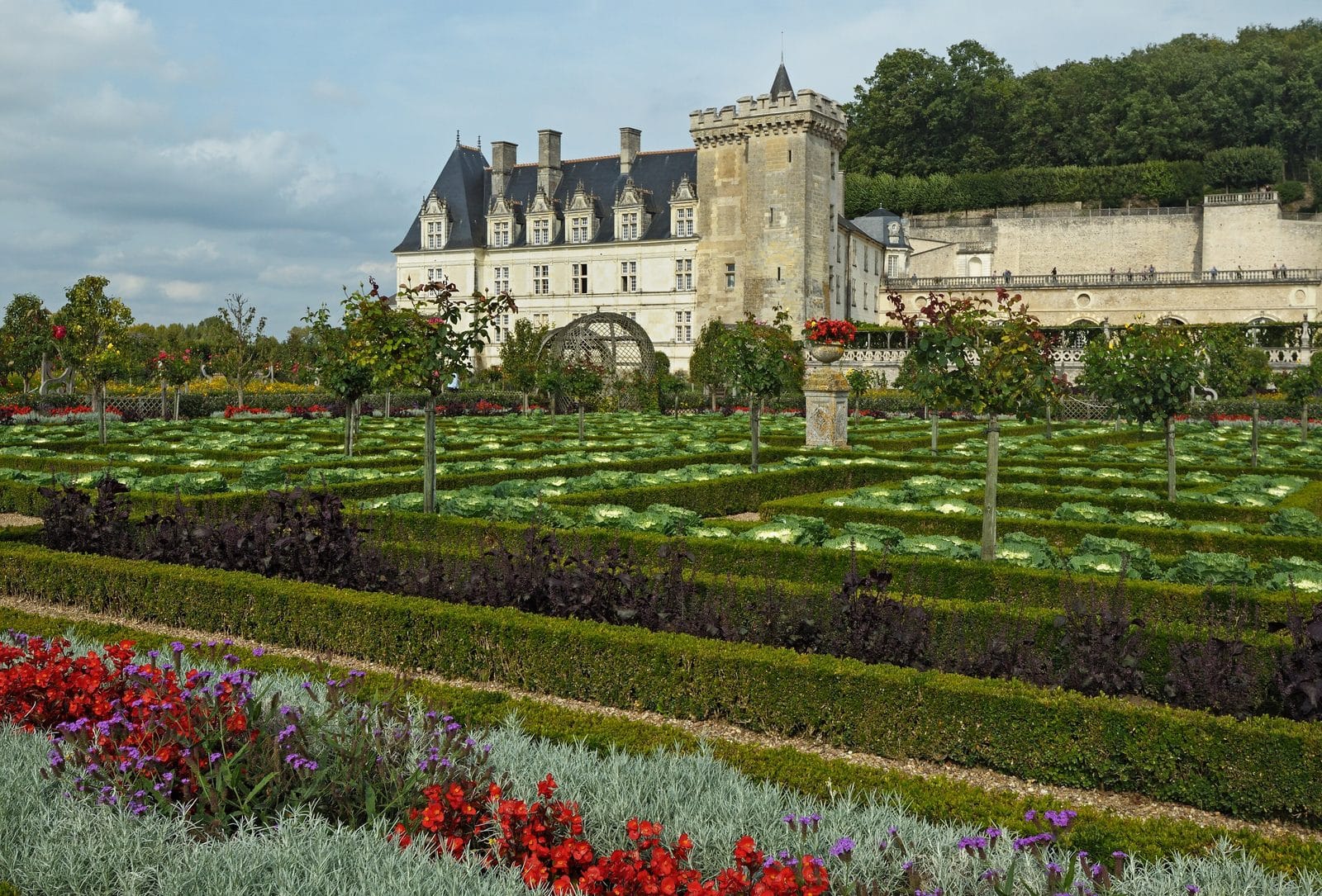
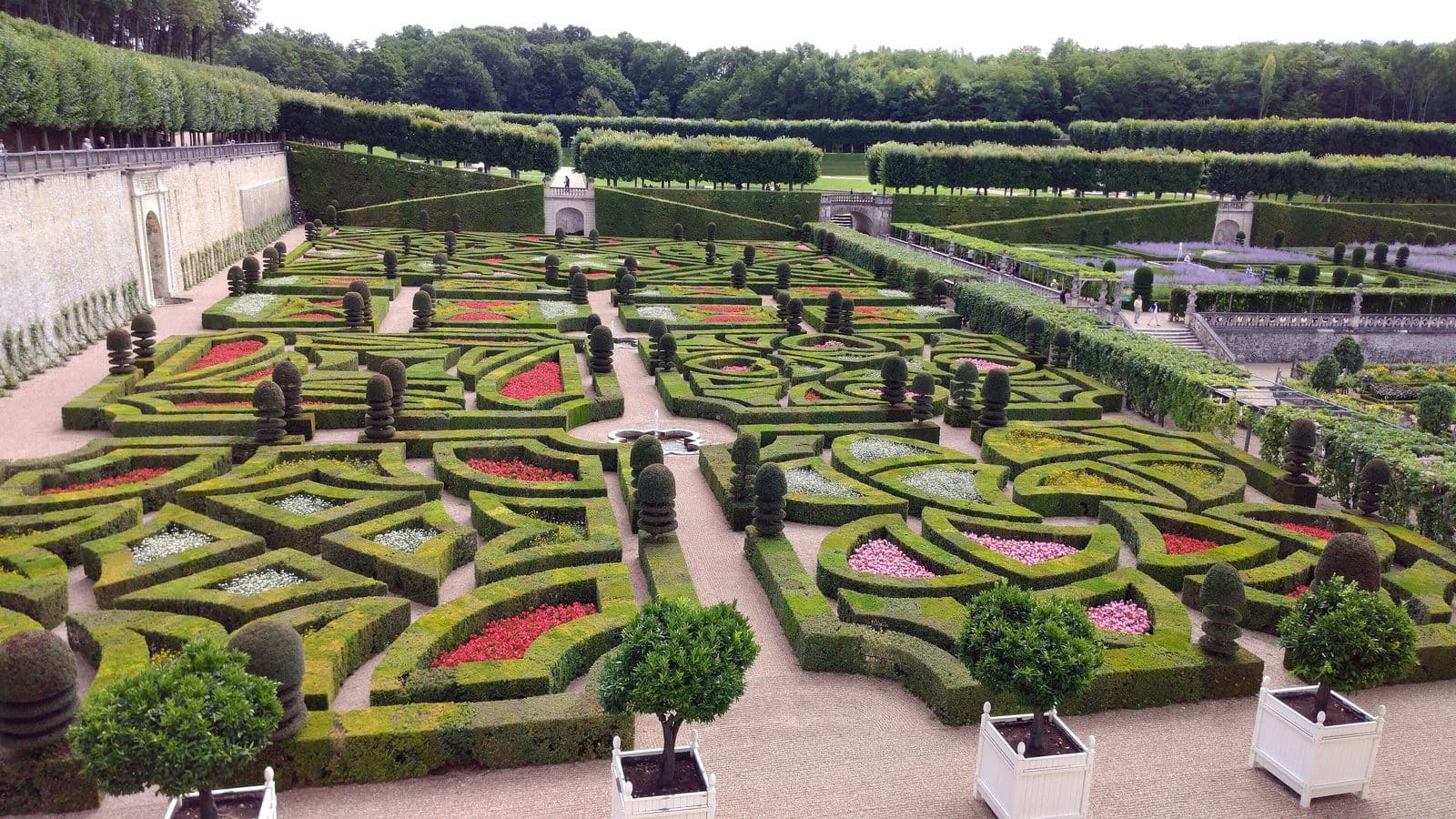
The most celebrated of them is the decorative kitchen garden, the potager. Nine squares of equal size, each filled with a different geometric pattern, turn cabbages, leeks, carrots, and ornamental greens into a checkerboard of color that changes with the seasons. The gardeners plant it twice a year, once for spring and once for summer, drawing on some forty species across eight botanical families, and since 2009 they have grown the whole thing organically. Above it sit the ornamental gardens, where clipped box draws the famous Garden of Love into four parterres: tender love in masked hearts, passionate love in broken ones, fickle love with its fans and love letters, and tragic love in blades like daggers. Nearby a Garden of Music shapes box into lyres and harps, and a Garden of the Crosses sets Maltese, Languedoc, and Basque forms side by side.
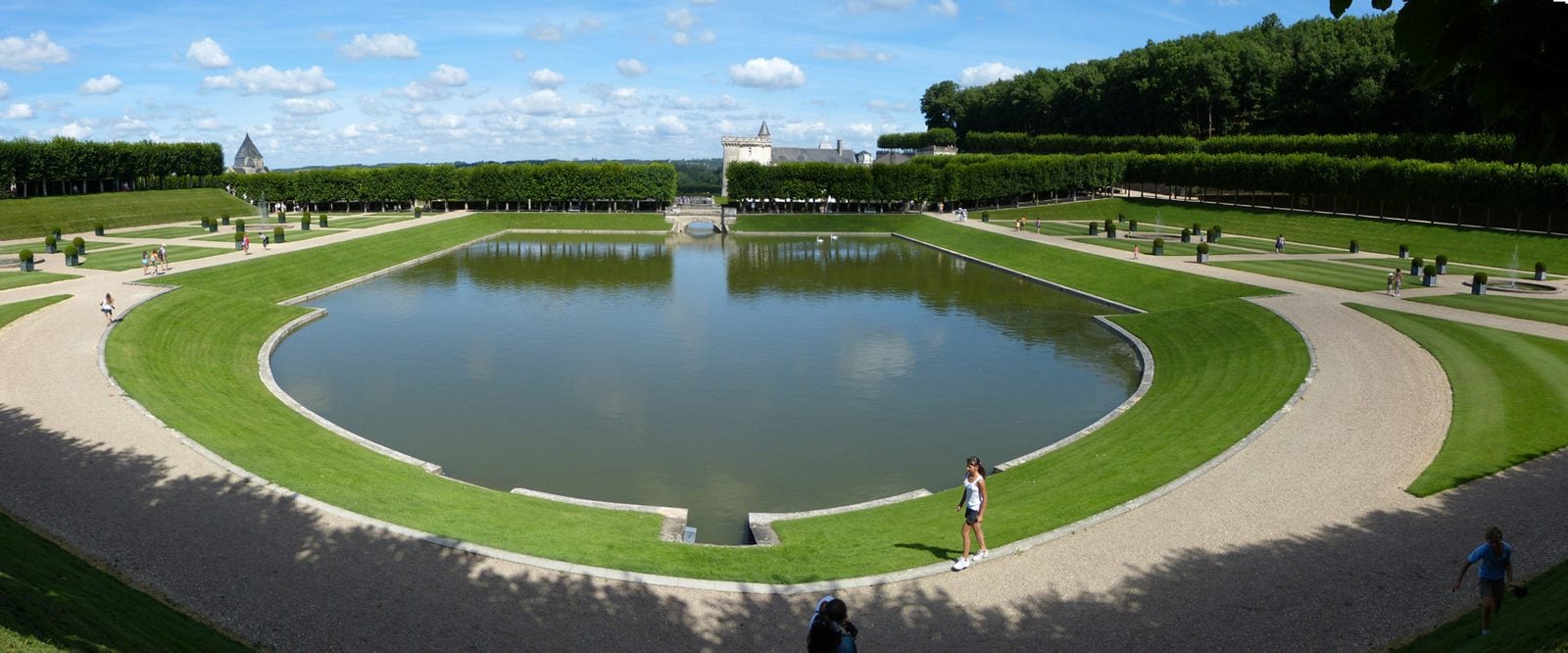
Higher still lies the water garden, classical in mood, built around a calm Louis XV mirror pool with cascades and a cloister of hornbeam. A medieval-style herb garden, added in 1970, gathers the aromatic and medicinal plants a Renaissance household would have known, and a hornbeam maze offers the one place at Villandry where the design lets you lose your way. The newest addition, the Sun Garden, opened in June 2008 from a plan Joachim Carvallo had left behind, realized under Henri Carvallo by the landscape architects Louis Benech and Alix de Saint-Venant; it unfolds in three chambers of sun, cloud, and play. Across roughly six hectares the estate keeps some twelve hundred lime trees, a thousand hornbeams, and a quarter of a million vegetable and fruit plants in trim, and the gardens carry the French state’s Jardin Remarquable label, awarded in 2004. The word that fits all of it is not preservation but resurrection.
Inside the château
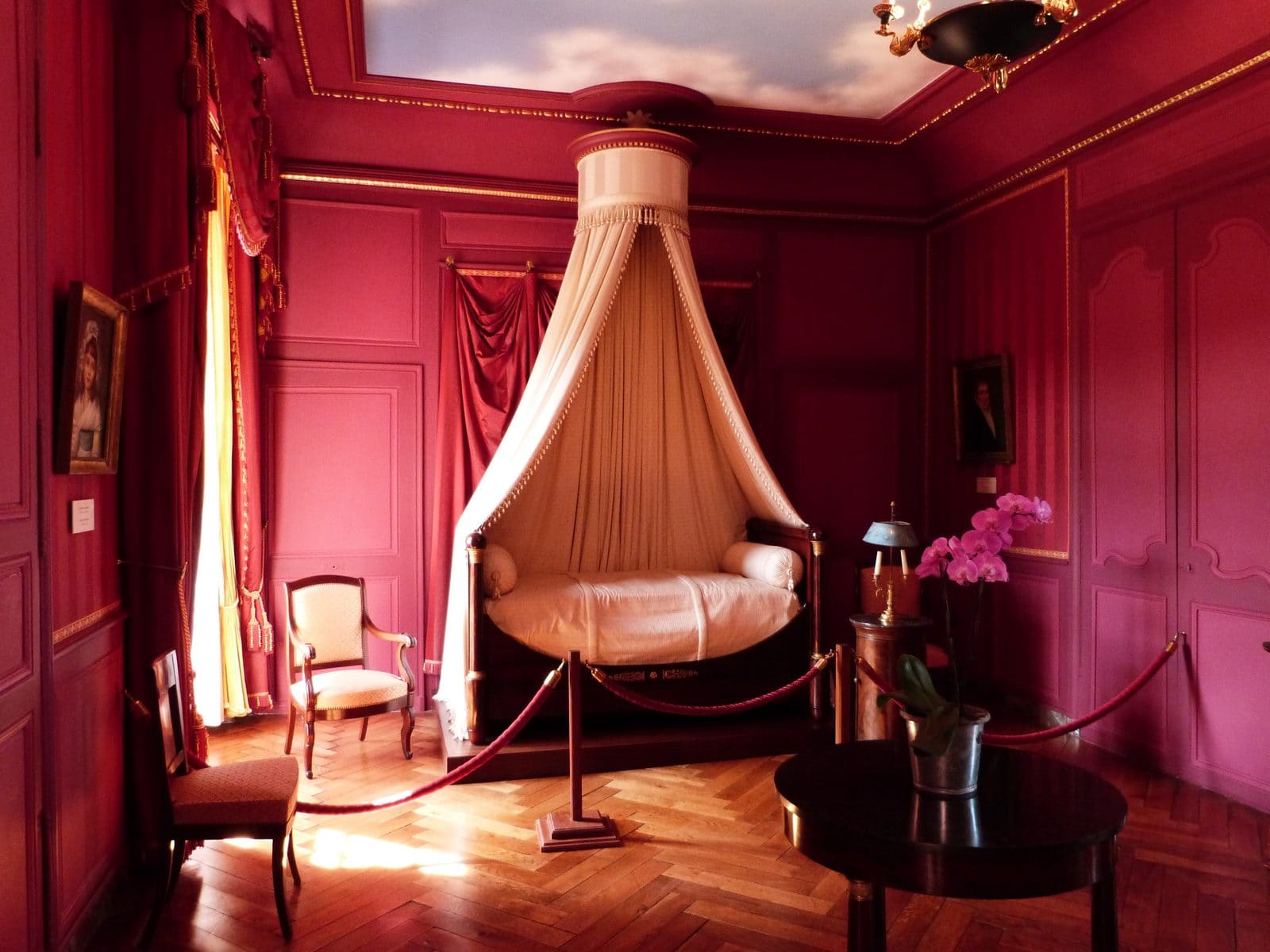
For all that the gardens command the attention, the rooms hold their own surprises, and they record the same layered history as the walls outside. Castellane’s years left the interiors their eighteenth-century grace: a dining room paneled in soft salmon pink, cooled by a small wall fountain that nods to the marquis’s Provençal origins, and a grand staircase wrapped in a Louis XV wrought-iron balustrade worked with the family’s interlaced initials. These are the comfortable, light-filled rooms of an Enlightenment household, and they carry their own historic-monument protection.
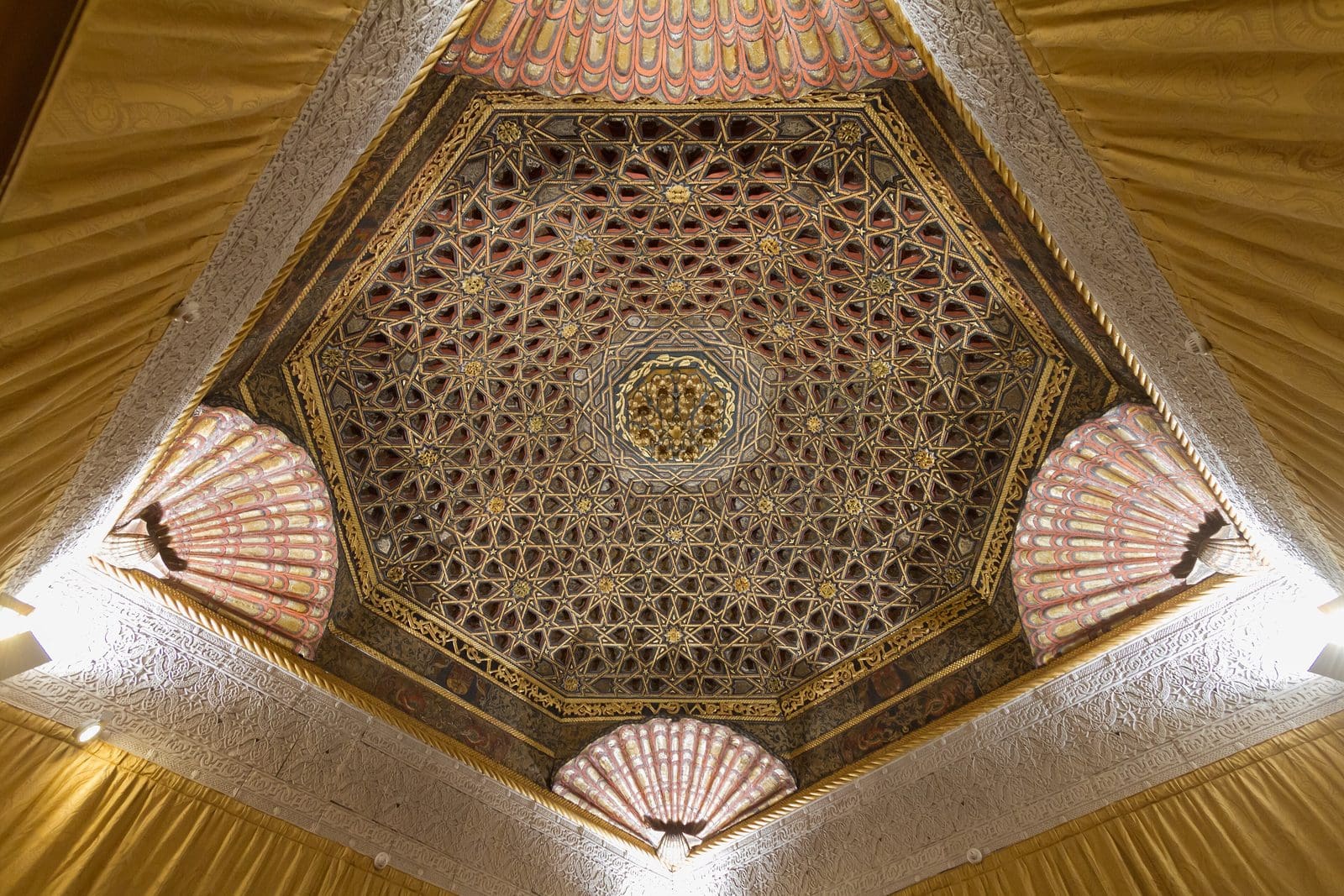
Carvallo overlaid that French refinement with his own Spanish inheritance. He hung the château with a notable collection of Spanish Golden Age paintings, and in one drawing room he installed a Hispano-Moorish ceiling carried in fragments from a palace in Toledo. More than three thousand pieces of carved and painted wood were fitted back together over the course of a year, a Mudéjar puzzle reassembled on the banks of the Cher. Three sister ceilings from the same Toledo source ended up in museum collections in Madrid, London, and San Francisco, which makes the Villandry example a rare survival in a private house. The interiors, like the gardens, are less a single period than a conversation among the owners who shaped them.
Visiting Château de Villandry
Villandry sits about fifteen kilometers west of Tours, reached by the D7 along the south bank near the point where the Cher joins the Loire, with free parking nearby and a stop on the Loire à Vélo cycle route. The two halves of the visit are ticketed separately, which catches some visitors out. In 2026 a combined château-and-gardens ticket costs fourteen euros for adults, eight for young people aged eight to eighteen and students under twenty-six, and is free for children under eight; the gardens alone are eight euros fifty, five euros fifty for the same young rate. An audio guide adds four euros. Tickets are sold on-site and through the official website, chateauvillandry.fr. Entry tickets and local tours can also be booked in advance through GetYourGuide.
The gardens open every day of the year except December 25, which makes them an unusually reliable destination in a region where many châteaux close for the winter. The château interiors keep a shorter calendar: in 2026 they open from February 7 to November 11, then again from November 28 to January 3, closed on Christmas Day. Opening windows and prices shift from year to year, so it is wise to check the official site before traveling. Climb to the belvedere on the keep terrace first; the gardens were designed to be read from above, and the view sets up everything you then walk through. The estate is at its fullest from April through October, when the beds are in flower, and on three summer evenings each year, set for July 31 to August 2 in 2026, the Nuits des Mille Feux light the paths with thousands of candles. Anyone staying overnight can compare hotels in and around Villandry.
Some links on this page are affiliate links, which means StoneKeep Atlas may earn a small commission, at no extra cost to you, if you book through them.
More Views of Château de Villandry
A closer look at the château and its gardens, from the patterned potager and the Garden of Love to the Toledo ceiling indoors and the keep that outlasted the fortress around it.
Beyond Villandry: the châteaux of the Loire
Villandry makes most sense as the garden counterpoint to the great houses upstream. At Château de Chambord, François I built the boldest statement of the French Renaissance on the same flat valley terms, all roofline and double-helix bravado where Villandry is all restraint. At Château de Chenonceau, the river itself becomes architecture, the gallery bridging the Cher that Villandry only overlooks. Château d'Amboise, the royal seat above the Loire where the young François I grew up, supplies the court culture that made a house like Villandry conceivable. And at Château de Chaumont-sur-Loire, the garden tradition Villandry restored looks forward instead of back, reinvented each summer in a festival of contemporary design. A short drive south, the Château d’Azay-le-Rideau rises from its island in the Indre, the early Renaissance complete in a single house. Seen together, they trace the arc from fortress to palace to garden that defines the Loire. Nearer the forest’s edge, Château d’Ussé raises its fairy-tale towers over the Indre, the white château long tied to Perrault’s Sleeping Beauty. Near Blois, Cheverny brings a different kind of devotion: a single family, a single house, and rooms kept furnished and lived in to this day. For the complete itinerary, see our guide to the Châteaux of the Loire Valley. Farther down the Loire in Anjou, the white Château de Saumur crowns its promontory, the ducal palace of the Très Riches Heures. West toward Saumur stands the Château de Brézé, whose château rises above a hidden underground fortress and the deepest dry moat in France. A short way west, the Château de Langeais keeps its fifteenth-century royal fortress and working drawbridge almost unaltered. Up the Indre valley, the Château de Loches holds Fulk Nerra’s great keep and a walled royal city above the river.
Conclusion
The strange thing about Villandry is that its most authentic feature is the one most thoroughly invented. The house is genuine sixteenth-century work, the keep older still, but the gardens that made the place famous are a scholar’s reconstruction barely a hundred years old. Carvallo did not find the Renaissance at Villandry; he reasoned his way back to it and then built it, square by square, from engravings and educated guesses. That the result feels older and truer than almost any surviving garden in France is the measure of how well he understood what he was reaching for. Villandry endures because one family decided that a lost idea was worth recovering, and because they have kept recovering it, season after season, for more than a century.
Principal Sources
- Château et Jardins de Villandry. Official site. chateauvillandry.fr (accessed June 2026).
- Encyclopædia Britannica. “Villandry.”
- Garrett, Martin. The Loire: A Cultural History. Oxford University Press, 2010.
- Inventaire général du patrimoine culturel, Région Centre-Val de Loire.
- Ministère de la Culture. Plateforme Ouverte du Patrimoine, base Mérimée, notice PA00098286.
- UNESCO World Heritage Centre. “The Loire Valley between Sully-sur-Loire and Chalonnes.” Property 933 (2000).
Image credits. Hero: Carsten Steger, CC BY-SA 4.0. The keep: Adobe Stock. Courtyard galleries and salmon dining room: ZohaStel, CC BY-SA 3.0. Historical postcard: unknown author, public domain. Potager: Ввласенко, CC BY-SA 3.0. Garden of Love parterres: David Tre, CC BY-SA 4.0. Water garden: Pintanescu, CC BY-SA 3.0. Gallery, in order: Benh Lieu Song (CC BY-SA 2.0); ZohaStel (CC BY-SA 3.0); Lydie Danjean (CC BY-SA 3.0); Ввласенко (CC BY-SA 3.0); Guiguilacagouille (CC BY-SA 3.0, two images); ZohaStel (CC BY-SA 3.0); Carl Ha (CC BY-SA 4.0). Images via Wikimedia Commons under the licenses noted; CC BY-SA images are reusable under the same terms.