
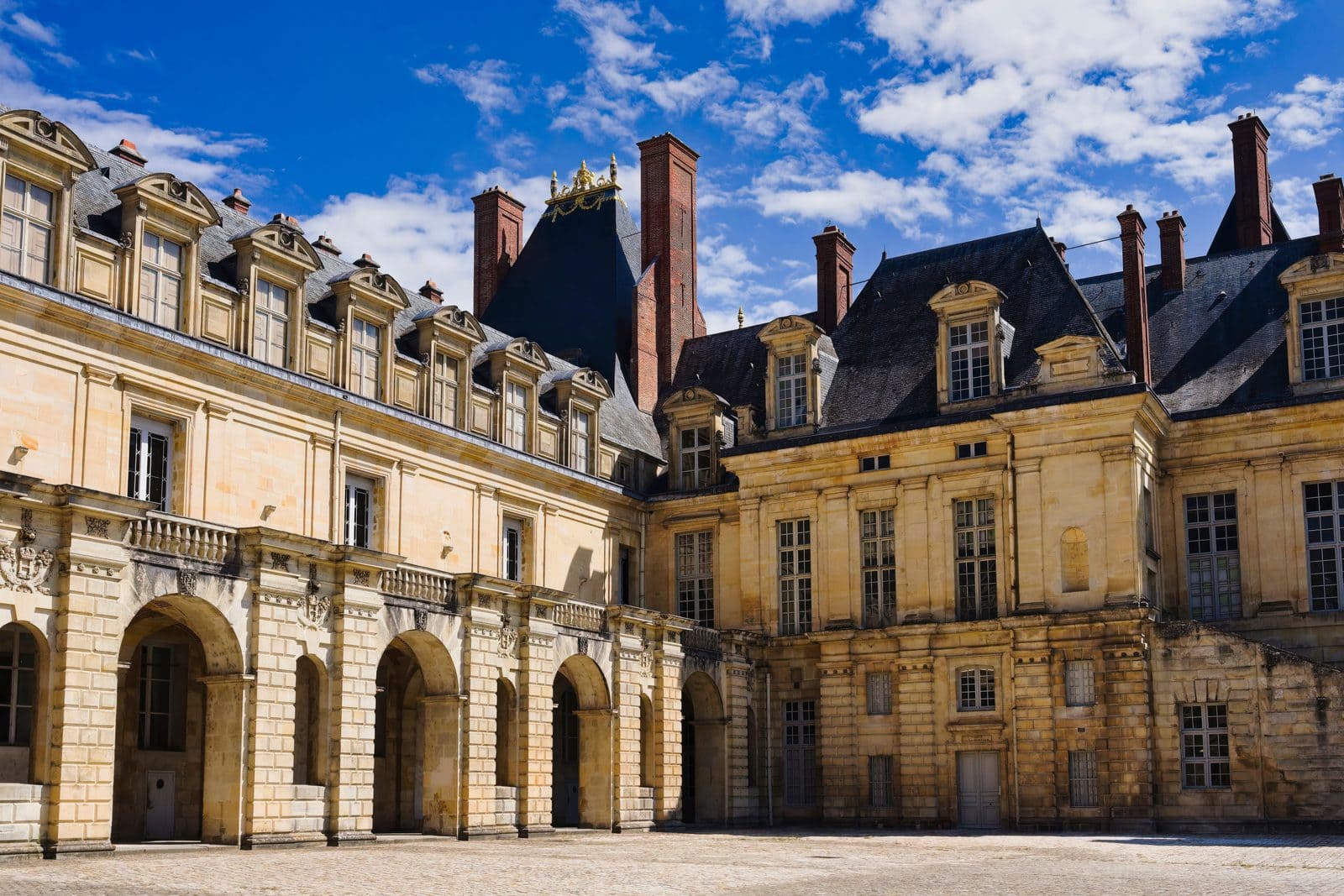
Château de Fontainebleau
About sixty kilometers southeast of Paris, at the edge of a forest that French kings hunted for eight centuries, stands the Château de Fontainebleau, which by its own count was lived in by every sovereign from the twelfth century to the nineteenth: thirty-four kings and two emperors. Where Versailles was the singular vision of one reign, Fontainebleau is a building made of layers. A medieval keep sits beside a Renaissance gallery; a Bourbon staircase frames a courtyard where Napoleon said goodbye to his guard; an empress’s Chinese museum opens onto a carp pond older than the palace around it.
Napoleon, recalling the palace from exile on Saint Helena in 1816, called it “the true home of kings, the house of the centuries.” That phrase is the key to the place. No single era defines Fontainebleau, because more than thirty rulers each left a layer here, and almost all of it survives. This guide follows those layers in order, from a hunting lodge first recorded in 1137 to the national museum and UNESCO World Heritage Site of today, and explains why a palace that shaped the French Renaissance and ended an empire remains the great residence that visitors to Paris most often overlook.
Quick Facts
| Location | Fontainebleau, Seine-et-Marne, Île-de-France, France |
| Earliest record | 1137 (medieval royal residence and hunting lodge) |
| Renaissance rebuild | From 1528, under François I |
| Architectural styles | Renaissance, Baroque, Classical, and Napoleonic (multiple periods) |
| Notable figures | François I, Henri IV, Louis XIII, Napoleon I, Napoleon III |
| Condition | Well preserved; never destroyed |
| Current use | National museum (château-musée) |
| UNESCO | Palace and Park of Fontainebleau (inscribed 1981) |
| Coordinates | 48.4021° N, 2.6999° E |
| Official website | chateaudefontainebleau.fr |
A hunting lodge in the forest
The Forest of Fontainebleau drew kings before any palace did. Its sandstone hills, deer, and wild boar made it some of the best hunting country within reach of Paris, and a spring among the rocks gave the place its name; the prettier reading of it as Fontaine Belle Eau, “fountain of beautiful water,” is a later folk etymology. Louis VII is the earliest king whose presence here can be documented: in 1137, the year he took the throne at seventeen, he issued a charter from his “palace” of Fontainebleau. In 1169 he founded a chapel dedicated to the Virgin and to Saint Saturnin and had it consecrated by an exiled English churchman then sheltering in France, Thomas Becket, Archbishop of Canterbury, a year before his murder in his own cathedral.
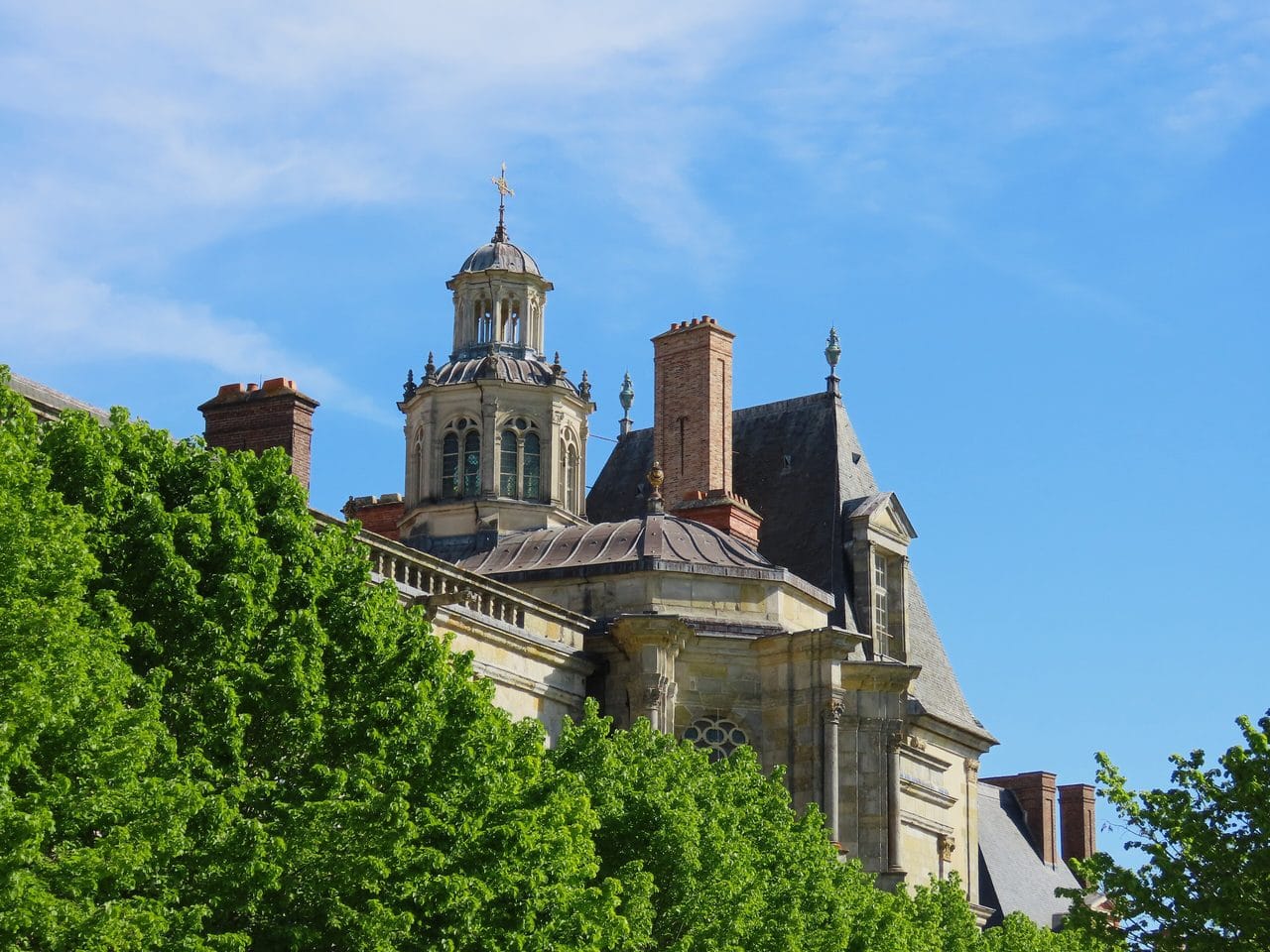
For three more centuries the château stayed a fortified residence and hunting retreat rather than a showpiece. Louis IX, the king later canonized as Saint Louis, settled an order of Trinitarian friars beside it in 1259 and built a hospital and convent. Philip IV, called le Bel, was born in the castle in 1268 and died there in 1314, the most Fontainebleau-bound of the medieval kings. Kings came for the hunting and the quiet, ruled from the place when it suited them, and left it much as they found it. Isabeau of Bavaria, queen to Charles VI, added embellishments in the fifteenth century, but the medieval core stayed essentially intact down to the reign of François I. A square keep anchored the whole, ringed by buildings set against an oval curtain wall. That keep, incorporated into the Cour Ovale (Oval Court), is the one medieval element to survive the rebuilding that came after, and it still stands at the heart of the palace: the oldest stone in a complex otherwise made by the Renaissance and everything that followed it.
François I and the birth of the French Renaissance
Everything changed in 1528. François I had spent his early reign at war in Italy and a long, humiliating stretch as a prisoner in Madrid after his defeat at Pavia, and he came home dazzled by the palaces and painting he had seen south of the Alps. Italy had beaten him on the battlefield; he would answer it in stone and fresco. He ordered the old fortress pulled down and a new palace raised on its footings. On April 28 of that year he signed a contract with the master mason Gilles Le Breton to demolish the medieval entrance tower and begin again. His ambition was explicit. He wanted Fontainebleau to be a “new Rome,” a French seat that could rival the courts of the Italian princes, and he meant to staff it with the artists who had made those courts famous.
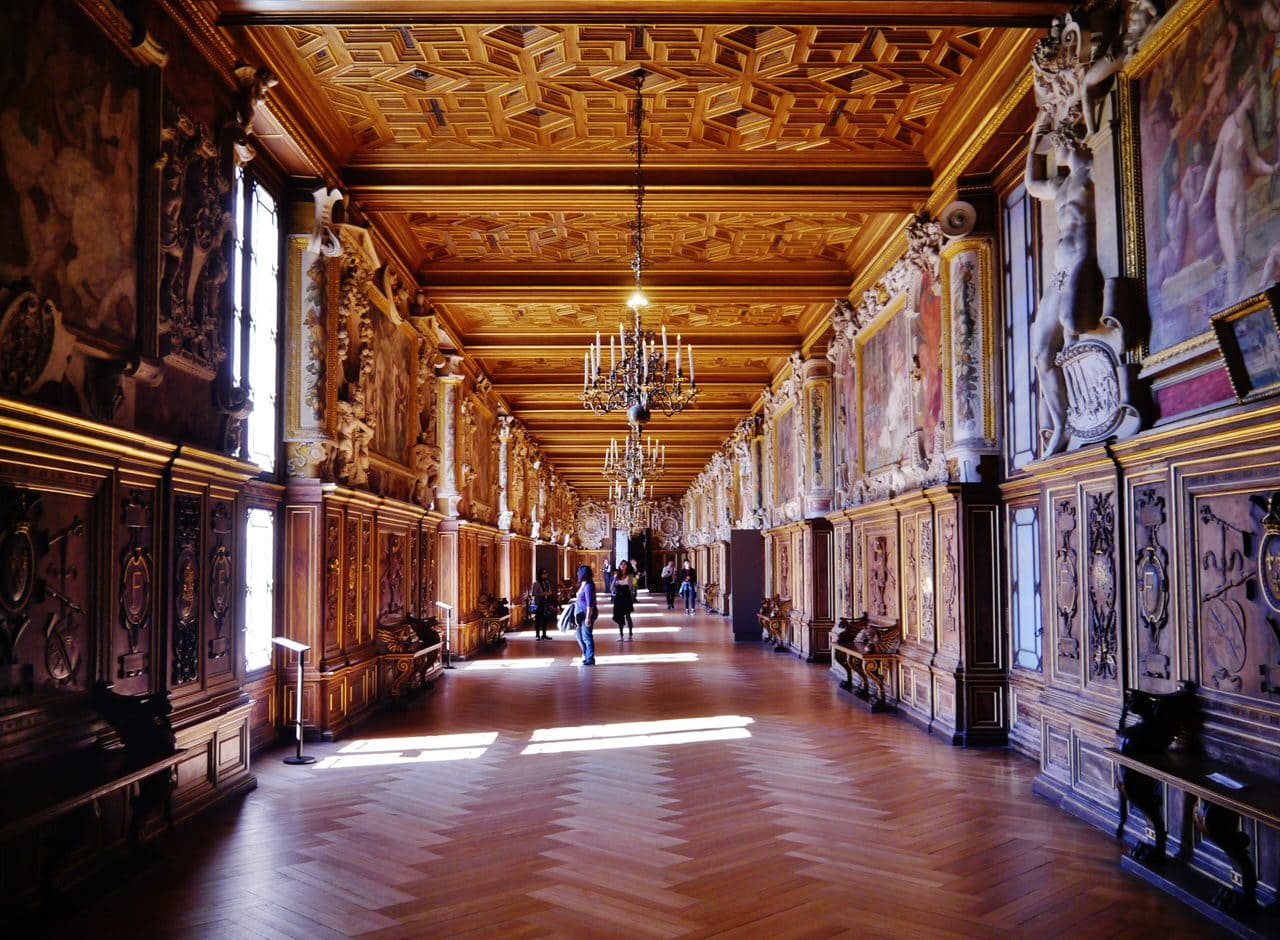
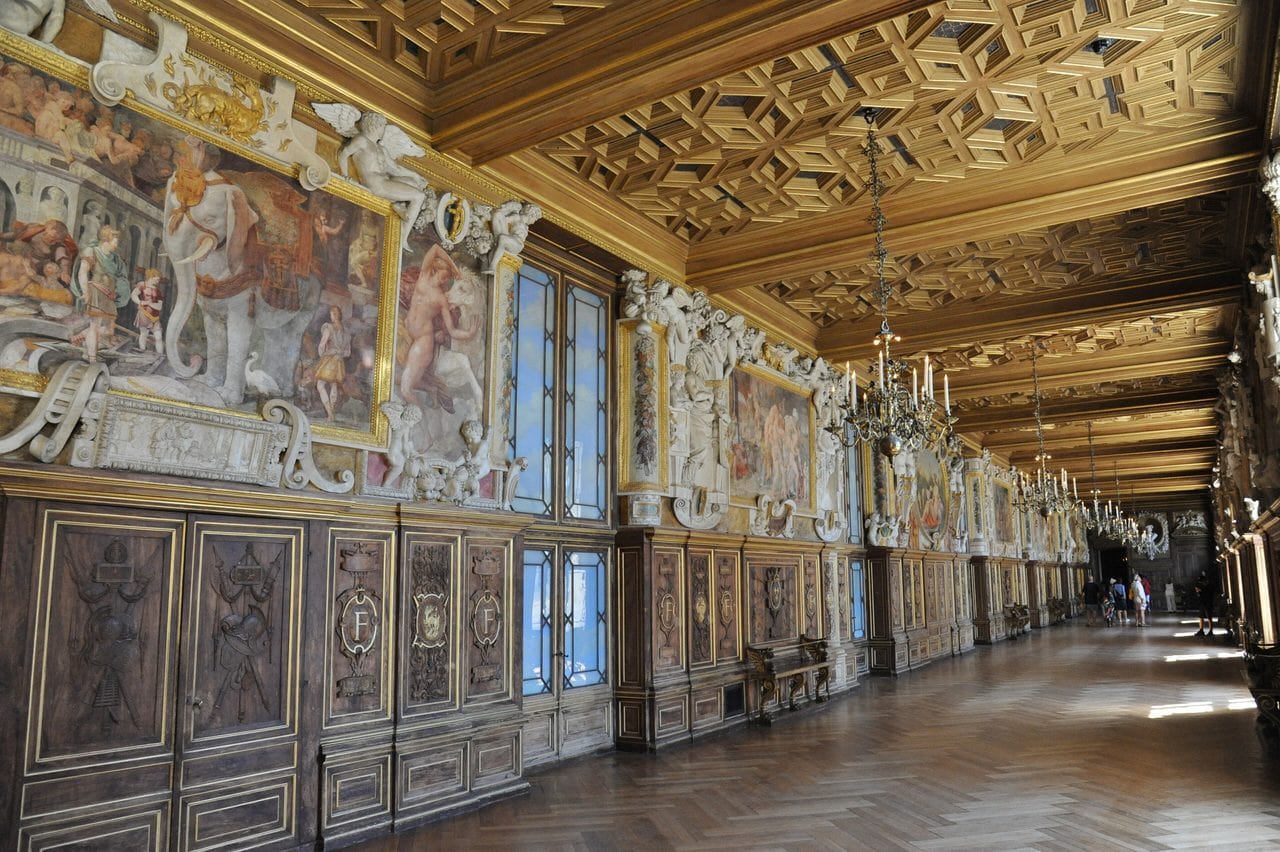
So he imported them. The Florentine painter Rosso Fiorentino arrived around 1530, joined two years later by Francesco Primaticcio of Bologna. Working with the cabinetmaker Francesco Scibec da Carpi, who paneled the lower walls in walnut, they created the Galerie François I, a long ceremonial gallery linking the king’s apartments to the chapel. Its scheme of mythological frescoes set in deep, high-relief stucco, woven around the king’s personal emblem of the salamander, had no precedent north of the Alps. Painting, sculpture, and woodwork fused into a single decorative idea. It was the first great decorated gallery built in France, and the style it launched became known across Europe as the First School of Fontainebleau, the earliest sustained flowering of Italian Mannerism in the country. François I prized the gallery so highly that he kept its only key and showed it to chosen guests alone, leading them past frescoes that flattered him through allegory, as warrior, as sage, and as a bringer of peace. The architect Sebastiano Serlio, whose treatises would teach Renaissance building to the whole continent, and later the painter Niccolò dell’Abate enlarged the same court of imported talent.
This was the same king, and the same impulse, behind the great Loire châteaux. François I built the Château de Chambord, held court at the Château d’Amboise, and brought Leonardo da Vinci to spend his last years nearby at the Château du Clos Lucé. When Leonardo died in 1519, the king acquired the painting the artist had carried over the Alps with him, and the Mona Lisa entered the royal collection. It hung at Fontainebleau among François I’s pictures through the sixteenth century, long before it ever reached the Louvre. The king had gathered the finest collection of Italian art in northern Europe, and for a time Fontainebleau, not Paris, was where it lived. The fuller story of that arrival runs through Leonardo in France.
The building campaign outlasted Rosso, who died in France in 1540, and ran on through the reign. The Cour Ovale rose over the medieval plan; the Porte Dorée was raised as a ceremonial gate; the great Salle de Bal was begun. By the time François I died in 1547, the hunting lodge had become a Renaissance palace, and France had a new artistic capital. At Fontainebleau, in the plainest terms, the Renaissance arrived in France.
Henri IV and the second flowering
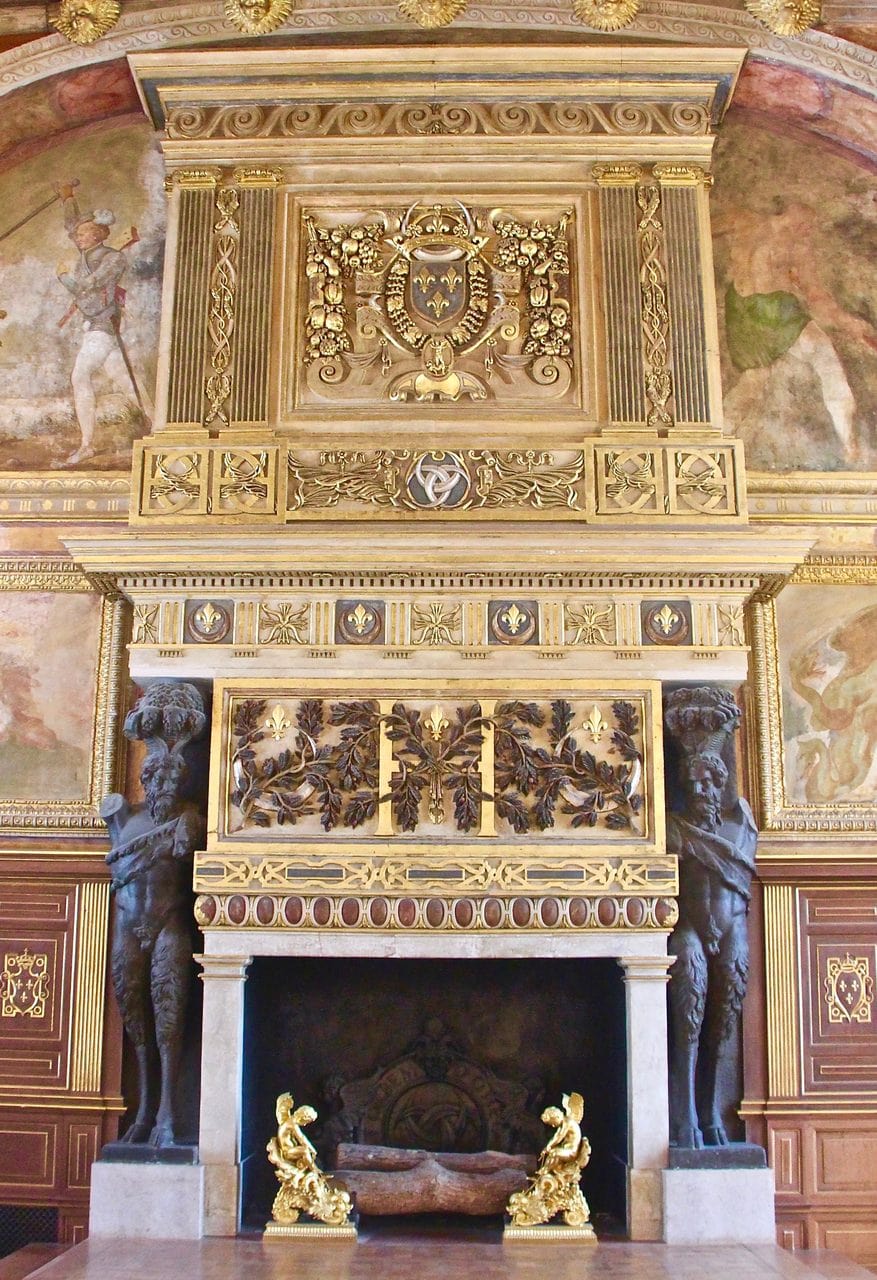
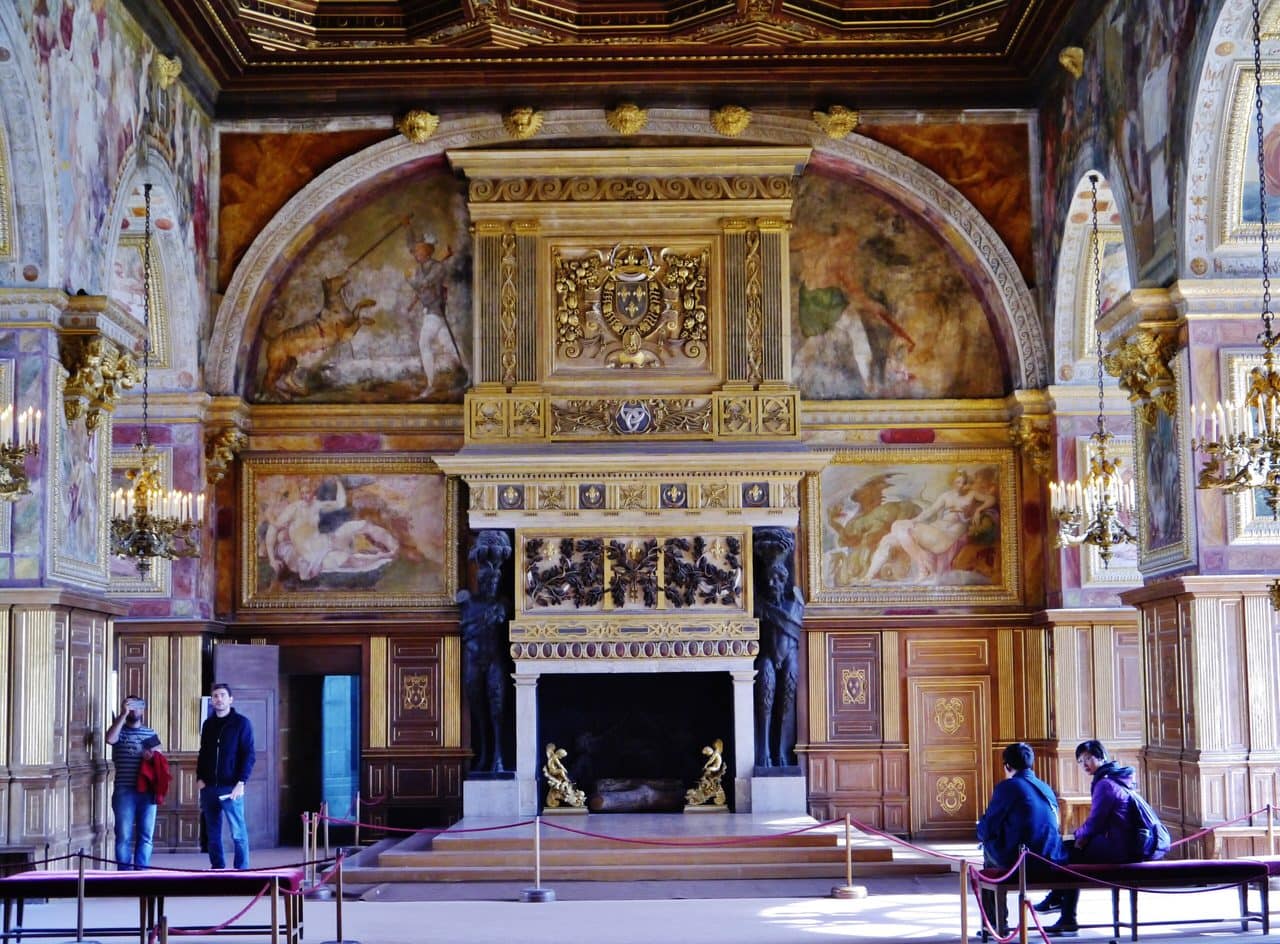
The Valois who followed François I kept building. Henri II finished the Salle de Bal, the great ballroom his father had begun, where Primaticcio’s frescoes and a chimneypiece carried on bronze atlantes still survive; the room ranks among the finest interiors of the French Renaissance. Henri’s queen, Catherine de’ Medici, and his mistress, Diane de Poitiers, both moved through Fontainebleau as they did through the Loire, where their long rivalry reshaped the Château de Chenonceau. That contest is told in The Ladies of the Loire.
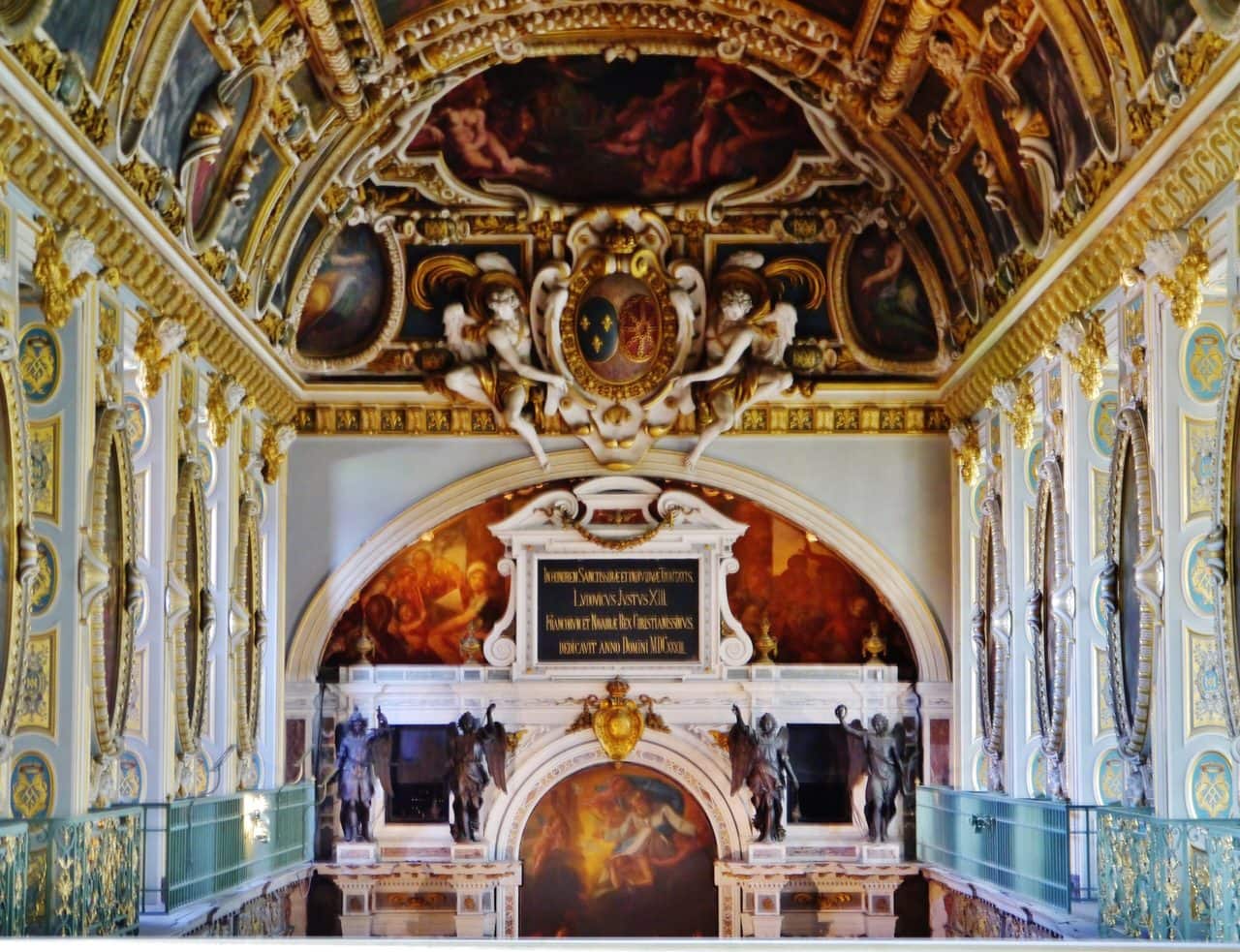
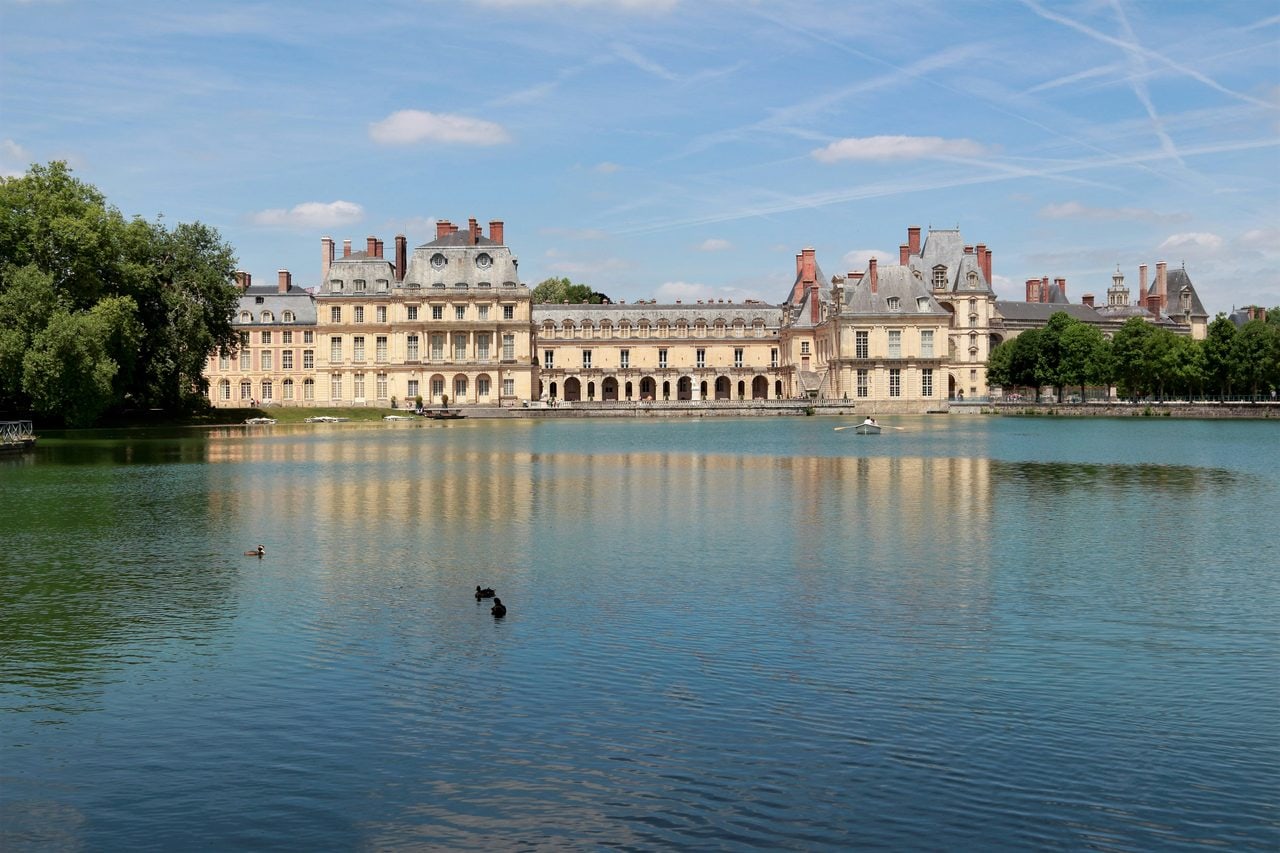
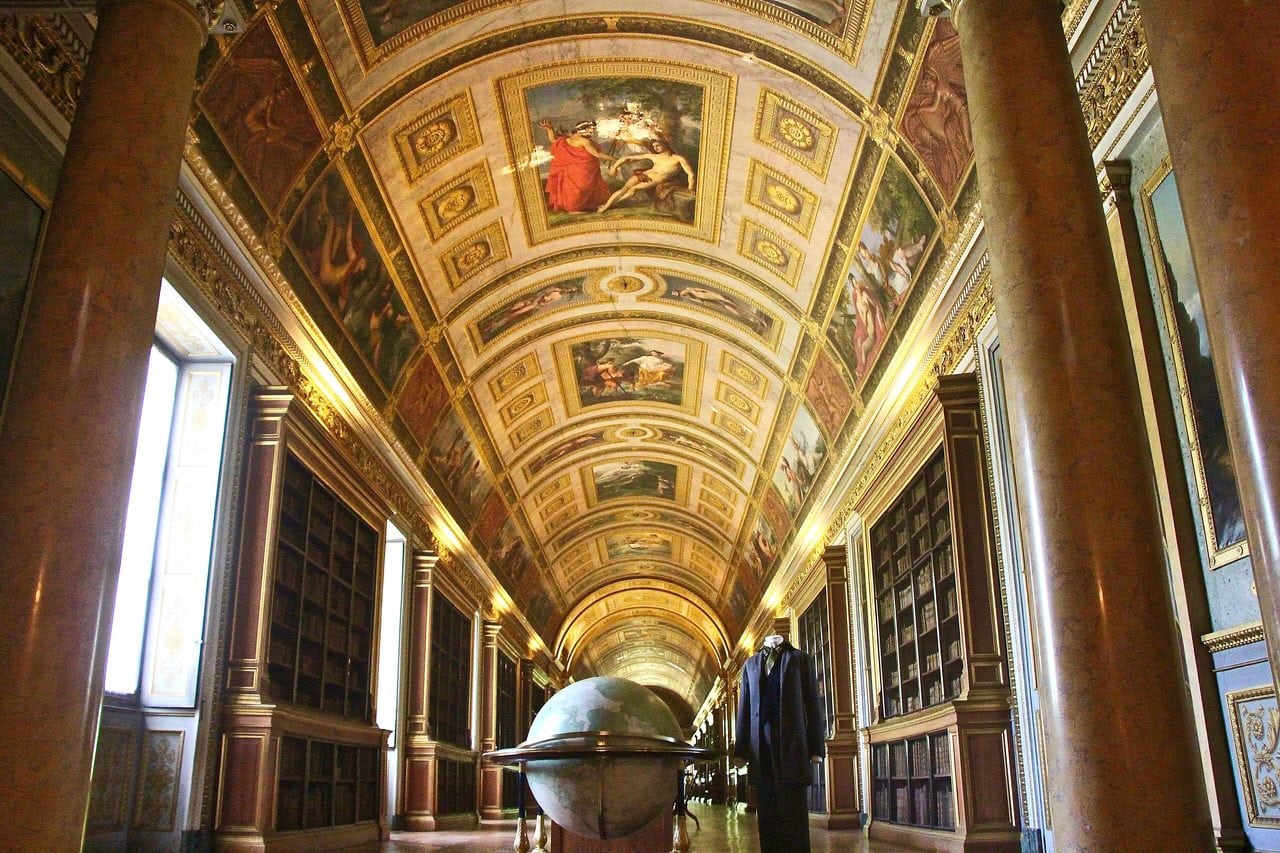
A second great phase belonged to Henri IV, the first Bourbon king, who loved Fontainebleau and enlarged it on a vast scale after 1600. Working with his queen, Marie de’ Medici, he transformed the palace in barely a decade. He laid out new courtyards and service ranges, including the Cour des Offices for the royal household; drove a long gallery dedicated to the goddess Diana along the palace’s flank, later rebuilt as its library; and stocked the pond below the buildings, medieval in origin and still mirroring the south façade, with the carp that gave it its name. A fresh generation of Flemish and French painters, among them Ambroise Dubois, Toussaint Dubreuil, and Martin Fréminet, produced the work now called the Second School of Fontainebleau. Fréminet’s vault crowns the Chapel of the Trinity, where royal weddings were later celebrated and where the future Napoleon III was baptized in 1810. Henri IV even built a court for jeu de paume, the royal tennis, thought to be the oldest of the few still in play in France. By the end of his reign the palace had sprawled into a maze of courts and galleries that led one English visitor to call it “a host of palaces.”
The Bourbons and the horseshoe staircase
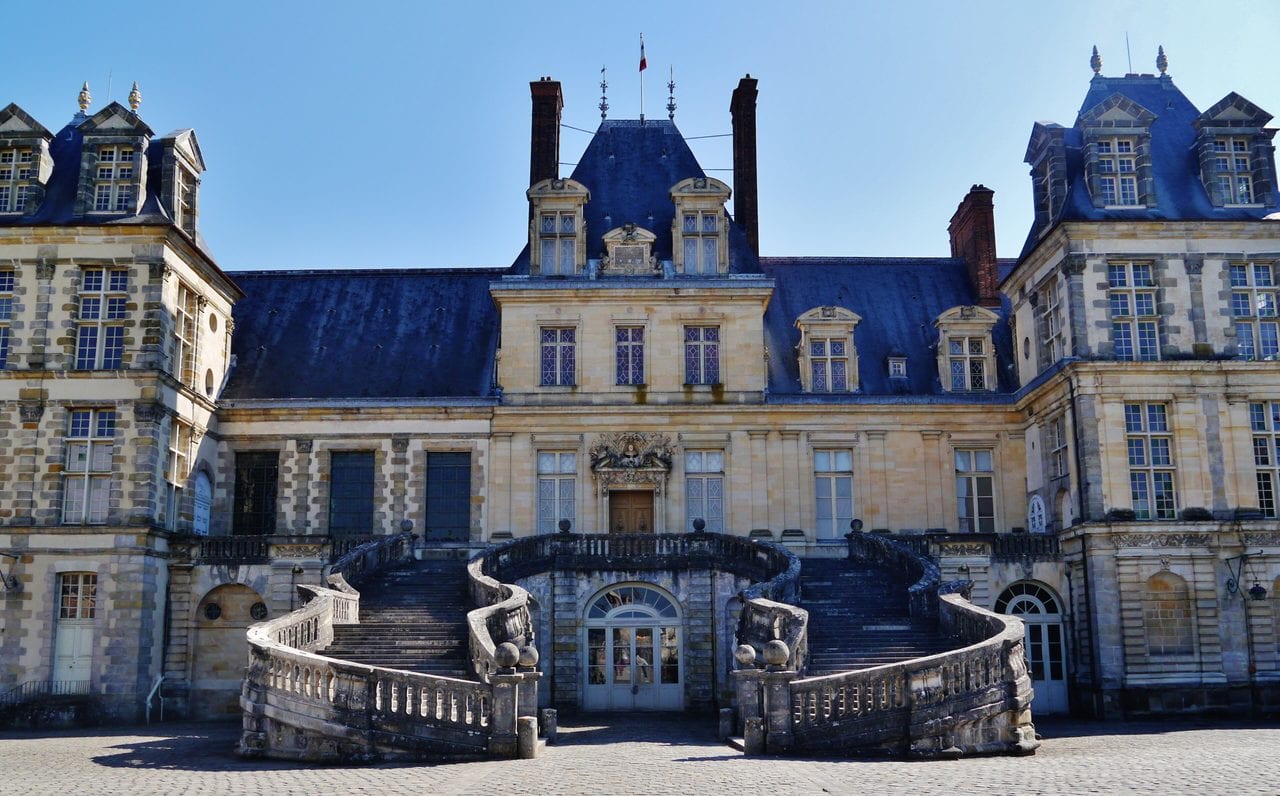
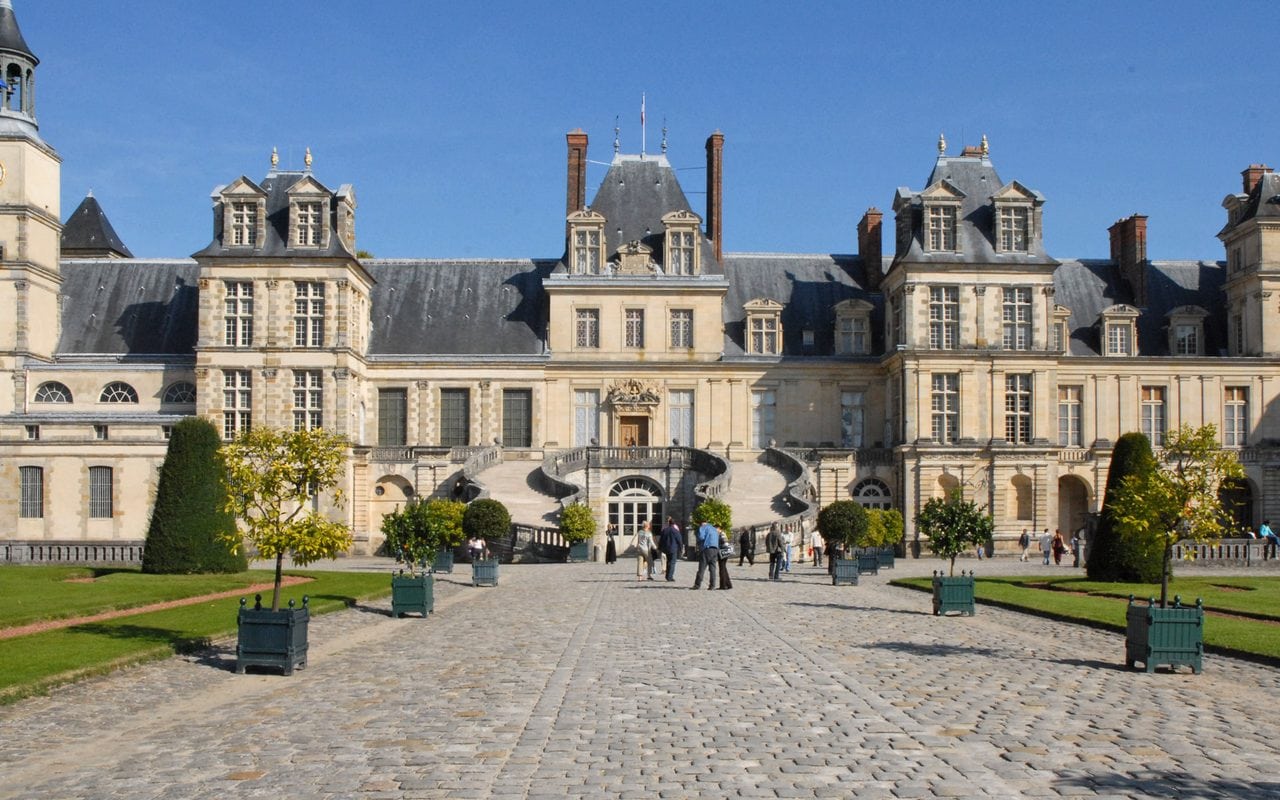
Louis XIII left Fontainebleau its single most famous gesture. Between 1632 and 1634 the architect Jean Androuet du Cerceau built the horseshoe staircase, the Escalier en fer-à-cheval, for Louis XIII, its two great curving flights sweeping down into the Cour du Cheval Blanc. It replaced an earlier staircase of similar form raised under Henri II to designs by Philibert de l’Orme. Each arm carries its steps to a central landing, and the whole is wide and high enough for a carriage to pass beneath. Du Cerceau wrapped a piece of theater around a practical problem, turning the awkward business of reaching a first-floor doorway into a ceremonial descent. It is the image most people carry away from the palace, and it would soon become the stage for the most theatrical moment in its history.
The Bourbon kings treated Fontainebleau as a fall residence, coming each year for the hunting season with the full machinery of the court. Louis XIV, who poured his energy and treasury into the Palace of Versailles, still held court here, and it was at Fontainebleau, on October 18, 1685, that he signed the edict revoking the Edict of Nantes and stripping French Protestants of the religious freedom Henri IV had granted them in 1598. Urged on by his devout second wife, Madame de Maintenon, the king set his name to a decree that drove hundreds of thousands of Huguenots into exile across Protestant Europe and the American colonies. A palace built and adorned by Henri IV had thus given its name to the act that undid his greatest law.
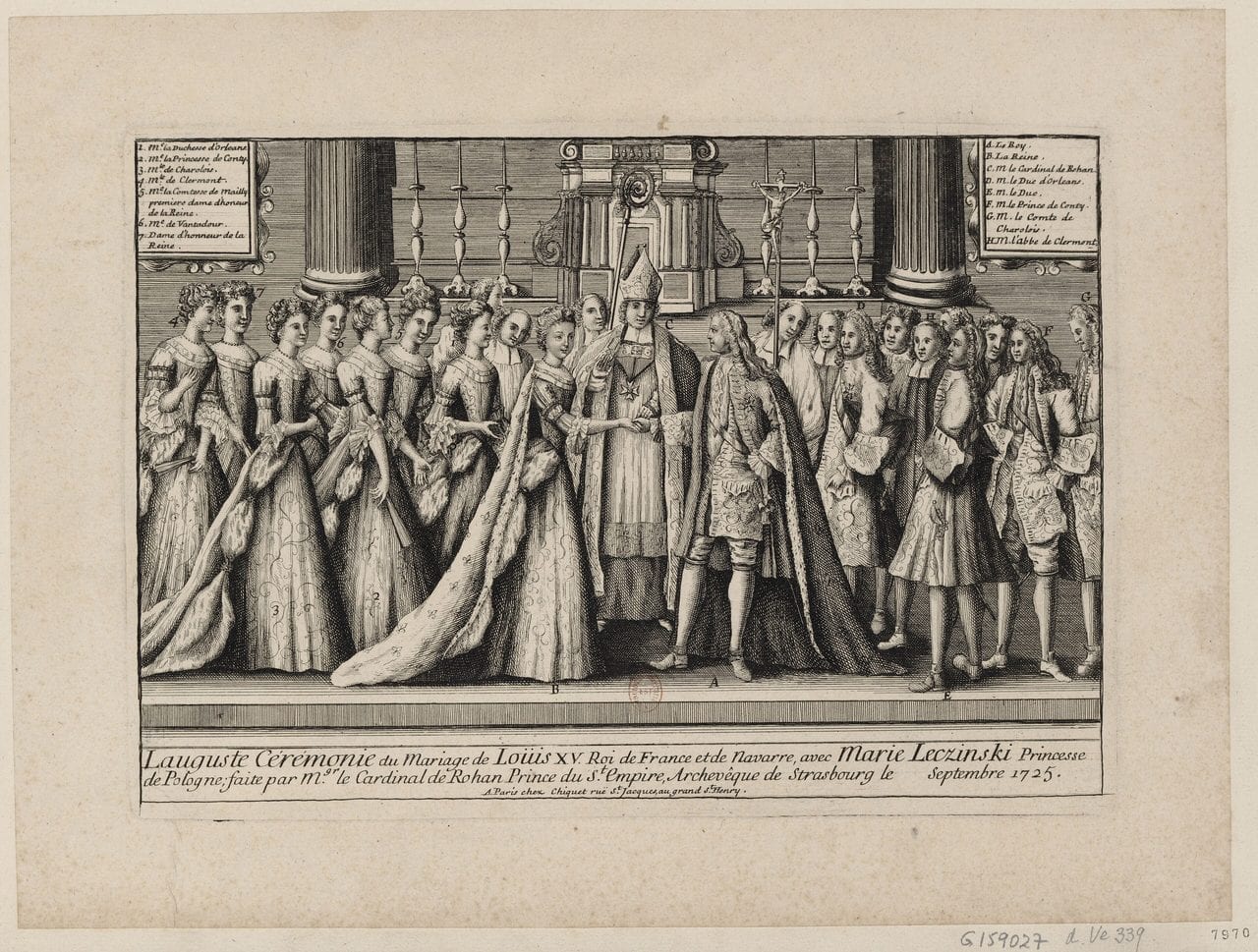
Louis XV and Louis XVI kept up the seasonal pattern, modernizing apartments and carving out intimate private rooms behind the state ones; Marie-Antoinette’s Turkish boudoir, an exotic confection of the 1770s, survives among them. Then the Revolution emptied the place. Its furniture was sold at auction, its collections scattered, and for a decade the house of the kings stood stripped and silent.
Napoleon: the house restored, the empire lost
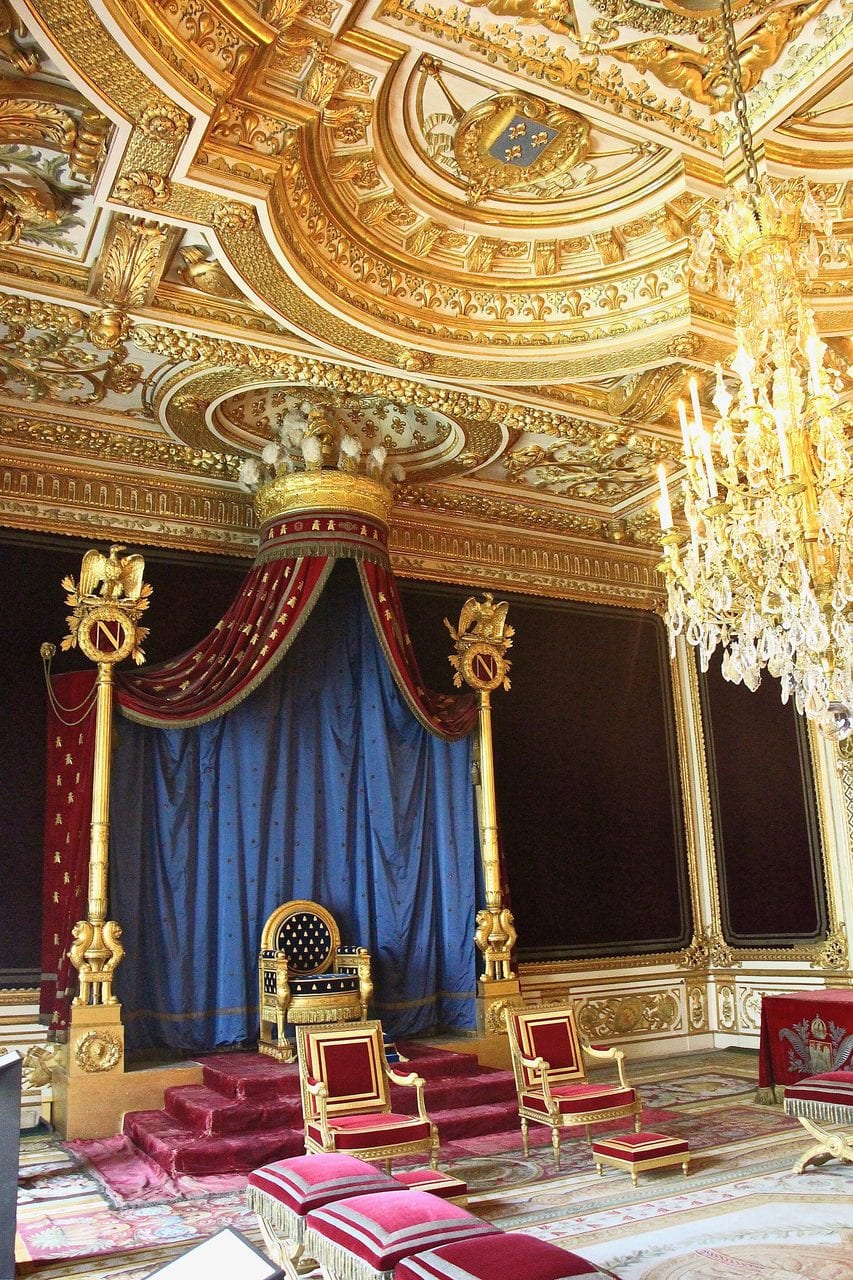
It was Napoleon who brought Fontainebleau back to life. Drawn to a palace that lent his new empire the legitimacy of older dynasties, he had it refurnished from 1804, in part so he could receive Pope Pius VII there on the eve of the coronation that would make him Emperor of the French. In 1808 he installed a Throne Room in the former royal bedchamber, the only throne room of the Napoleonic era in France still standing in its original place. Older kings had ruled from the palace without one; the new emperor wanted the symbol, and set it at the building’s heart. In the years that followed he held that same pope at Fontainebleau as a near-prisoner and wrung from him the short-lived Concordat signed there in 1813. The palace had become a working seat of empire, a place where the emperor entertained, deliberated, and decided.
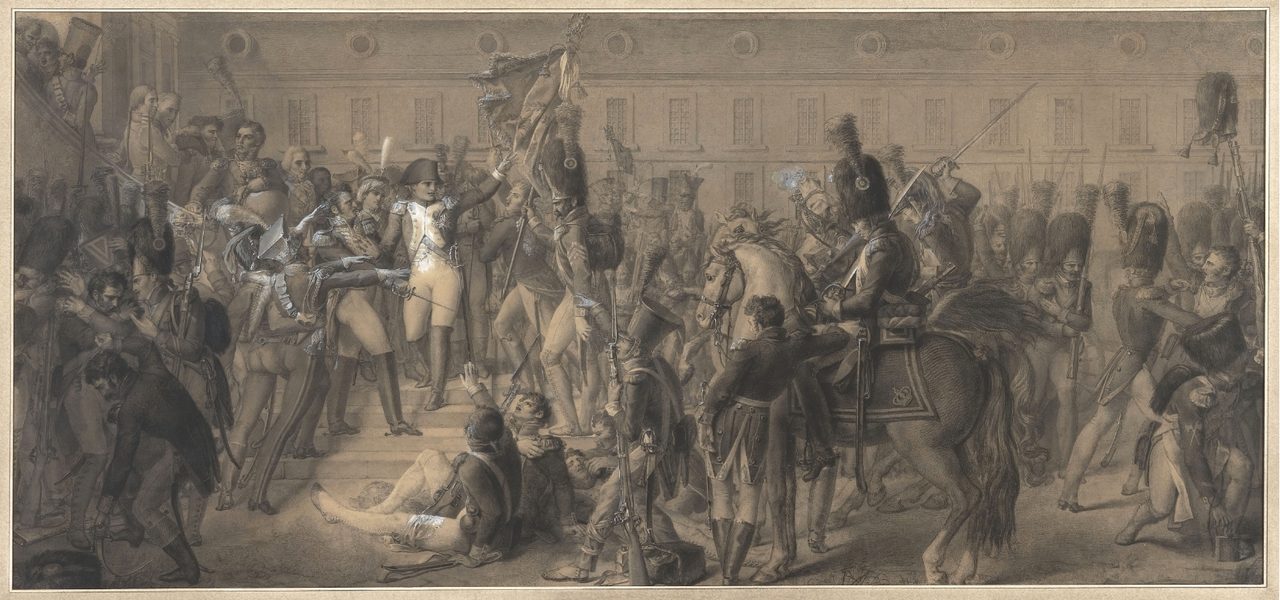
It also witnessed the empire’s collapse. With Paris fallen on March 31, 1814, and the allied armies closing in, Napoleon waited at Fontainebleau through what became known as the twenty days, pressed by his own marshals to give up the throne. His army was spent, several of his commanders had gone over to the enemy, and the Senate in Paris had already voted him deposed. He tried first to abdicate in favor of his infant son, then surrendered unconditionally, and the Treaty of Fontainebleau, signed on April 11, sent him into exile on the island of Elba. On the night of April 12 he is said to have tried to poison himself and survived. On April 20, 1814, before he left, he came down the horseshoe staircase into the Cour du Cheval Blanc, where his Old Guard stood drawn up, and gave them a farewell that passed into legend. “Soldiers of my Old Guard, I bid you farewell,” he began, before kissing the eagle standard and turning away. From that day the courtyard has been called the Cour des Adieux, the Court of Farewells. Napoleon saw Fontainebleau only once more, for a few hours in March 1815 on his march back to Paris for the Hundred Days, and he carried a snuffbox painted with a view of the palace into his final exile. The house he called “the true home of kings” had become the place where his reign ended.
From imperial residence to national museum
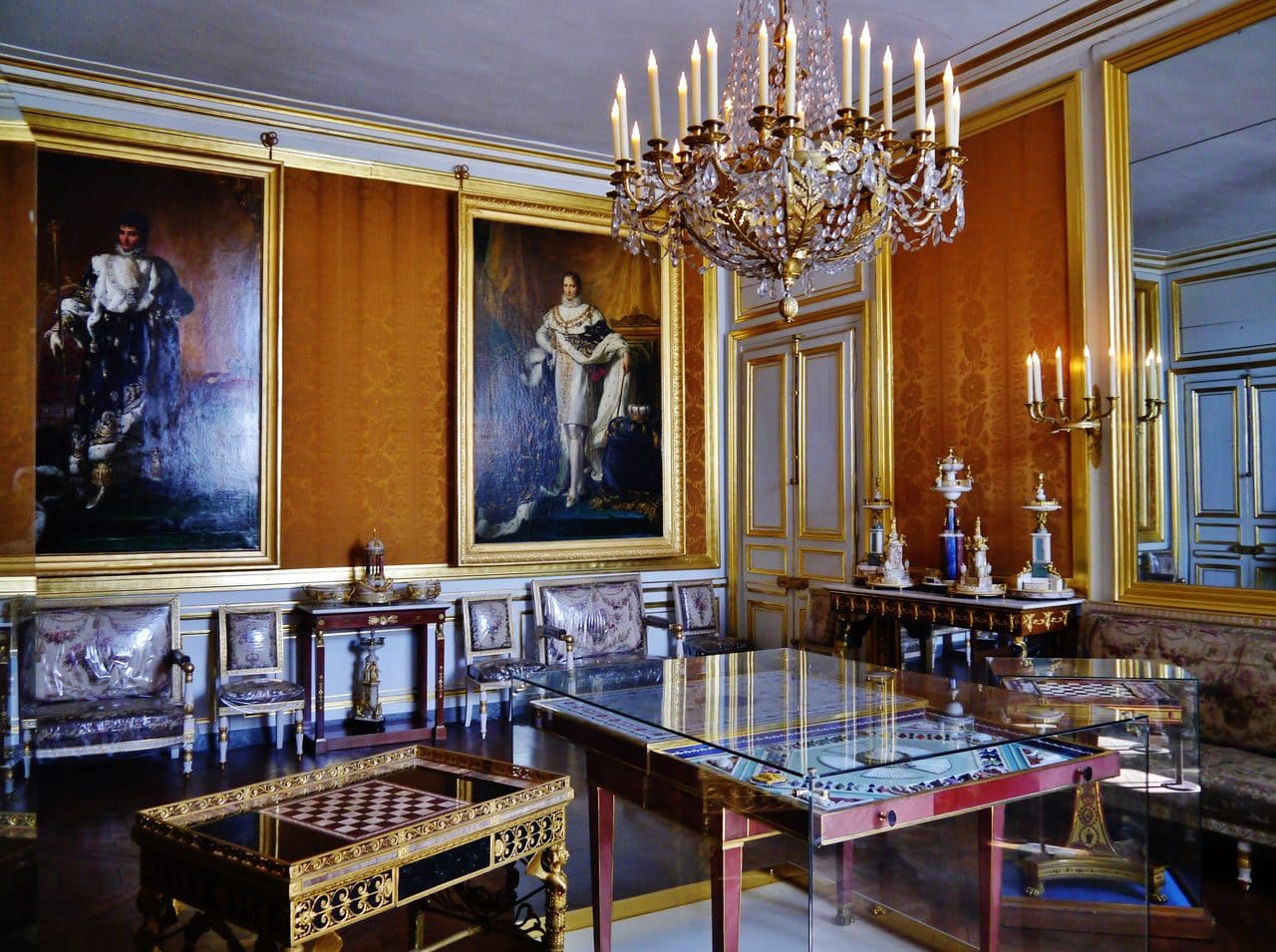
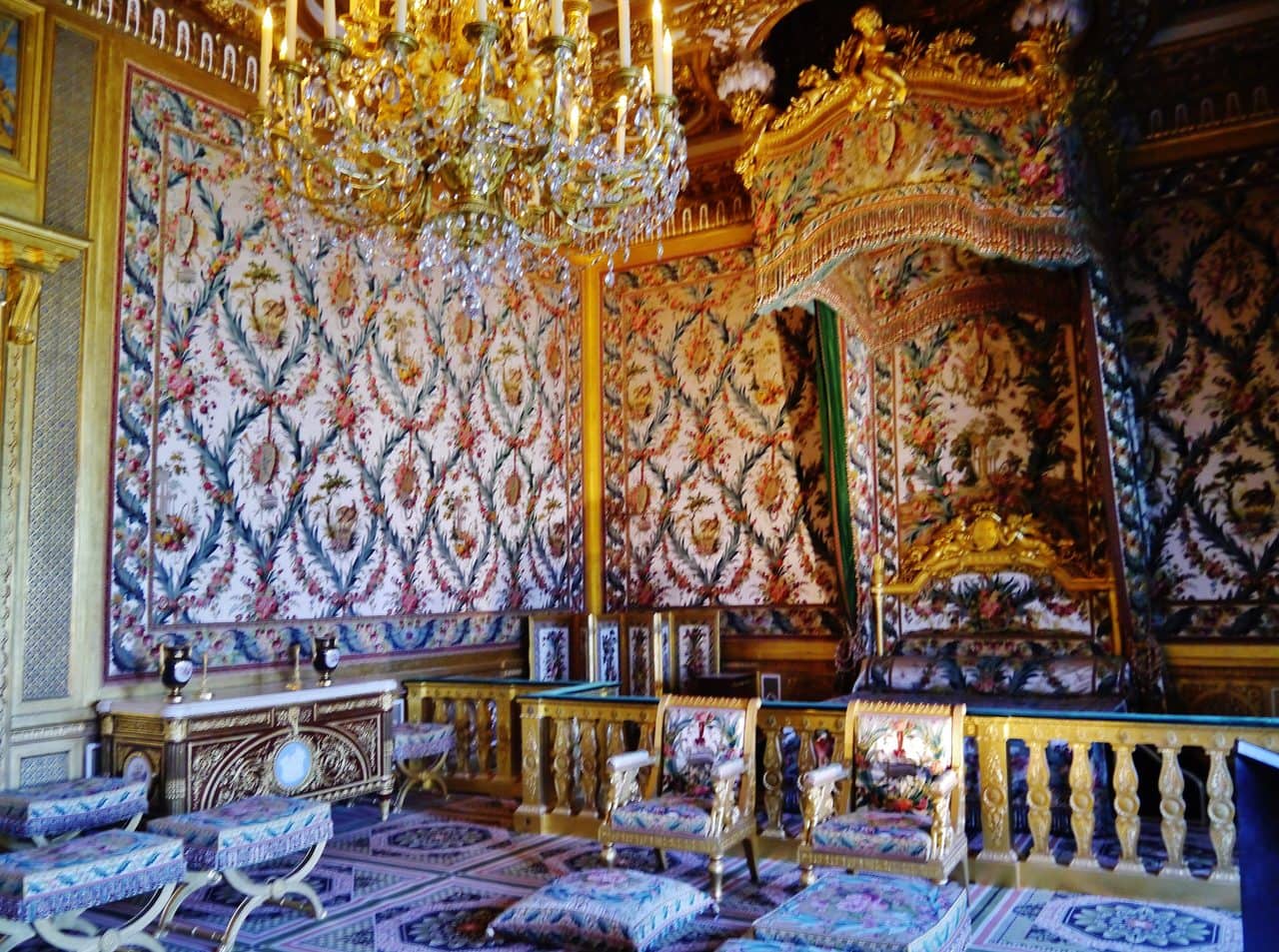
The palace had one last residential chapter. Napoleon III and the Empress Eugénie made Fontainebleau a favorite retreat of the Second Empire, settling in with the court each fall. They added the comforts of their age: an imperial theater, inaugurated in 1857 and echoing the opera house at Versailles, and Eugénie’s Chinese Museum of 1863, four ground-floor rooms hung with lacquer and crowded with some eight hundred objects from East Asia, about three hundred of them taken from the Summer Palace in Beijing in 1860 and others presented by a Siamese embassy received in the ballroom in 1861. Louis-Philippe, in the decades before, had paid for sweeping restorations of the older interiors, so that by mid-century the palace held a near-continuous record of French taste. Few European palaces preserve so unbroken a sequence of interiors, one room opening into the next across three hundred years of changing fashion.
When the Second Empire fell in 1870 and the imperial couple went into exile, seven centuries of sovereign life at Fontainebleau came to an end, and for a time the buildings served other purposes, housing military schools among them. What the monarchs left behind, the Republic kept. The palace became a national museum in 1927, its rooms preserved across every style from the Renaissance to the Second Empire, a continuity that makes it one of the most completely furnished of the French royal châteaux. In 1981 it joined the UNESCO World Heritage List as the “Palace and Park of Fontainebleau,” recognized for an architecture and decoration that shaped European art for three centuries.
The gardens, the park, and the forest
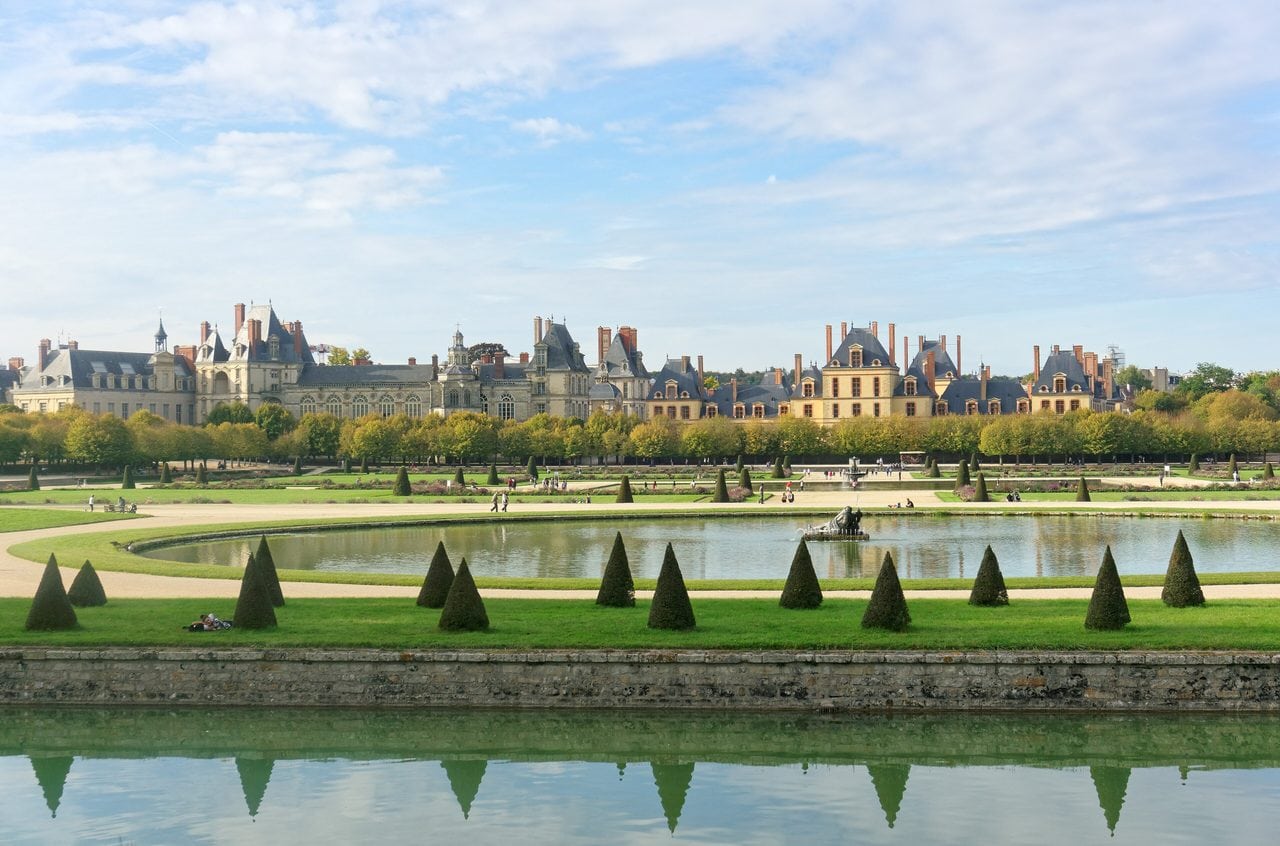
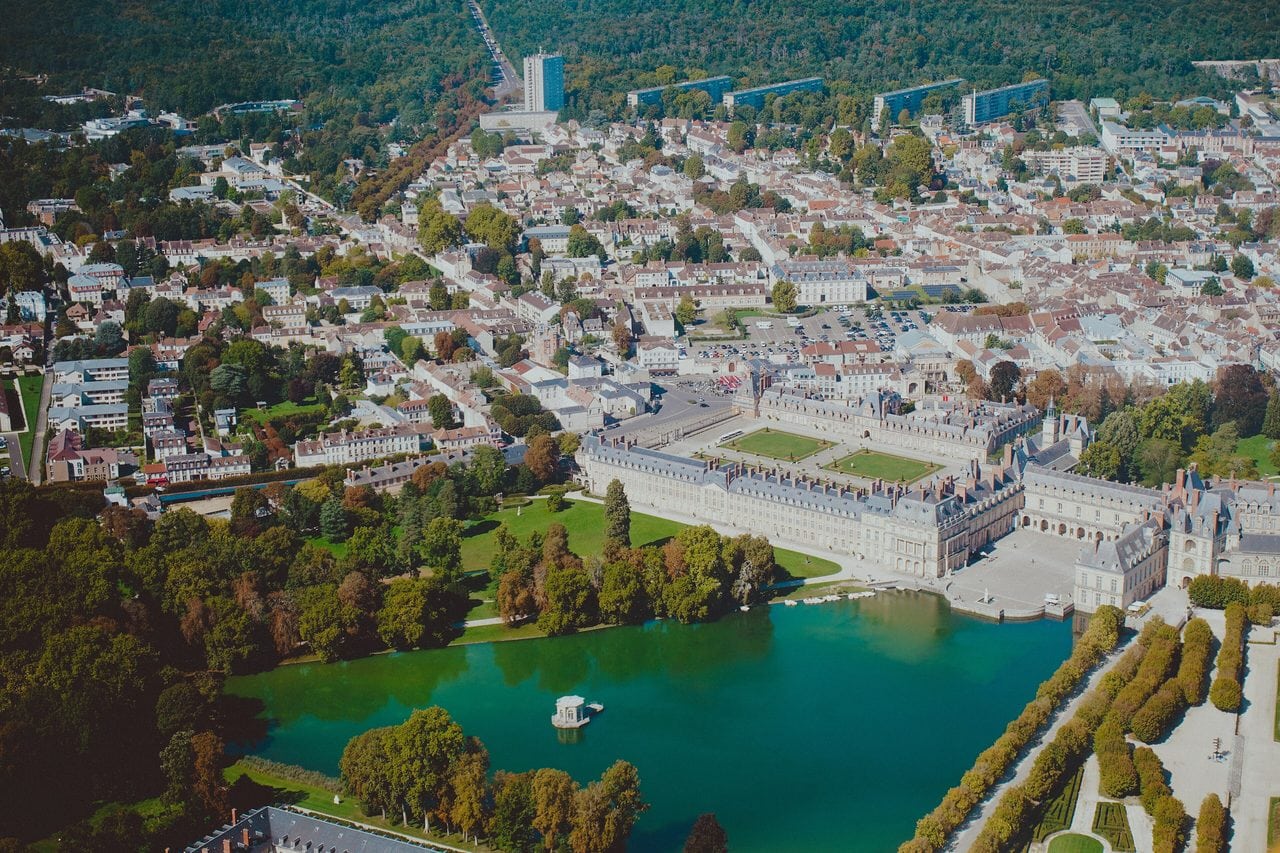
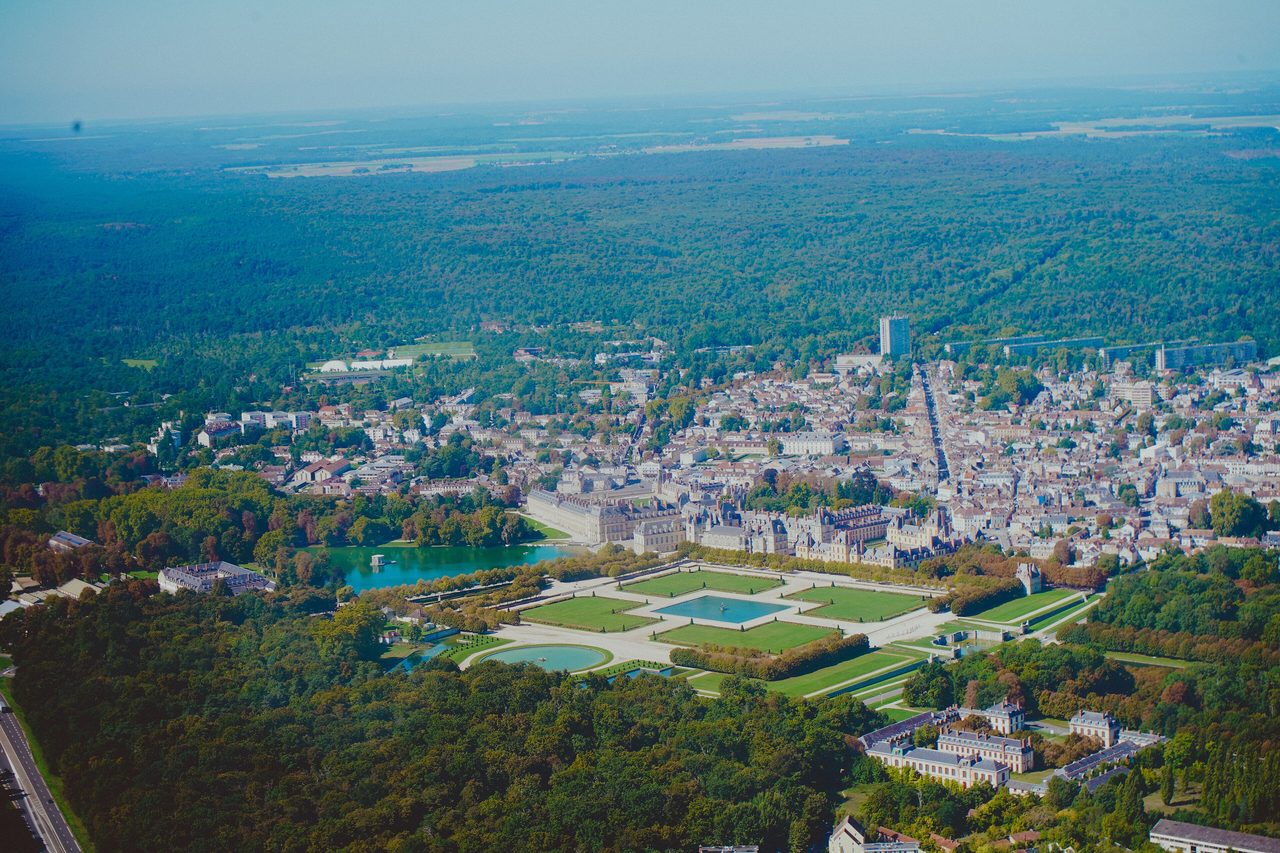
Fontainebleau’s grounds record the same long accumulation as its rooms. André Le Nôtre, the gardener of Versailles, laid out the Grand Parterre between 1660 and 1664 for Louis XIV, a vast expanse of clipped symmetry often called the largest formal garden in Europe. To its east the Carp Pond, medieval in origin and stocked since Henri IV’s day, carries a small octagonal pavilion on an island reachable only by boat; visitors can still row across it in summer. Napoleon added the rambling English Garden, with its artificial stream and groves of tall trees, and the older Garden of Diana, first planted under François I, was reshaped in the nineteenth century around its bronze fountain. Each garden answers a different age, the formal parterre of Louis XIV giving way to the looser, picturesque taste that Napoleon and his heirs preferred. Near the main entrance survives the Grotte des Pins, a rusticated grotto left from the earliest Renaissance works.
Beyond the walls lies the Forest of Fontainebleau, a vast spread of oak, pine, and weathered sandstone that first brought the kings here to hunt. In the nineteenth century the same forest drew a different court. The painters of the Barbizon school settled at its edge to work directly from nature, and their landscapes helped clear the path toward Impressionism. Today the boulders those painters admired draw climbers from across Europe, and the old hunting trails carry walkers and cyclists through one of the largest forests near Paris. The forest that made the palace possible became, in the end, a subject and a destination in its own right.
Visiting the Château de Fontainebleau in 2026
The Château de Fontainebleau is open every day except Tuesdays, along with January 1, May 1, and December 25. Hours run from 9:30 a.m. to 5:00 p.m. between October and March, with last admission at 4:15 p.m., and to 6:00 p.m. from April through September, with last admission at 5:15 p.m. The park and gardens are open free of charge year-round.
A standard entry ticket, covering the Grand Apartments and the Napoleon I Museum, costs €14 for adults as of early 2026; admission is free for visitors under twenty-six who reside in the European Union, and free for everyone on the first Sunday of most months. Guided visits to areas otherwise closed, including the Petits Appartements and the imperial theater, are sold separately, and multimedia tablets lead visitors through the main rooms in several languages. A combined ticket pairs Fontainebleau with the nearby château of Vaux-le-Vicomte, the 1661 house whose splendor first stirred Louis XIV to outdo it at Versailles. Prices and hours change, so confirm the current schedule on the official site before you travel.
Fontainebleau makes an easy day trip from Paris. Direct trains from the Gare de Lyon reach Fontainebleau-Avon station in about forty minutes, where a local bus runs to the château gate. Allow at least half a day for the apartments and the two museums, and a full day if you mean to walk the Grand Parterre, row on the Carp Pond, or lose an afternoon in the forest. The Galerie François I, the Salle de Bal, the Throne Room, and Eugénie’s Chinese Museum reward unhurried looking.
For an overnight stay in a genuine château, the moated Château de Bourron sits about seven kilometers away, one of the stays in our guide to Castle Hotels Near Paris.
To make the most of a visit, a range of guided tours and skip-the-line tickets for the Château de Fontainebleau can be booked in advance, and travelers who would rather stay overnight beside the forest can compare hotels in the town of Fontainebleau.
Some links on this page are affiliate links, which means StoneKeep Atlas may earn a small commission, at no extra cost to you, if you book through them.
More Views of Fontainebleau
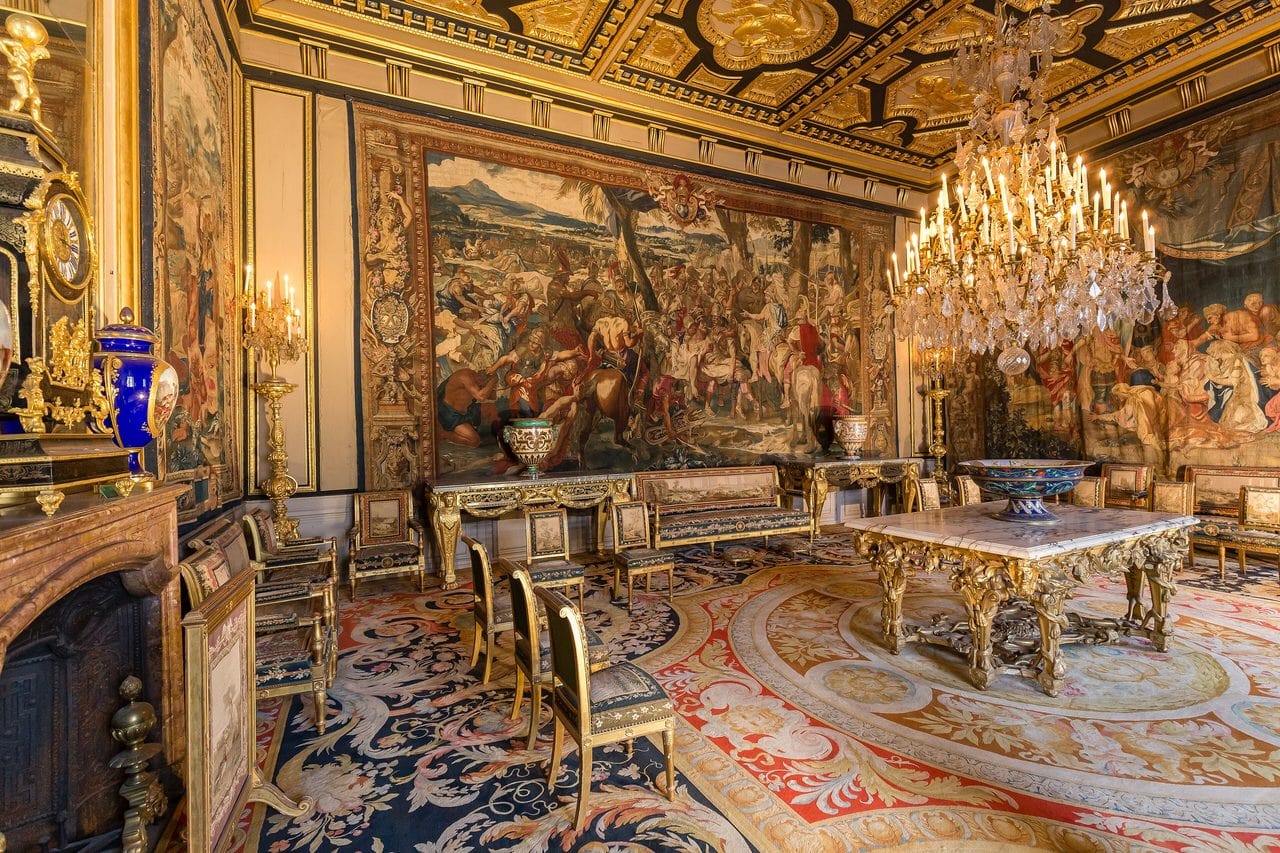
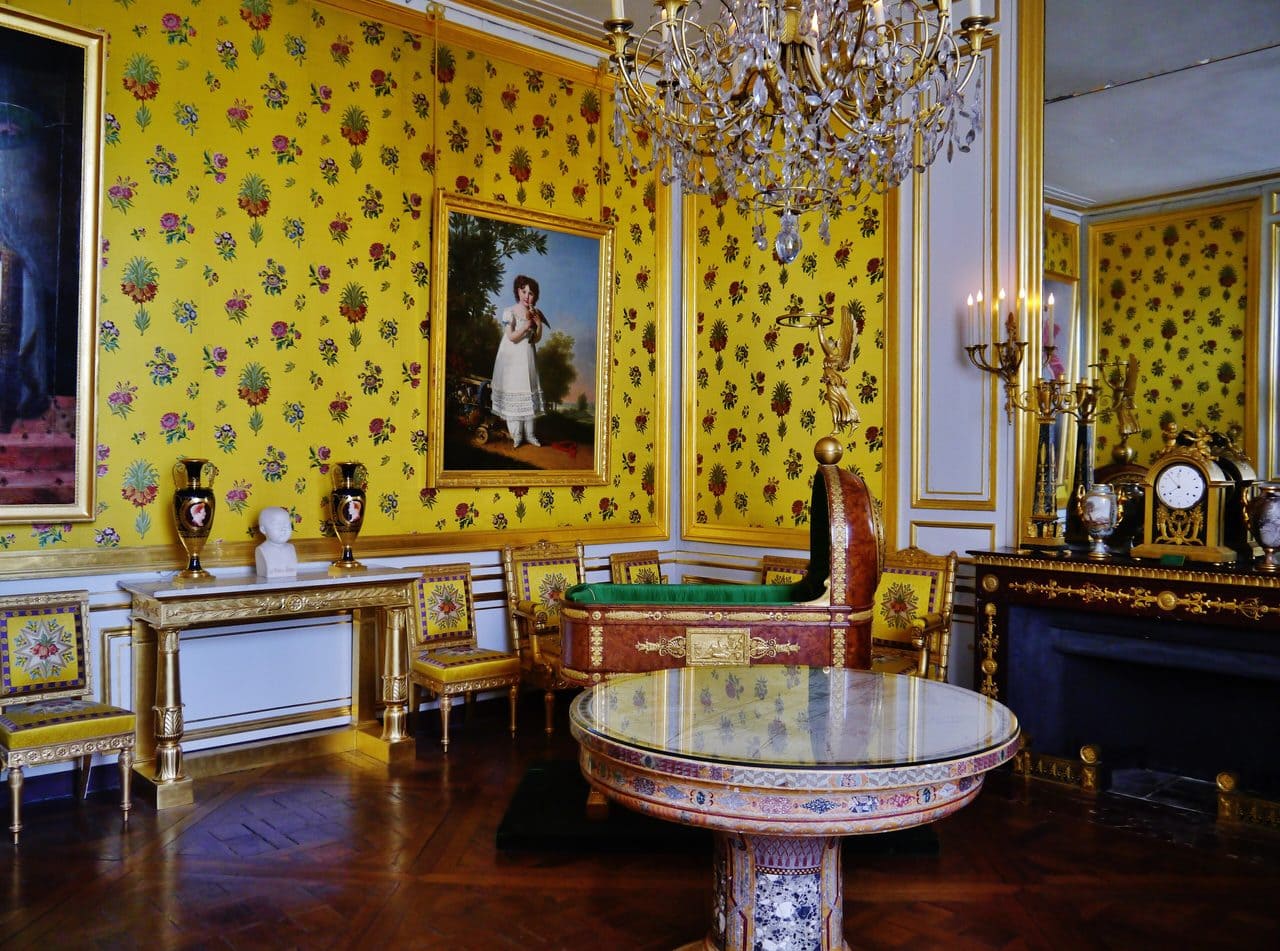
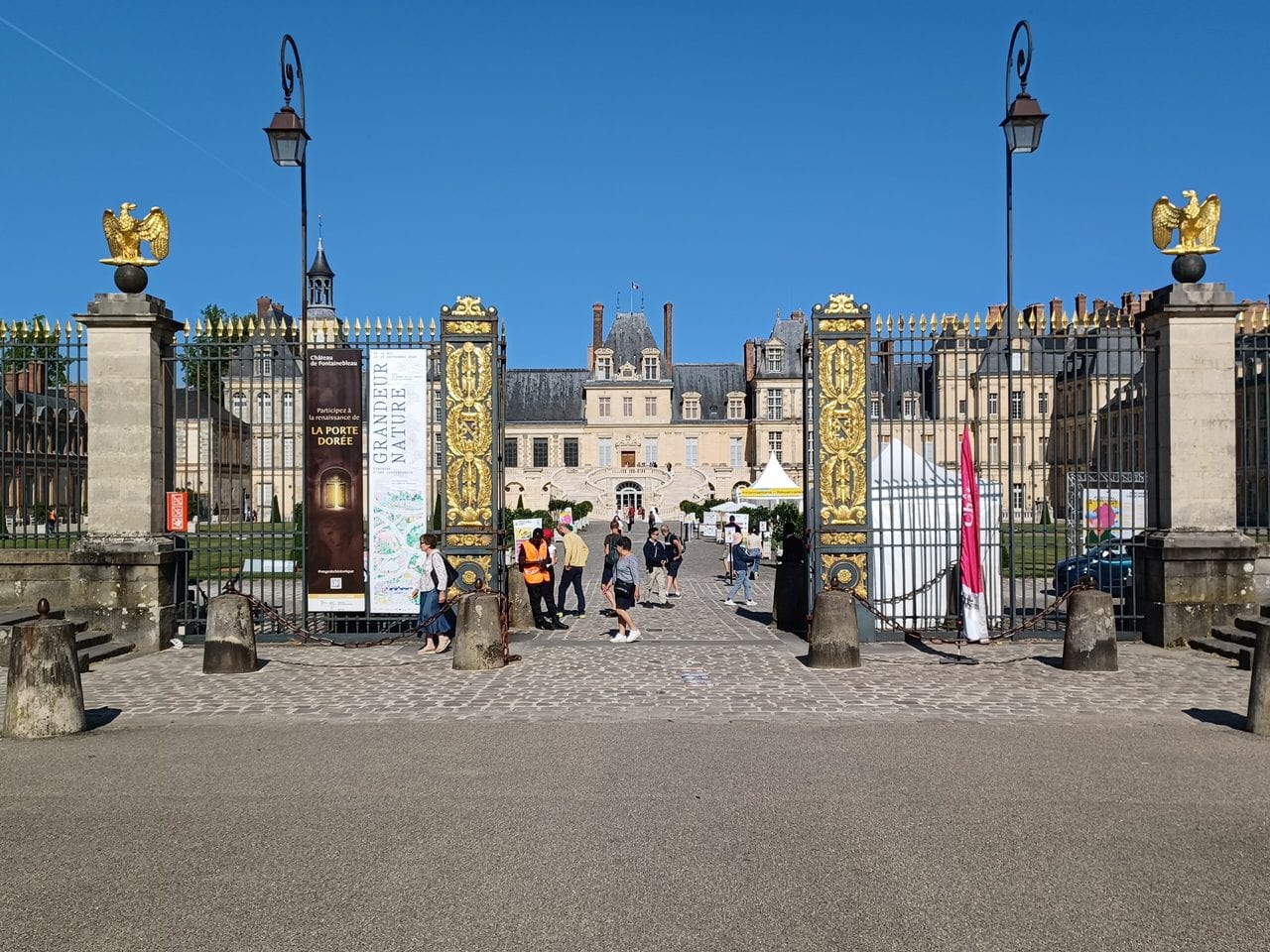
A few more views of the palace, its courtyards, and its grounds.
Beyond the Château de Fontainebleau
Fontainebleau is best understood next to its great rival in the same region. The Palace of Versailles, an hour to the west, is the opposite kind of monument: the total work of a single will, Louis XIV’s, built to overwhelm. Fontainebleau is the older idea of a royal house, shaped by accretion rather than command, and the comparison sharpens both. For the Renaissance roots of that idea, the Châteaux of the Loire Valley trace the same François I impulse that remade Fontainebleau, from the Château de Chambord to the Château de Blois. And for the artist whose path through France runs straight to these walls, where the Mona Lisa once hung, see Leonardo in France. And for the medieval root of that royal power in the same region, the Château de Vincennes is the fortress-capital the monarchy used long before it learned to build pleasure palaces. And for the other palace Napoleon made his own, the Château de Compiègne carries the imperial story north into the Oise. It also takes its place among the royal residences of the Île-de-France, the great seats of power within a day of Paris.
Conclusion
No other French palace holds so many centuries inside one set of walls. A medieval keep, a Renaissance gallery, a Bourbon staircase, a Napoleonic throne room, and an empress’s cabinet of Eastern treasures all share the Château de Fontainebleau, each left by a ruler who chose to add rather than replace. That is what Napoleon meant by the house of the centuries, and it is why the palace can feel less like a single monument than like French history itself, kept under one roof. Versailles dazzles; Fontainebleau remembers.
Principal Sources
- Britannica, “Mona Lisa,” on the painting’s acquisition by François I and its place in the French royal collection.
- Château de Fontainebleau, official site (chateaudefontainebleau.fr), consulted June 2026, for the medieval and Napoleonic chronologies, the courtyards and gardens, room and collection histories, and current visitor information.
- Fondation Napoléon (napoleon.org), “Napoleon’s adieux to the Old Guard at Fontainebleau, 20 April 1814,” for the abdication chronology and the farewell in the Cour du Cheval Blanc.
- Musée protestant, “The Edict of Fontainebleau or the Revocation (1685),” for Louis XIV’s revocation of the Edict of Nantes.
- Smarthistory, “The Gallery of Francis I at Fontainebleau (and French Mannerism),” for the Galerie François I and the First School of Fontainebleau.
- UNESCO World Heritage Centre, “Palace and Park of Fontainebleau,” for the 1981 inscription and statement of value.
Image credits. Main facade: Eric Prouzet, via Pexels; Chapel of Saint-Saturnin: Rémih, CC BY-SA 4.0, via Wikimedia Commons; Galerie François I (two views): Zairon and Frédéric Neupont, CC BY-SA 4.0, via Wikimedia Commons; Salle de Bal chimneypiece and ballroom: Thomas1313 and Zairon, CC BY-SA 4.0, via Wikimedia Commons; Chapel of the Trinity vault: Zairon, CC BY-SA 4.0, via Wikimedia Commons; Horseshoe staircase: Zairon, CC BY-SA 4.0, via Wikimedia Commons; Marriage of Louis XV (1725 engraving): unknown engraver, public domain, via Wikimedia Commons; Throne Room: Thomas1313, CC BY-SA 4.0, via Wikimedia Commons; Napoleon’s farewell, 1814: François Aimé Louis Dumoulin, public domain, via Wikimedia Commons; Napoleon I Museum (two rooms): Zairon, CC BY-SA 4.0, via Wikimedia Commons; Empress’s bedchamber: Zairon, CC BY-SA 4.0, via Wikimedia Commons; Gros Salon: Davidh820, CC BY-SA 4.0, via Wikimedia Commons; Galerie de Diane: Thomas1313, CC BY-SA 4.0, via Wikimedia Commons; Grand Parterre: Jvillafruela, CC BY-SA 4.0, via Wikimedia Commons; Cour du Cheval Blanc: Jean-Pierre Dalbéra, CC BY 2.0, via Wikimedia Commons; entrance gates: Thomas1313, CC BY-SA 4.0, via Wikimedia Commons; Carp Pond reflection: Stefan K, via Unsplash; Carp Pond from the air and aerial view: Nyyynon, CC BY-SA 4.0, via Wikimedia Commons. Freely licensed images are resized to fit; otherwise unaltered.