
The Castle Records Dataset
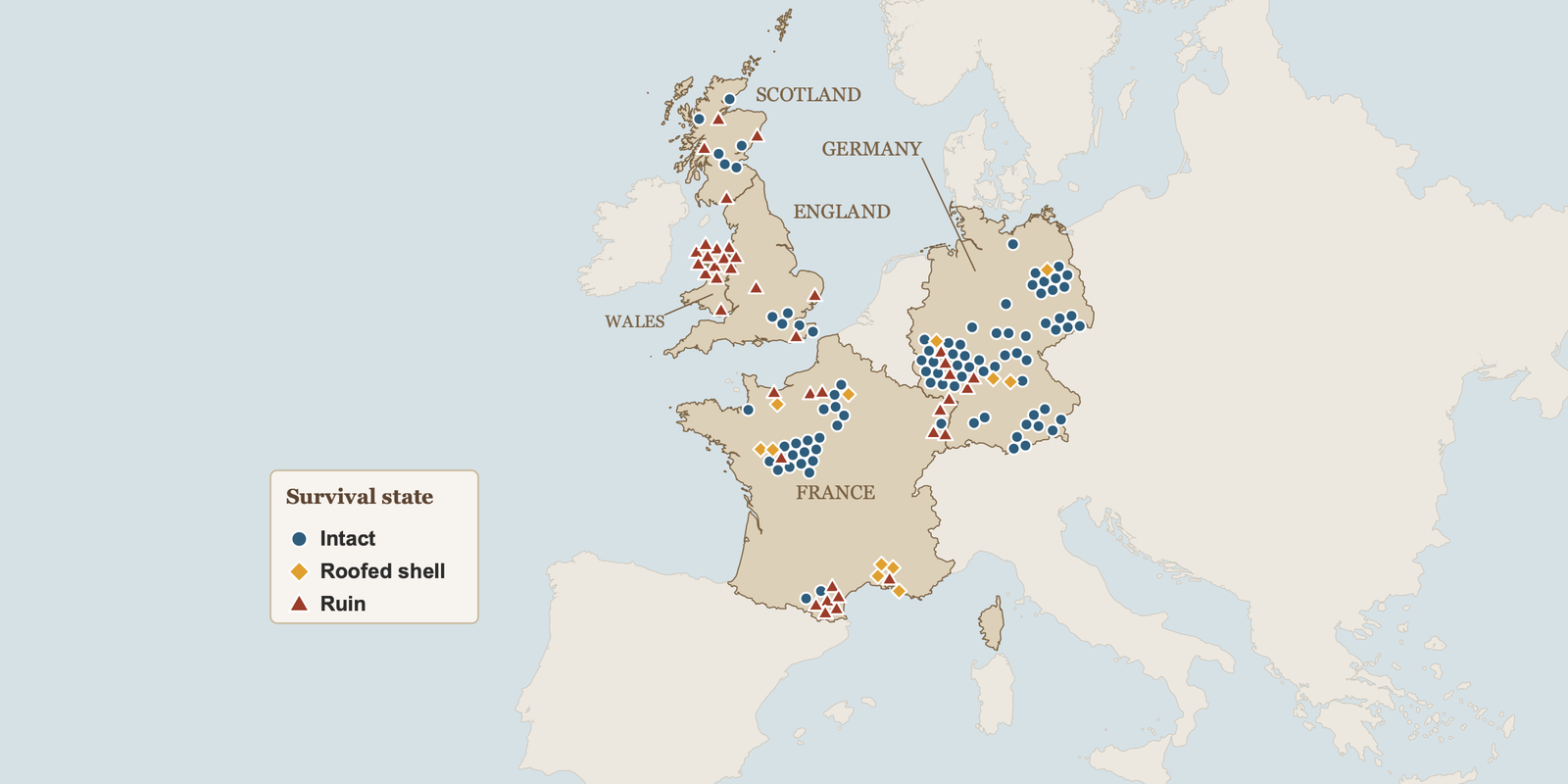
The Castle Records Dataset holds StoneKeep Atlas’s own records of 141 castles, palaces and fortresses in England, Scotland, Wales, France and Germany: those it has written guides about, and six with a record page ahead of a full guide. It is not a census of any country’s castles. Each record sets down what a castle was built to do, when it was built and on what evidence, how much of it stands, how much of that was renewed, how a visitor gets inside, who looks after it, and where it appears in the heritage registers.
The records are worth citing for their provenance. Every block of values names the page it was read on and the date it was read, and every designation number (the number of a castle’s entry in a statutory heritage list or register) was read in the register that issued it. A reader who doubts a value can open its source and check it.
This is version 1.2.0, released on 21 November 2026. Our own values are published under the Creative Commons Attribution 4.0 license, while identifiers taken from heritage registers keep each register’s terms, as set out below. To browse the same castles on a map and filter them, use the castle directory.
Download the Records
Version 1.2.0 comes as three data files, generated from the same records on the same day.
Files and Formats
| File | Format | What it holds |
|---|---|---|
| castle-records-1.2.0.csv | CSV | One row per castle record, 141 rows, with vocabulary terms as short codes |
| castle-records-1.2.0.json | JSON | The same 141 records, with identifiers as lists, plus the release details, the list of columns with a definition of each, and the label and definition of every vocabulary term |
| castle-people-1.2.0.csv | CSV | 891 rows linking the castles to the people, families and institutions in their history |
The CSV files open in any spreadsheet. Start from the JSON file if you can, because its dictionary explains every coded value in the other two. Rows run in record order, from SKC-00001 to SKC-00141, and each record links back to the castle’s guide or record page on this site; in the people file, each relation names its castle by record number. The files hold no images, prices or opening hours. This page carries schema.org Dataset markup, the structured data Google’s Dataset Search tool reads.
Preview the Records
The table below is read from this release’s JSON file when the page loads, so it shows exactly what the file holds. Search it, or filter it by country, survival state or access, to check a record before you download. Each name links to that castle’s guide, and the files carry every column the table leaves out.
The preview table needs JavaScript in your browser. The files above open in any spreadsheet.
License and Upstream Terms
Our own values in these records are released under the Creative Commons Attribution 4.0 license (CC BY 4.0). Identifiers and entry names taken from heritage registers remain under each register’s own terms, which the license note names. The split follows from the license itself: its legal code limits the rights it grants to those “… that apply to Your use of the Licensed Material and that the Licensor has authority to license.” The license note gives each source’s attribution line.
| Source | What the records take from it | Terms named in the license note |
|---|---|---|
| Historic England, National Heritage List for England | list entry numbers and names | Historic England’s Open Data Hub terms, with the attribution line they require |
| Cadw | scheduled monument and listed building numbers | Open Government Licence |
| Royal Commission on the Ancient and Historical Monuments of Wales, National Monuments Record of Wales | site numbers, from the record’s layer on Data Map Wales | Open Government Licence 3.0 |
| Historic Environment Scotland | designation numbers and Canmore site numbers | Open Government Licence |
| Ministère de la Culture, Base Mérimée | Mérimée references and entry names | Licence Ouverte 2.0, credited with the date of the Ministry’s last update |
| Bayerisches Landesamt für Denkmalpflege | Bavarian list numbers and names | CC BY-ND, credited “© BLfD”; our CC BY 4.0 does not relicense this material |
| Landesamt für Denkmalpflege Sachsen | Saxon list numbers and names | CC BY-NC-ND, as printed on each list extract; our CC BY 4.0 does not relicense this material |
| Other German state heritage offices and towns | list numbers and names | each list’s own terms; the license note names the offices and towns, and each record names the list and its address |
| EBIDAT, Europäisches Burgeninstitut | links to castle entries | links only; EBIDAT reserves all rights |
| UNESCO World Heritage Centre | World Heritage status and property name | UNESCO’s Terms of Use |
| Wikidata | item identifiers | CC0 |
Other inventories that some records link, among them KuLaDig and two English county Historic Environment Records, are named in the license note as sources. Neither this page nor the note is legal advice.
How to Cite the Records
StoneKeep Atlas. The Castle Records Dataset, version 1.2.0, released 21 November 2026. CC BY 4.0.
https://doi.org/10.5281/zenodo.24413644
The DOI identifies the files of version 1.2.0 as deposited at Zenodo; the same files are on this page. Cite the version you used, since values can change between releases. If your work rests on one castle, give its record number as well (Caerlaverock Castle is SKC-00132), so a reader can find the same row.
What a Record Holds
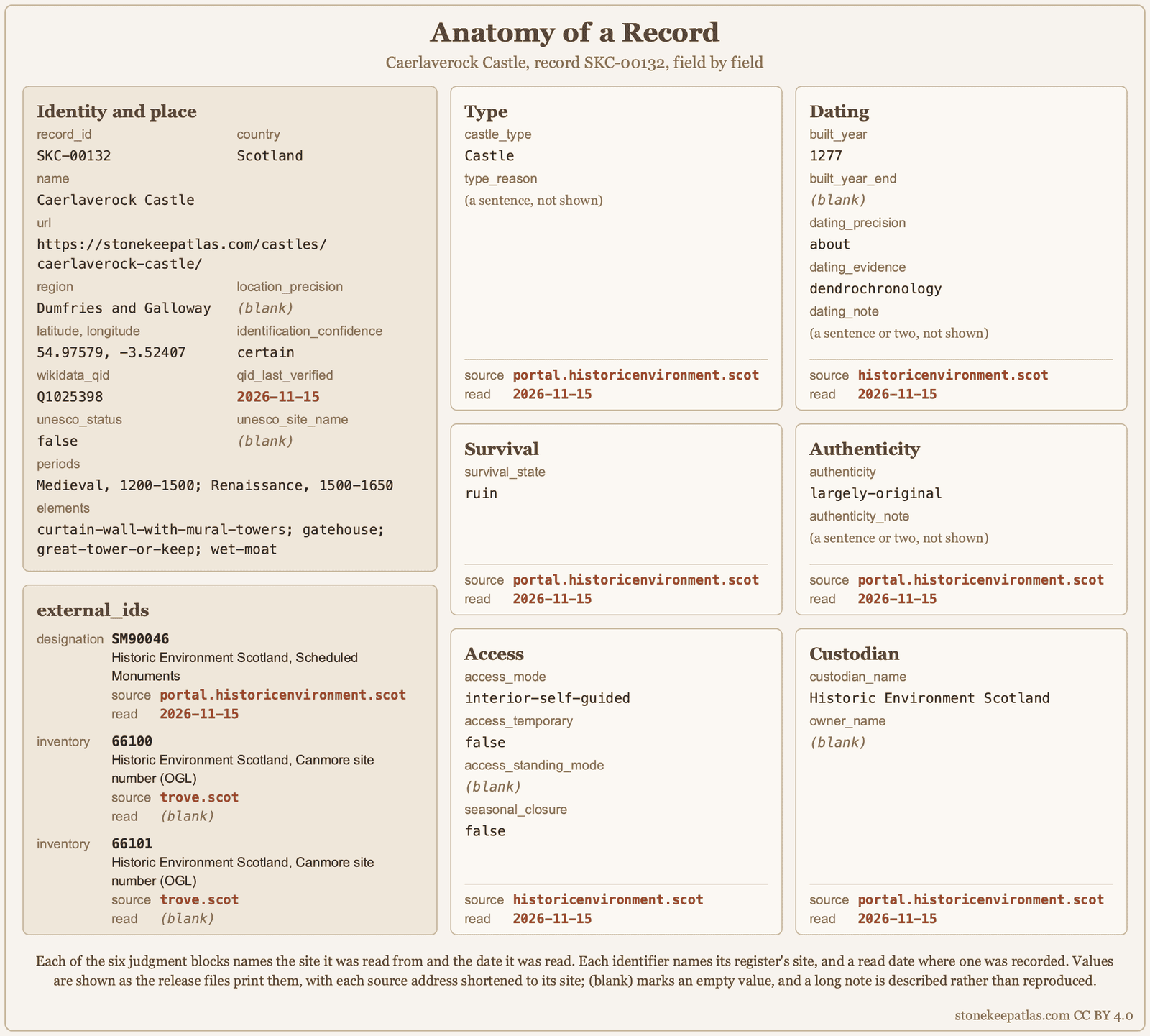
The plate lays out one record, Caerlaverock Castle’s, field by field. It is filed as a castle, begun about 1277, the tree-ring date of its first bridge, and recorded as a ruin whose standing fabric is largely original. Its dating note, not shown on the plate, records an earlier castle of the 1220s a couple of hundred meters to the south-east, abandoned about fifty years later. Visitors can go inside and walk around on their own, Historic Environment Scotland manages the site, and the record carries one scheduled monument number and two Canmore site numbers (Canmore is Historic Environment Scotland’s record of sites, now published on trove.scot). Each of its blocks was read on 15 November 2026. Every other record follows the same pattern, with blanks where a value is not known.
Name, Place and Identifiers
Each record has a record number (SKC followed by five digits), the castle’s English name as its guide gives it, the guide’s address, the country and region, and a latitude and longitude. A confidence value says how securely the site is identified as a castle, palace or fortress; every record in version 1 reads certain. The castle’s Wikidata identifier is stored with the date it was last checked. An identifiers column lists the castle’s entries in outside registers, each marked as a designation, an inventory record or a gazetteer entry (a castle database or scholarly gazetteer), with the register’s name, the number, the address of the entry and, where the entry was read at source, the date it was read. Every designation carries that date; some inventory and gazetteer entries carry none yet.
Type and Period
Each record carries one type (castle, fortress or palace), chosen by what the building was built to do or, for nineteenth-century buildings in castle form, by what the building is called: a Burg is a castle, a Schloss a palace. A short note gives the reason for the type in a sentence. Where the line between a castle and a palace falls, and why it is drawn there, is argued in our comparison of castle, palace and fortress. The many forms a castle can take are set out in our guide to types of castles.
A period column gives the age of what a visitor sees today, in one or two date bands, or three on the four sites whose visible fabric spans three periods, such as “Medieval, 1200-1500” or “Renaissance, 1500-1650”, with a band of its own for nineteenth-century revival building. An elements column lists the principal parts recorded for the castle: a great tower or keep, a German Bergfried, a tower house, a gatehouse, a barbican, concentric defenses, a shield wall, a wet moat or a dry ditch, among others.
Dates and Their Evidence
Each record gives a building year, with an end year where the sources give a span. Each date carries the kind of evidence it rests on: a first written mention, a building record such as accounts or a contract, a chronicle or other narrative source, tree-ring dating, a dated inscription, excavation, the form of the building alone, or a date from the published literature. A date from a first written mention is the year of the document: the castle stood by then, and building may have begun earlier. A precision value says whether the sources give the year itself, an approximate year, a decade or only a century. A dating note explains the date in a sentence or two.
Survival State and Authenticity
EBIDAT, the castle database of the Europäisches Burgeninstitut, records preservation in a single list of states that mixes how much survives with how far it has been reworked (stark historisierend überformt, heavily reshaped in historicist style). These records keep the two questions apart, as survival state and authenticity.
Survival state records how much of a castle stands. It runs from no visible remains, through earthworks and footings, to a ruin, whose walls stand well above their foundations while the main buildings are unroofed. Above a ruin come a roofed shell, which is roofed but has its historic interiors lost or empty, and an intact castle, which is roofed and has interiors that are furnished or in use.
In these records, authenticity means how much of a castle’s standing fabric was renewed, and by what kind of later work. It is not a judgment of authenticity in the sense of the Nara Document on Authenticity, drafted at the Nara Conference on Authenticity (Nara, Japan, 1-6 November 1994), which holds that “it is thus not possible to base judgements of values and authenticity within fixed criteria.” A castle is largely original when most of what stands comes from its own historic building phases, however many, with ordinary repairs. It is restored when a documented campaign renewed significant parts of the surviving fabric, and mixed when substantial original fabric stands beside substantial later rebuilding, which the note names. A historicist rebuilding is a castle largely rebuilt in a revival style in the nineteenth or twentieth century, on or around older remains. A reconstruction is a castle rebuilt to a recorded earlier form after destruction, a threshold close to the Venice Charter’s rule that restoration “must stop at the point where conjecture begins …”. The charter was drawn up at the Second International Congress of Architects and Technicians of Historic Monuments in Venice in 1964 and adopted by ICOMOS in 1965.
Survival state says what stands and whether it is roofed and in use; authenticity says how much of it was renewed, so a castle can be intact and largely rebuilt. Neither value can stand in for the other. Hohenzollern Castle’s record, for one, reads intact for survival and historicist rebuilding for authenticity. The record for Château de Pierrefonds reads roofed shell and historicist rebuilding: its walls stand to their roofs, its medieval interiors are lost, and most of what a visitor sees was rebuilt in a revival style. How ruin, restoration and the protected monument came to be separate ideas is traced in our history of castles.
Access
The access mode records what a visitor could do on the date it was read, for the standard admission to the principal rooms, in the site’s main season. A castle may be open inside to visitors on their own, open inside by guided tour only, visible from outside or from its grounds only, open by arrangement (by appointment, on open days, or for guests and events), or not open to the public. For a ruin, going inside means walking within its walls. A seasonal closure means the operator closes the site, or its principal interior, for two weeks or more every year; a winter of shorter hours is not a closure. Where an operator has closed the site or its principal interior for works or another temporary reason, the record says so in a separate column and, where it is known, gives the castle’s usual mode beside it. The records carry no opening hours, prices or closure dates: for a visit, use the castle’s guide or the operator’s page that the record links to.
Custodian and Owner
A custodian column names the body that manages the site, such as Historic Environment Scotland, a state palace administration, a town or a family. An owner column names the owner where the records hold one, and is left empty on the others.
World Heritage Status
Each record gives the castle’s World Heritage status and, where it has one, the name of the World Heritage property it belongs to. Version 1 does not include UNESCO’s reference numbers for those properties.
People and Their Roles
The second file links each castle to the people, families and institutions in its history, in four roles: the patron a surviving phase was built for, the architect or builder of a phase that stands, the lords who held the castle, and whoever restored or rebuilt it. Each relation gives its years where they are known and, where one was recorded, the page it was read on; most relations with no page were taken from the castle’s guide on this site and have not yet been re-read at a primary source, and the others were read in a printed book that has no web page. Each person, family or institution is given one standard name across the records, and a detail column holds any title, office, branch or other name that a castle’s record gives and the standard name leaves out, including a title held for only part of the relation’s years. A further column gives the entity’s Wikidata identifier, and 702 of the 891 relations in version 1.2.0 carry one. A certainty column says whether a source states the relation as fact or only attributes it. In version 1.2.0, 813 of the 891 relations have not yet been graded, and an empty certainty is shown as “not yet judged”.
How the Records Are Sourced and Checked
Values are read on the highest-ranked source that carries them, in the order set out in our editorial standards: the operator or owning institution first, then the heritage authority and its register, then the academic literature. Wikipedia is never a source.
A Source Page and a Read Date for Each Block
Every block of a record carries the address of the page its values were read on and the date they were read; a designation number was read in the register itself. A block not yet read at source would leave both columns empty; in version 1.2.0 every block of every record has both. The blocks are the type reason, the dating, survival state, authenticity, access and the custodian, and each has its own pair of columns. A reuser can therefore see the age and the source of each block without asking us. The name, country, region, coordinates, periods, elements, owner, identification confidence and World Heritage columns carry no source column of their own.
Designations Read in the Register
Each designation number was looked up in the register that issued it, on the register’s own record or list, and copied from there. A Wikidata item can point the way to a register entry, but no number is taken from Wikidata. Where a register gives an entry no number, the record stores the entry’s name as the register prints it; where the register did not cover the place when it was read, the row says so.
Wikidata Identifiers Matched Exactly
A Wikidata identifier was accepted only on an exact match, and the first result of a search never counted as one; where no label matched exactly, the item was confirmed by hand before it was stored, and the people file’s identifiers follow the same rule. Each record’s Wikidata identifier points to an item whose structured data Wikidata releases under CC0. It joins the record to other datasets that use Wikidata; the values in the record come from the pages named in its source columns.
Pins Compared with the Monument
Each pin was compared with the monument’s own coordinates, and any pin more than 250 meters away was opened on the map and checked. A pin is meant to sit on the castle, never on the town around it. A large site can lie well away from a single reference point while its pin is correctly placed, which is why a distant pin is opened and looked at rather than moved. On the map at the head of this page, symbols that would overlap are drawn apart; the files hold each castle’s own coordinates.
When a Value Is Due to Be Read Again
A value whose read date is more than twelve months old is due to be read again. The prices and hours in a castle’s guide run on a shorter, 180-day cycle. Since the records carry no prices or hours, none of their values is on that shorter clock.
When Sources Disagree
A value is not dropped because a second credible source gives a different one. The record keeps one value, and its source column names the page that value was read on. In the dating and authenticity blocks, which carry notes in the files, the note names the other source and what it says. Moritzburg Castle’s dating note, for one, gives the start of building as 1541 in the operator’s history and 1542 in the state heritage register. How the catalog treats conflicts of this kind across its guides is set out on our page on where the sources disagree.
Counts of the Record Set
The tables count the 141 records of version 1.2.0, released 21 November 2026. They describe this record set, the castles our guides and record pages cover, and nothing wider. Percentages are shares of the 141, rounded to one decimal place, so a column may not total exactly 100.
Records by Country
| Country | Records | Share of the 141 |
|---|---|---|
| Germany | 64 | 45.4% |
| France | 46 | 32.6% |
| Wales | 13 | 9.2% |
| Scotland | 10 | 7.1% |
| England | 8 | 5.7% |
Records by Type
| Type | Records | Share of the 141 |
|---|---|---|
| Castle | 76 | 53.9% |
| Palace | 46 | 32.6% |
| Fortress | 19 | 13.5% |
Records by Survival State
| Survival state | Records | Share of the 141 |
|---|---|---|
| Intact | 89 | 63.1% |
| Roofed shell | 12 | 8.5% |
| Ruin | 40 | 28.4% |
| Footings | 0 | 0.0% |
| Earthworks | 0 | 0.0% |
| No visible remains | 0 | 0.0% |
Records by Authenticity
| Authenticity | Records | Share of the 141 |
|---|---|---|
| Largely original | 70 | 49.6% |
| Restored | 35 | 24.8% |
| Mixed | 19 | 13.5% |
| Historicist rebuilding | 14 | 9.9% |
| Reconstruction | 3 | 2.1% |
Records by Access Mode
| Access mode | Records | Share of the 141 |
|---|---|---|
| Interior open | 112 | 79.4% |
| Interior by guided tour only | 19 | 13.5% |
| By arrangement | 5 | 3.5% |
| Exterior and grounds only | 4 | 2.8% |
| No public access | 1 | 0.7% |
| Flag beside the access mode | Records | Share of the 141 |
|---|---|---|
| Temporary mode in force (works or another closure) | 6 | 4.3% |
| Seasonal closure of two weeks or more every year | 38 | 27.0% |
Records by Dating Evidence and Precision
| Dating evidence | Records | Share of the 141 |
|---|---|---|
| Literature | 83 | 58.9% |
| Building record | 25 | 17.7% |
| First written mention | 17 | 12.1% |
| Dendrochronology (tree-ring dating) | 6 | 4.3% |
| Narrative source | 5 | 3.5% |
| Stylistic | 3 | 2.1% |
| Archaeological | 2 | 1.4% |
| Inscription | 0 | 0.0% |
| Unknown | 0 | 0.0% |
| Dating precision | Records | Share of the 141 |
|---|---|---|
| Year | 71 | 50.4% |
| About (approximate year) | 34 | 24.1% |
| Decade | 8 | 5.7% |
| Century | 28 | 19.9% |
What the Records Do Not Cover
The records cover the castles our guides and record pages cover. A castle enters the set when its guide or its record page is written, so the shares in the tables describe our choices as much as the castles themselves, and they say nothing about castles we have not yet written about. National totals, and the bodies that publish them, are the subject of our look at which country has the most castles; world totals are discussed on our page on the oldest castle in the world.
Several columns are thinner than the rest. Location precision is a column in every record and is filled on only six, the Welsh records added in version 1.2.0, whose pins mark a point inside the monument’s outline; for the other 135 the files do not say whether a pin marks a point inside the outline or a point on the principal building. On 16 of the 141 records the elements column is empty. The largest group of building dates rests on the literature, and for those dates the files cannot say what the original evidence was.
An access mode is a reading on one date, in one season. A castle closed, or with its principal interior closed, for works or another temporary reason carries the temporary mode, which will change when the closure ends, so check the operator’s page before planning a visit around it.
Siege histories are not part of these records; our siege ledger codes those. No field ranks one castle against another or measures how important a castle is.
Releases and Corrections
Each release has a version number and release notes that list what changed since the last one. The release notes are published beside the files. The files are generated from the record fields stored with each published castle guide or record page, in record order, so the same state of the site always produces the same files. A published file is never edited by hand: a correction is made to the castle’s record and reaches the files in the next release. Every change to the files after release is published as a new version, so the version number in a citation always identifies the files that were used. Version 1.2.0 adds seven records, six of them for castles with a record page and no full guide yet, corrects titles and dates found not to match the years of a relation, and brings 34 standard names into one house form; not every title carried in a name has yet been checked against those years. The files of the earlier versions stay downloadable at their own addresses: version 1.1.0’s CSV, JSON, people file and license note, version 1.0.1’s CSV, JSON, people file and license note, and version 1.0.0’s CSV, JSON, people file and license note. To report a value you believe is wrong, write to us through our contact page and give the record number.
These records are our second published dataset. The first is the siege ledger in How Castles Fell, which codes how the sieges told in our guides ended.
Common Questions
What does “survival state” mean in the records?
Survival state is not a condition grade. Historic England’s Heritage at Risk Register grades the condition of the sites on it, from very bad to good for buildings; survival state records how much of a castle stands, so a well-kept ruin is still a ruin here. In the same way, a castle with sound roofs whose rooms were stripped of their historic interiors is a roofed shell, however good its stonework.
Is authenticity in the records the same as UNESCO’s test of authenticity?
No. UNESCO’s Operational Guidelines for the World Heritage Convention (2026 edition) say a property may meet the conditions of authenticity if its cultural values are “truthfully and credibly expressed through a variety of attributes including: form and design; materials and substance; …” and on to “spirit and feeling”. The records ask one narrower, material question about standing fabric. For World Heritage, they state only whether a castle lies within an inscribed property, and which.
How are the castles’ building dates evidenced?
Two columns answer this together: the kind of evidence and its precision. Where the sources give only a decade or a century, the stored year is the round year that opens it (1100 for the twelfth century), so read the precision column before comparing two dates. EBIDAT’s dating field, by comparison, gives the half-century or century a castle was built in and does not record the kind of evidence, so a date in these records and an EBIDAT date for the same castle can differ in kind as well as in value.
Which registers and identifiers does each record carry?
Every record but one carries at least one designation: the National Heritage List for England, the lists of Cadw (the Welsh Government’s historic environment service) for Wales, Historic Environment Scotland’s designations, the Base Mérimée for France, and for Germany the list of the castle’s state, or of its town where the town keeps it. The exception is Frankenstein Castle, whose municipality Hesse’s online register did not cover when the record was read; its row says so in place of an identifier. Welsh records add a National Monuments Record of Wales number, and all Scottish records but one a Canmore number. In England, Wales and Scotland a building is listed, or a monument scheduled, by being included in the list or the schedule.
Can I reuse the records in my own work?
Yes, within the terms set out under Download the Records, which differ for our own values and for register identifiers. Two upstream licenses speak to CC BY directly. The UK Open Government Licence states that when its information is adapted and licensed under CC BY 4.0, complying with CC BY 4.0 satisfies the OGL’s conditions. France’s Licence Ouverte 2.0 states that it is compatible with the Creative Commons Attribution license (CC-BY), and names no version of it.
Why are some castles not in the records?
A castle joins when StoneKeep Atlas writes its guide or its record page, and the set grows with them. Some sites never qualify. Unless they stand on or contain a castle, the inclusion test leaves out “town walls and gates on their own, fortified churches, country houses and manors that were never fortified and were not built as a seat of display, follies, and modern buildings named ‘castle’.” For national totals and who keeps them, see which country has the most castles.
Principal Sources
- Bayerisches Landesamt für Denkmalpflege. “Denkmal-Daten (BLfD): Baudenkmal“, metadata record d0e7d4ea-62d8-46a0-a54a-09654530beed. geoportal.bayern.de.
- Creative Commons. “Attribution 4.0 International, Legal Code.” creativecommons.org.
- Etalab. “Licence Ouverte / Open Licence, version 2.0.” data.gouv.fr.
- Europäisches Burgeninstitut. EBIDAT, die Burgendatenbank des Europäischen Burgeninstitutes: “Impressum” and search mask. ebidat.de.
- Google Search Central. “Dataset (Dataset, DataCatalog, DataDownload) structured data.” developers.google.com.
- Historic England. “Heritage at Risk: Terms and Abbreviations Explained.” historicengland.org.uk.
- Historic England. “Historic England Open Data Hub Terms and Conditions.” historicengland.org.uk.
- Historic Environment Scotland. “Canmore Points” map service. inspire.hes.scot.
- Historic Environment Scotland. “Terms and Conditions” (Portal). portal.historicenvironment.scot.
- ICOMOS. International Charter for the Conservation and Restoration of Monuments and Sites (The Venice Charter 1964). icomos.org.
- Ministère de la Culture. “Immeubles protégés au titre des Monuments Historiques.” data.gouv.fr.
- Ministère de la Culture. “Réutiliser les données“, Plateforme ouverte du patrimoine (POP). pop.culture.gouv.fr.
- Nara Conference on Authenticity. The Nara Document on Authenticity. Nara, 1994. icomos.org.
- Natural Earth. “Terms of Use.” naturalearthdata.com.
- Royal Commission on the Ancient and Historical Monuments of Wales. “National Monuments Record of Wales – Heritage Assets (Terrestrial).” Data Map Wales. datamap.gov.wales.
- The National Archives. “Open Government Licence for public sector information, version 3.0.” nationalarchives.gov.uk.
- UNESCO. “Terms of Use.” unesco.org.
- UNESCO World Heritage Centre. Operational Guidelines for the Implementation of the World Heritage Convention, WHC.26/01, 29 July 2026, para. 82. whc.unesco.org.
- United Kingdom. Ancient Monuments and Archaeological Areas Act 1979, s. 1. legislation.gov.uk.
- United Kingdom. Planning (Listed Buildings and Conservation Areas) Act 1990, s. 1. legislation.gov.uk.
- United Kingdom. Planning (Listed Buildings and Conservation Areas) (Scotland) Act 1997, s. 1. legislation.gov.uk.
- Wales. Historic Environment (Wales) Act 2023, ss. 3 and 76. legislation.gov.uk.
- Welsh Government. “Cadw: Scheduled Monuments” (metadata), Data Map Wales. datamap.gov.wales.
- Wikidata. “Wikidata:Licensing.” wikidata.org.
Image credits. Hero, the castle records mapped by survival state: Own-work map, StoneKeep Atlas, CC BY 4.0, country outlines from Natural Earth (public domain); the anatomy of one record: Own-work plate, StoneKeep Atlas, CC BY 4.0. Freely licensed images are resized to fit; any other change, such as a crop, is named in the credit.