Criccieth Castle
Record: full guide not yet written. This page carries the verified record fields and the sources they rest on.
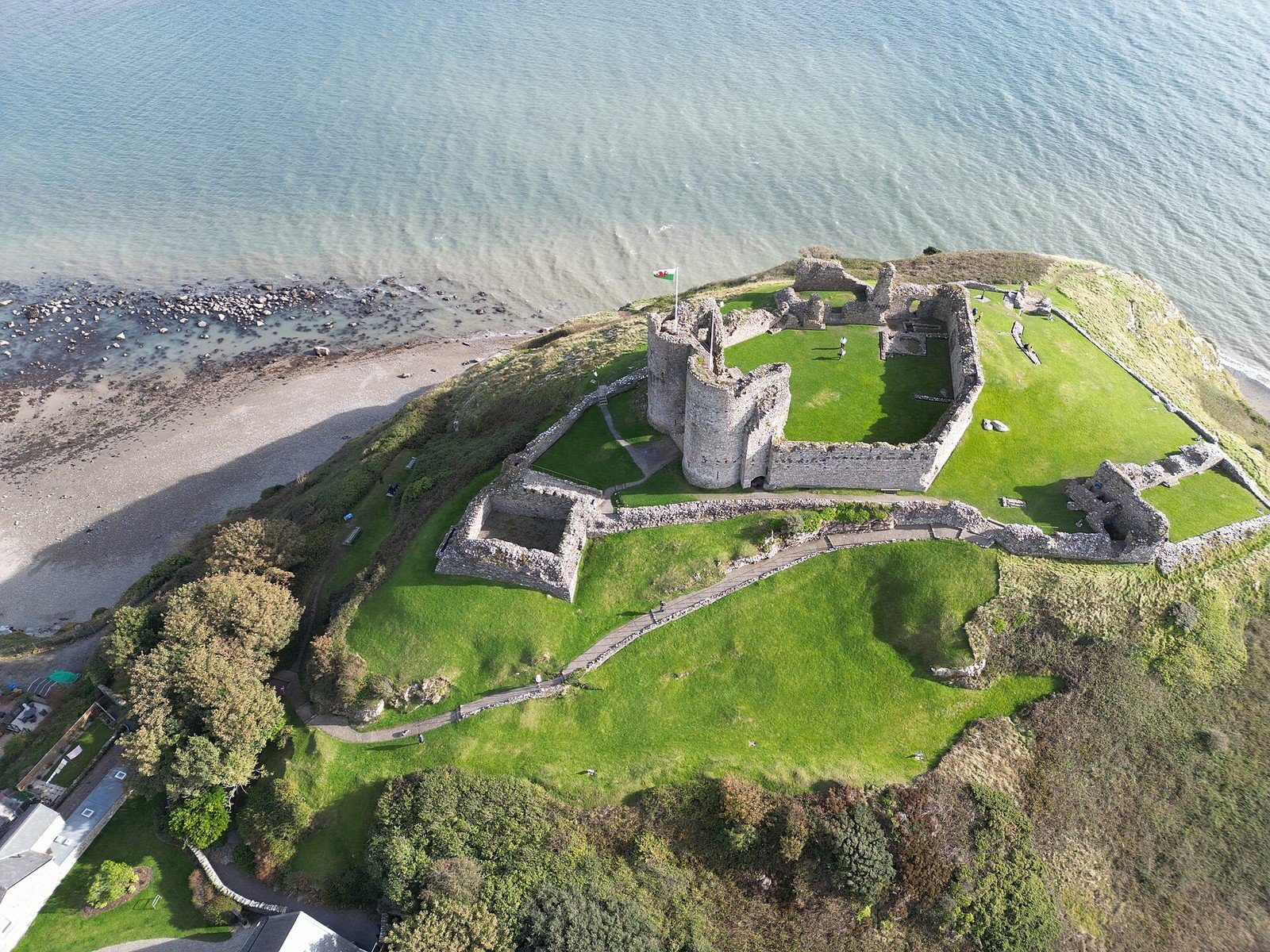
Criccieth Castle is a ruined castle of the princes of Gwynedd on a rocky headland at Criccieth, in Gwynedd, north-west Wales. Its inner ward is attributed to Llywelyn ap Iorwerth and its outer ward to his grandson Llywelyn ap Gruffudd. Edward I’s forces held it by 1283, and the English kings remodeled it before Owain Glyndŵr’s rising left it a ruin. It is one of the castles of the Welsh princes, a group among the castles in Wales, and the nearest castle with a full guide is Harlech Castle.
Quick Facts
| Location | On a rocky headland at Criccieth, Gwynedd, north-west Wales |
|---|---|
| Built | Inner ward probably about 1230; outer ward about 1260-70 by Cadw’s listing; remodeled under Edward I and Edward II after 1283 |
| Built for | Attributed to Llywelyn ap Iorwerth, prince of Gwynedd (d. 1240), for the inner ward, and to his grandson Llywelyn ap Gruffudd, Prince of Wales (d. 1282), for the outer ward |
| Architectural style | Castle of the princes of Gwynedd with a gatehouse of paired D-shaped towers, remodeled by the English kings |
| Castle type | Castle |
| Condition | Ruin; the inner gatehouse stands three stories high, while the outer ward survives mostly as low walls |
| Survival | Ruin |
| Authenticity | Largely original; consolidated from 1933, with the gatehouse’s arched entrance a modern rebuild of before 1933 |
| Access | Interior open |
| Owner / managed by | In State care since 1933; maintained by Cadw |
| Heritage designation | Scheduled monuments CN015 and CN173 (Cadw); Grade I listed building 4396 (Cadw) |
| Nearest town & station | Criccieth; Criccieth station, about 400 m by Cadw’s figure |
| Open to public | Yes, in every season but not every day of the week; closed 24-26 December and 1 January |
| Official website | Cadw: Castell Cricieth |
History
Cadw attributes the inner ward and its twin-towered gatehouse to Llywelyn ap Iorwerth (Llywelyn the Great, d. 1240), prince of Gwynedd, probably about 1230. The castle is first recorded in 1239. That year, according to the chronicle Brut y Tywysogyon, Llywelyn’s son and heir, Dafydd ap Llywelyn, imprisoned his half-brother Gruffudd there. Cadw also attributes the outer ward to Llywelyn ap Iorwerth’s grandson, Llywelyn ap Gruffudd, Prince of Wales (d. 1282), who was the second son of that Gruffudd, according to the Dictionary of Welsh Biography. Cadw’s listing dates that work to about 1260-70. Its guidebook places it in the 1260s or early 1270s in one passage and between 1267 and his death in 1282 in another. The RCAHMW record dates his enlargement only to the later thirteenth century.
That division of the fabric is an interpretation. Cadw’s listing says the castle’s form is now accepted as substantially Welsh. Yet by the account in Cadw’s 2011 guidebook, C. N. Johns, revising the official guidebook in 1970, suggested “that the inner ring was built by Edward I, as a secondary feature within an earlier Welsh castle.” The 2011 guidebook itself returns to the view of B. H. St J. O’Neil, who in 1944-45 assigned much of the surviving masonry to the princes, though it also says that “debate still continues about who built what and when.”
By Taylor’s account, Criccieth was in Llywelyn ap Gruffudd’s possession from 1259, if not earlier, and was still held by him at his death in 1282; the Dictionary of Welsh Biography records that he was killed on 11 December 1282. The forces of Edward I (king 1272-1307) took Criccieth during his second war against Llywelyn ap Gruffudd. It was in English hands by 14 March 1283, the date from which, A. J. Taylor records, Henry of Greenford received wages as its constable. How it was taken is not recorded. Cadw’s guidebook records that on 22 November 1284 Edward chartered a free borough at Criccieth, and that on 23 December he appointed Sir William Leyburn its constable. On Taylor’s and the guidebook’s estimates, Edward had spent perhaps £500 on the castle’s repair by 1292. Taylor wrote that this expenditure “… cannot be related with certainty to particular parts of the surviving buildings.” Cadw’s listing credits Edward I with raising the gatehouse, rebuilding and refacing the south-east and south-west towers, remodeling the north tower to carry a siege engine and extending the outer gatehouse with a barbican.
In Madog ap Llywelyn’s rising of 1294-95, the castle was besieged and held, supplied by sea from Ireland. Cadw’s guidebook counts a garrison of 29 men under Leyburn, with 41 people from the town, among them 13 women and 19 children, sheltering inside.
By Taylor’s account, over £250 was spent on the castle under Edward II (king 1307-1327), and in 1310-11 the accounts record £12 5s. 2d. for “making a tower called Leyburn Tower by taskwork.” That tower was named after William Leyburn, the constable of 1284, “but which of the towers bore his name it is difficult to say,” Taylor wrote. He also records that a survey of 1321 found only minor defects, but that by 1343 the roof of the great hall, the “Gynnetour”, Leyburn Tower and Cistern Tower all needed repair, at an estimate of £96.
About 1359, by Cadw’s account, the Black Prince made Sir Hywel ap Gruffudd, known as Hywel y Fwyall, Criccieth’s first Welsh constable; he held the post until his death in 1381. Cadw’s guidebook says he was called Sir Hywel of the Axe because of his bravery at the Battle of Poitiers in 1356. In a poem the bard Iolo Goch celebrates “the bright fort high on a rock,” in Cadw’s translation.
Criccieth was lost in the rising of Owain Glyndŵr. According to Cadw’s booklet on the castles of the princes, his forces besieged it in 1403; by Cadw’s scheduling record, it fell and was burned in 1404; Taylor has it captured and partly demolished that year. Cadw’s guidebook says that Harlech and Aberystwyth, deprived of seaborne provisions by a French fleet supporting Owain, surrendered in the spring of 1404, that Criccieth seems to have capitulated at about the same time, and that both the castle and the borough were destroyed. Cadw’s listing dates the slighting to 1403, and the RCAHMW record says the castle was taken and destroyed in 1403-4. It was never rebuilt or reoccupied. Criccieth remained with the Crown until 1858, when the ruins were sold to W. Ormsby Gore, MP. In 1933 Lord Harlech placed the castle in State care.
What Stands Today
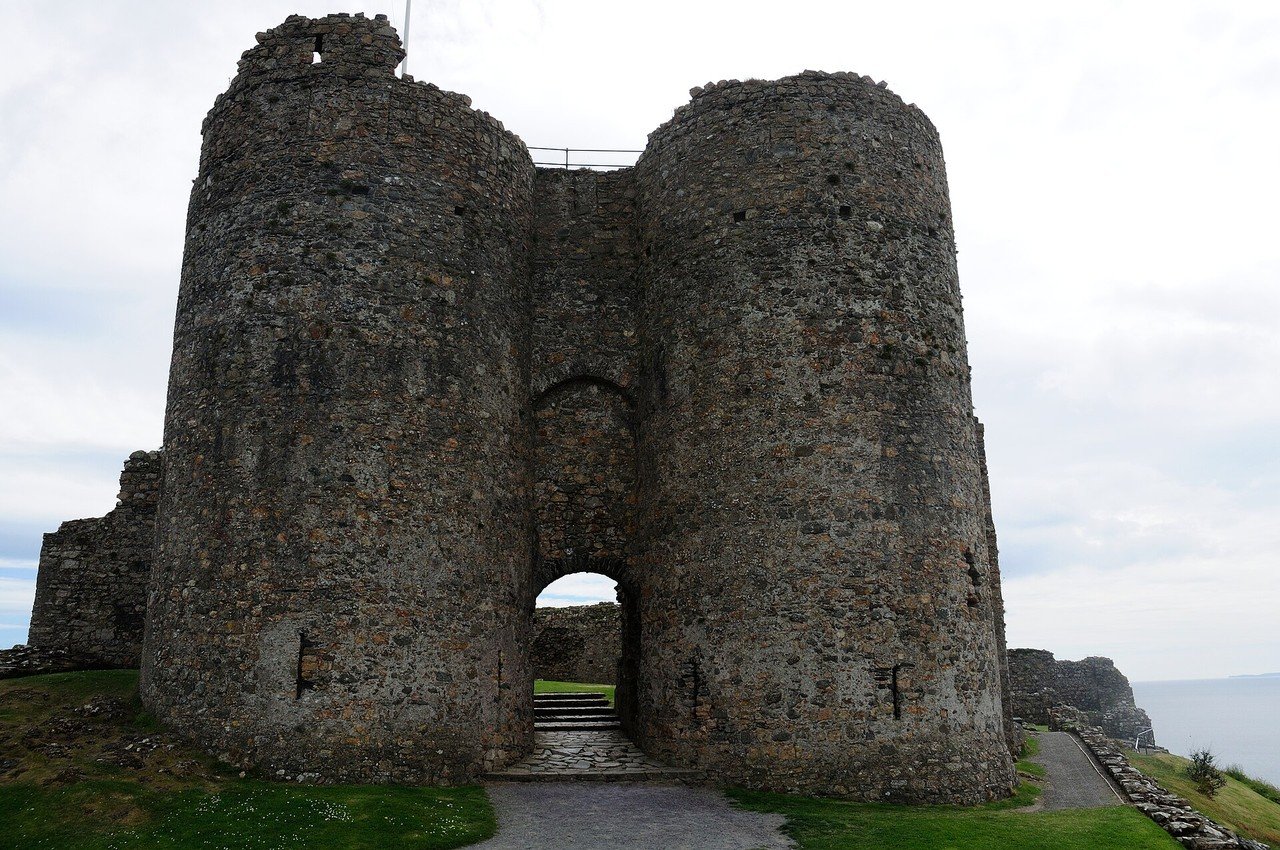
Both wards are unroofed. In the inner ward, Cadw’s listing says, the curtain walls survive to considerable height and keep well-preserved stretches of the original wall-walk. Its gatehouse is a pair of D-shaped towers which, with a latrine tower to the west, survive to a height of three stories. Arrow slits at ground-floor level and a portcullis in the passage defended it. Cadw’s listing says the gatehouse was raised in height under Edward I, and its battlements rebuilt, and raised again under Edward II, the only work of that reign that can be identified in the surviving fabric with certainty. Its arched entrance, with a high-set relieving arch, is a modern rebuild that predates 1933. Of the south-east tower only the lower walls survive, with a small section rising to the level of the floor above the ground. Cadw’s scheduling record says that, apart from the fallen corners, the tower’s masonry survives to a height of about 3 m.
The outer ward nowhere survives to its original height. Only the lower story of the north tower is left, with fragmentary remains of the south-west tower and the outer gatehouse. Of the south-west tower, Cadw’s scheduling record says, the north wall and parts of the east wall survive, and the south and west walls seem to have fallen over the edge. A shallow, stepped ramp climbs the south-east side of the north tower, presumably to give access for the siege engine, though the scheduling record finds it not entirely clear from the remains how this was achieved. The ramp, the record adds, is a clear addition, with a very obvious straight joint following the tower’s original outer face. Cadw’s guidebook says the medieval name “Le Gynnetour”, or Engine Tower, probably refers to the north tower.
Cadw’s guidebook distinguishes three periods of masonry. To Llywelyn ap Iorwerth it assigns angular, naturally split stones quarried from the castle rock or from Dinas. To Llywelyn ap Gruffudd it assigns a different masonry that includes slates, which in places give the walls a bluish-gray tint. To Edward I and Edward II it assigns stone quarried almost entirely from the castle rock or nearby Dinas; in places the stones appear to have been roughly squared and laid in almost regular courses, and the mortar resembles the previous period’s but contains more and larger shells. In the south-west tower, the guidebook points to masonry that has “been burnt red, like the walls of the south-east tower, no doubt during Glyndŵr’s destruction.” Burnt layers were found when the inner gatehouse and the south-east and south-west towers were excavated, it adds.
Outside the boundary wall, Cadw separately schedules as CN173 what it thinks are the castle’s outer defensive bank and ditch: a definite bank, and a dip it says may well be the remains of a ditch. The RCAHMW record describes a rock-cut ditch on the north and north-east, lower down the castle rock, with an outer rampart along its base, and calls these works undated.
Access
Criccieth Castle has been in State care since 1933 and is maintained today by Cadw, which opens it in every season, though not on every day of the week, and closes it on 24, 25 and 26 December and 1 January. Entry is through the visitor center. Its ground floor holds a shop and the admissions area, and its lower ground level an exhibition, reached by a couple of steps or a platform lift. From there, Cadw’s access guide says, the path up to the castle is about 70 m long and very steep, with around 10 staggered stone steps and a handrail on part of the way. At the top, the castle is all on one level and mostly laid to grass, with some gravel and uneven areas; Cadw grades the terrain Level 3, moderate. The site has a single accessible toilet and an induction loop, but no cafe. Dogs on short leads are welcome on the ground floor levels only.
There is no car park at the castle itself. Parking is permitted on the road around the castle, and a pay car park is a few hundred meters away. Criccieth station, on the Shrewsbury-Machynlleth/Pwllheli route, is about 400 m away by Cadw’s figure, and buses stop about 200 m away. The A497 reaches Criccieth from Porthmadog or Pwllheli, and National Cycle Network Route 8 passes the castle. Times can change, so check Cadw’s Castell Cricieth page before you travel.
Principal Sources
- Avent, Richard. Criccieth Castle; Penarth Fawr Medieval Hall-House; St Cybi’s Well. Cadw, 2011.
- Cadw. “Castell Cricieth.” cadw.gov.wales.
- Cadw. “Castell Cricieth – Access Guide.” cadw.gov.wales.
- Cadw. “Listed building 4396: Criccieth Castle.” cadwpublic-api.azurewebsites.net.
- Cadw. “More about Castell Cricieth.” cadw.gov.wales.
- Cadw. “Scheduled monument CN015: Castell Cricieth.” cadwpublic-api.azurewebsites.net.
- Cadw. “Scheduled monument CN173: Criccieth Castle, Outer Bank Defences.” cadwpublic-api.azurewebsites.net.
- Cadw. The Castles of the Lords and Princes of Wales. Cadw, undated, p. 6.
- Pierce, Thomas Jones. “Llywelyn ap Gruffydd (‘Llywelyn the Last,’ or Llywelyn II), Prince of Wales (died 1282).” Dictionary of Welsh Biography. biography.wales.
- RCAHMW. “Criccieth Castle, NPRN 95281.” coflein.gov.uk.
- Taylor, A. J. “The King’s Works in Wales, 1277-1330.” In Colvin, H. M., ed. The History of the King’s Works, vol. I. HMSO, 1963, pp. 365-7.
Image credits. Hero, Criccieth Castle from the air: Photo: Llywelyn2000, CC BY-SA 4.0. Source: Castell Cricieth o’r awyr yn 2023 - Cricieth Castle from a drone - Welsg built castle in Gwynedd, Wales 38, Wikimedia Commons; Criccieth’s inner gatehouse: Photo: TomGough, CC BY-SA 2.0. Freely licensed images are resized to fit; any other change, such as a crop, is named in the credit.