
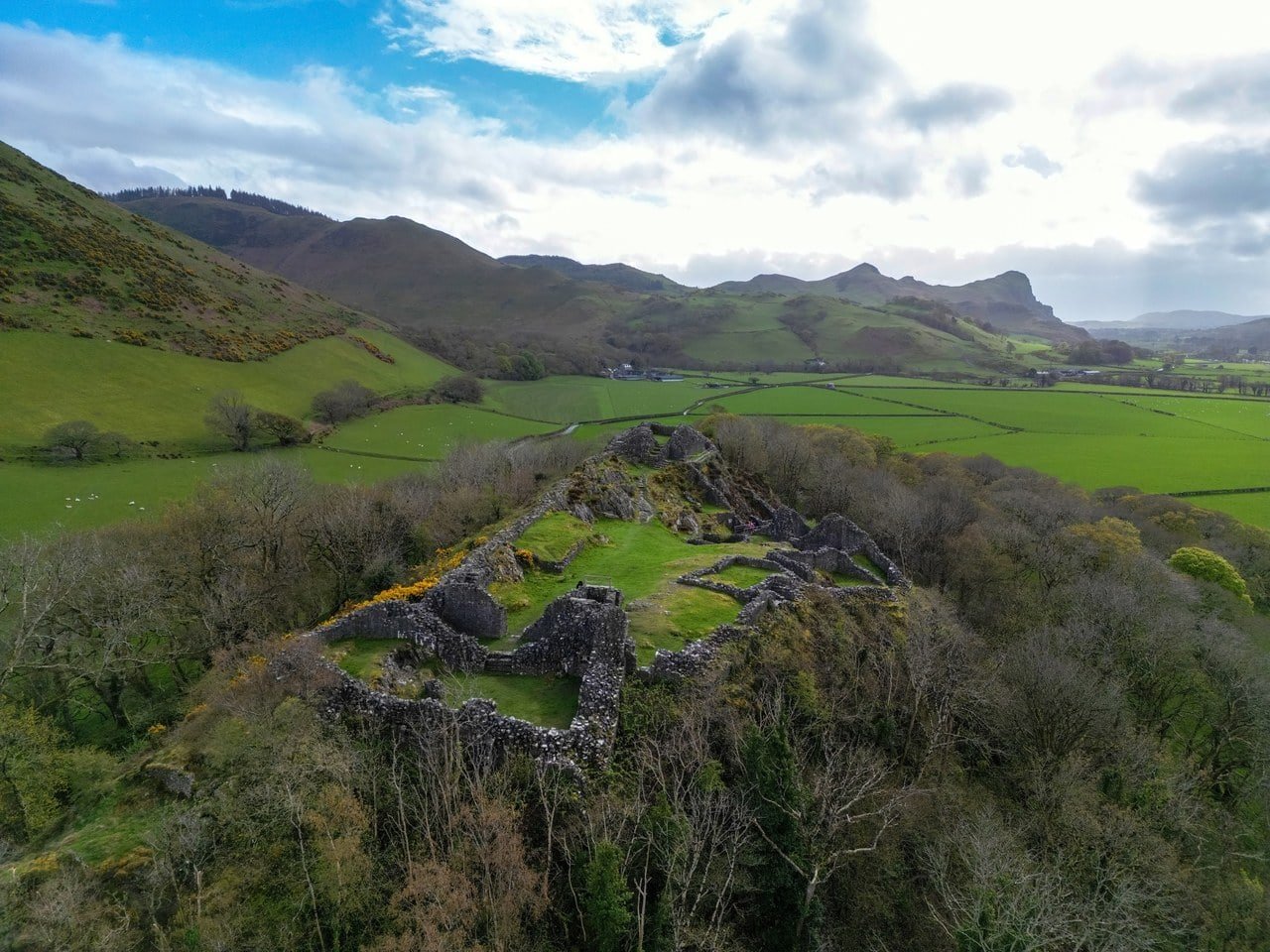
Castell y Bere
Record: full guide not yet written. This page carries the verified record fields and the sources they rest on.
Castell y Bere is a ruined native Welsh castle on a long, narrow rock near Llanfihangel-y-Pennant in Gwynedd, probably begun in 1221 by Llywelyn ap Iorwerth, prince of Gwynedd. English forces took it in 1283, and Cadw says it was abandoned during the Welsh rising of 1294. Bere is one of the castles of the Welsh princes, a group among the castles in Wales, and the nearest castle described in a full guide is Harlech Castle.
Quick Facts
| Location | Near Llanfihangel-y-Pennant, off the B4405 northeast of Tywyn, Gwynedd, Wales |
|---|---|
| Built | Probably begun about 1221; English works followed between 1283 and 1290 |
| Built for | Llywelyn ap Iorwerth, prince of Gwynedd (d. 1240); Cadw’s booklet says some parts may be the work of his grandson, Llywelyn ap Gruffudd |
| Architectural style | Native Welsh castle on a long, narrow rock, with two towers of the D-shaped plan Cadw calls characteristic of Welsh castles |
| Castle type | Castle |
| Condition | Ruin; the walls survive to very different heights |
| Survival | Ruin |
| Authenticity | Largely original; the site was cleared by the Ministry of Works between 1950 and 1960, exposing the ground plan |
| Access | Interior open |
| Owner / managed by | In the care of Cadw |
| Heritage designation | Scheduled monument ME023 (Cadw) |
| Town & station | Tywyn, the town and rail station Cadw names for the castle |
| Open to public | Yes, all year except 24-26 December and 1 January |
| Official website | Cadw: Castell y Bere |
History
The chronicle Brut y Tywysogion records that in 1221 Llywelyn ap Iorwerth (d. 1240), prince of Gwynedd, took the cantref of Meirionnydd and the commote of Ardudwy from his son Gruffudd and began to build a castle there for himself, but it does not name the castle. Cadw and the historian A. J. Taylor judge that it was probably Castell y Bere, and Cadw gives 1221 as the year construction began. In Cadw’s account, it was built to protect Gwynedd’s southern frontier, on the route from the coast at Tywyn toward Dolgellau. Carved stonework from excavations at the site, in the National Museum of Wales by 1963, is consistent with a date in the second quarter of the thirteenth century, Taylor wrote. According to Cadw’s booklet, some parts of the castle may have been built by Llywelyn’s grandson, Llywelyn ap Gruffudd, and Cadw says that Llywelyn ap Iorwerth’s successors continued to use it after his death. Paul Davis calls it the largest and most elaborate of the native castles of north Wales.
In the war of 1282-83 Llywelyn ap Gruffudd was killed in battle, and by April 1283, in Taylor’s account, Bere was one of the remaining strongholds of his brother, Dafydd ap Gruffudd. Paul Davis names both among the sons of Gruffudd, the son of Llywelyn ap Iorwerth who lost Meirionnydd to his father in 1221. Edward I’s forces under Roger Lestrange and William de Valence besieged the castle in April 1283, and it fell to them on 25 April. Davis writes that it was surrendered. After the army left, five masons and five carpenters stayed behind “to carry out various works,” apparently, Taylor wrote, under the direction of Master Bertram the engineer and his assistant, Simon le Counte. Building accounts for the castle run to 1290. Walter of Huntercombe, its constable between March 1284 and October 1285, received money to build a new chamber there. Cadw says that Edward hoped an English frontier town would grow there; a borough charter followed in 1284, but no town grew.
During Madog ap Llywelyn’s rising of 1294 Welsh rebels besieged the castle, and the king ordered an expedition to relieve it, “whose safety we desire with all our heart.” Taylor wrote that the outcome is unknown. Cadw says the English abandoned it during that rising, and Taylor judged it probably destroyed and abandoned in 1294-95. In his words, “in contrast to the other Merioneth castles of Harlech and Criccieth, Castell y Bere makes no further appearance in the accounts.” Taylor’s other evidence was archaeological: when the castle well was excavated in 1952, late thirteenth-century pottery was found in association with charred timbers, probably from the roof of the well-house. Excavations began in 1850, and the Ministry of Works cleared the site between 1950 and 1960.
What Stands Today
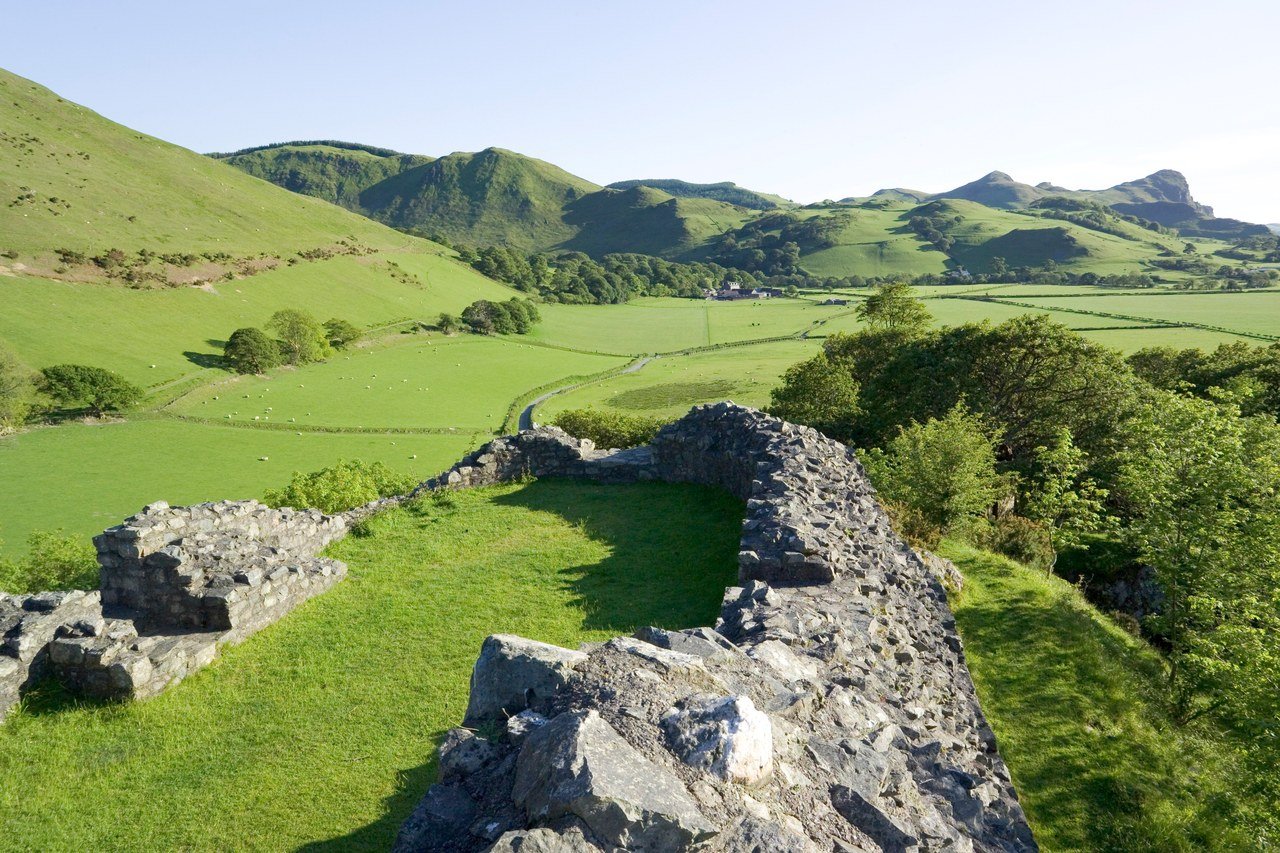
Castell y Bere’s ruins follow a narrow rock, and Cadw’s scheduling record calls the ground plan “unusually long and narrow, constrained by the underlying rock.” Complex works on the southwest lead into an inner ward, which has an apsidal (D-ended) tower at its north end and a rectangular tower at its south. Beyond a ditched yard stands a second large apsidal tower. The castle’s walls survive to very different heights. On the west side, north of the entrance, are the footings of a small round tower overlooking a tiny barbican, and a cistern or well lies just inside the entrance. Stretches of rock-cut ditch survive outside the walls, particularly at either end of the ridge.
Two of the towers follow the D-shaped plan that Cadw calls characteristic of Welsh castles. In the words of the scheduling record, “there have clearly been alterations to the fabric, in particular the apparent addition of the southern apsidal tower, but these are difficult to date.” Walls that close off the area in front of the southern apsidal tower are a later addition, which Taylor suggested, from the building accounts, may be English work of 1286-87.
Cadw describes the entrance, with its ditches and two gate-towers, each with its own drawbridge and probably a portcullis, as Welsh work of the early 1220s. Such a sophisticated entrance, Cadw says, “cannot be matched in any other Welsh castle.” In 1990 John Kenyon wrote that the simple entrance is protected by an elaborate barbican, and he had some doubts that the barbican is Welsh: if it were, its two turning-bridges would be “seemingly the earliest examples of this type of bridge,” a type more commonly found in later English castles. Yet he noted that no straight joints show where English masonry would meet the Welsh fabric, while in other parts of the castle such joints are plain to see.
Access
Castell y Bere is in the care of Cadw, which opens it all year except 24, 25 and 26 December and 1 January. A trail leads from a small car park through woodland to the entrance steps, and Cadw asks visitors not to park on the narrow main road. Cadw grades the terrain strenuous: there are steps, short climbs and wooden bridges that can be slippery when wet, and the trail is uneven underfoot and may be muddy in poor weather. Dogs are welcome.
Cadw names Tywyn as the rail station for the castle, and National Cycle Network Route 8 serves cyclists. The postcode is LL36 9TS. Times can change, so check Cadw’s Castell y Bere page before you travel.
Principal Sources
- Archaeologia Cambrensis. “Castell y Bere, Merionethshire.” Unsigned report, 3rd series, vol. 7 (1861), pp. 105-110.
- Cadw. “Castell y Bere.” cadw.gov.wales.
- Cadw. “More about Castell y Bere.” cadw.gov.wales.
- Cadw. “Scheduled monument ME023: Castell y Bere.” cadwpublic-api.azurewebsites.net.
- Cadw. The Castles of the Lords and Princes of Wales. Cadw, undated, p. 6.
- Davis, Paul R. Castles of the Welsh Princes. Christopher Davies, 1988.
- Kenyon, John R. Medieval Fortifications. Leicester University Press, 1990.
- Taylor, A. J. “The King’s Works in Wales, 1277-1330.” In Colvin, H. M., ed. The History of the King’s Works, vol. I. HMSO, 1963.
- Williams ab Ithel, J., ed. and trans. Brut y Tywysogion; or, The Chronicle of the Princes. Rolls Series 17. Longman, 1860, p. 309.
Image credits. Hero, Castell y Bere on its ridge from the air: Photo: Janos / Adobe Stock; Castell y Bere’s walls above the valley: Photo: Stephen / Adobe Stock. Freely licensed images are resized to fit; any other change, such as a crop, is named in the credit.