
The 15 Best Castles in Germany
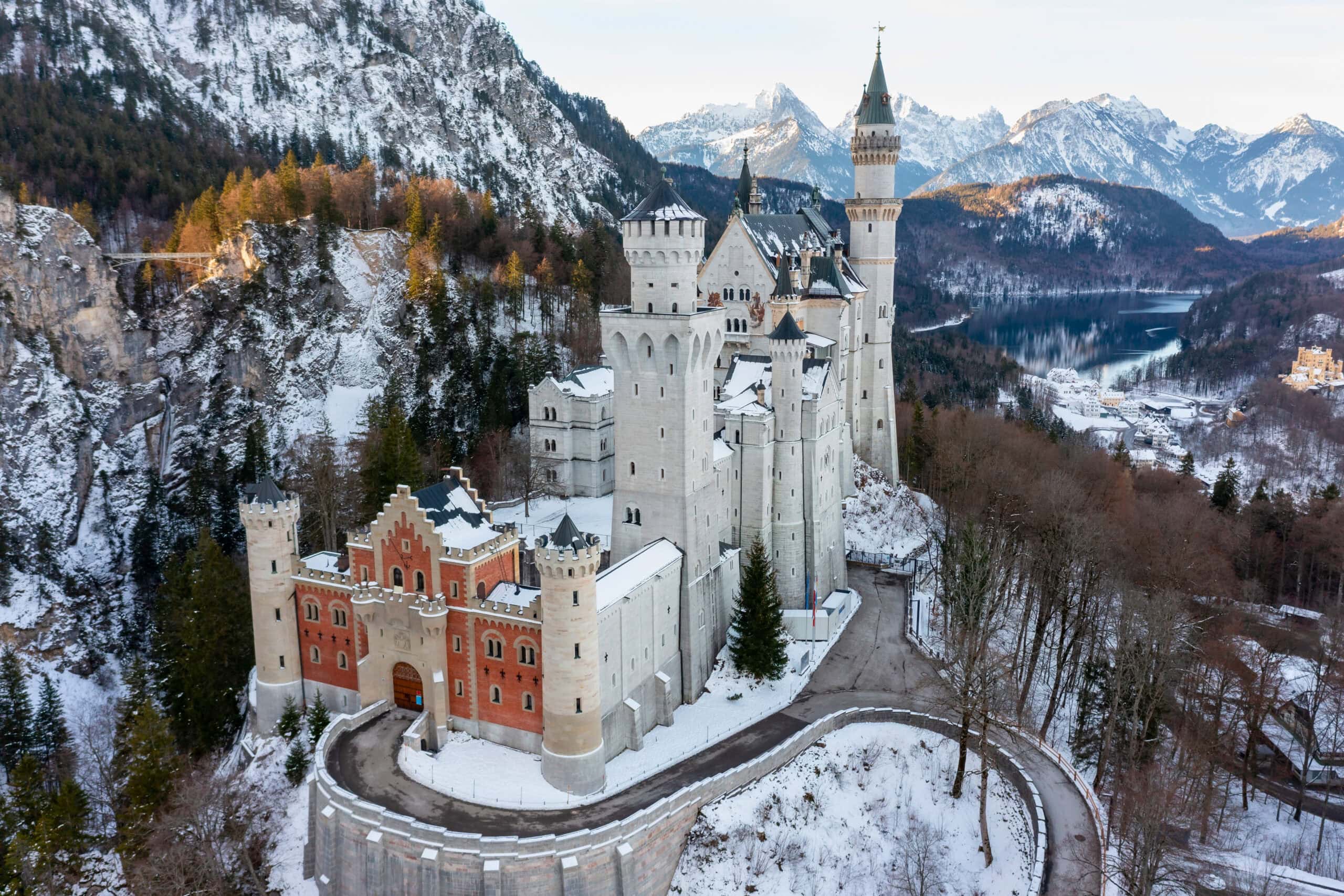
Choosing the best castles in Germany means accepting that the country never settled on a single idea of what a castle should be. Across roughly a thousand years, the German lands produced fortified strongholds built to survive a siege, ceremonial residences built to overawe a visiting prince, and historicist showpieces built to dream a medieval past back into being.
This guide gathers fifteen of them, drawn from ten regions and organized by that underlying purpose: castles built to be defended, castles built to impress, and castles built to dream. Each entry links to a full StoneKeep Atlas guide with visiting details, history, and our own photography. Six carry UNESCO World Heritage status, and two of those inscriptions arrived only in the past two years.
You can read the collection straight through as a short history of how the German castle evolved, or jump to the movement that fits your trip. The locator map below plots all fifteen, color-coded by group, so you can see which cluster lies near your route, and the comparison table that follows lets you scan the whole list before reading the entries in full.
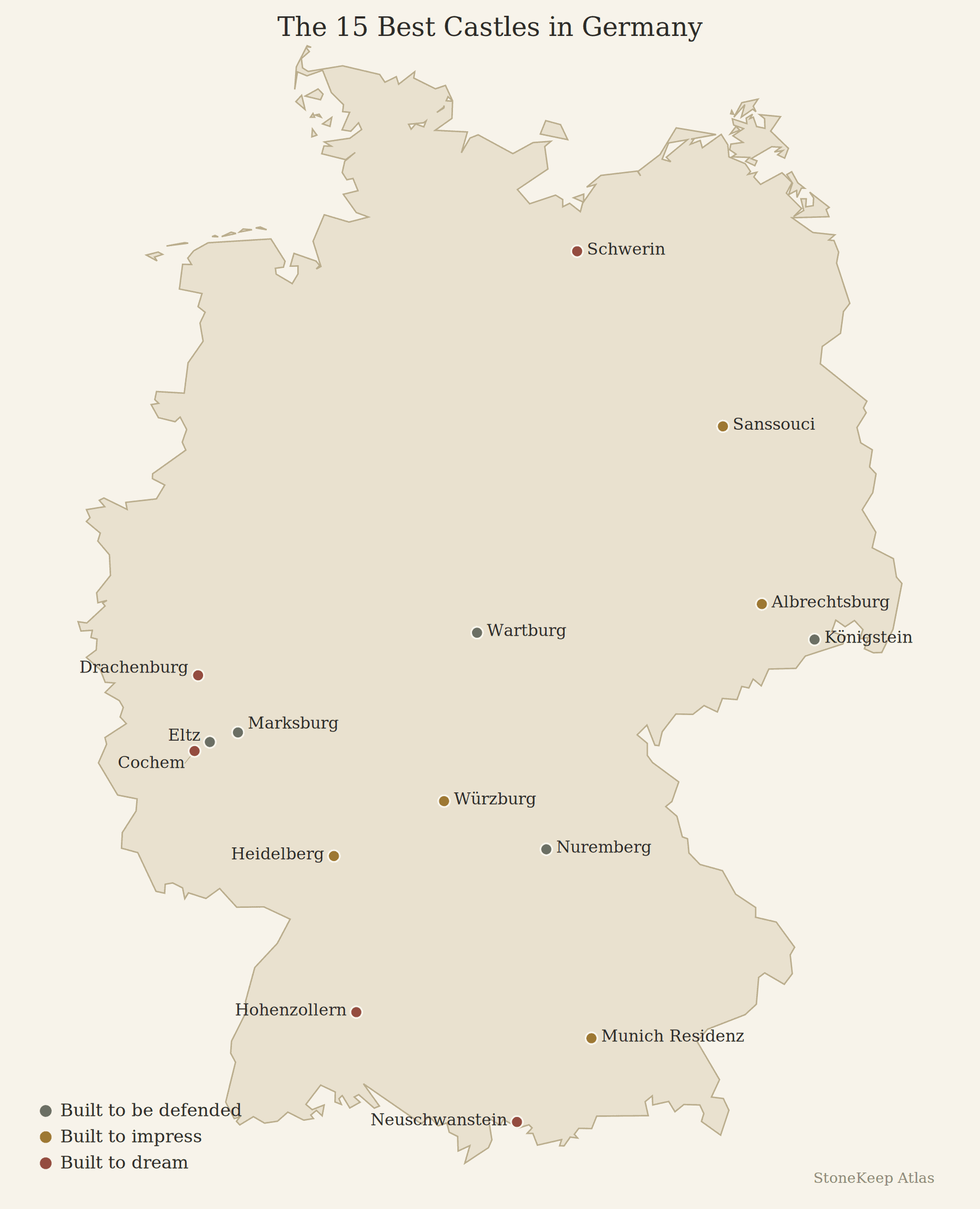
The 15 best castles in Germany at a glance
| Castle | Region | Type | UNESCO | Signature draw |
|---|---|---|---|---|
| Wartburg Castle | Thuringia | Castle | 1999 | Luther’s refuge; the German national castle |
| Eltz Castle | Moselle Valley | Castle | No | Never destroyed in war; same family for 34 generations |
| Marksburg Castle | Rhine Gorge | Castle | 2002* | The only Rhine hill castle never destroyed |
| Nuremberg Castle | Franconia | Castle | No | Imperial Kaiserburg of the Holy Roman Empire |
| Königstein Fortress | Saxony | Fortress | No | Vast clifftop fortress, never taken by force |
| Heidelberg Castle | Baden-Württemberg | Palace | No | Germany’s most famous romantic ruin |
| Würzburg Residence | Franconia | Residence | 1981 | Supreme German Baroque; the Tiepolo staircase |
| Munich Residenz | Bavaria | Residence | No | Germany’s largest city-center palace |
| Sanssouci Palace | Brandenburg | Palace | 1990 | Frederick the Great’s rococo retreat |
| Albrechtsburg Castle | Saxony | Palace | No | Cradle of Meissen porcelain; an early German Schloss |
| Neuschwanstein Castle | Bavaria | Palace | 2025 | The world’s most famous castle |
| Hohenzollern Castle | Baden-Württemberg | Castle | No | Prussian ancestral seat on a misty cone |
| Cochem Castle | Moselle Valley | Castle | No | The iconic romantic Moselle rebuild |
| Drachenburg Castle | North Rhine-Westphalia | Palace | No | Gründerzeit fantasy above the Rhine |
| Schwerin Castle | Mecklenburg-Vorpommern | Palace | 2024 | The “Neuschwanstein of the North” |
Built to be defended
These five were built for survival. Before a castle was a symbol or a stage, it was a military problem solved in stone: walls thick enough to absorb a battering ram, a keep high enough to command the valley, a position that made an attacker pay for every meter. The castles below still read as machines for holding ground, and several were never taken.
1. Wartburg Castle
 CC BY-SA 3.0, via Wikimedia Commons" srcset="https://stonekeepatlas.com/wp-content/uploads/2026/07/wartburg-castle-ridge-aerial-exterior.jpg 1280w, https://stonekeepatlas.com/wp-content/uploads/2026/07/wartburg-castle-ridge-aerial-exterior-300x169.jpg 300w, https://stonekeepatlas.com/wp-content/uploads/2026/07/wartburg-castle-ridge-aerial-exterior-1024x576.jpg 1024w, https://stonekeepatlas.com/wp-content/uploads/2026/07/wartburg-castle-ridge-aerial-exterior-768x432.jpg 768w" sizes="auto, (max-width: 1280px) 100vw, 1280px" />
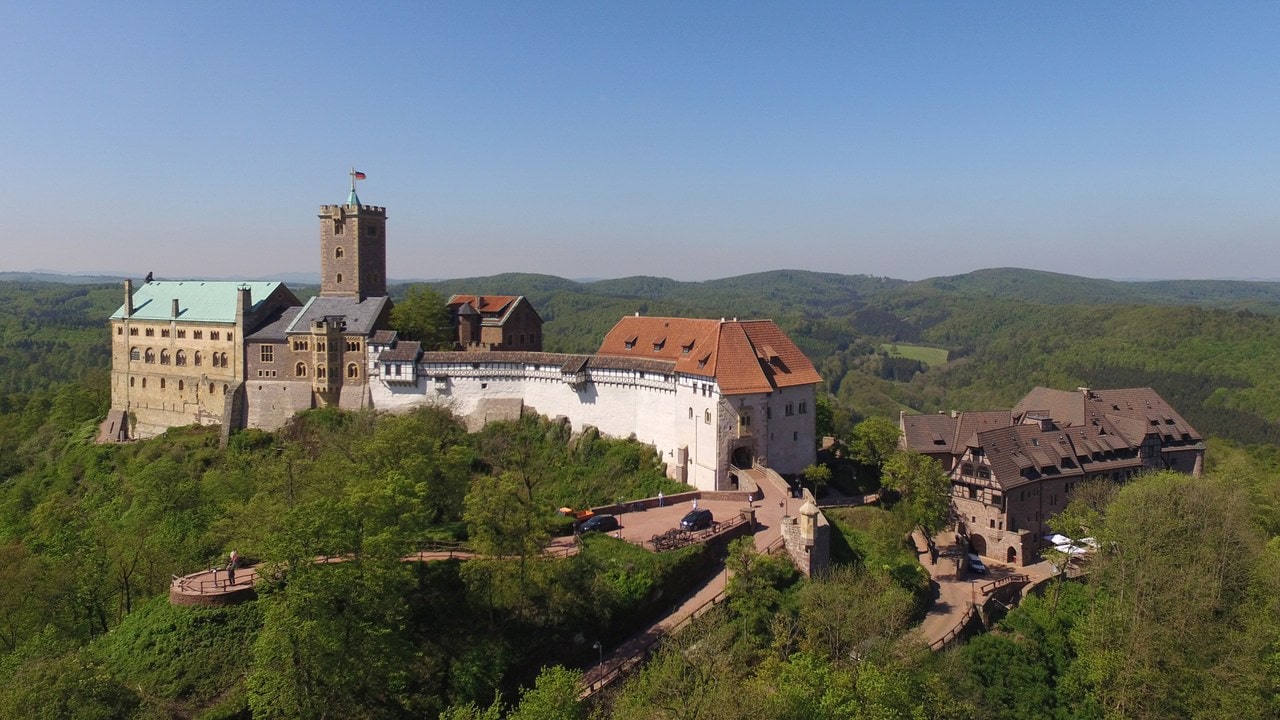
No castle sits closer to the German national story than the Wartburg, set on a wooded ridge above Eisenach. In 1521 Martin Luther, under imperial ban and disguised as the knight “Junker Jörg,” was hidden here, and in roughly eleven weeks he translated the New Testament into German, a text that helped standardize the language itself. Its Romanesque palas is among the finest surviving secular buildings of its era in Central Europe. UNESCO inscribed the Wartburg in 1999. Wagner set the singers’ contest of Tannhäuser in its great hall, and a nineteenth-century restoration turned the ridge into a monument of German identity.
Read the full Wartburg Castle guide →
2. Eltz Castle
 CC BY-SA 4.0, via Wikimedia Commons" srcset="https://stonekeepatlas.com/wp-content/uploads/2026/04/eltz-castle-guide-trail-vantage-with-trutzeltz_WC-scaled.jpg 2560w, https://stonekeepatlas.com/wp-content/uploads/2026/04/eltz-castle-guide-trail-vantage-with-trutzeltz_WC-300x200.jpg 300w, https://stonekeepatlas.com/wp-content/uploads/2026/04/eltz-castle-guide-trail-vantage-with-trutzeltz_WC-1024x683.jpg 1024w, https://stonekeepatlas.com/wp-content/uploads/2026/04/eltz-castle-guide-trail-vantage-with-trutzeltz_WC-768x512.jpg 768w, https://stonekeepatlas.com/wp-content/uploads/2026/04/eltz-castle-guide-trail-vantage-with-trutzeltz_WC-1536x1024.jpg 1536w, https://stonekeepatlas.com/wp-content/uploads/2026/04/eltz-castle-guide-trail-vantage-with-trutzeltz_WC-2048x1365.jpg 2048w" sizes="auto, (max-width: 2560px) 100vw, 2560px" />
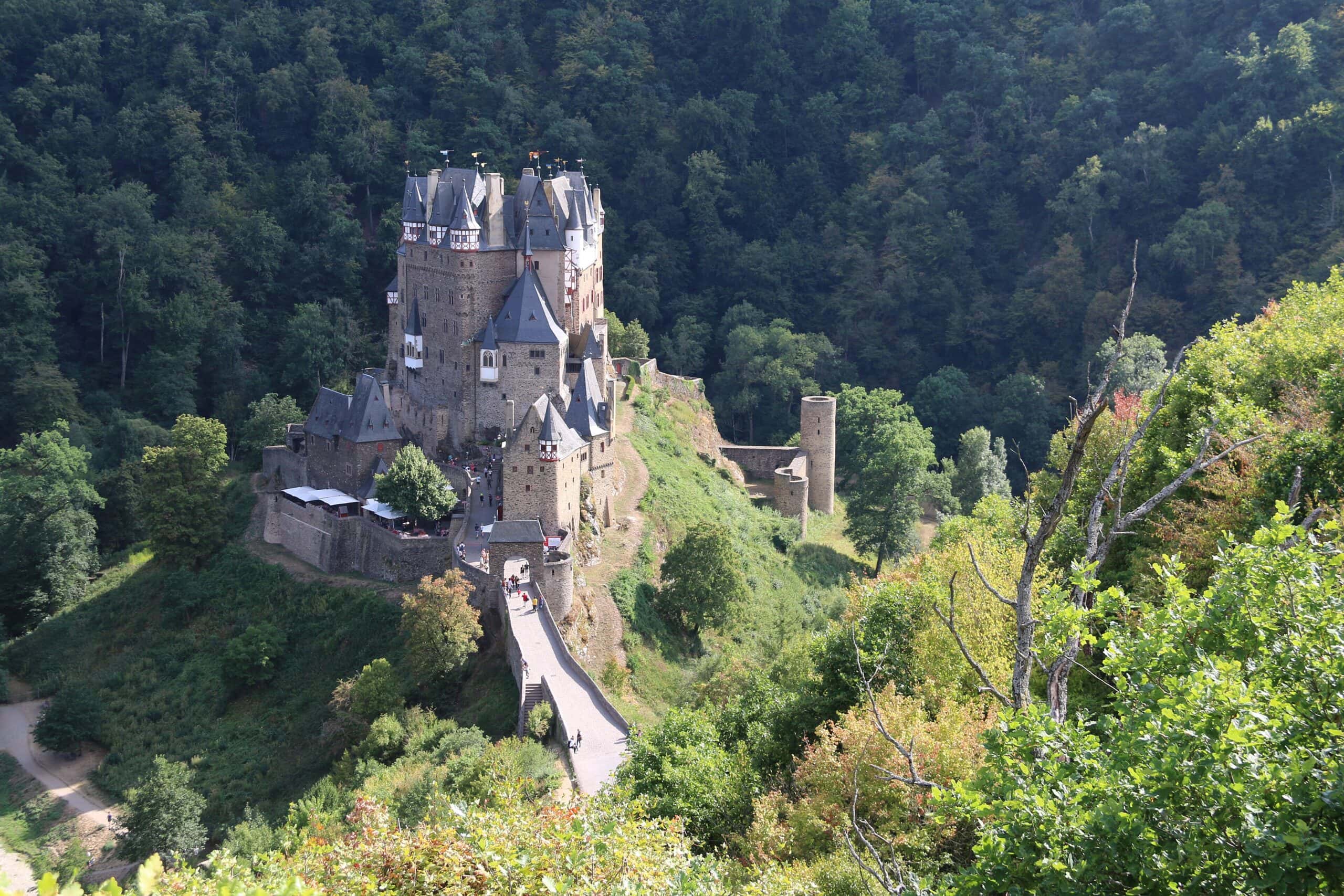
Hidden in a side valley of the lower Moselle, Burg Eltz has belonged to the same family for more than 800 years and is now in the hands of the 34th generation, a continuity rarely matched in Europe. It was never destroyed in war and never taken by storm, and the one share that ever changed hands, in 1815, passed to another branch of the same family. For decades it appeared on the 500 Deutsche Mark banknote, fixing it in the national imagination. The last stretch is made on foot or by shuttle bus from the car park, which is part of why the approach feels so unchanged.
Read the full Eltz Castle guide →
3. Marksburg Castle
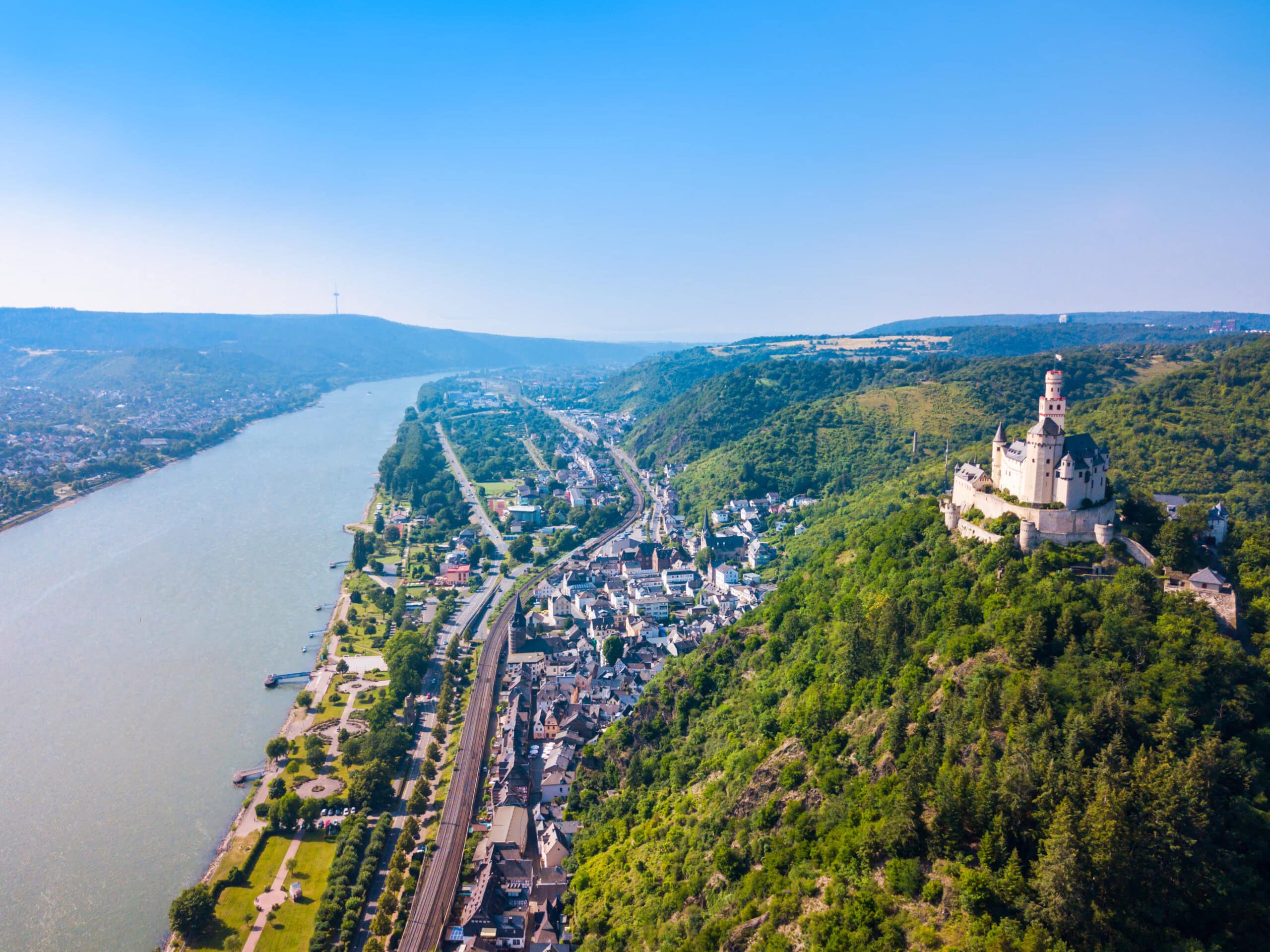
Of the many castles crowning the Rhine Gorge between Koblenz and Bingen, the Marksburg above Braubach is the only hill castle on the Middle Rhine that was never destroyed. Everything around it was burned, blown up, or left to ruin; the Marksburg came through intact, which makes it the best place on the river to see how a working medieval fortress actually fit together, from the rock-cut stairway to the great battery. It serves today as headquarters of the German Castles Association and sits within the Upper Middle Rhine Valley, a UNESCO World Heritage Site since 2002. Guided tours lead through the kitchen, the chapel tower, and a sobering collection of armor and instruments of justice.
Read the full Marksburg Castle guide →
4. Nuremberg Castle
 CC BY-SA 2.0 DE, via Wikimedia Commons" srcset="https://stonekeepatlas.com/wp-content/uploads/2026/05/nuremberg-castle-winter-southwest-panorama-scaled.jpg 2560w, https://stonekeepatlas.com/wp-content/uploads/2026/05/nuremberg-castle-winter-southwest-panorama-300x225.jpg 300w, https://stonekeepatlas.com/wp-content/uploads/2026/05/nuremberg-castle-winter-southwest-panorama-1024x768.jpg 1024w, https://stonekeepatlas.com/wp-content/uploads/2026/05/nuremberg-castle-winter-southwest-panorama-768x576.jpg 768w, https://stonekeepatlas.com/wp-content/uploads/2026/05/nuremberg-castle-winter-southwest-panorama-1536x1152.jpg 1536w, https://stonekeepatlas.com/wp-content/uploads/2026/05/nuremberg-castle-winter-southwest-panorama-2048x1536.jpg 2048w" sizes="auto, (max-width: 2560px) 100vw, 2560px" />
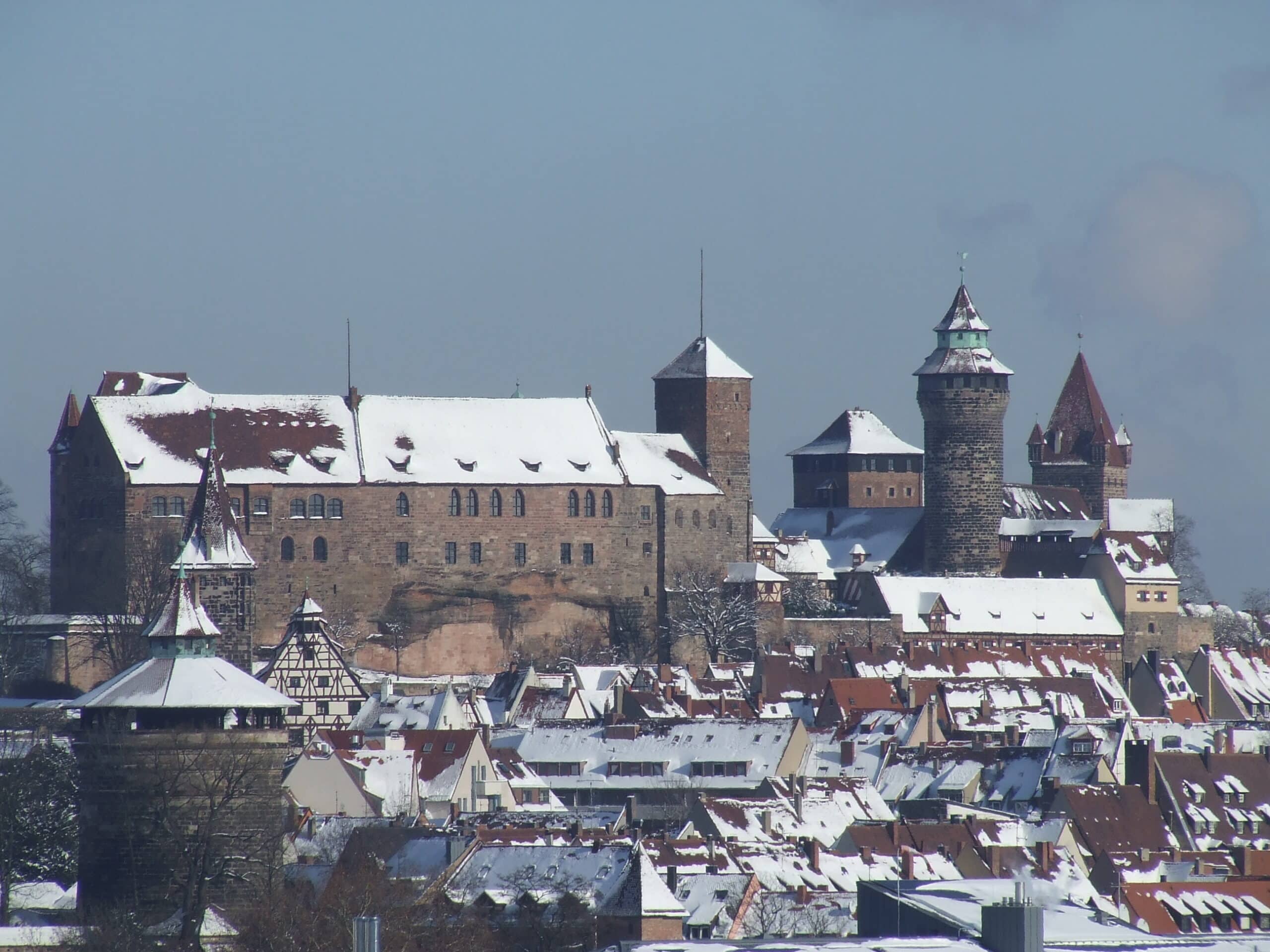
The Imperial Castle of Nuremberg, the Kaiserburg, was effectively a second capital of the Holy Roman Empire. Under the Golden Bull of 1356, every newly elected king was required to hold his first imperial diet at Nuremberg, and emperors lodged here repeatedly across the medieval centuries. The complex layers a Romanesque double chapel, a deep well house, and the round Sinwell Tower above the red roofs of the old city. From the ramparts the view runs out over the medieval core of Nuremberg, rebuilt after heavy wartime destruction.
Read the full Nuremberg Castle guide →
5. Königstein Fortress
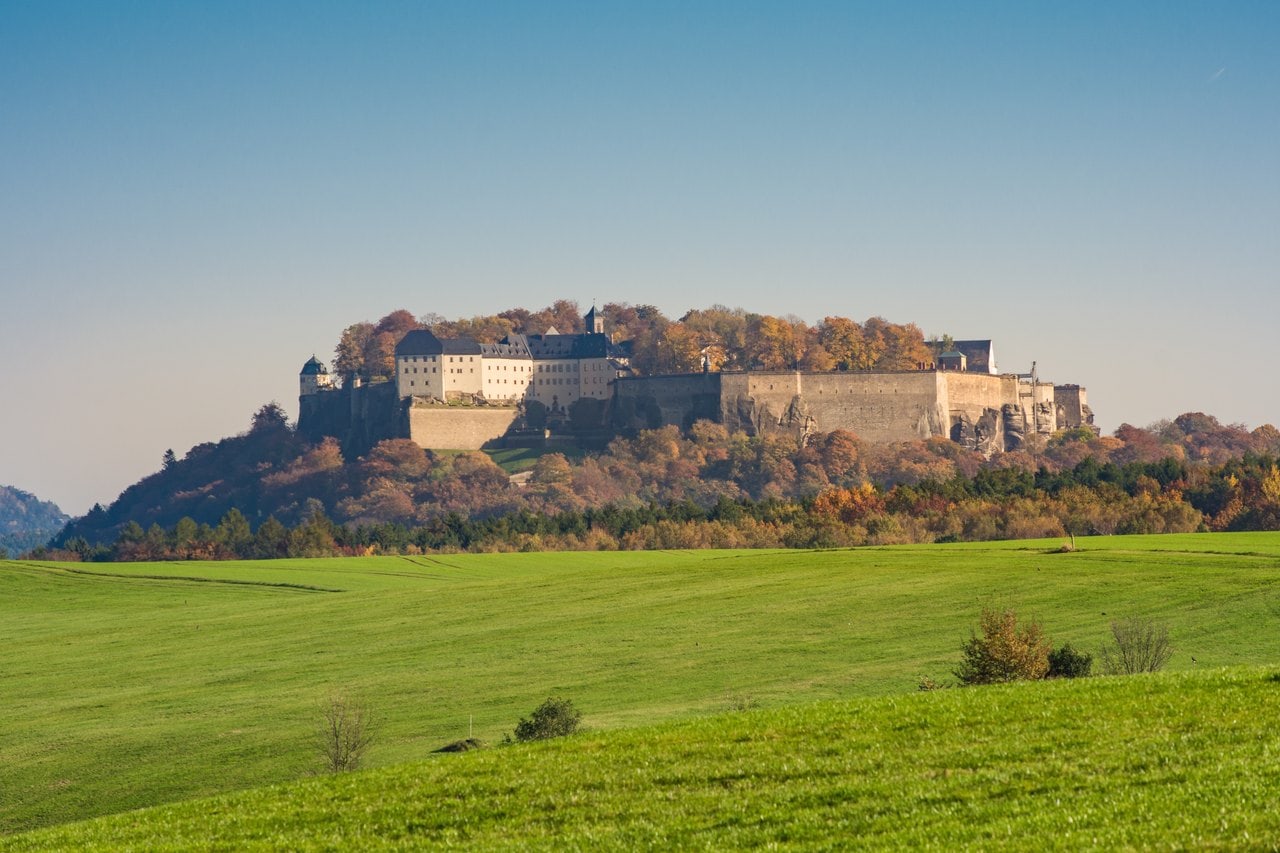
Spread across a sandstone table mountain roughly 240 meters above the Elbe in Saxon Switzerland, Königstein is one of the largest hill fortresses in Europe and was never taken by force in its long history. Its sheer walls made it both an impregnable refuge for the Saxon court and, for centuries, a state prison: the alchemist who stumbled onto European porcelain was confined here, as was the anarchist Mikhail Bakunin. More than fifty buildings stand on the plateau, some over 400 years old. A walk around the rim of the plateau gives one of the finest panoramas in Saxon Switzerland, out over the Elbe and the sandstone country beyond.
Read the full Königstein Fortress guide →
Built to impress
By the Renaissance and into the Baroque, the threat shifted from siege engines to rivals at court, and a castle’s job changed with it. These five trade arrow slits for staircases, fresco ceilings, and garden axes engineered to make a guest feel small. They are residences first and fortresses barely at all, built to project the wealth and taste of the prince who paid for them.
6. Heidelberg Castle
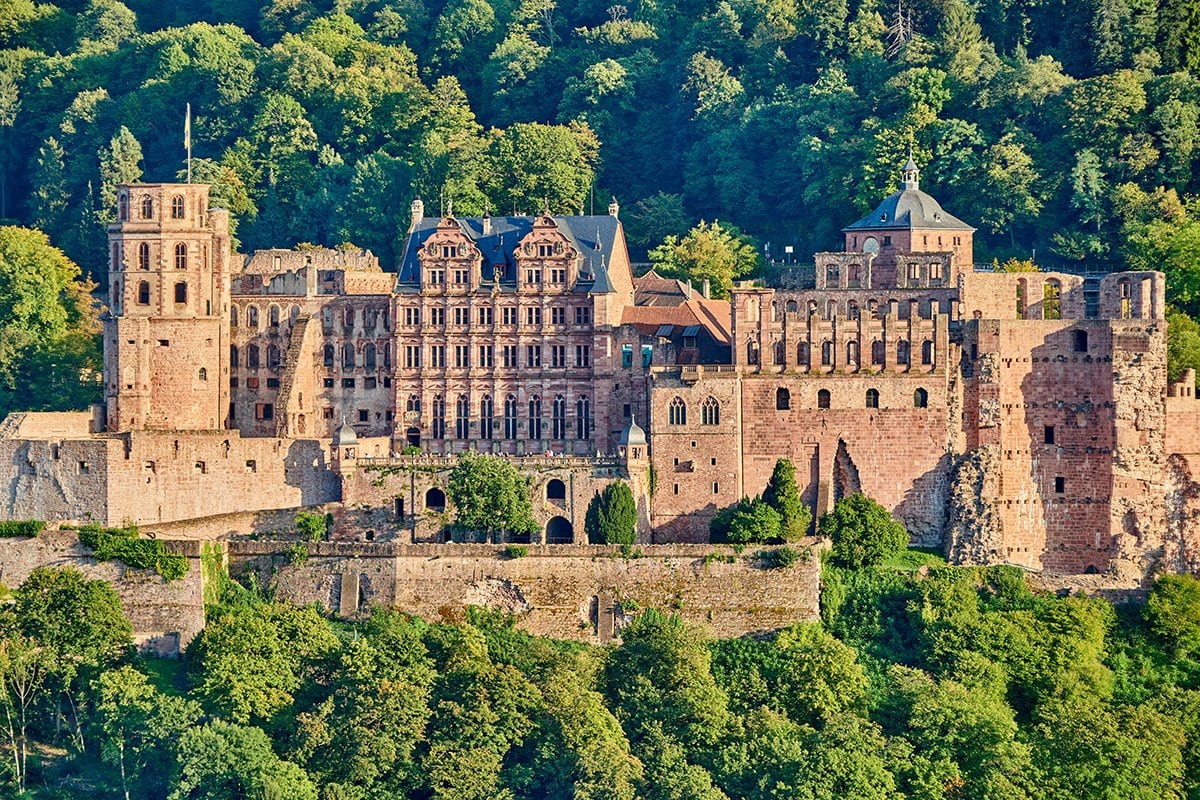
Heidelberg is the most celebrated ruin in Germany, a red-sandstone palace dismantled in stages by the wars of the seventeenth century and a lightning strike in 1764, then left half-collapsed above the Neckar. French troops under Louis XIV burned and blew up large parts of it in 1689 and 1693; the gap-toothed Renaissance facades that remain became a defining image of European Romanticism. Inside sits the Great Vat, a wine barrel so large that a dance floor was built on top of it. A funicular climbs from the old town, and the great terrace remains one of the classic views in the country.
Read the full Heidelberg Castle guide →
7. Würzburg Residence
 CC BY-SA 4.0, via Wikimedia Commons" srcset="https://stonekeepatlas.com/wp-content/uploads/2026/05/01-hero-wuerzburg-residence-west-facade-scaled.jpg 2560w, https://stonekeepatlas.com/wp-content/uploads/2026/05/01-hero-wuerzburg-residence-west-facade-300x199.jpg 300w, https://stonekeepatlas.com/wp-content/uploads/2026/05/01-hero-wuerzburg-residence-west-facade-1024x678.jpg 1024w, https://stonekeepatlas.com/wp-content/uploads/2026/05/01-hero-wuerzburg-residence-west-facade-768x508.jpg 768w, https://stonekeepatlas.com/wp-content/uploads/2026/05/01-hero-wuerzburg-residence-west-facade-1536x1017.jpg 1536w, https://stonekeepatlas.com/wp-content/uploads/2026/05/01-hero-wuerzburg-residence-west-facade-2048x1356.jpg 2048w" sizes="auto, (max-width: 2560px) 100vw, 2560px" />
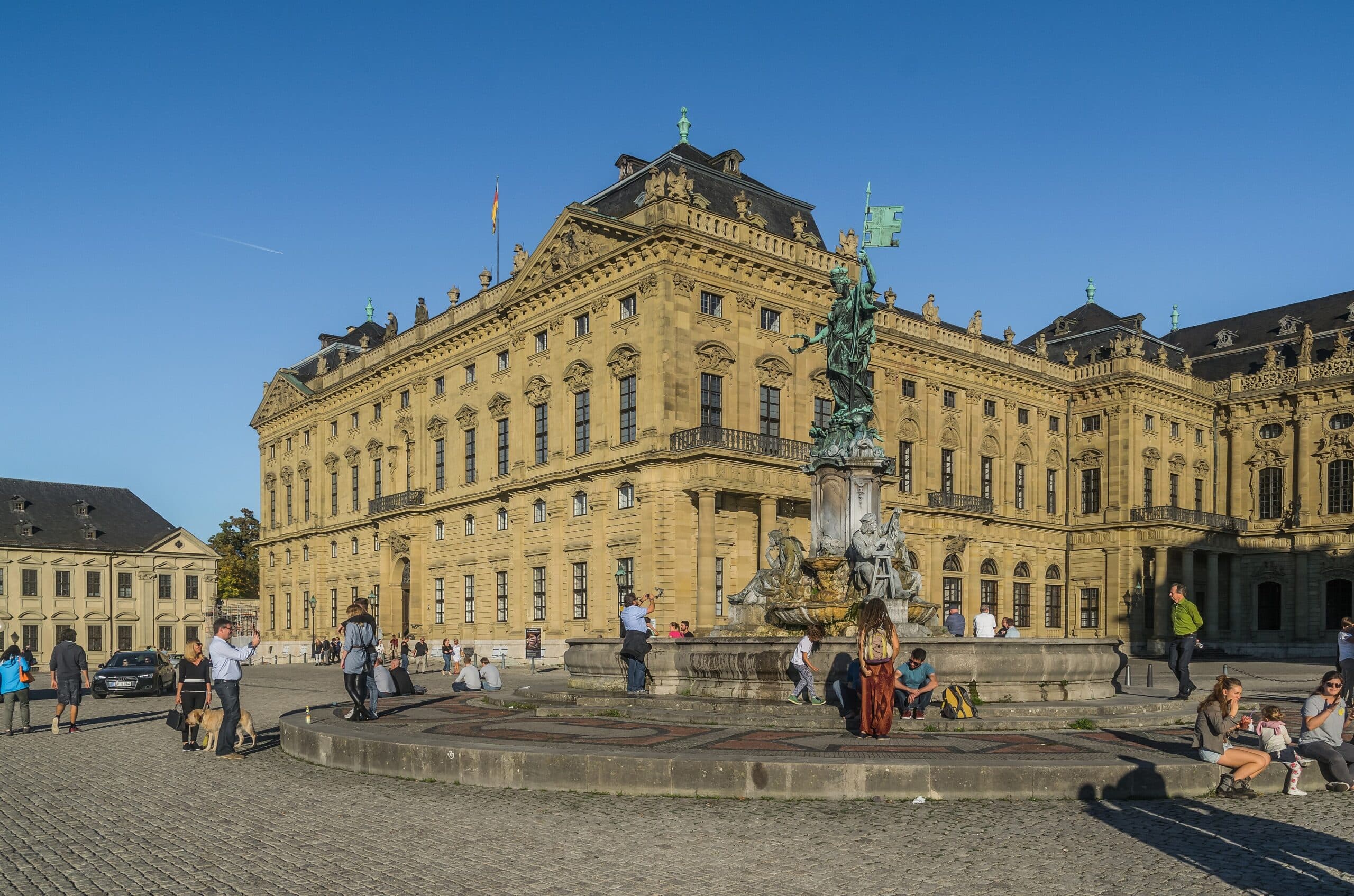
The Würzburg Residence is the supreme statement of German Baroque, built for the prince-bishops by Balthasar Neumann and inscribed by UNESCO in 1981. Its grand staircase is the building’s masterstroke: a vast vault, unsupported by a single interior column, crowned by what the palace administration calls the largest ceiling fresco ever painted. Giovanni Battista Tiepolo covered it in 1752 and 1753 with an allegory of the four continents paying homage to the prince-bishop. The Imperial Hall and the restored court garden round out a visit that asks for more time than most people expect.
Read the full Würzburg Residence guide →
8. Munich Residenz
 CC BY-SA 4.0, via Wikimedia Commons" srcset="https://stonekeepatlas.com/wp-content/uploads/2026/07/munich-residenz-koenigsbau-max-joseph-platz.jpg 1280w, https://stonekeepatlas.com/wp-content/uploads/2026/07/munich-residenz-koenigsbau-max-joseph-platz-300x225.jpg 300w, https://stonekeepatlas.com/wp-content/uploads/2026/07/munich-residenz-koenigsbau-max-joseph-platz-1024x768.jpg 1024w, https://stonekeepatlas.com/wp-content/uploads/2026/07/munich-residenz-koenigsbau-max-joseph-platz-768x576.jpg 768w" sizes="auto, (max-width: 1280px) 100vw, 1280px" />
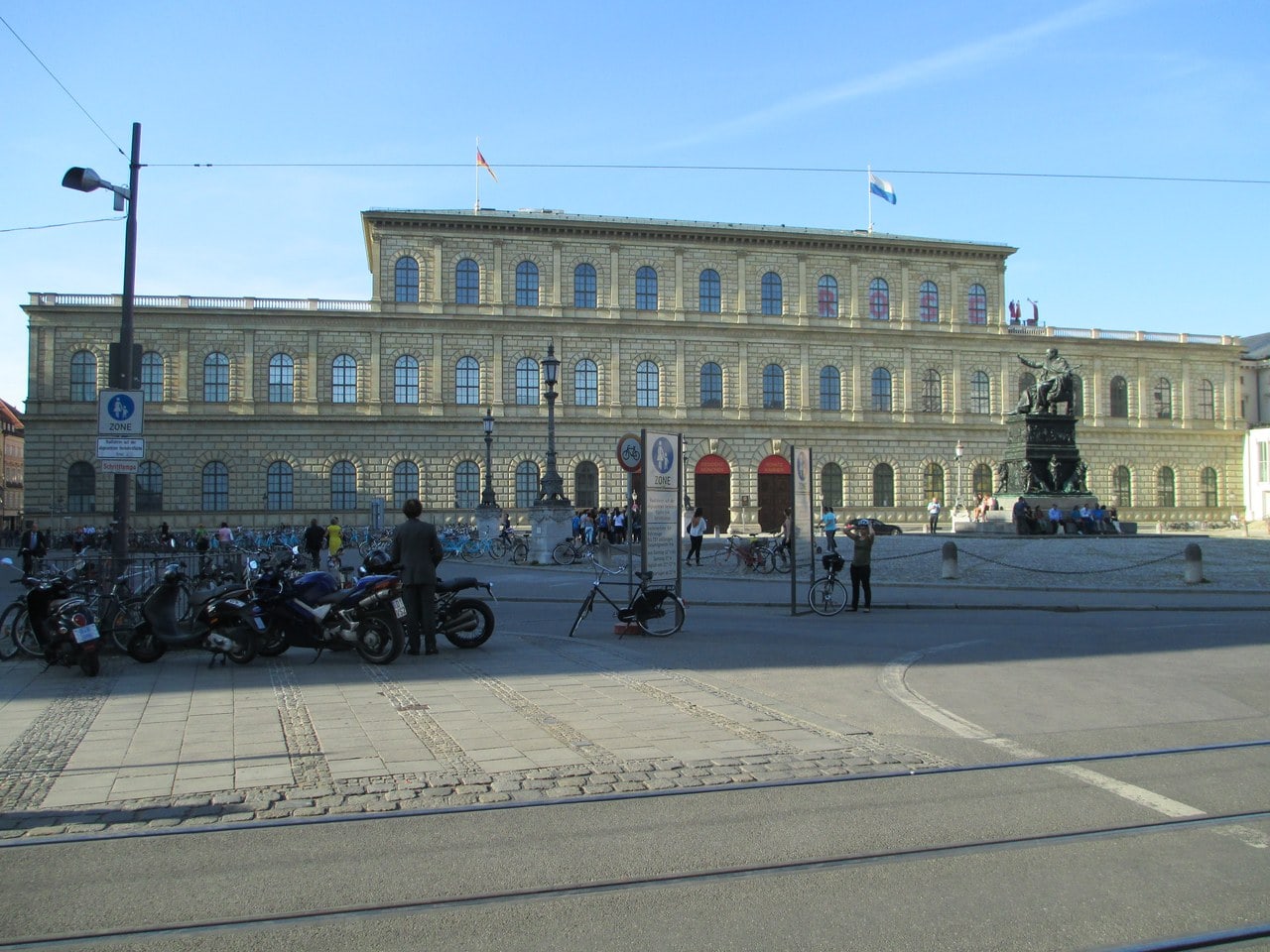
For four centuries the Wittelsbach dukes, electors, and kings governed Bavaria from the Munich Residenz, and what began as a moated castle in 1385 grew into the largest city-center palace in Germany. Behind a sober street facade lie ten courtyards and roughly 130 rooms in every style from Renaissance to neoclassicism, including the barrel-vaulted Antiquarium and the rococo jewel box of the Cuvilliés Theatre. It is less a single building than a city block of accumulated dynastic ambition. Several separate museums share the complex, so it pays to pick a route through the staterooms before going in.
Read the full Munich Residenz guide →
9. Sanssouci Palace
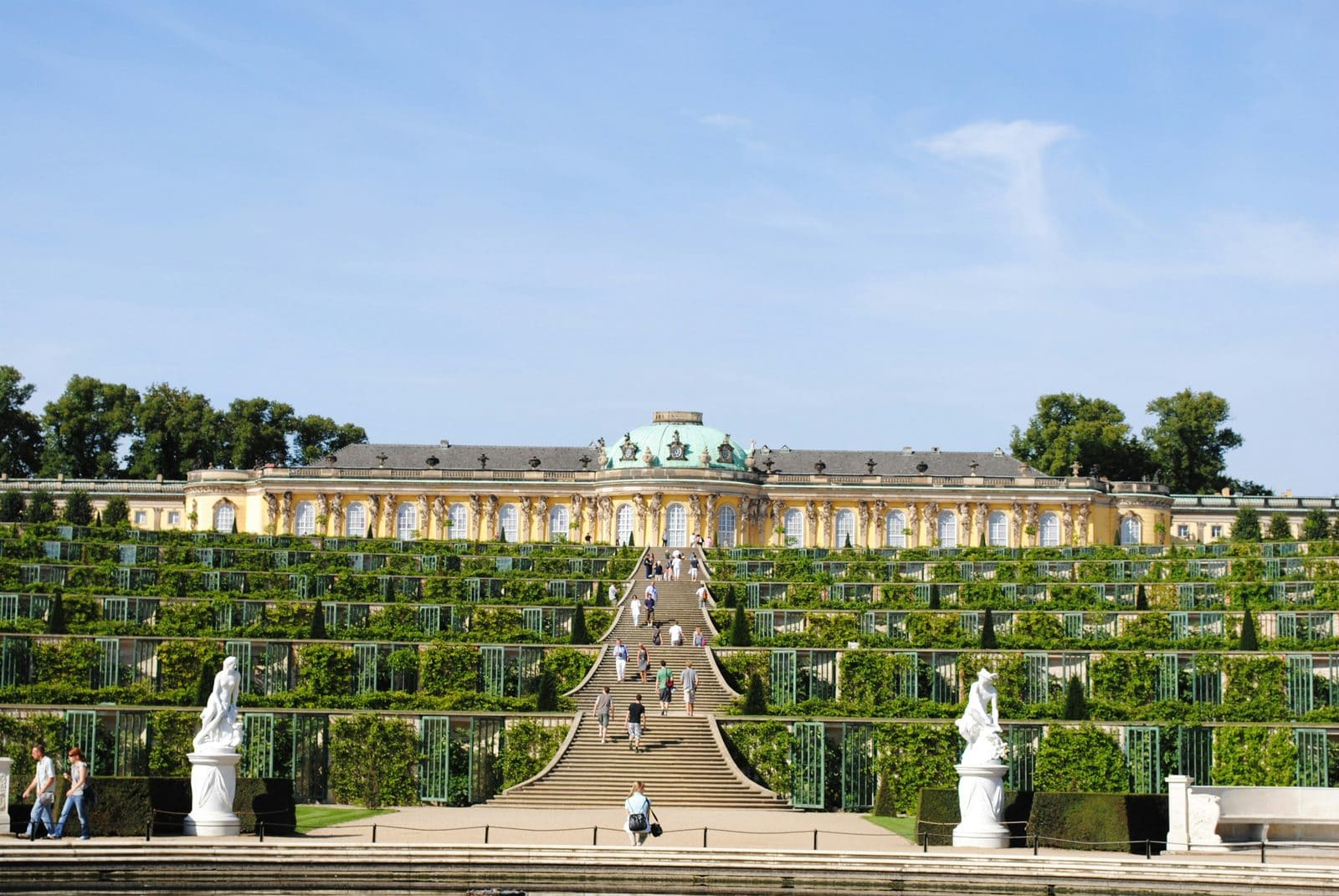
Sanssouci was Frederick the Great’s private escape, a single-story rococo pavilion he designed in close collaboration with the architect Georg Wenzeslaus von Knobelsdorff and completed in 1747. Its name is French for “without a care,” and the building lives up to it, stepping down to the Potsdam vineyards on curving garden terraces, more summer villa than palace of state. Frederick was buried, by his own wish, on the terrace beside his dogs. It anchors the Palaces and Parks of Potsdam and Berlin, a UNESCO World Heritage Site since 1990. The vineyard terraces and the surrounding park are free to wander, even when timed palace tickets have sold out.
Read the full Sanssouci Palace guide →
10. Albrechtsburg Castle
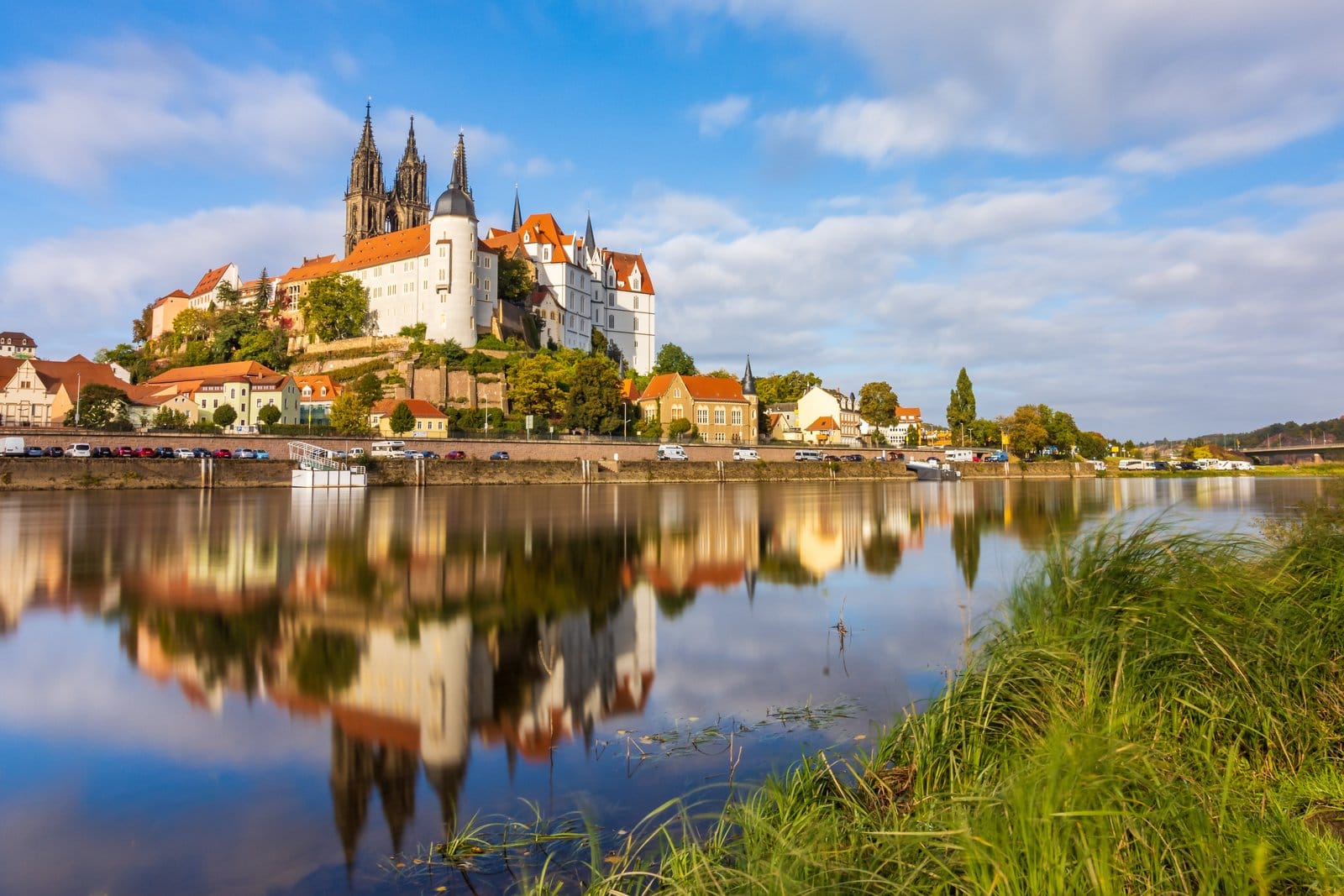
Rising over Meissen beside its cathedral, the Albrechtsburg is often described as the first building in Germany conceived as a residential palace rather than a fortress. Begun in 1471 by the master builder Arnold von Westfalen, its tracery vaults and great spiral staircase show late-Gothic architecture turning toward comfort and display. From 1710 the secure castle housed Europe’s first hard-paste porcelain manufactory, where the secret of true porcelain, newly cracked in nearby Dresden, was guarded behind its walls. Its halls now tell the story of how Europe finally matched the porcelain of China.
Read the full Albrechtsburg Castle guide →
Built to dream
The nineteenth century looked back at the medieval castle and chose to rebuild the idea rather than the reality. These five are products of romanticism and the industrial fortunes that funded it: a ruined toll castle made to look more medieval than it ever was, a king’s mountain fantasy, an ancestral seat reconstructed from almost nothing. They were never meant to withstand a siege. They were meant to be seen.
11. Neuschwanstein Castle
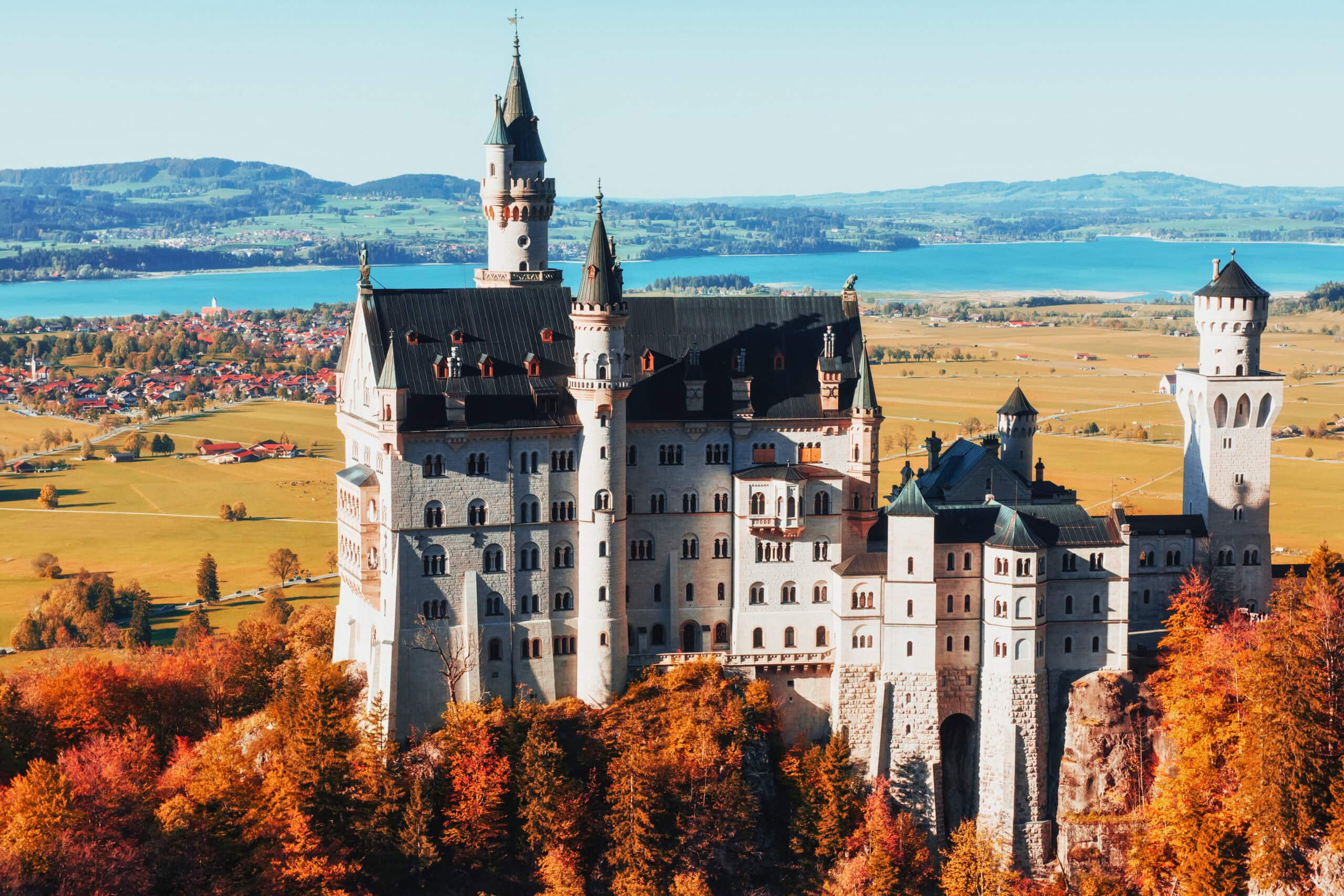
Neuschwanstein is the most photographed castle on earth and the one that taught the world what a castle should look like. King Ludwig II of Bavaria laid its foundation stone in 1869 as a private retreat dressed in medieval and operatic fantasy; he died in 1886 with the building unfinished, having lived in it for only about 170 days. Its towers above the Alpsee later inspired the castle at the center of Disney’s “Sleeping Beauty.” In 2025 UNESCO inscribed it, with Ludwig’s other palaces, as a World Heritage Site. The Marienbrücke footbridge gives the postcard view, and timed tickets are essential in every season.
Read the full Neuschwanstein Castle guide →
12. Hohenzollern Castle
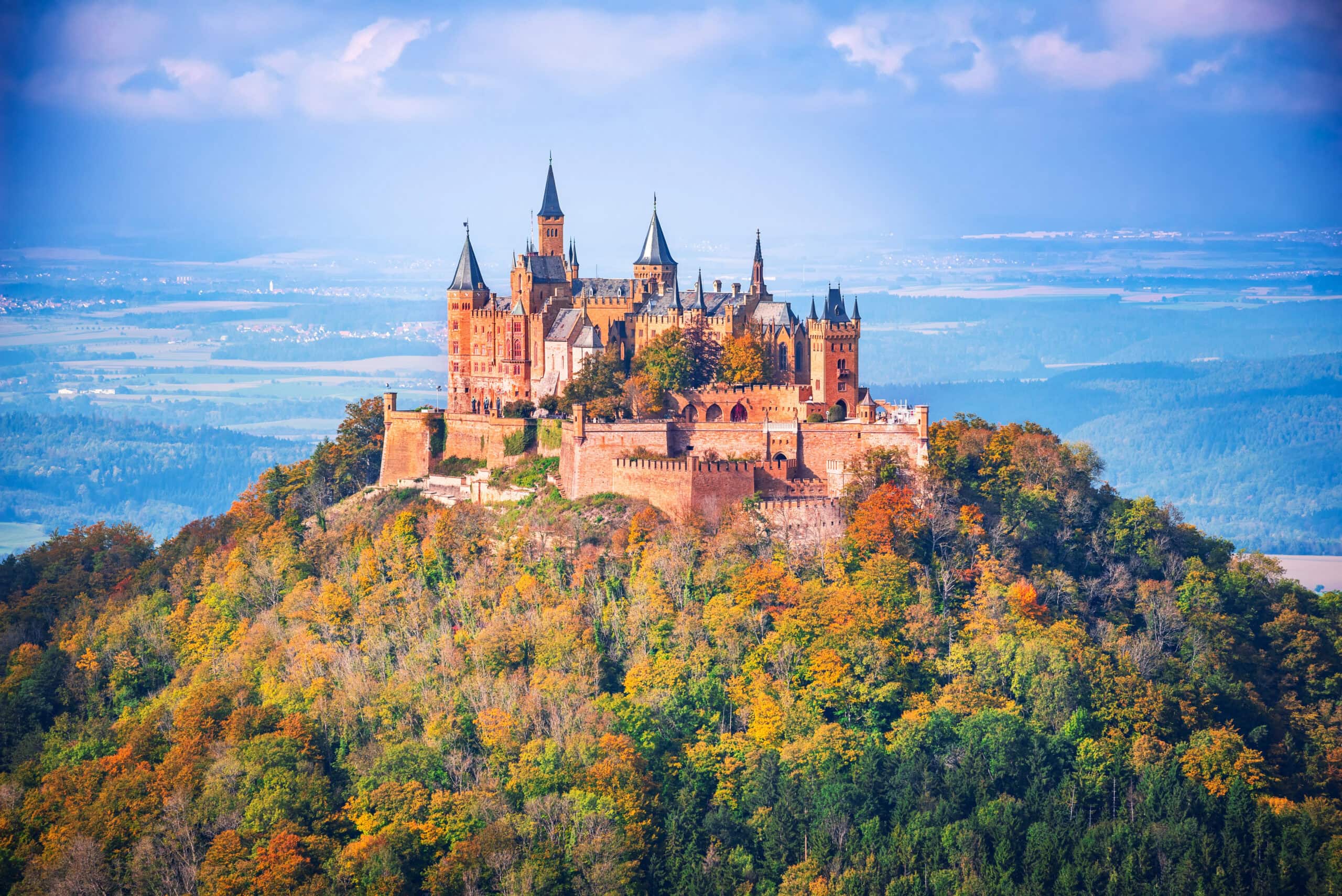
From the Swabian plain, Hohenzollern appears as a crown of towers floating on an isolated cone, a silhouette that often rises clear of the morning mist. It is the ancestral seat of the house that became kings of Prussia and German emperors, though the structure visitors climb to today is the third castle on the site, a neo-Gothic reconstruction built between 1846 and 1867 under King Frederick William IV of Prussia. The earlier strongholds had been ruined and rebuilt across the centuries. A shuttle covers the steep final climb, and clear autumn mornings reward early arrivals with the floating-castle effect.
Read the full Hohenzollern Castle guide →
13. Cochem Castle
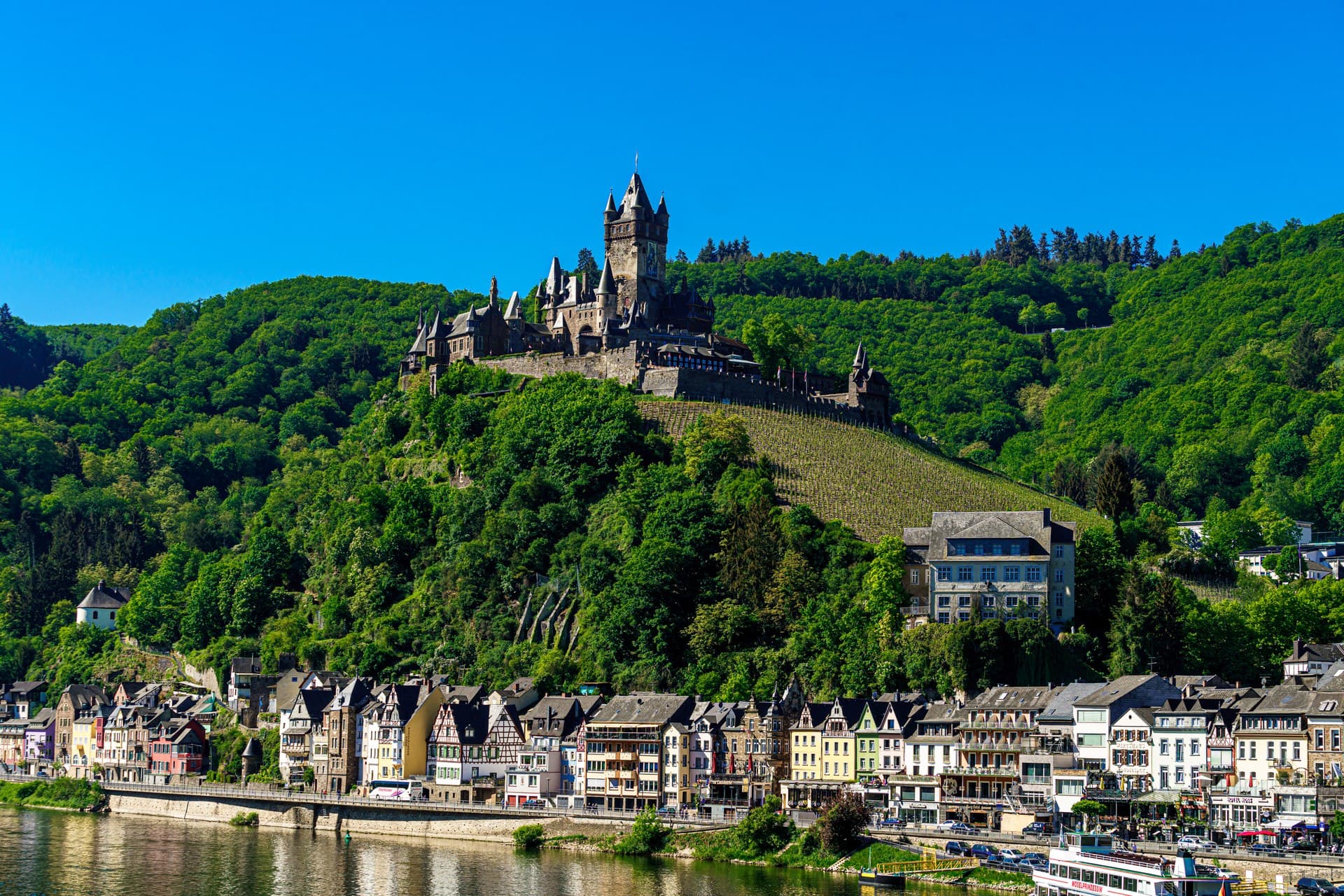
The Reichsburg above Cochem gives the Moselle its defining postcard, a steep cluster of towers and pointed roofs over the river bend. French troops destroyed the medieval castle in 1689, and it lay in ruins for nearly two centuries until the Berlin businessman Louis Ravené bought the site in 1868 and rebuilt it in romantic neo-Gothic style. The result is a nineteenth-century vision of the Middle Ages rather than a survivor of it, and it is all the more enjoyable for being honest about that. The climb up from the riverside town takes about fifteen minutes, and a guided tour is the only way inside.
Read the full Cochem Castle guide →
14. Drachenburg Castle
 CC BY 2.0, via Wikimedia Commons" srcset="https://stonekeepatlas.com/wp-content/uploads/2026/05/drachenburg-castle-south-facade-siebengebirge-scaled.jpg 2560w, https://stonekeepatlas.com/wp-content/uploads/2026/05/drachenburg-castle-south-facade-siebengebirge-300x200.jpg 300w, https://stonekeepatlas.com/wp-content/uploads/2026/05/drachenburg-castle-south-facade-siebengebirge-1024x682.jpg 1024w, https://stonekeepatlas.com/wp-content/uploads/2026/05/drachenburg-castle-south-facade-siebengebirge-768x512.jpg 768w, https://stonekeepatlas.com/wp-content/uploads/2026/05/drachenburg-castle-south-facade-siebengebirge-1536x1023.jpg 1536w, https://stonekeepatlas.com/wp-content/uploads/2026/05/drachenburg-castle-south-facade-siebengebirge-2048x1364.jpg 2048w" sizes="auto, (max-width: 2560px) 100vw, 2560px" />
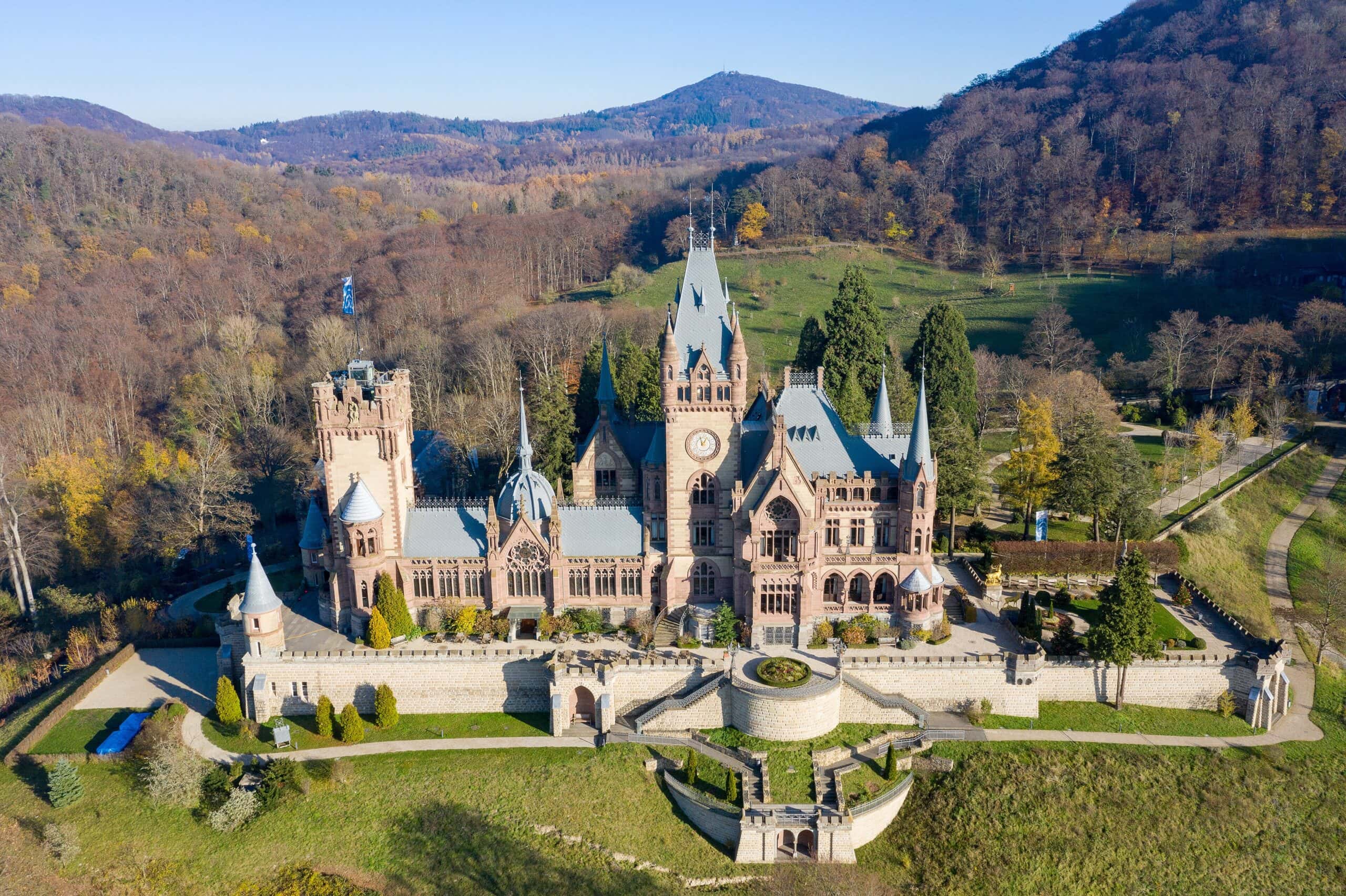
Schloss Drachenburg is the youngest castle on this list and one of the strangest, a private villa-palace thrown up on the Drachenfels hill above Königswinter in barely two years, between 1882 and 1884. Its patron, Baron Stephan von Sarter, was a Bonn-born stockbroker who made a fortune in Paris, commissioned a Rhineland dream castle, and then never moved in. Behind its historicist towers and stained glass is the confidence of the German Gründerzeit boom rather than any feudal past. It is now a museum of the Gründerzeit era, reached by a historic rack railway up the Drachenfels.
Read the full Drachenburg Castle guide →
15. Schwerin Castle
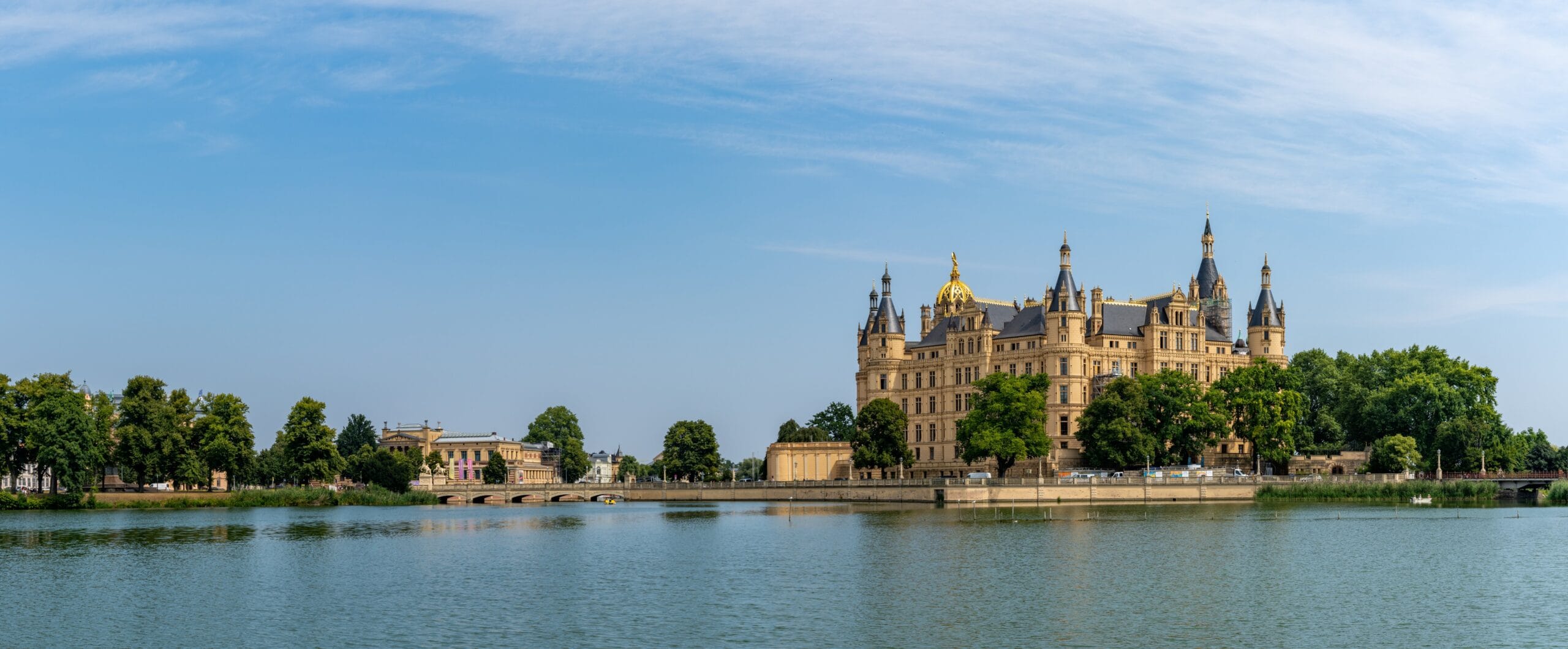
Often called the Neuschwanstein of the North, Schwerin spreads across its own island in the lake at the heart of the city, a romantic-historicist palace of golden domes and turrets completed in the 1850s for the grand dukes of Mecklenburg. It now houses the state parliament, so a working seat of government sits inside one of Germany’s most ornamental buildings. In 2024 UNESCO inscribed the wider Schwerin Residence Ensemble as a World Heritage Site, the country’s newest at the time. The throne room, the chapel, and the lakeside gardens make it one of the most rewarding palace visits in the north.
Read the full Schwerin Castle guide →
Beyond the 15: regional and thematic guides
Fifteen castles can only sample a country that counts its surviving fortifications in the thousands. For deeper regional dives, StoneKeep Atlas keeps roundups for the areas with the densest concentrations: the Castles of the Rhine Gorge, the best castles in Bavaria, the Castles of Saxony, the Castles of Franconia, and the Castles of Thuringia. Three thematic collections cut across regions: the Prussian Royal Castles around Berlin and Potsdam, the nineteenth-century Romantic Revival of German castles that produced several of the showpieces above, and the fairytale castles in Germany, the eleven buildings that carry the storybook silhouette. Each gathers a cluster of full guides in one place.
Which German castle should you visit?
There is no single best castle in Germany, only the best castle for the experience you are after. To stand inside a working medieval fortress, choose the Marksburg or the Wartburg. For Baroque spectacle, Würzburg or Sanssouci. For the romantic dream the nineteenth century sold to the world, Neuschwanstein, Hohenzollern, or Schwerin.
Several of the fifteen pair naturally into a single trip. Eltz and Cochem sit within a short drive of each other on the lower Moselle; Koenigstein and the Albrechtsburg bracket the Elbe in Saxon Switzerland and Meissen, an easy day apart near Dresden; and Neuschwanstein and the Munich Residenz bookend a Bavarian visit. Clear autumn mornings are kindest to the hilltop silhouettes, when mist pools below Hohenzollern’s cone and the river valleys turn, though the interiors reward a visit in any season.
The fifteen here span ten regions and four centuries of building, and every one rewards a visit in person far more than any photograph suggests. Start with the guides linked above, and let the map decide your route.
Principal Sources
- Albrechtsburg Meissen (Staatliche Schlösser, Burgen und Gärten Sachsen). Official history of the castle and the Meissen porcelain manufactory.
- Bayerische Schlösserverwaltung (Bavarian Palace Administration). Official pages for Neuschwanstein, the Würzburg Residence, the Munich Residenz, and the Imperial Castle of Nuremberg.
- Burg Eltz administration. Official family history, including the line of succession to the present generation.
- Reichsburg Cochem. Official account of the castle’s destruction in 1689 and its nineteenth-century reconstruction.
- Schloss Drachenburg (NRW-Stiftung). Official history of the building and its patron, Stephan von Sarter.
- Stiftung Preußische Schlösser und Gärten Berlin-Brandenburg. Official material on Sanssouci and Frederick the Great.
- Schwerin Residence Ensemble (UNESCO World Heritage). Official documentation of the 2024 inscription.
- UNESCO World Heritage Centre. Inscription records for the Wartburg (1999), the Würzburg Residence (1981), the Upper Middle Rhine Valley (2002), the Palaces and Parks of Potsdam and Berlin (1990), the Schwerin Residence Ensemble (2024), and the Palaces of King Ludwig II of Bavaria (2025).
- Wartburg-Stiftung Eisenach. Official history of Luther’s stay and the translation of the New Testament.
Front-end visiting details, dimensions, and dates were cross-checked against the individual StoneKeep Atlas castle guides linked throughout this collection.
Image credits. Wartburg Castle: Moritz Grenke, CC BY-SA 3.0, via Wikimedia Commons; Eltz Castle: FrDr, CC BY-SA 4.0, via Wikimedia Commons; Marksburg Castle: via Adobe Stock; Nuremberg Castle: DALIBRI, CC BY-SA 2.0 DE, via Wikimedia Commons; Königstein Fortress: seaq68, via Pixabay; Heidelberg Castle: via Envato Elements; Würzburg Residence: Krzysztof Golik, CC BY-SA 4.0, via Wikimedia Commons; Munich Residenz (Königsbau façade): Avi1111 (Dr. Avishai Teicher), CC BY-SA 4.0, via Wikimedia Commons; Sanssouci Palace: Sandip Roy, via Unsplash; Albrechtsburg Castle: via Adobe Stock; Neuschwanstein Castle: via Adobe Stock; Hohenzollern Castle: via Adobe Stock; Cochem Castle: via Adobe Stock; Drachenburg Castle: dronepicr, CC BY 2.0, via Wikimedia Commons; Schwerin Castle: via Adobe Stock. National locator map: StoneKeep Atlas (own work). Freely licensed images are resized to fit; otherwise unaltered.