
Leeds Castle
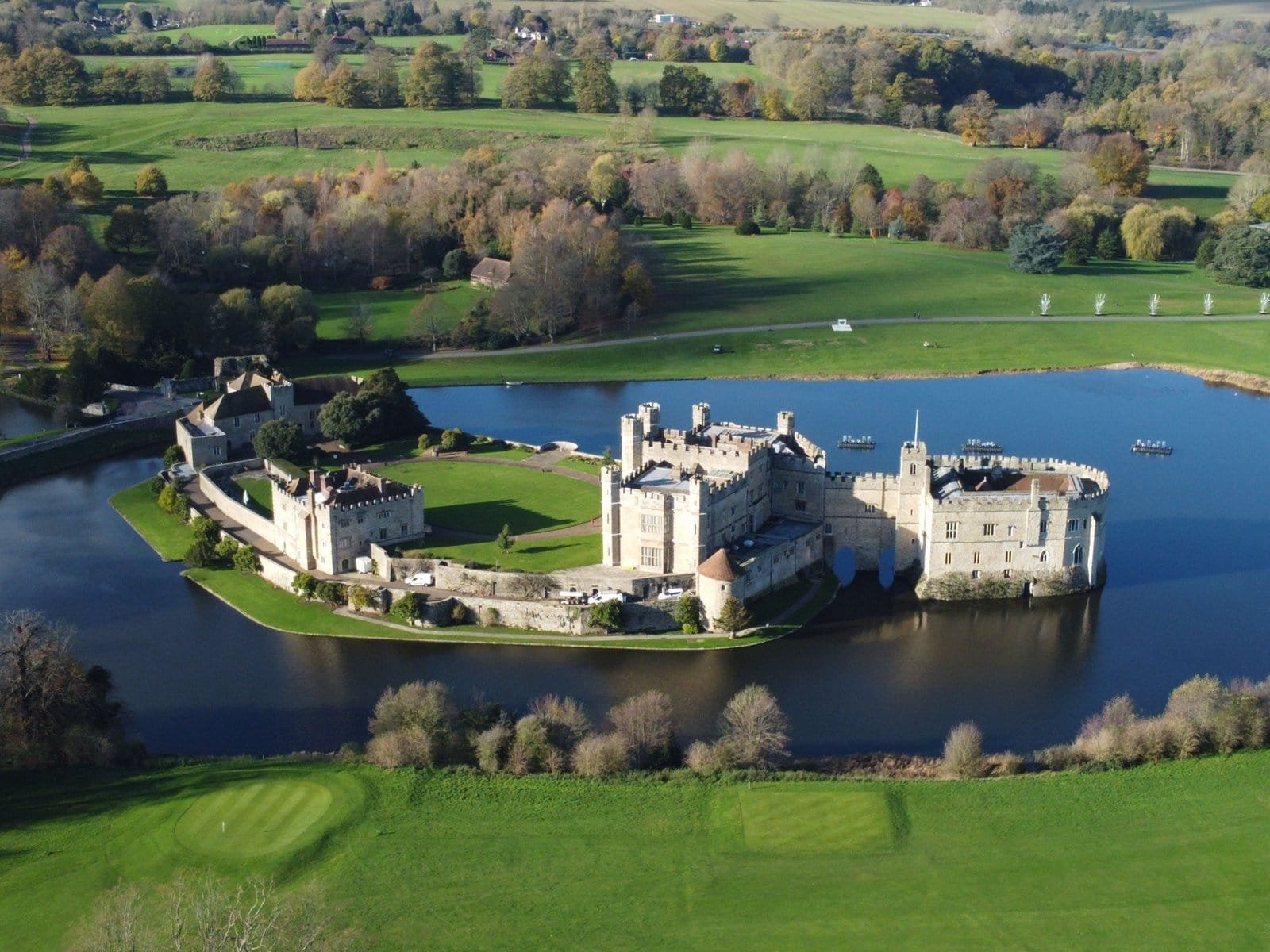
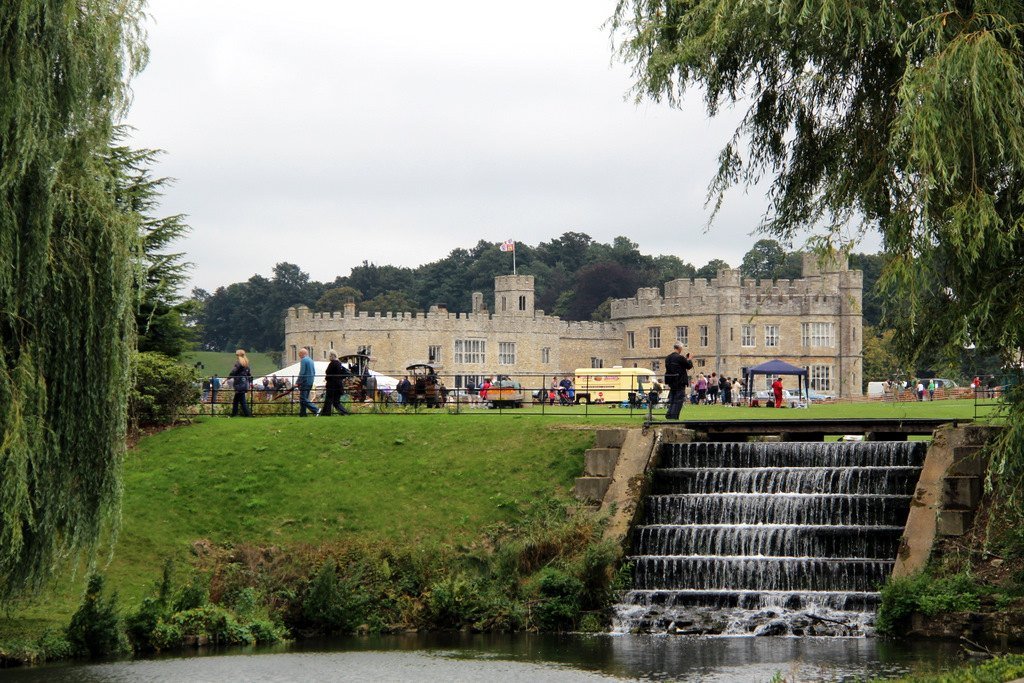
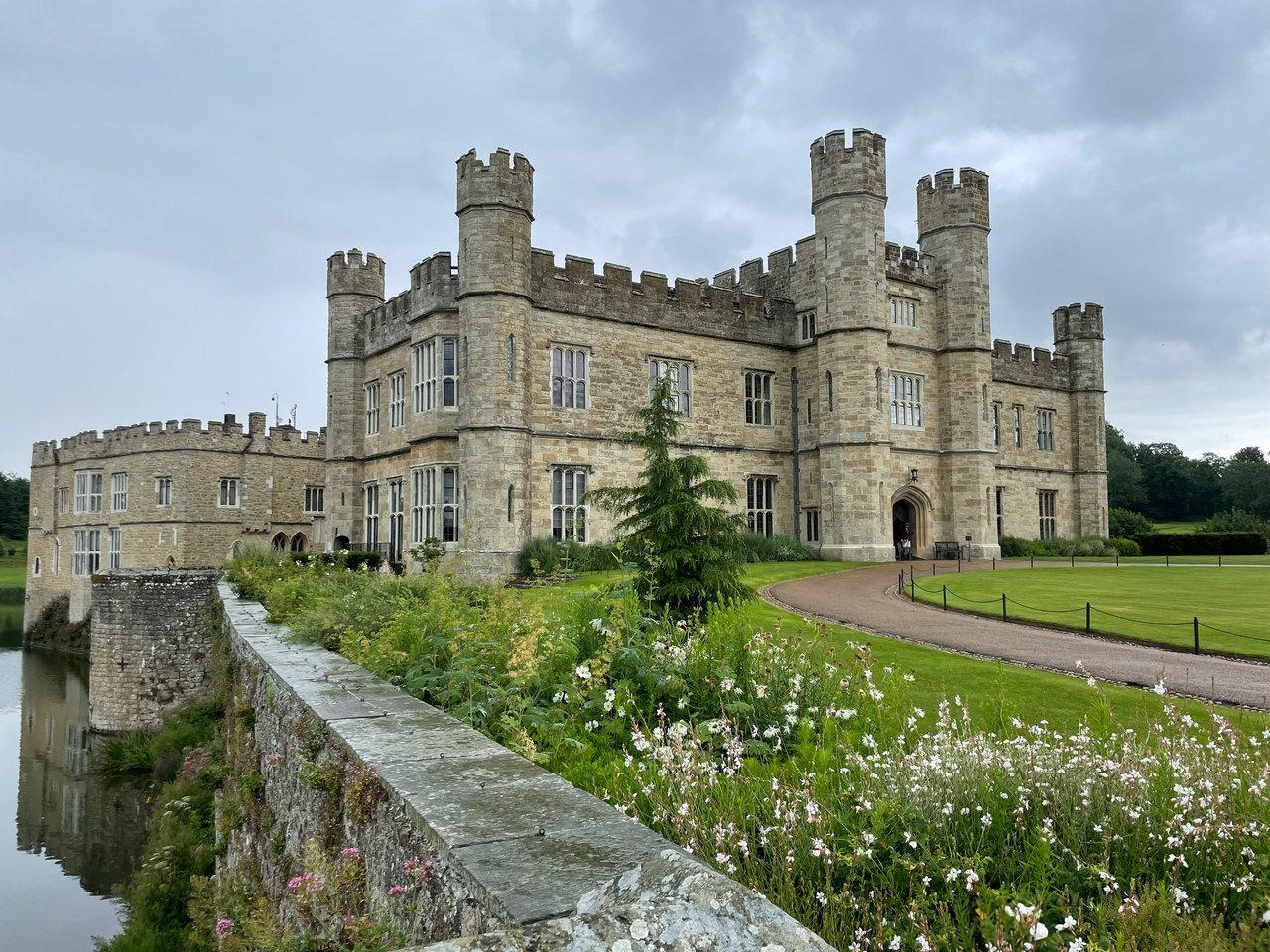
Crossing the cascade by the Cedar Lake, on the walk from the visitor center through the Princess Alexandra Gardens, gives what the castle’s owners call the first “grand reveal” of Leeds Castle. It stands on two islands in a moat at the eastern edge of the village of Leeds, near Maidstone in Kent, and takes its name from that village: this is not the Leeds of West Yorkshire. Historic England records the moat from at least 1272.
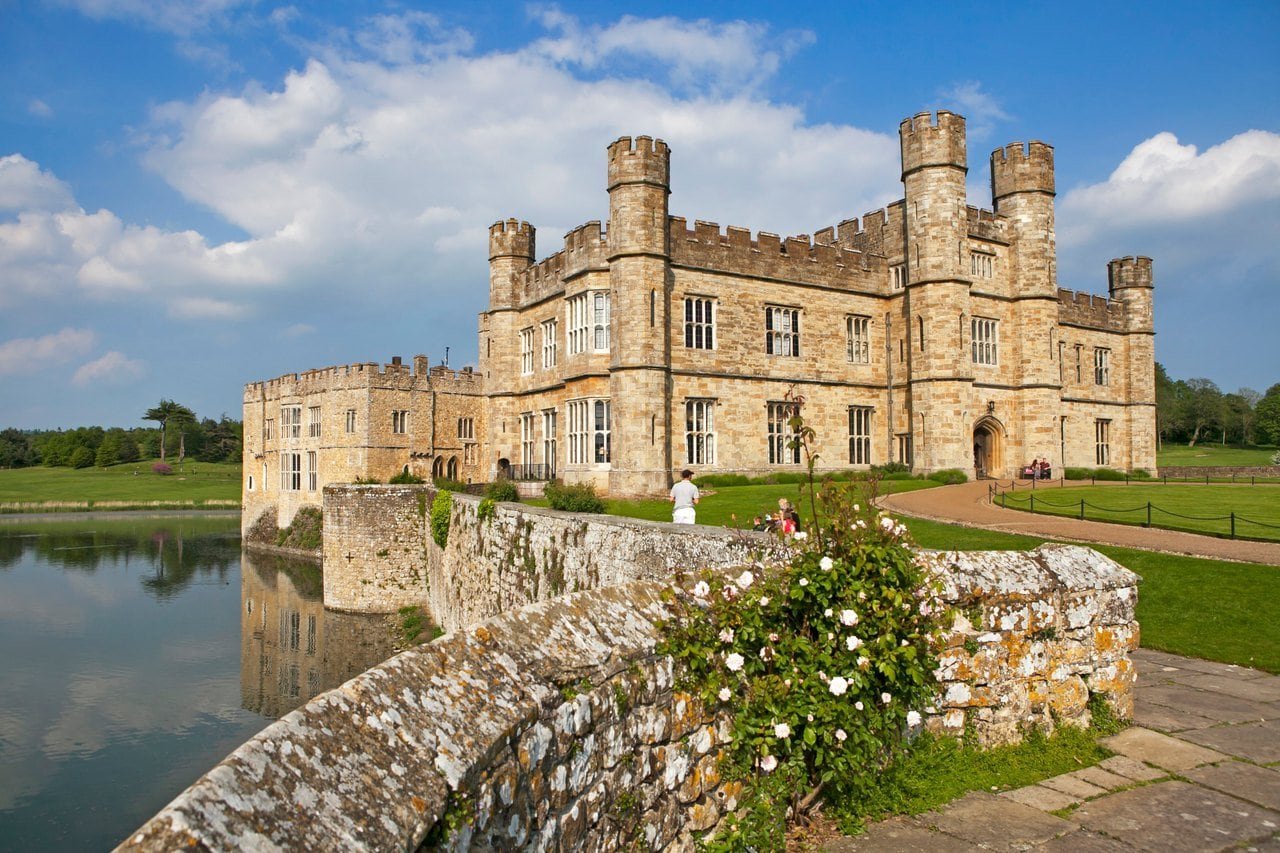
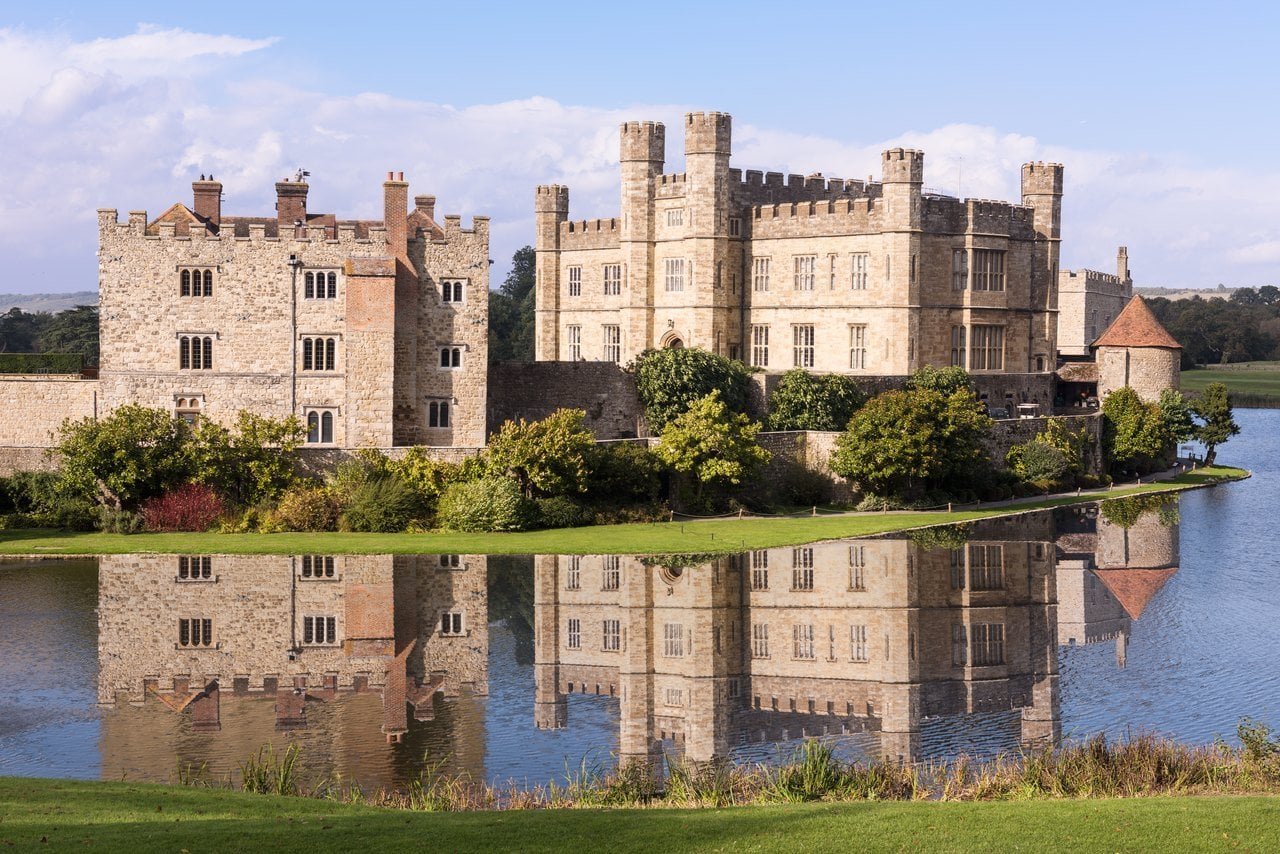
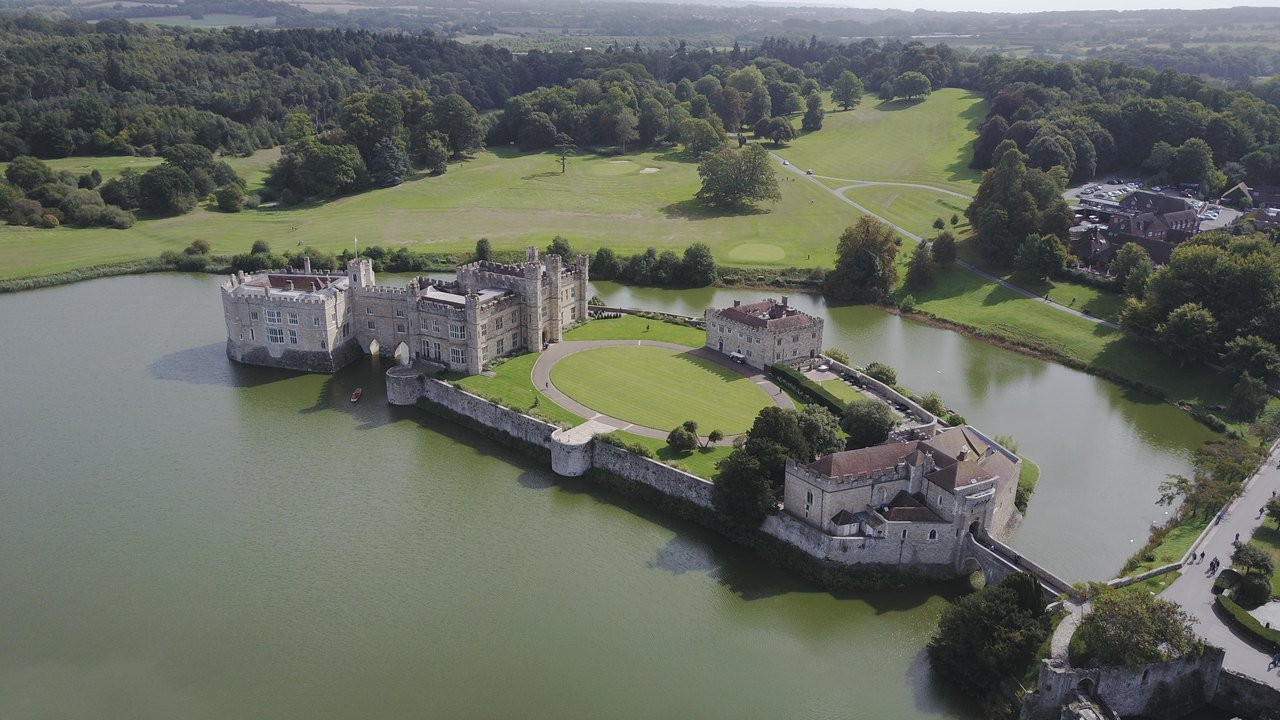
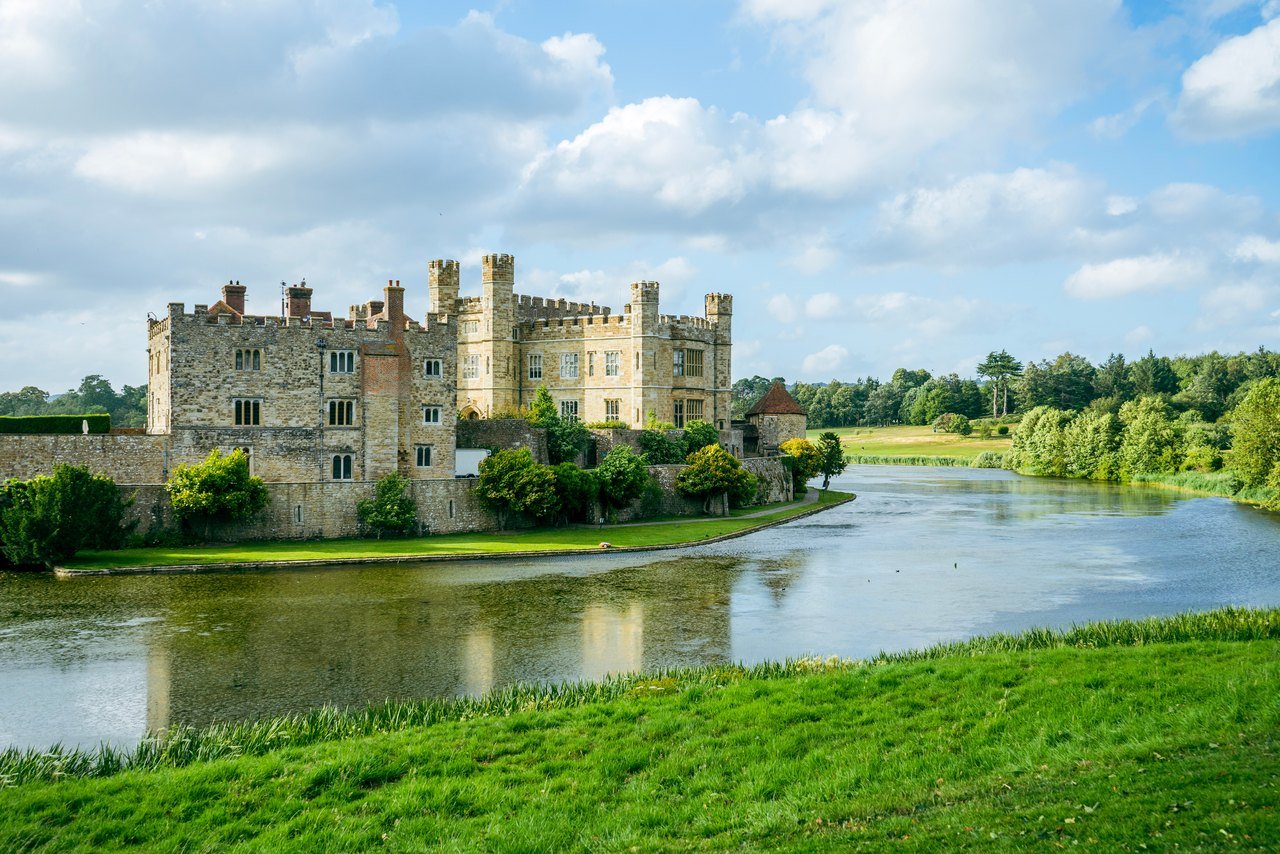
From the park, Leeds reads as a single medieval stronghold rising from its water. What stands on the islands is layered. There is a medieval outer wall, a gatehouse and the ruins of the barbicans that guarded the approach; on the smaller island, a Gloriette whose outer walls are medieval and whose upper floor is Tudor; a house in the Tudor style built in 1822-23; and rooms remade for Lady Baillie from 1926 to the 1960s, first by her architect Owen Little and the Paris designer Armand-Albert Rateau, then by Stéphane Boudin.
Edward I and Eleanor of Castile acquired the castle in about 1278. It remained a royal castle until 1552, though kings sometimes granted it out, and in those centuries six medieval queens held it in turn, as the Foundation that now runs it counts them. Henry VIII’s constable remodeled it for the king and Catherine of Aragon, the Foundation says. In 1926 the Hon. Olive Wilson Filmer, later Lady Baillie, bought it with her husband, and since her death in 1974 it has belonged to the Leeds Castle Foundation, a charity, which opened the castle to visitors in 1976.
Quick Facts
| Location | Broomfield and Kingswood parish, near Maidstone, Kent ME17 1PL (postal address), England; on the eastern edge of Leeds village |
|---|---|
| Built | Earliest fabric early-to-mid 12th century (Historic England); outer wall and barbicans 13th century; Gloriette upper floor 16th century; New Castle 1822-23 |
| Built for | The Crevecoeur family; Edward I and Eleanor of Castile (13th-century works, dated by architecture); Henry VIII and Catherine of Aragon (1517-23 works, the Foundation); Fiennes Wykeham Martin (New Castle) |
| Architectural style | Medieval fortifications; New Castle in the Tudor style (1822-23, William Baskett); interiors of 1926 to the 1960s |
| Castle type | Moated castle on two islands |
| Condition | Roofed and furnished main buildings; barbicans ruined; all but one of the D-shaped wall towers cut down |
| Owner / managed by | Leeds Castle Foundation (registered charity 268354) |
| Heritage designation | Historic England, National Heritage List for England: 1039919, Leeds Castle, listed building Grade I (20 Oct 1952); 1060933, Ruins of Barbicans and Dam at Leeds Castle, listed building Grade I (18 Dec 1985); 1000184, Leeds Castle, registered park and garden Grade II* (1 May 1986) |
| Town & stations | Maidstone; Hollingbourne and Bearsted stations (Southeastern) |
| Open to public | Yes, ticketed, through the year on opening days that vary by season; the castle keeps shorter hours than the grounds |
| Official website | Leeds Castle (leeds-castle.com) |
History
Esledes, Ledian and the Crevecoeurs, to the 1260s
A first, wooden castle here is sometimes dated to 857 and credited to a Saxon chief minister called Ledian. An eighteenth-century chronology, John Trusler’s of 1776, prints the date; Edward Hasted in 1798 told the Ledian story from an earlier Kent writer, Kilburne, under a king who began to reign in 978; and the castle’s own guidebook later repeated the date. Domesday Book, in 1086, records the manor of Esledes but no castle. Its lord then was Odo, bishop of Bayeux, the half-brother of William the Conqueror.
The Crevecoeur family, who held Leeds from about the end of the eleventh century until the 1260s, built the castle, and Hasted credits Robert de Crevecoeur with erecting it. The Foundation dates the first stone castle to 1119 and Historic England’s park register to about 1119; the building’s own list entry dates its earliest fabric only to the early-to-mid twelfth century. According to Hasted, 1119 is also the year in which Robert de Crevecoeur founded Leeds Priory, moving there the canons who had served a chapel inside his castle. Robert was the lord who had the castle built; the earliest architect Historic England’s records name for any building on the site is William Baskett of Camberwell, who designed the house of 1822-23.
In 1138, during the war between King Stephen and the Empress Matilda, the castle was held for Matilda’s half-brother Robert, earl of Gloucester, until Gilbert de Clare, whom Stephen had just made earl of Pembroke, besieged it and the garrison surrendered. Orderic Vitalis, the chronicler who tells the story, names it with Bristol and Dover among the strongholds the earl had taken into his own hands: “the very strong fortresses of Bristol, Leeds, and Dover.” In the 1260s the Crevecoeurs lost Leeds, and it passed to the Leybourne family.
The Queens’ Castle, 1278-1437
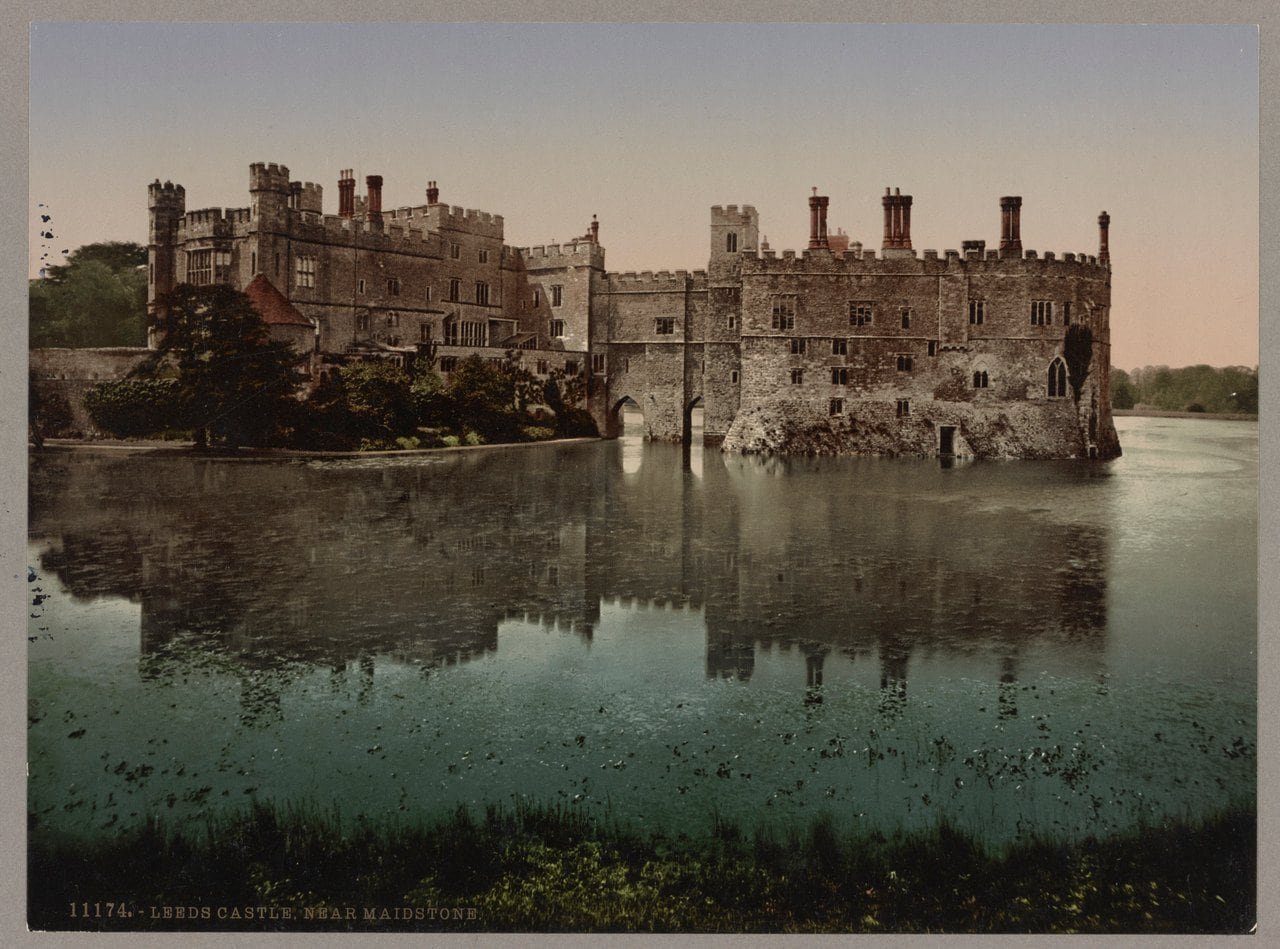
Edward I and Eleanor of Castile acquired Leeds in about 1278 from William of Leybourne. Historic Royal Palaces counts it among the manors Eleanor gained in the 1270s by buying up debts owed to Jewish moneylenders. No enrolled works accounts for Leeds survive from Edward I’s reign, a gap that Colvin’s History of the King’s Works attributes to the castle’s tenure by two queens, yet much was built. Colvin reads the architecture as showing that in Edward I’s time the outer wall and its D-shaped towers were added, the main gatehouse much amended and the Gloriette built or rebuilt; Historic England’s list entry records late-thirteenth-century work on all three. The only documentary evidence for the outer wall, Colvin writes, is an account of 1298-99, for works done ahead of a visit by the king and queen.
The Gloriette’s name, which Leeds shared with chambers at Corfe and Chepstow, is thought to derive from the Saracen palace of a twelfth-century French epic, La Prise d’Orange. It was already in use in England by 1260-61, before Eleanor came to Leeds.
Edward I gave the castle in dower to his second queen, Margaret of France, in 1299. Edward II, Margaret’s stepson, later granted it to Bartholomew de Badlesmere in exchange for the manor of Adderley in Shropshire, although its reversion had been promised to Queen Isabella.
The Siege of 1321
In the autumn of 1321 Queen Isabella was refused entry to Badlesmere’s castle. She had asked, according to the chronicle known as the Vita et mors Edwardi Secundi, to spend the night there. Who turned her away is told two ways: Colvin’s King’s Works blames Badlesmere’s castellan, while the Complete Peerage gives the refusal to Badlesmere’s wife. Hasted writes that the queen then tried to force an entry, and that one or more of her attendants were killed in the skirmish that followed. Edward II besieged the castle in person; a rebel relief force got no nearer than Kingston, and the garrison surrendered. Members of the garrison were executed, and Lady Badlesmere (Margaret de Clare) and her children were sent to the Tower of London. Badlesmere himself, defeated with the rebels at Boroughbridge, was executed at Canterbury on 14 April 1322. Our ledger of how castles fell lists the 1321 siege among the surrenders whose terms are not recorded.
Isabella held the castle herself from 1327 until her death in 1358, the Foundation says. Edward III kept it and did not grant it to his own queen, Philippa of Hainault, and in July 1359 William of Wykeham, later bishop of Winchester, was appointed keeper and surveyor of the castle. Richard II granted Leeds to Anne of Bohemia in 1382, the Foundation says, and records that she spent the Christmas before her wedding there. In July 1395 the chronicler Jean Froissart followed Richard’s court to what Thomas Johnes’s translation calls “a beautiful palace in the county of Kent, called Leeds castle …” How the words castle and palace were used for buildings like this is the subject of our guide to castle, palace and fortress.
After Anne’s death the castle was granted to private holders for a short time, the Foundation says. Froissart has Richard II’s second queen, Isabella of Valois, living at Leeds with the lady of Coucy when Richard was taken in 1399, and Hasted records that at the start of the next reign Henry IV sent Richard himself there as a prisoner. Henry IV then gave Leeds to his own queen, Joan of Navarre, on their marriage in 1403, the Foundation says. In 1419 Joan, stepmother of Henry V, was accused of plotting against the king’s life and confined at Leeds before being moved to Pevensey (Hasted); the Foundation adds that the charge was witchcraft, and that she returned to Leeds in March 1422 and was freed that July. Between 1421 and 1425, Colvin records, extensive repairs were made at a time when Charles, duke of Orléans, was a captive in the castle. When Henry V died in 1422 he left Leeds to his queen, Catherine de Valois, who held it until her death in 1437, according to the Foundation. With her the line of medieval queens ends: Eleanor, Margaret, Isabella, Anne, Joan and Catherine.
Henry VIII and the Gloriette, 1512-1552
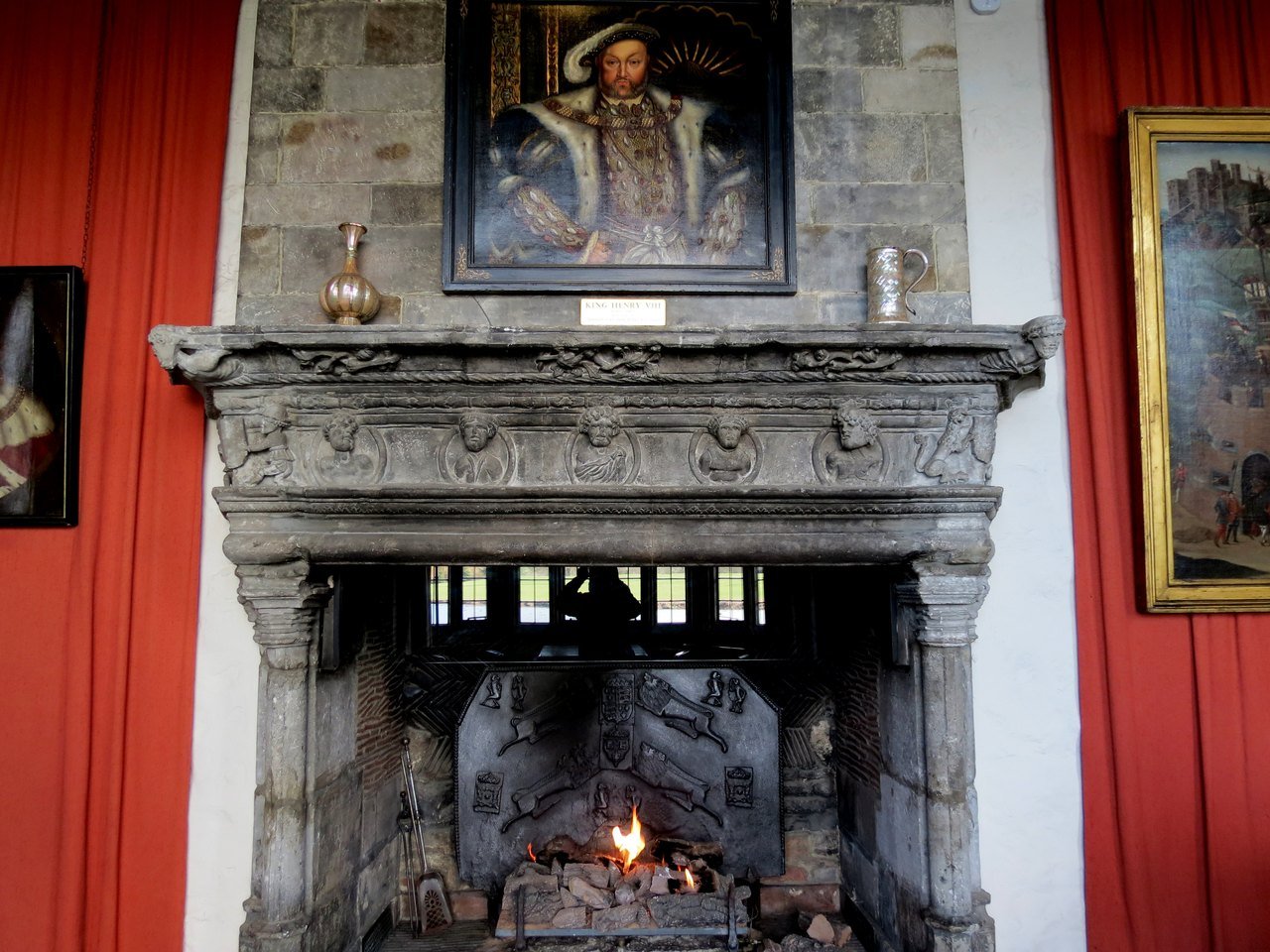
Henry VIII made his friend Sir Henry Guildford constable of Leeds in 1512, and Guildford held the post until his death in 1532. Between 1517 and 1523, in the Foundation’s account, the king spent heavily on turning the castle into a palace fit for himself and Catherine of Aragon, and the inventory taken at Guildford’s death shows that the principal apartments were still in the Gloriette and that an upper floor had been added to it. Historic England dates the Gloriette’s upper-floor windows and its two-story canted bay window to about 1520-30, and records an early-sixteenth-century stone fireplace in what its list entry calls the “former banqueting room.”
The court’s stay at Leeds on the way to the Field of Cloth of Gold in May 1520 has long been told. Research by the Foundation found no surviving account that confirms it, and suggests the party may have lodged at the Archbishop’s Palace in Maidstone instead. Surviving records do show, the Foundation says, that venison from the Leeds estate and butter from its dairies were supplied for the summit.
In 1552 Edward VI granted Leeds to Sir Anthony St Leger, who served as lord deputy of Ireland, and the castle passed out of royal hands for good.
Private Owners, 1552-1821
A Warham St Leger sold Leeds to Richard Smythe (Hasted and the History of Parliament put the sale before 1599; the Foundation and Historic England’s park register say 1618), and Sir Richard built a Jacobean house on the main island. In 1632 the Smythes sold the castle to Sir Thomas Culpeper. Leeds came through the English Civil War relatively unscathed, the Foundation says, while Hasted writes that Parliament seems to have used it as a place for its committee men and sequestrators to meet and as a prison for ejected ministers. Many English castles fared worse, as our survey of why so many English castles are in ruins explains. In 1663 the castle was bought by a cousin, Thomas, 2nd Lord Culpeper, whose father, the 1st Lord Culpeper, had been rewarded for political services with large landholdings in America (Historic England).
In October 1665, during the Second Anglo-Dutch War, John Evelyn, a commissioner for prisoners of war, arranged the march of 500 prisoners to Leeds Castle, “which I had hired of Lord Culpeper”; in November 1666 he mustered about 600 Dutch and French prisoners there. (Evelyn’s dates are Old Style, as he wrote them.) A fire during the prisoners’ stay, between 1665 and 1667, destroyed the rooms in a large part of the old castle on the smaller, northern island, W. A. Scott Robertson wrote in 1883; the Foundation says the prisoners started it, and that the damage was not repaired until the nineteenth century.
Through the marriage in 1690 of Lord Culpeper’s daughter Catherine to Thomas, 5th Lord Fairfax, Leeds passed to the Fairfax family. In the 1740s their son, the 6th Lord Fairfax, settled in Virginia to manage his estates, leaving Leeds to his brother Robert. Robert Fairfax had the estate surveyed by the cartographer Thomas Hogben in 1748, and from the 1750s he altered Sir Richard Smythe’s house in the Strawberry Hill Gothick manner (Historic England). A later owner, Charles Wykeham Martin, thought little of the result; the Foundation quotes his verdict: “A more ruinous disfigurement was perhaps never perpetrated.”
On 3 November 1778, after reviewing the army camp at Coxheath, George III and Queen Charlotte spent the night at Leeds Castle as guests of the Hon. Robert Fairfax, leaving the next morning (London Gazette). Robert Fairfax died in 1793; Leeds passed to his nephew and then to the nephew’s brother, General Philip Martin, who left it, with the fortune from the sale of his American estates, to a distant relative, Fiennes Wykeham, who took the additional name of Martin (Historic England).
Wykeham Martin and the New Castle, 1821-1925
Fiennes Wykeham Martin inherited Leeds in 1821 and commissioned William Baskett to survey it; the Foundation says the report was devastating. He demolished the Jacobean house and, with Baskett as his architect, built the present New Castle in 1822-23 (Historic England), a house in the Tudor style that the Foundation describes as finished by 1823, “an extraordinarily swift process.” He also laid out the park between 1822 and 1825.
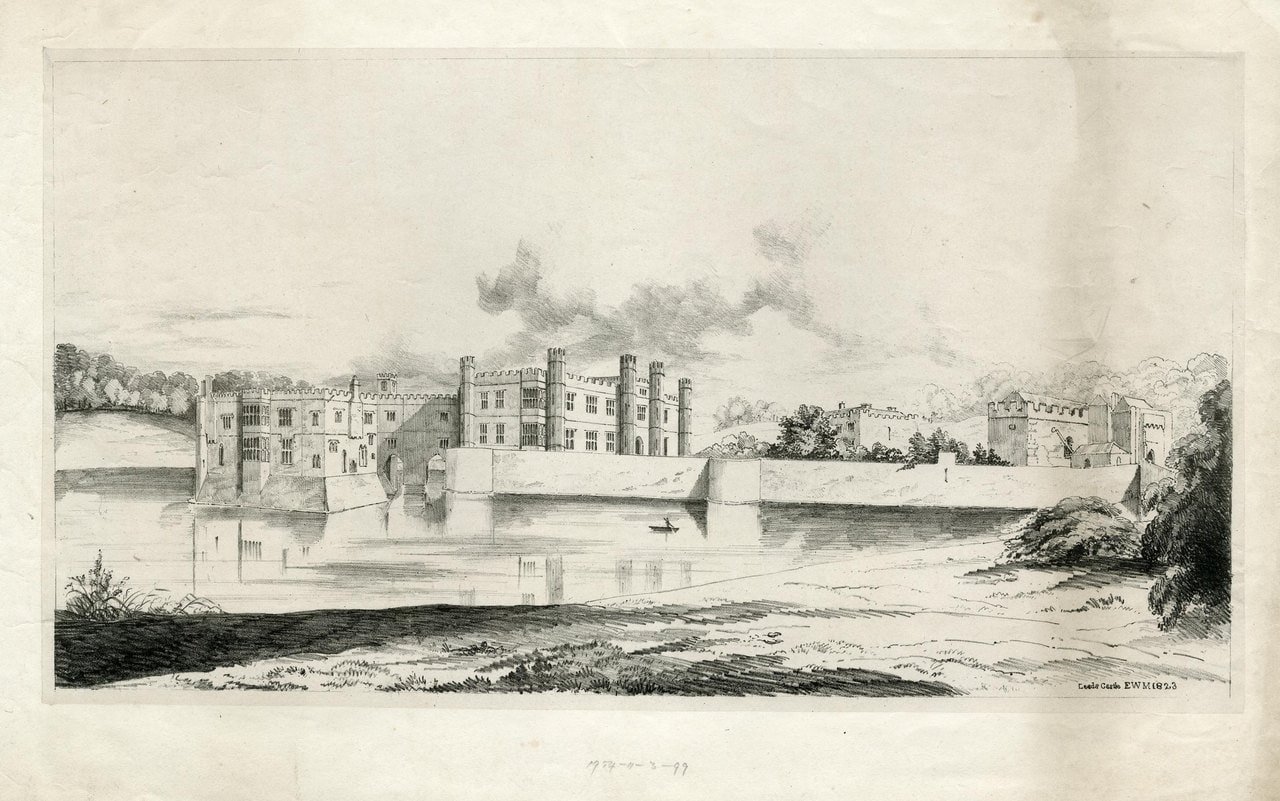
Leeds remained with the Wykeham Martins for another century. In December 1913, when it was still the seat of the family, Sir Martin Conway wrote in Country Life that motorists on the London-to-Folkestone road “may catch a momentary glimpse through an opening in a pine wood of the loveliest castle, as thus beheld, in the whole world.” After the death of Cornwallis Wykeham-Martin in 1924 the family had to sell the castle to pay death duties.
Lady Baillie and the Foundation, 1926-1976
In 1926 the Hon. Olive Wilson Filmer, later Lady Baillie, and her husband Arthur Wilson Filmer bought the castle. She was an Anglo-American heiress looking for a country retreat in Kent, and in the Foundation’s words “the newly married couple bought Leeds Castle together in 1926 and furnished it in the medieval style.” The marriage did not last, and in November 1931 she married for the third time, to Sir Adrian Baillie. In the 1930s, in the Foundation’s words, Leeds became “a centre of lavish hospitality for leading statesmen, European royalty and film stars.”
In the Second World War, the Foundation records, the house parties continued, but the family moved into the Gloriette and the New Castle became a hospital. Soldiers brought back after the retreat from Dunkirk were treated there, and the castle was also used for the rehabilitation of severely burned pilots treated by the surgeon Archibald McIndoe at East Grinstead. Weapons research went on in secret in the grounds, including work on emergency flame weapons to counter a feared German invasion, and the minister responsible, Geoffrey Lloyd, became a regular visitor.
Lady Baillie died in September 1974 and bequeathed the castle, its grounds and contents to the charitable company she had set up that May (first named Leeds Village Estates Ltd), now the Leeds Castle Foundation, registered as a charity (no. 268354) in October 1974. Geoffrey Lloyd, by then Lord Geoffrey-Lloyd, became the Foundation’s first chairman. The Foundation opened the gardens to the public in 1975 and the castle the following year.
Leeds Castle and Diplomacy, 1978 and 2004
In July 1978 the US secretary of state, Cyrus Vance, brought the Israeli and Egyptian foreign ministers, Moshe Dayan and Mohammed Ibrahim Kamel, to Leeds Castle for talks. Vance cabled to Washington that the first full day “was considerably more serious and useful than I had anticipated, but it is clear that wide gaps remain.” The Camp David Accords were signed that September. In September 2004 Tony Blair and Bertie Ahern held three days of Northern Ireland talks at the castle. Afterward the British and Irish governments said they believed the issues of ending paramilitary activity and putting weapons beyond use could be resolved, though there was not yet comprehensive agreement on changes to the Good Friday Agreement.
Architecture
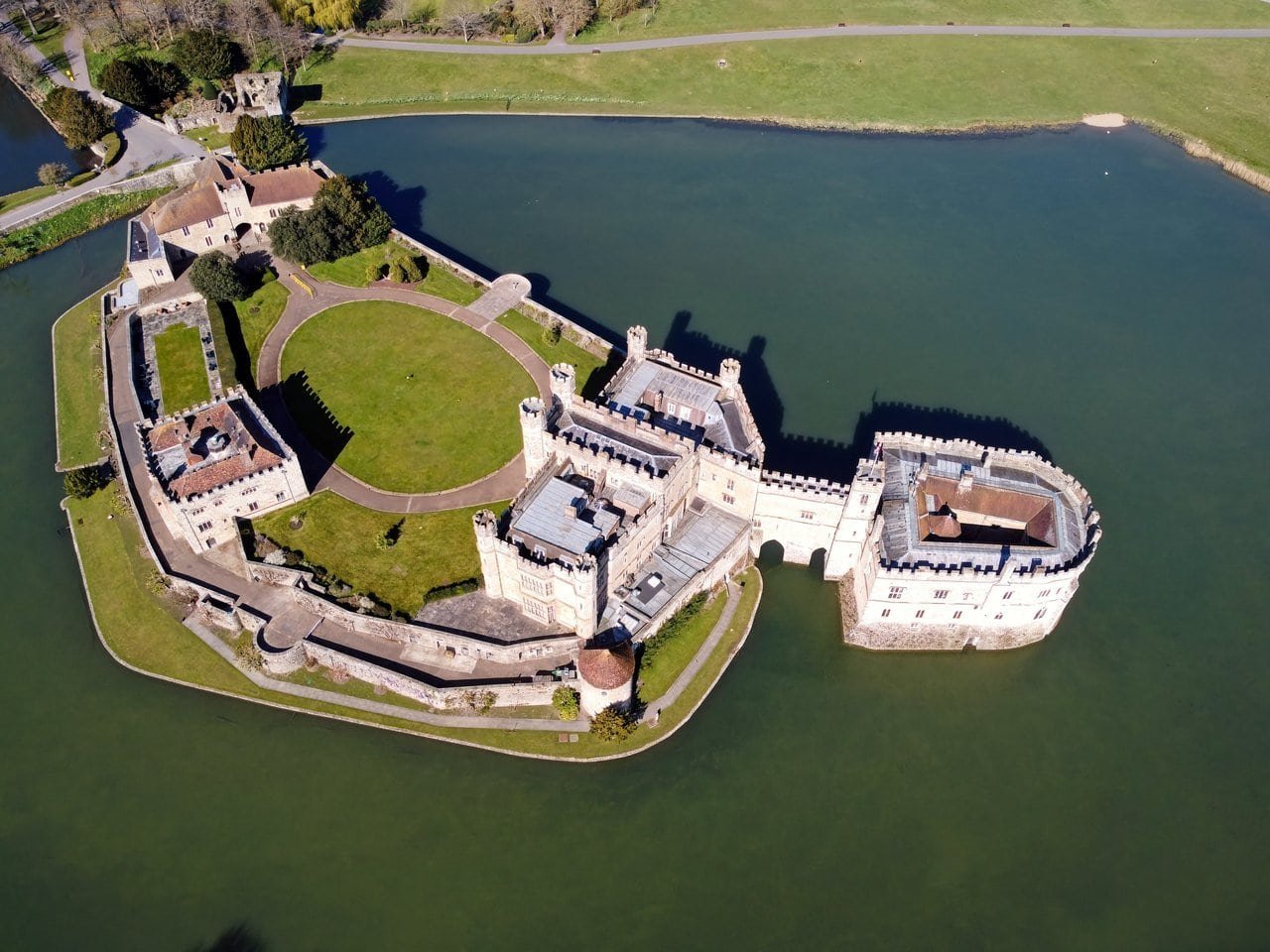
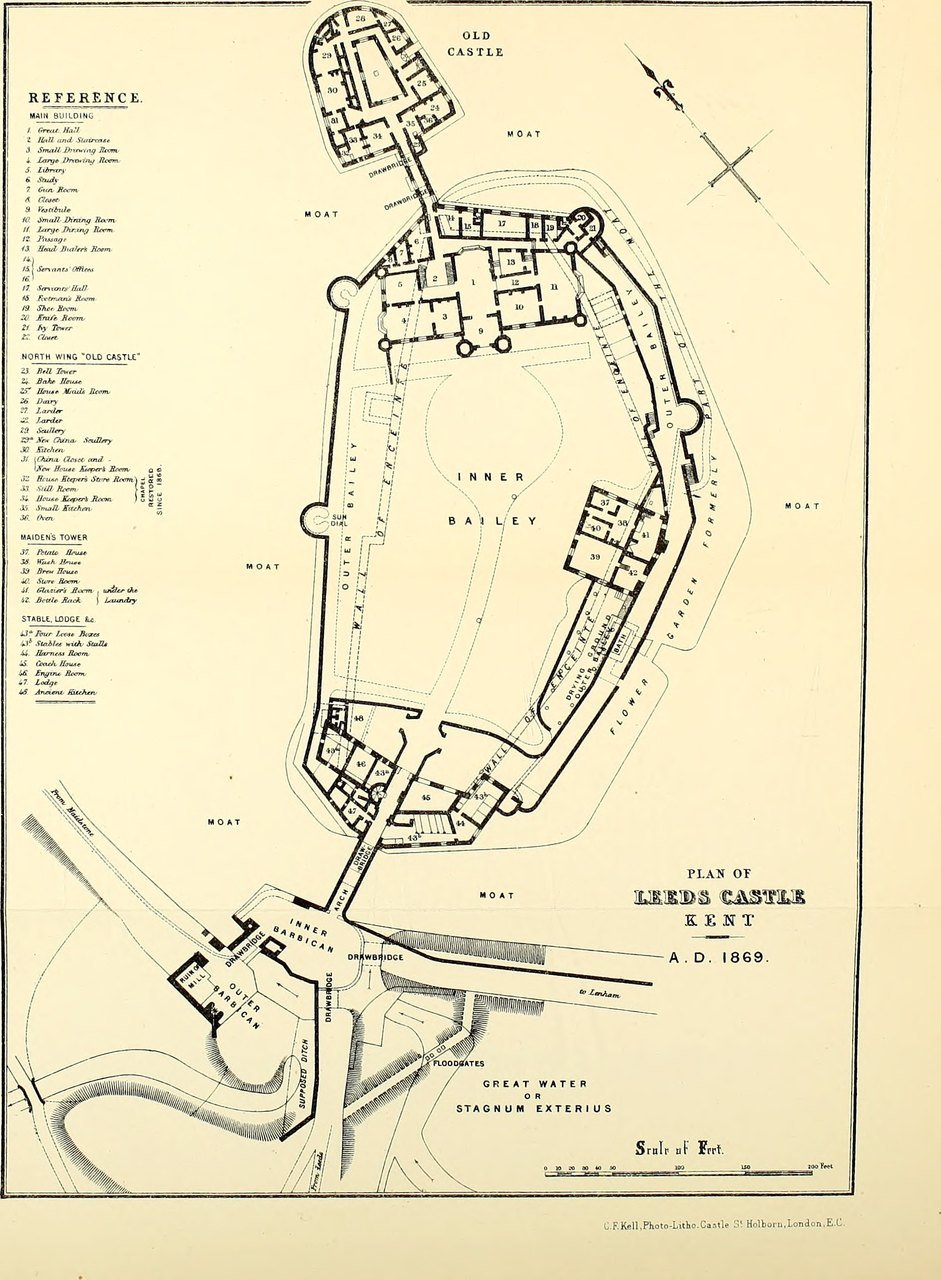
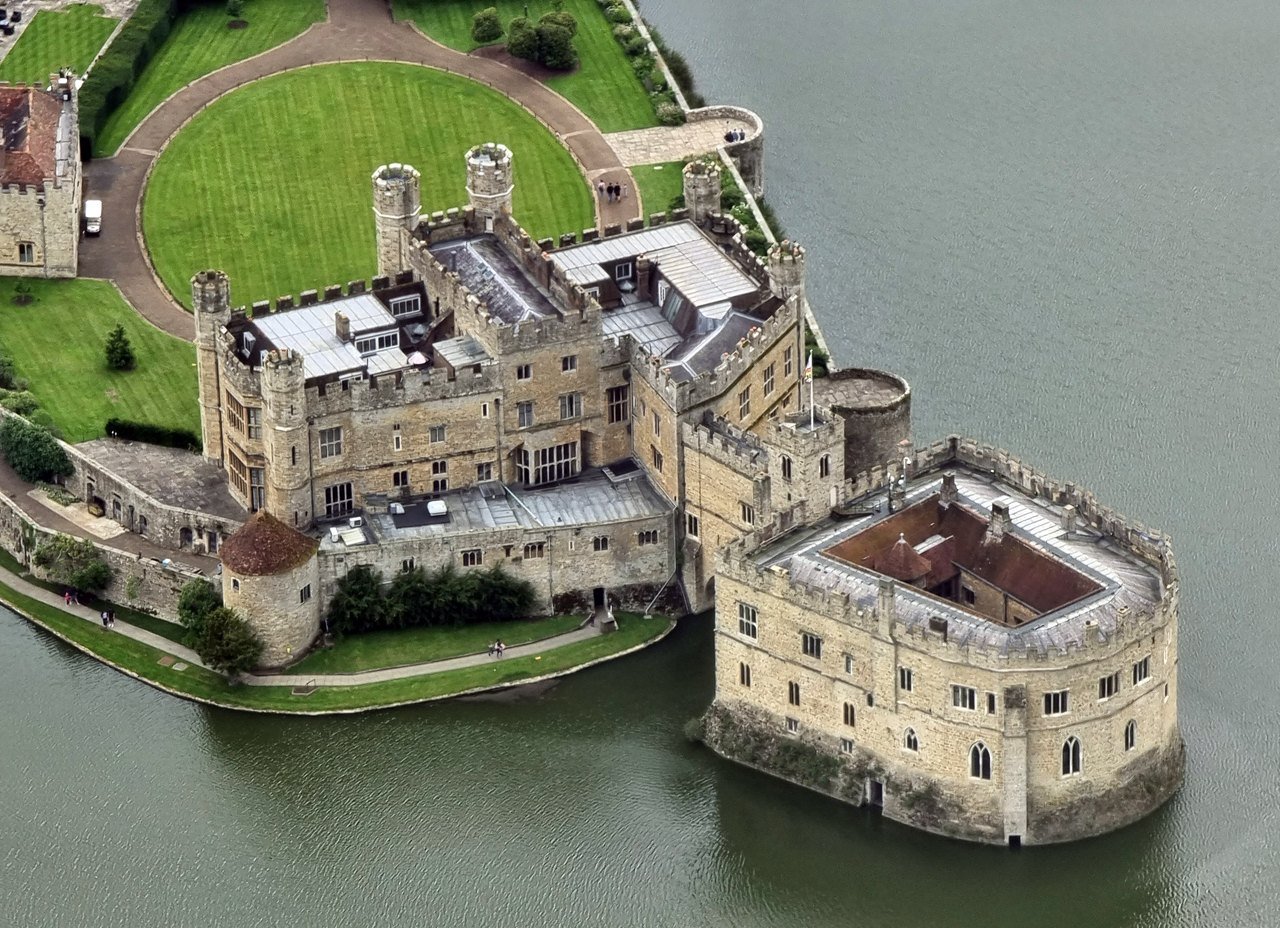
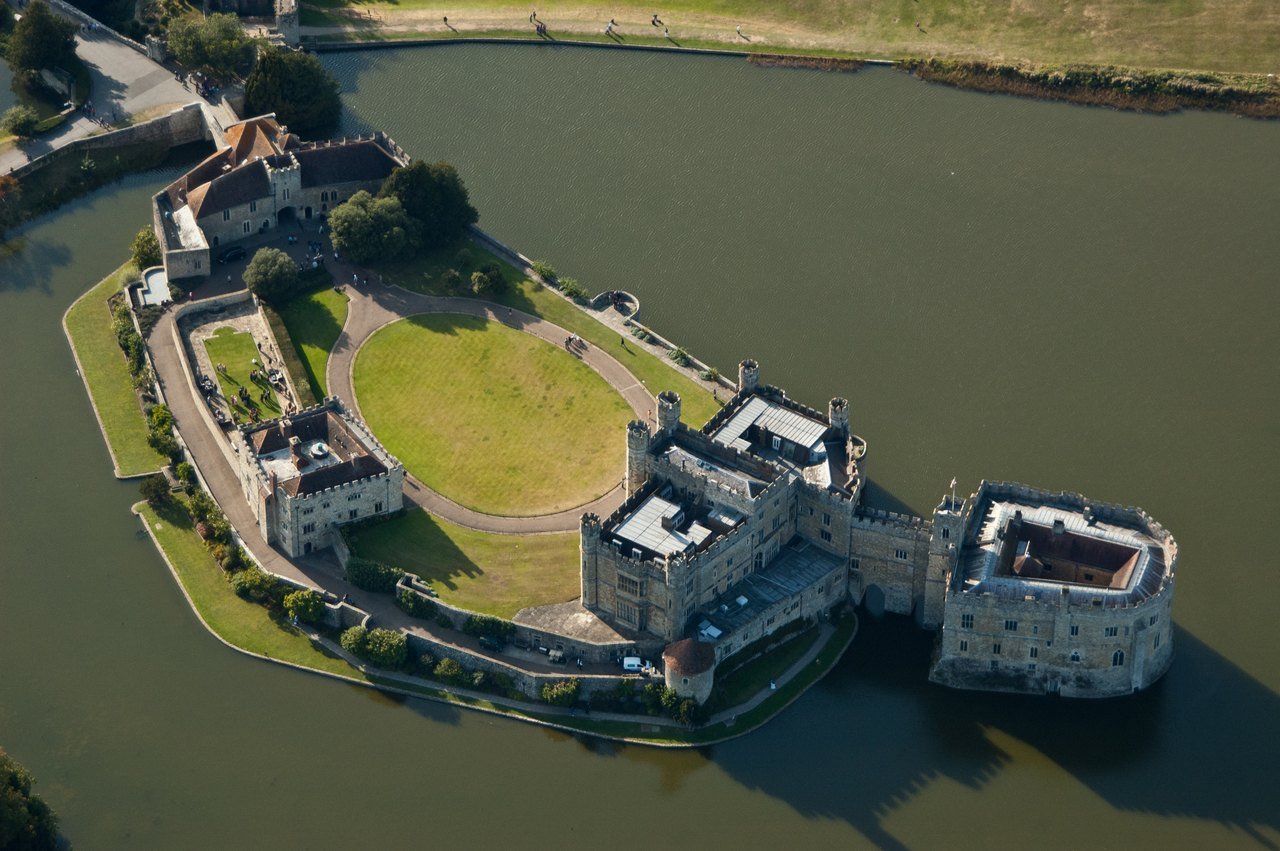
Leeds is a water castle, and it reads most clearly from the approach inward. Its two islands stand in a moat held at its south end by a dam: the larger island carries the gatehouse, the Maiden’s Tower and the New Castle inside the outer wall, and the smaller one carries the Gloriette, reached by a bridge from the New Castle (Historic England). In the Middle Ages the valley beyond the dam could also be flooded as a further barrier. The lake there now, the Great Water, belongs to the twentieth-century gardens. Medieval water defenses like these are the subject of our guide to how castle moats worked.
The Barbicans, the Dam and the Mill
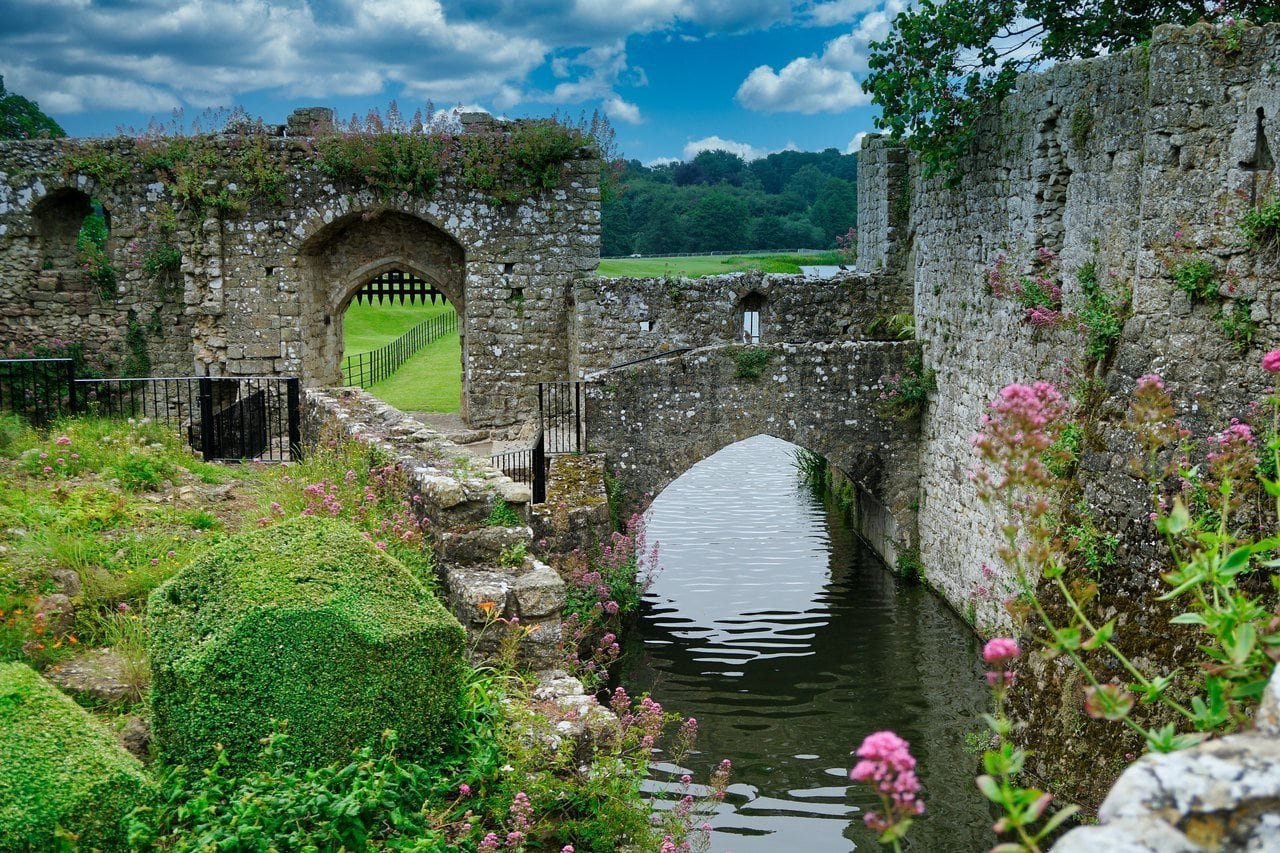
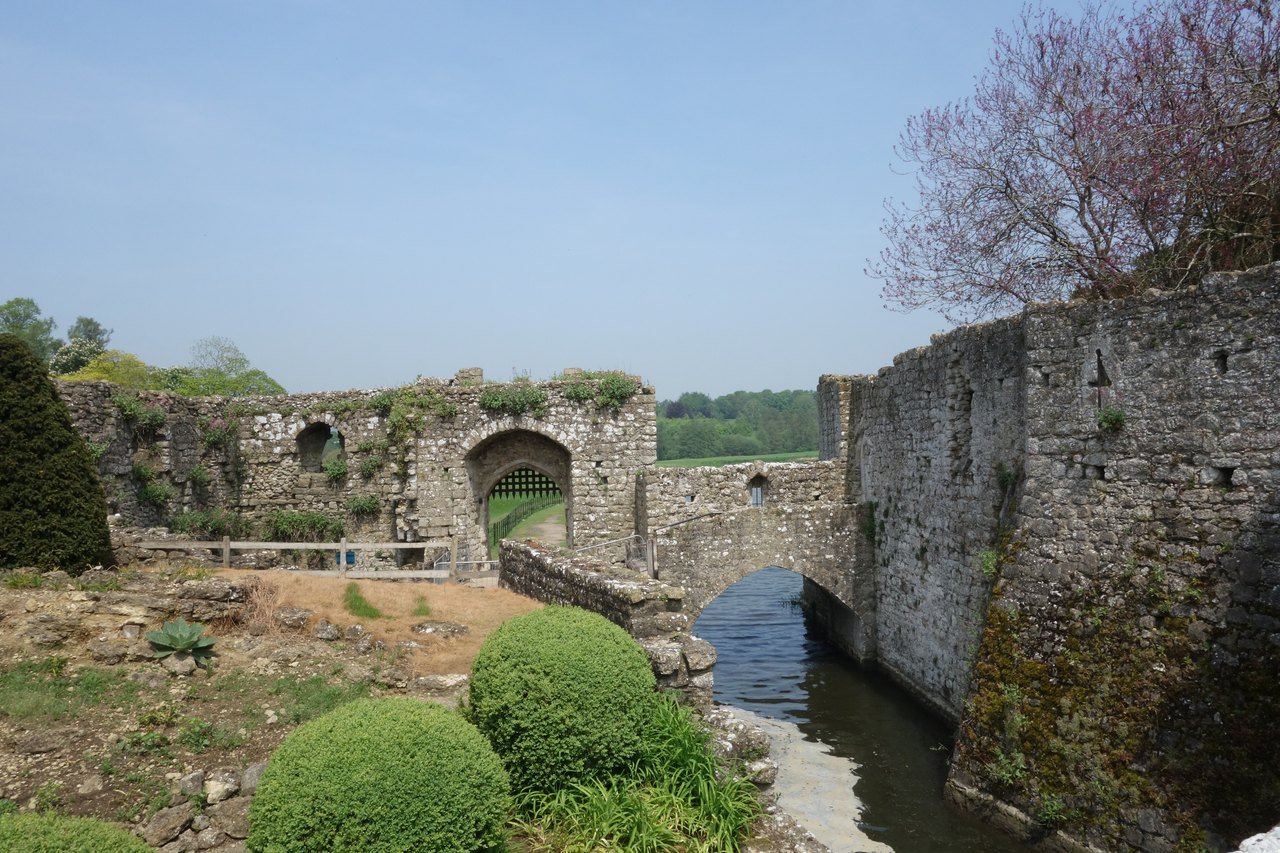
A triple barbican guarded the approach over the dam. Two of its island barbicans, probably of the early-to-mid thirteenth century, survive as ruins with portcullis grooves, and the outer one holds the ruins of the castle mill, repaired in 1298-99 (Historic England). Historic England’s park register adds that the outer barbican was built with three gates, serving approaches from the northwest, the west and the southeast. How a barbican, gatehouse and portcullis worked together is set out in our guide to the castle gatehouse.
From the barbican a stone bridge of two pointed arches, with a ramped parapet, crosses to the gatehouse. Historic England records that it was formerly a drawbridge, and in 1298-99, Colvin records, timber was supplied for the castle bridges, including the main bridge between the barbican and the gatehouse.
The Gatehouse
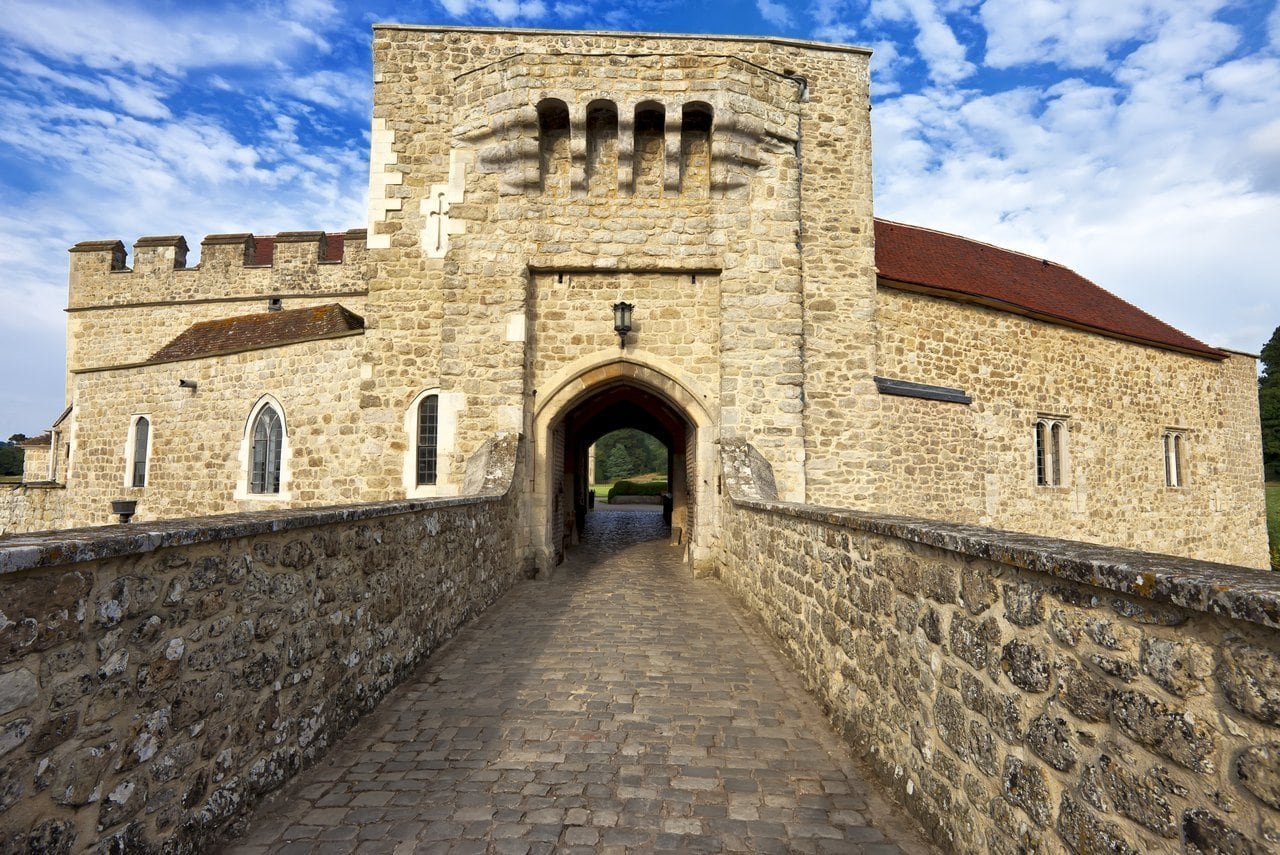
The gatehouse has a core that may date from the early-to-mid thirteenth century and was extended in the late thirteenth; deep machicolations were added over its outer arch in the late fourteenth or early fifteenth century (Historic England). Machicolations are openings in the floor of a parapet built out from the wall face, and here they sit above a depressed-pointed arch of two orders that still has its portcullis groove, like the barbican gateways. Inside, on the floor above the ground floor, Historic England records a thirteenth-century doorway with decorative chamfer stops. Seventeenth-century stable fittings with arcaded wooden stalls, which the list entry records as formerly within the gatehouse range, have gone.
The Outer Wall and Its D-Shaped Towers
A stone wall rises from the moat around the larger island. Historic England gives it two possible dates: early-to-mid thirteenth-century work altered later in that century, or a new build of the late thirteenth century, when the accounts of 1298-99 were drawn up. The Foundation says the wall originally rose about 10 meters straight from the water; Historic England’s park register describes the larger island as surrounded by 5-meter stone revetment walls. D-shaped towers strengthened the wall. All but one were later cut down to the height of the wall, and the survivor, which Historic England calls the Ivy Tower, keeps its full height and a half-conical roof. Historic England’s list entry and the Foundation place it at the northeast corner; the park register places the full-height tower to the southeast.
The Watergate or Bath House
Beneath the outer wall, two low pointed arches with a portcullis groove open from the moat into a vaulted chamber, with two vaulted passages to the moat and stone stairs up to a room above. Historic England calls it the Watergate and gives it two possible dates: early-to-mid thirteenth-century work converted to a bath in the late thirteenth century, or a new build of the late thirteenth. Colvin finds, in the roll of Queen Eleanor’s executors for 1291-92, payments for work on “the king’s bath at Leeds”. Charles Wykeham Martin identified the bath with this chamber in 1869, while Colvin’s King’s Works judges that it looks more like a water-gate. The Foundation calls it the bath house. In spring 2016 the Foundation and Oxford Archaeology drained and dredged the chamber; the finds included a Victorian fishing-tackle box, an anchor, coins and medallions, and no medieval artifacts.
The Maiden’s Tower
The Maiden’s Tower, on the main island, is a sixteenth-century building by Historic England’s list entry, though the park register gives it a fourteenth-century origin; it was battlemented in the eighteenth or early nineteenth century. Lady Baillie turned what had been the brewhouse into bachelor apartments and a cinema (the Foundation), and Rateau redesigned the inside so thoroughly that little of its sixteenth-century interior remained (Alan Bignell). Its rooms are now let as bed and breakfast.
The New Castle, 1822-23
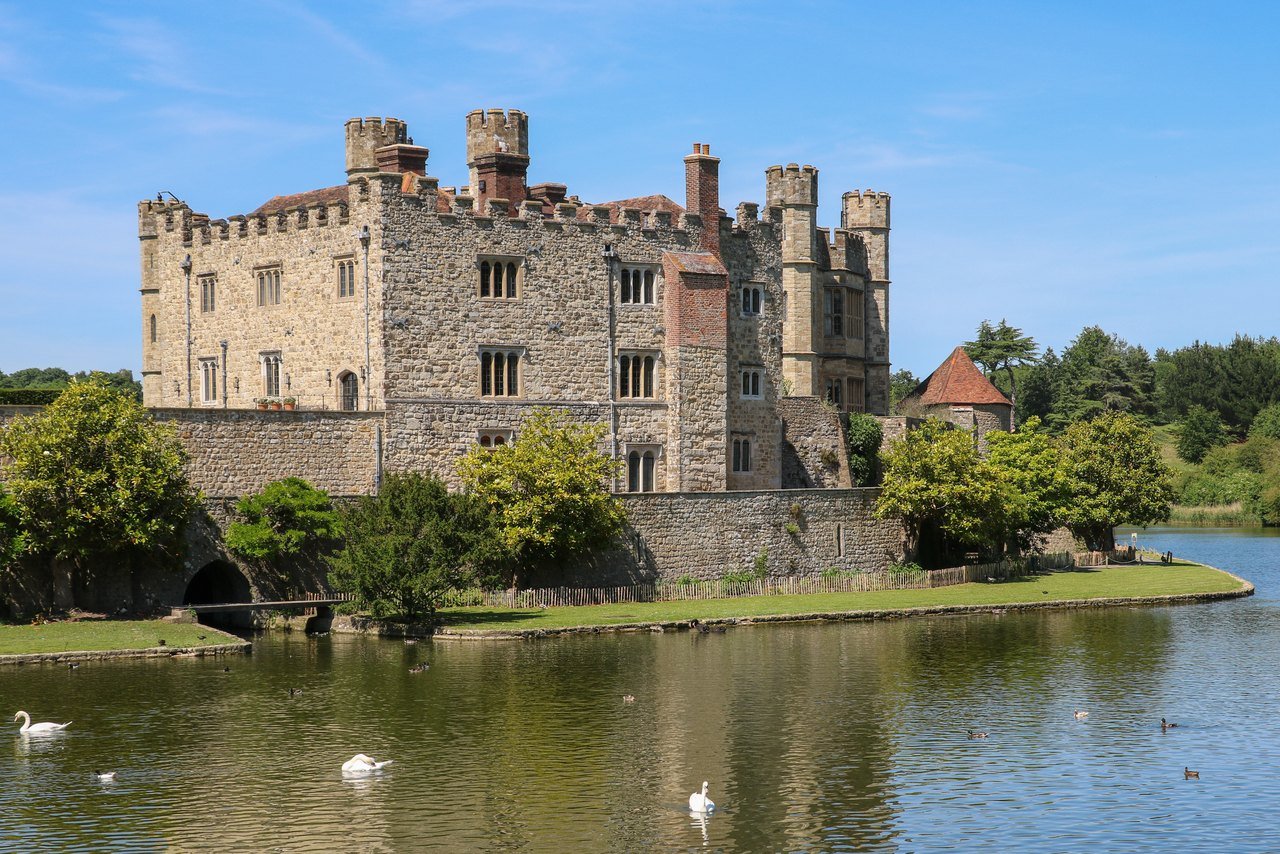
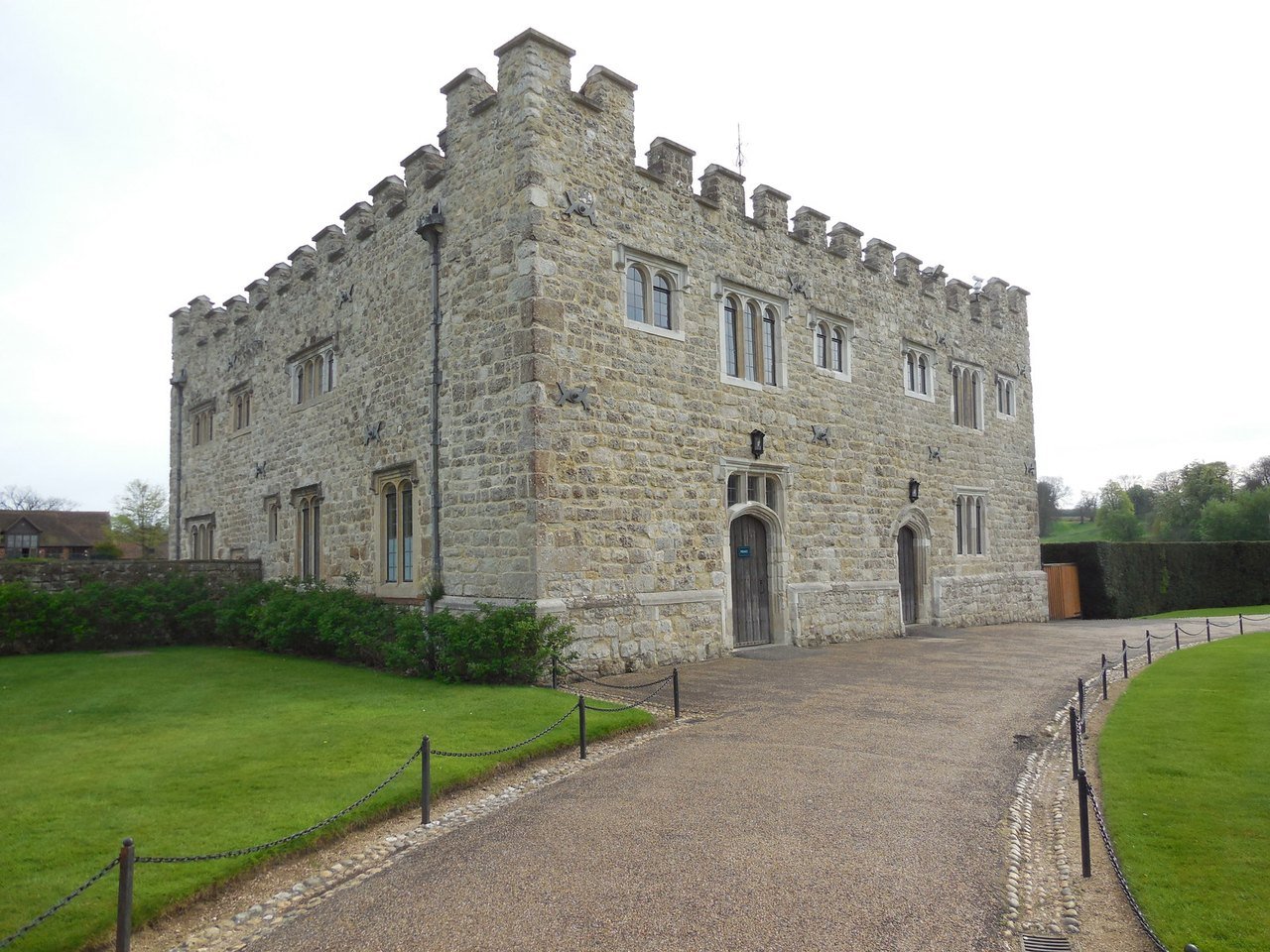
Built in 1822-23 in the Tudor style to designs by William Baskett for Fiennes Wykeham Martin, the New Castle is a battlemented ragstone block of two stories with octagonal corner turrets, a three-story gate-tower at the center of its front, stone mullioned and transomed windows and a two-story canted bay at each gable end (Historic England). Outwardly it has changed little since, the Foundation says. Work on the New Castle in 1993 uncovered the foundations of the Smythes’ Jacobean house, which the Foundation describes as a substantial mansion only slightly smaller than its successor. Repairs to the front in 2018-19 replaced stones with Kentish ragstone, repointed the walls in lime mortar and renewed the lead roofs of the main turrets, and the southwest and west elevations were repaired between October 2025 and April 2026 (the Foundation).
The Gloriette and Its Bridge
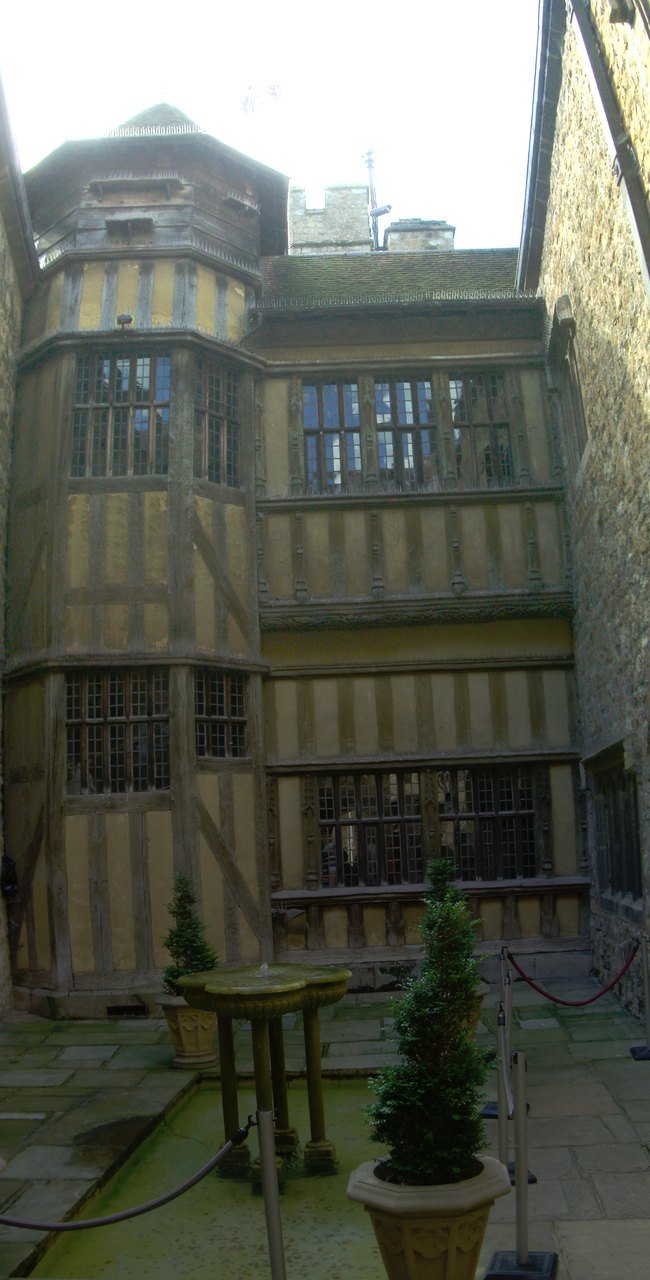
The Gloriette stands on the smaller island, on the site of the first castle’s keep, the Foundation says. It is a ring of apartments around a small courtyard. Its outer walls are possibly of the twelfth century (Historic England), its ground-floor windows of the late thirteenth and early fourteenth centuries, its upper-floor windows of about 1520-30 and its battlements of 1822. Its roof, courtyard front and rooms were largely remade by Rateau, whose work there began in 1926 by the Foundation’s account; the courtyard front, Tudor in manner, is a 1920s design of his, and his drawings for it survive in the Foundation’s archive. The bridge that joins it to the New Castle is largely of 1822, two stories over two pointed arches, with battlements and stone mullioned windows in the sixteenth-century manner (Historic England); it replaced a timber bridge. In the three-story bell turret at the north end of the bridge hangs a bell dated 1435 (Historic England).
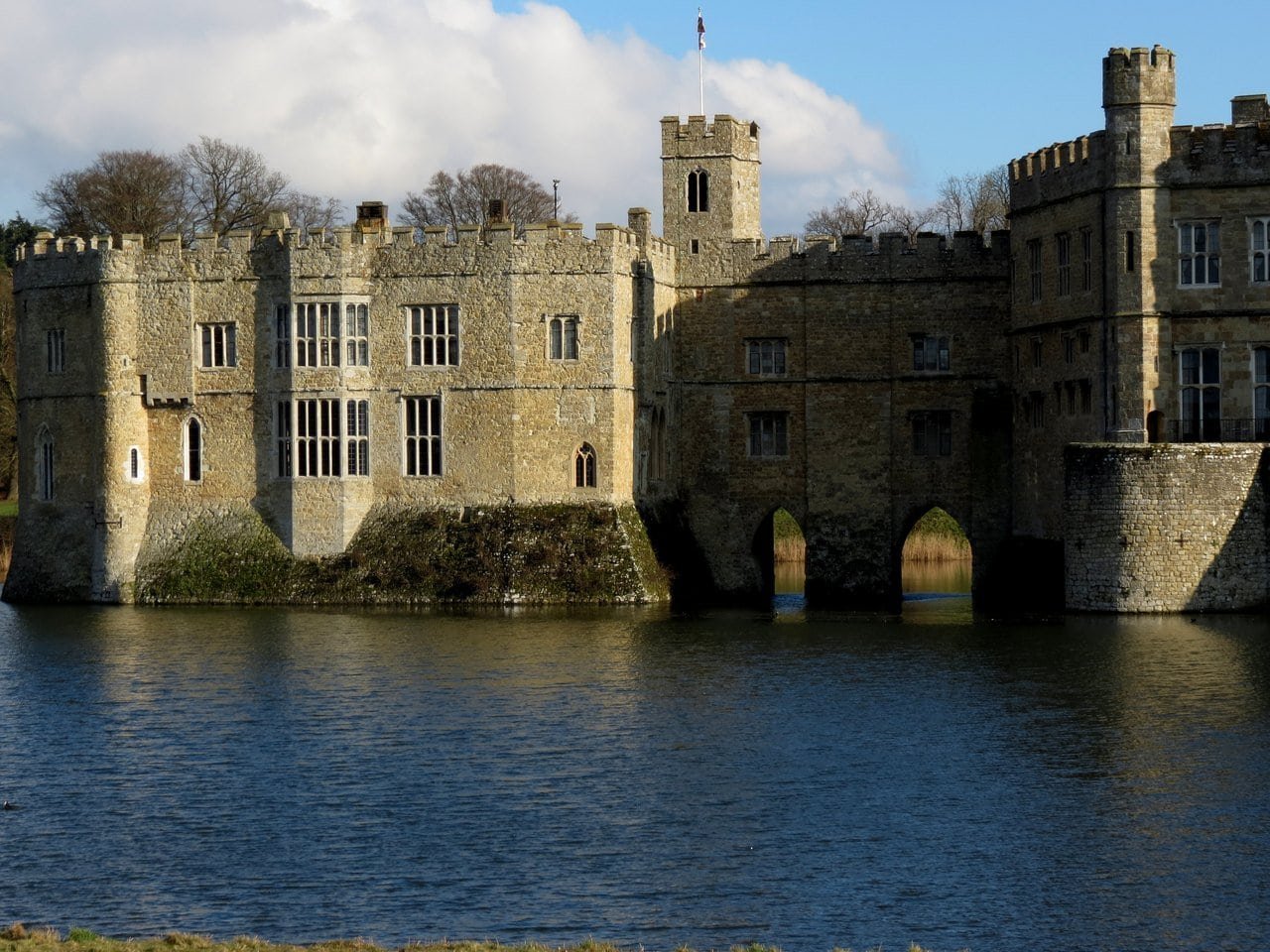
Historic England’s list entry classes Leeds as a “motte-and-bailey castle with shell keep”, moated from at least 1272; on the smaller island, where the Foundation places the first castle’s keep, the building today is the Gloriette described above.
What Is Medieval, What Is Tudor, What Is 1822-23, What Is Twentieth-Century
Read from the dam to the Gloriette, the castle sorts into four layers:
- Medieval: the dam and the ruins of two island barbicans with the castle mill (barbicans probably early-to-mid thirteenth century; mill repaired 1298-99); the gatehouse (core possibly early-to-mid thirteenth century, extended late thirteenth, machicolations late fourteenth or early fifteenth); the outer wall and its D-shaped towers, all but the Ivy Tower cut down (thirteenth century); the Watergate or bath house (thirteenth century); the Gloriette’s outer walls (possibly twelfth century) and its ground-floor windows of the late thirteenth and early fourteenth centuries; the bell of 1435.
- Tudor: the Gloriette’s upper floor and canted bay window (about 1520-30); the Maiden’s Tower (sixteenth century by Historic England’s list entry, fourteenth-century in origin by its park register).
- 1822-23: the New Castle, built in the Tudor style; the bridge to the Gloriette (largely 1822); the Gloriette’s battlements (1822).
- Twentieth century: the Gloriette’s roof, courtyard front and rooms (Rateau, from 1926 by the Foundation’s account); the inside of the Maiden’s Tower (Rateau); the New Castle’s rooms (Owen Little, Rateau, then Stéphane Boudin from the 1930s until his death in 1967); the Great Water, formed in the mid-twentieth century.
Lady Baillie’s Interiors
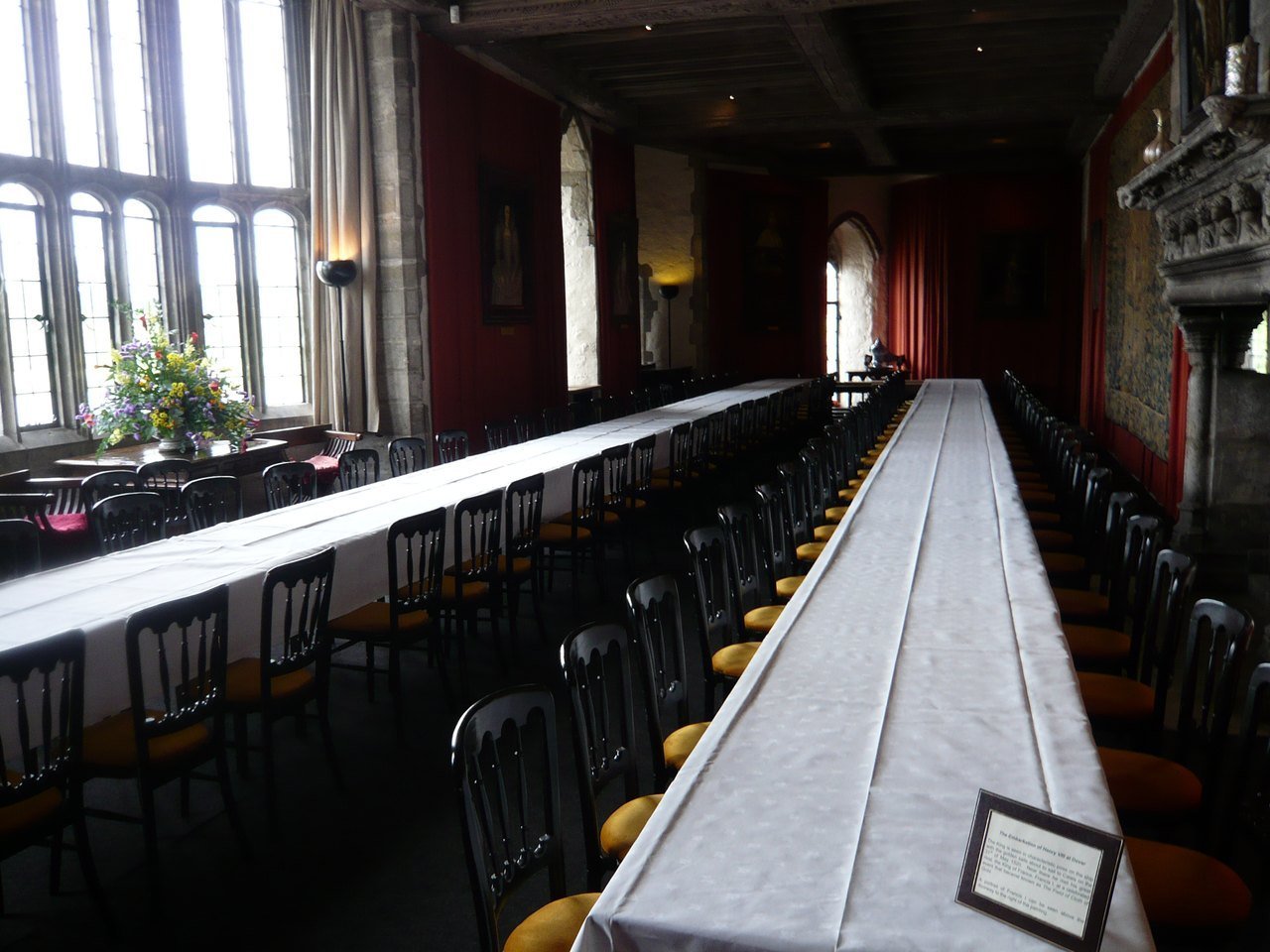
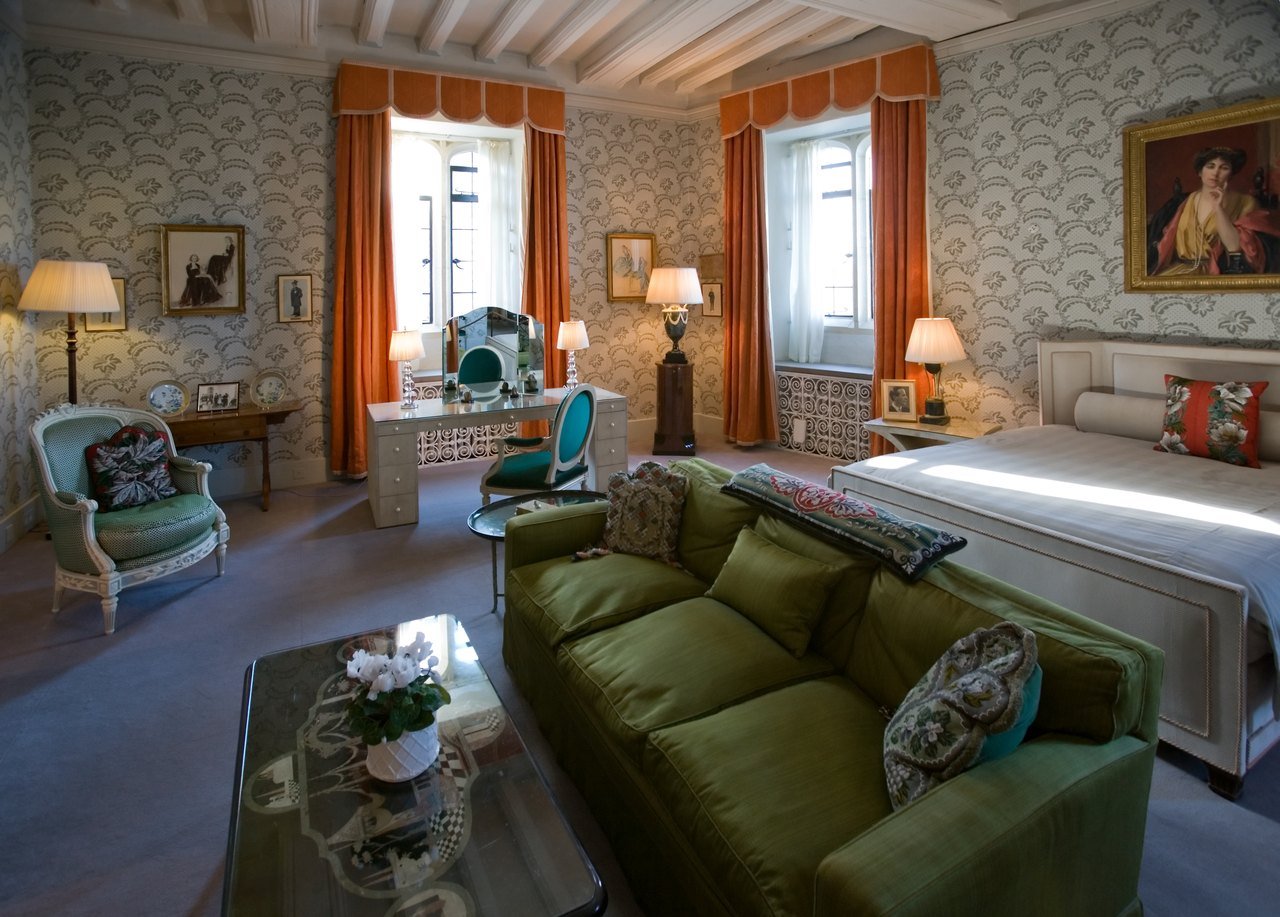
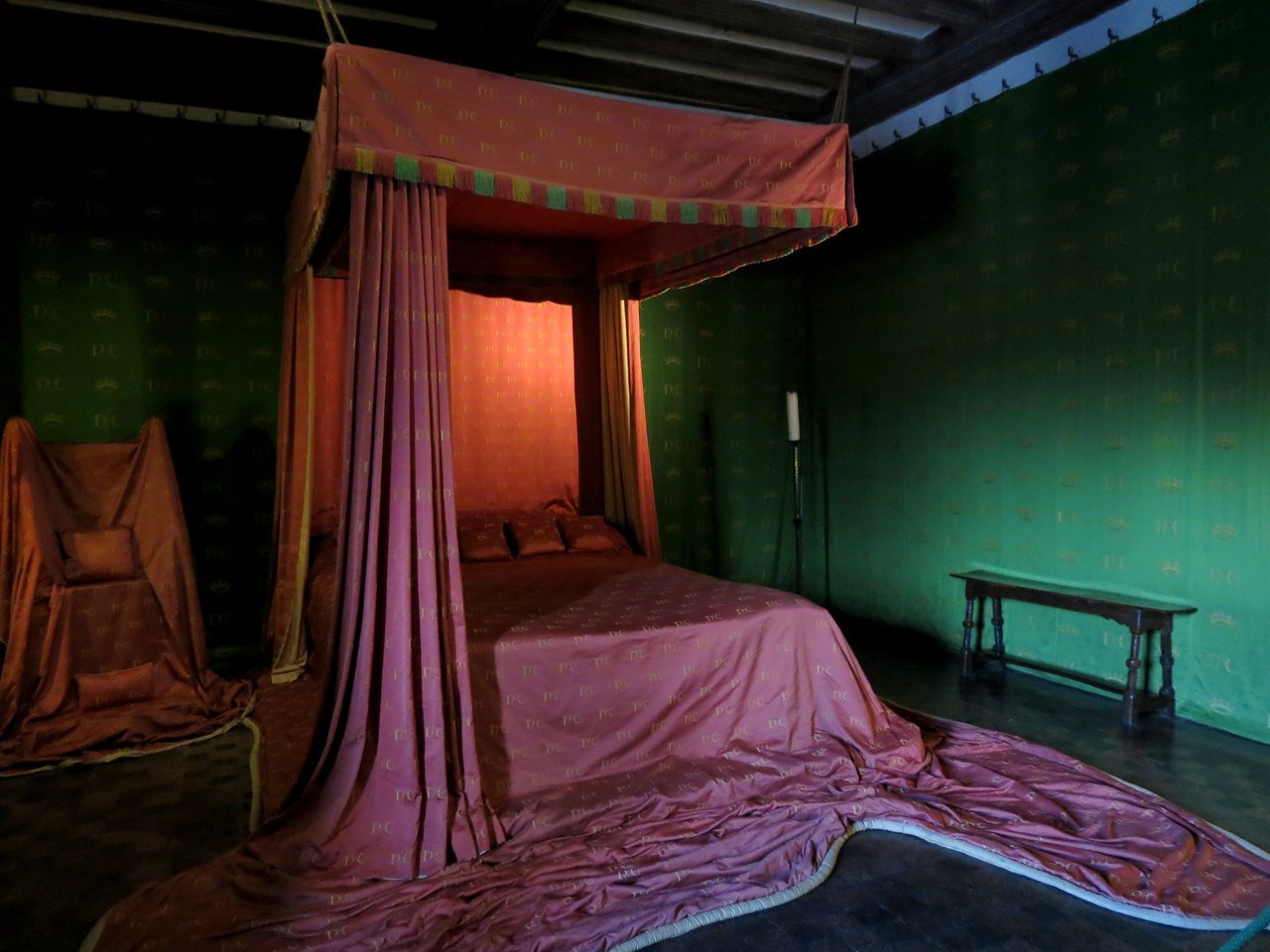
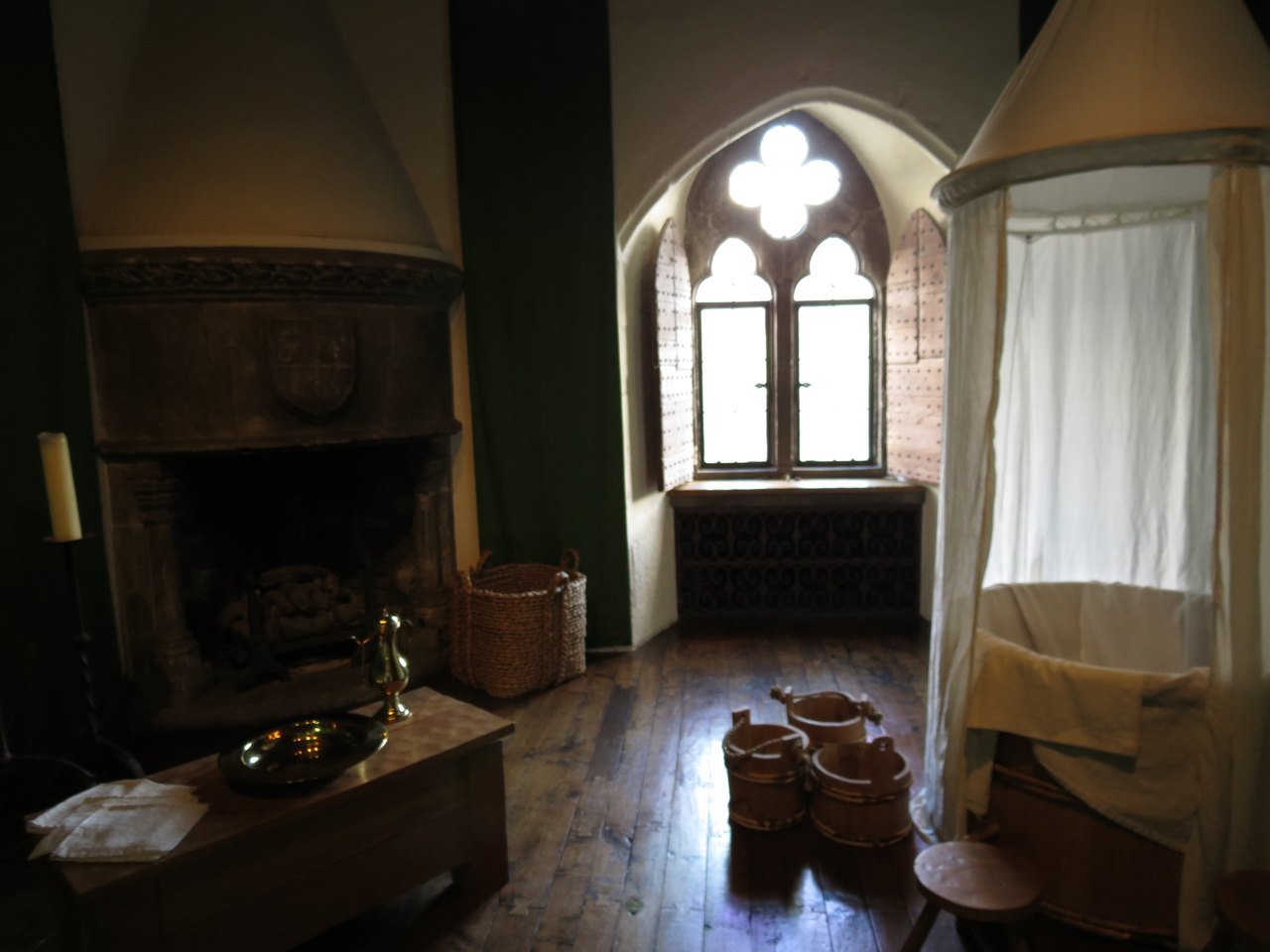
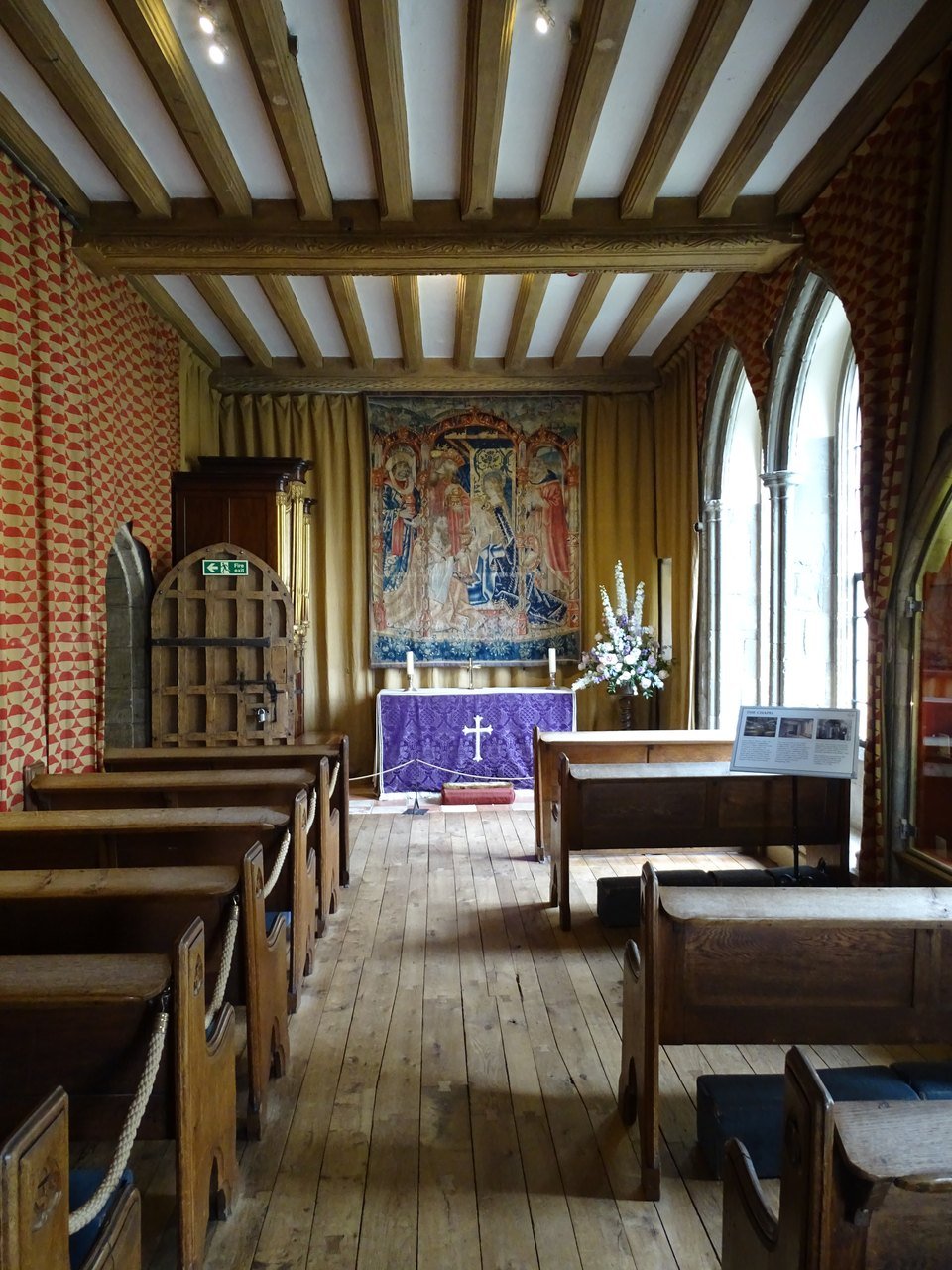
Historic England dates the remodeling of the castle’s interiors to the first half of the twentieth century, and the Foundation describes the rooms on the visitor route as “complete interiors styled by Lady Baillie and some of the most talented French designers of the time including Armand-Albert Rateau and Stéphane Boudin.” Her first architect, Owen Little, reorganized the ground floor of the New Castle around a new inner hall, the Foundation says. For the harder work in the Gloriette and on the upper floors of the New Castle she turned to Armand-Albert Rateau, the Paris designer known particularly for his Art Deco work, whom, the Foundation says, she engaged in 1926, and who worked there into the late 1920s. In the Foundation’s phrase, “He created a glorious Gothic fantasy for her.” Rateau restored the Banqueting Hall in the Gloriette to its full size, after it had been divided into a china closet, kitchen and scullery; dismantled the chapel, which became a music room; and set a newel staircase brought from France against the south wall of the Gloriette’s fountain court. In the Gloriette, the Foundation says, a medieval chapel very likely stood roughly where the present one is. His archive at Leeds holds two albums of photographs he gave Lady Baillie showing the rooms as he left them, and portfolios of plans and drawings later given by his son, François.
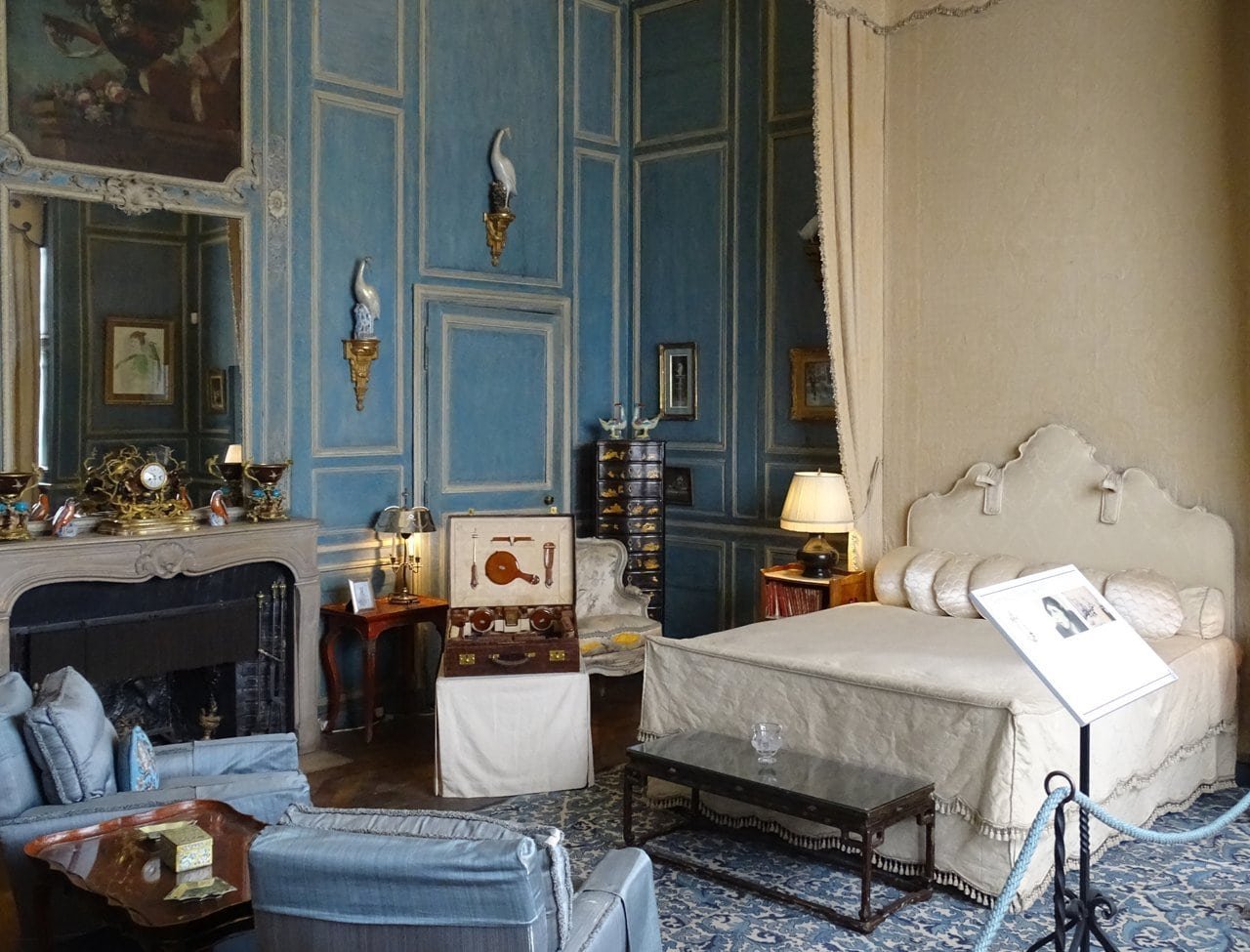
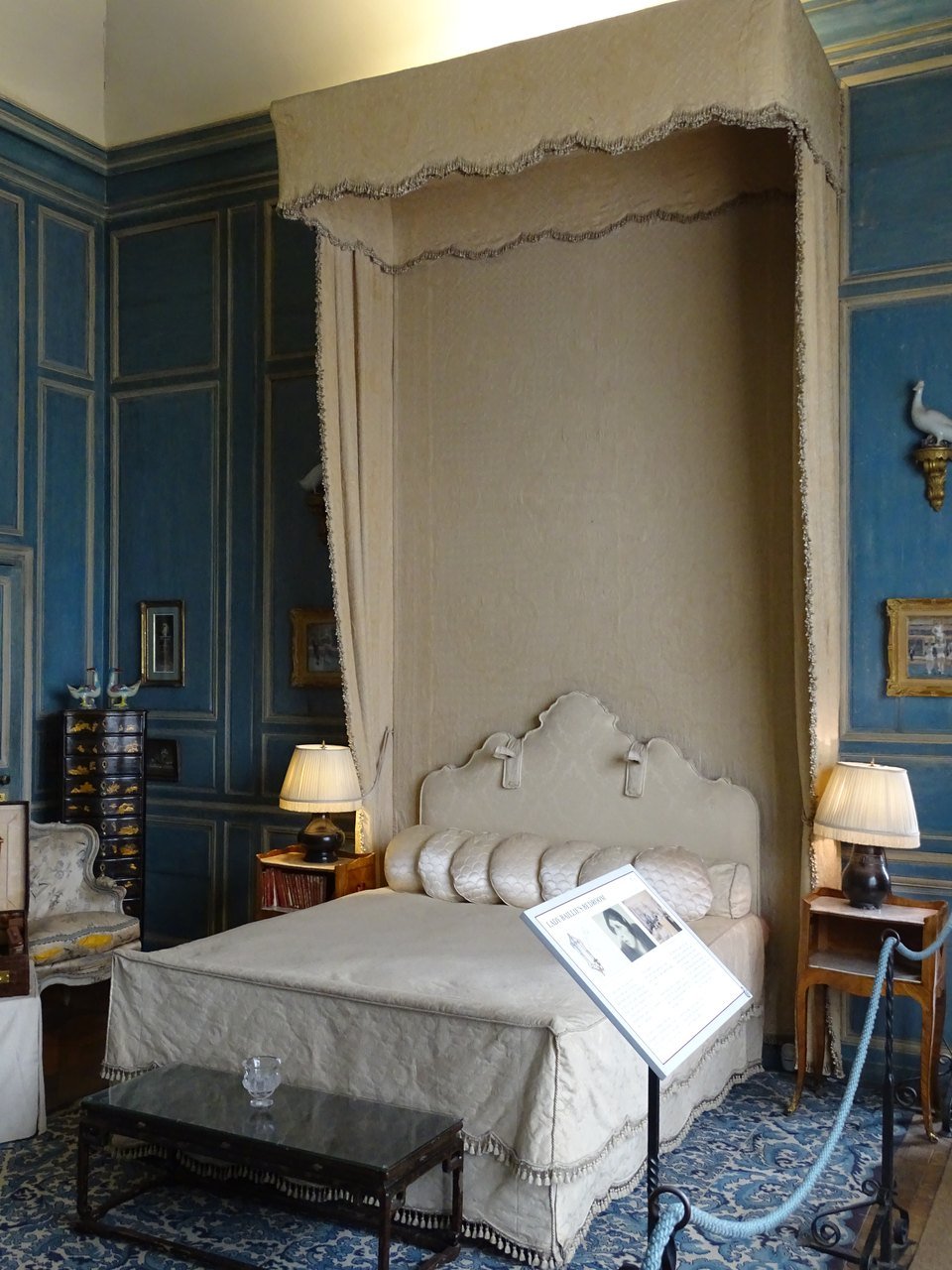
As her taste changed, Lady Baillie entrusted her interiors to Stéphane Boudin, president of the Paris decorating firm Maison Jansen, who worked for her from the 1930s until his death in 1967 and created several of the castle’s interiors, among them schemes in the French eighteenth-century style. The Foundation calls her blue bedroom “one of the rarest and finest surviving examples of a Stéphane Boudin (1888-1967) interior scheme from the 1930s, anywhere in the world”; its bathroom is lined with Russian onyx, and the bedroom and its dressing room were conserved during the lockdowns of 2020-21. In her last decade she redecorated the Dining Room with a new designer, Claude Mandron, in a scheme of the 1960s.
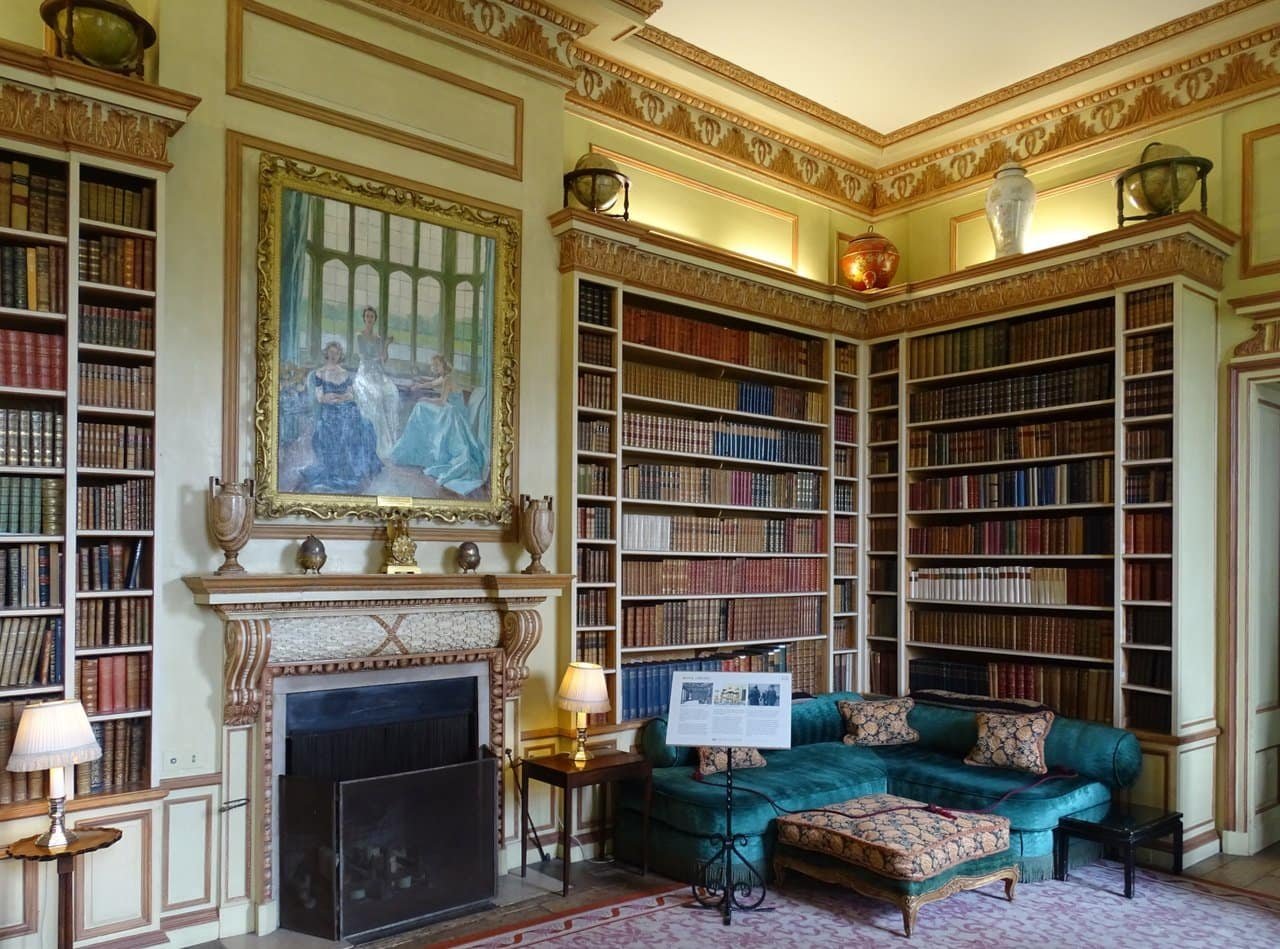
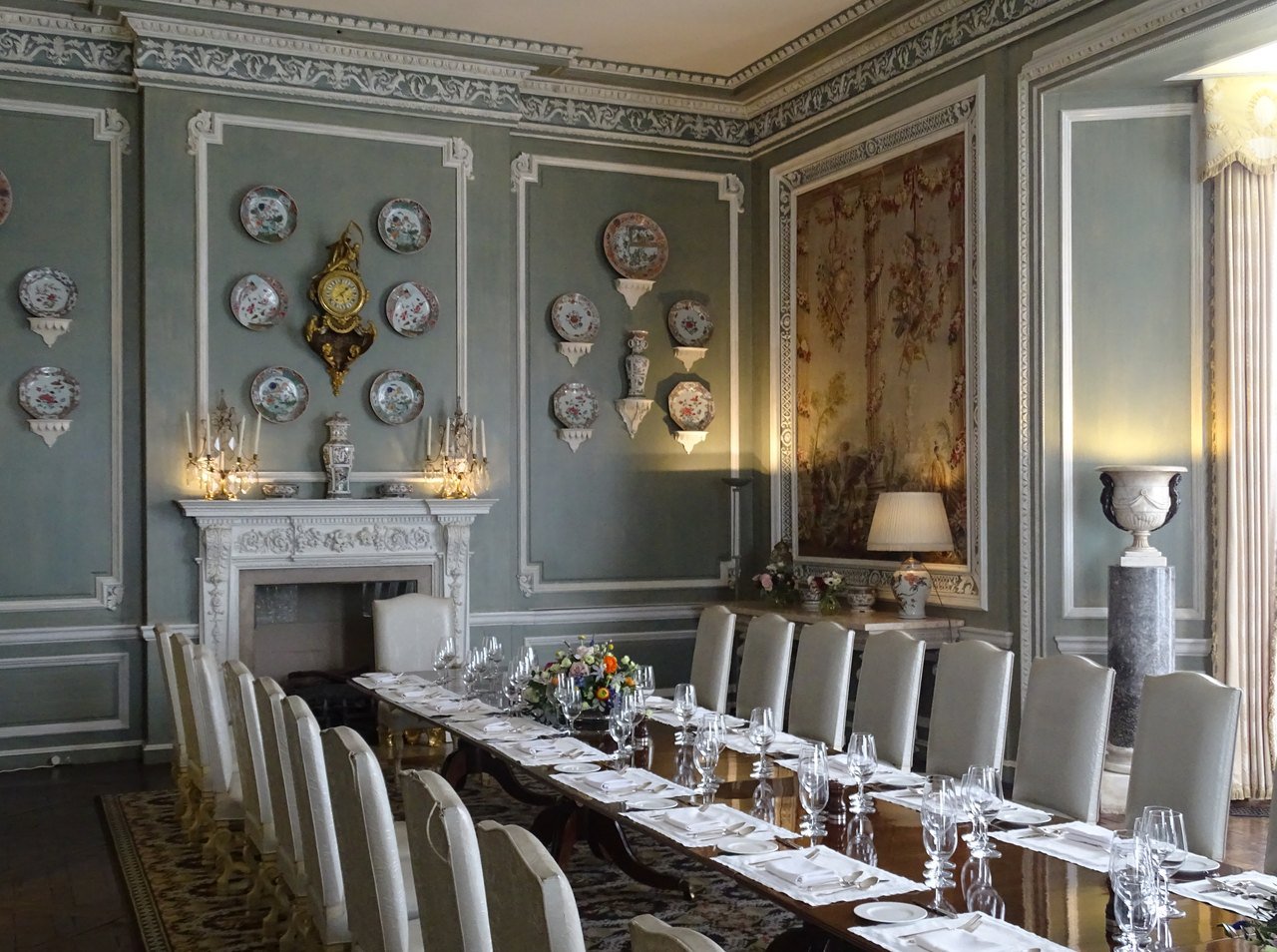
Two rooms on today’s route show how the house changed. Under the Wykeham Martins the Library was a small dining room; it became a schoolroom for Lady Baillie’s daughters in 1926 and was made a library in 1938. In the war it was a ward of 10 Company, Royal Army Medical Corps, its bookcases boarded over with the books still on the shelves, and the faint nail marks on the front panels can still be seen. It holds hundreds of books from Lady Baillie’s own collection and from the library of her father, Lord Queenborough. Lady Baillie first used the Dining Room as a servants’ hall; in 1938 she and Boudin set about making it a formal dining room with eighteenth-century tapestries and Chinese porcelain, and its restoration in 2015 reinstated the dragged “water green” paint, a Boudin trademark, found beneath later layers. Both rooms were begun in 1938 and finished after the war.
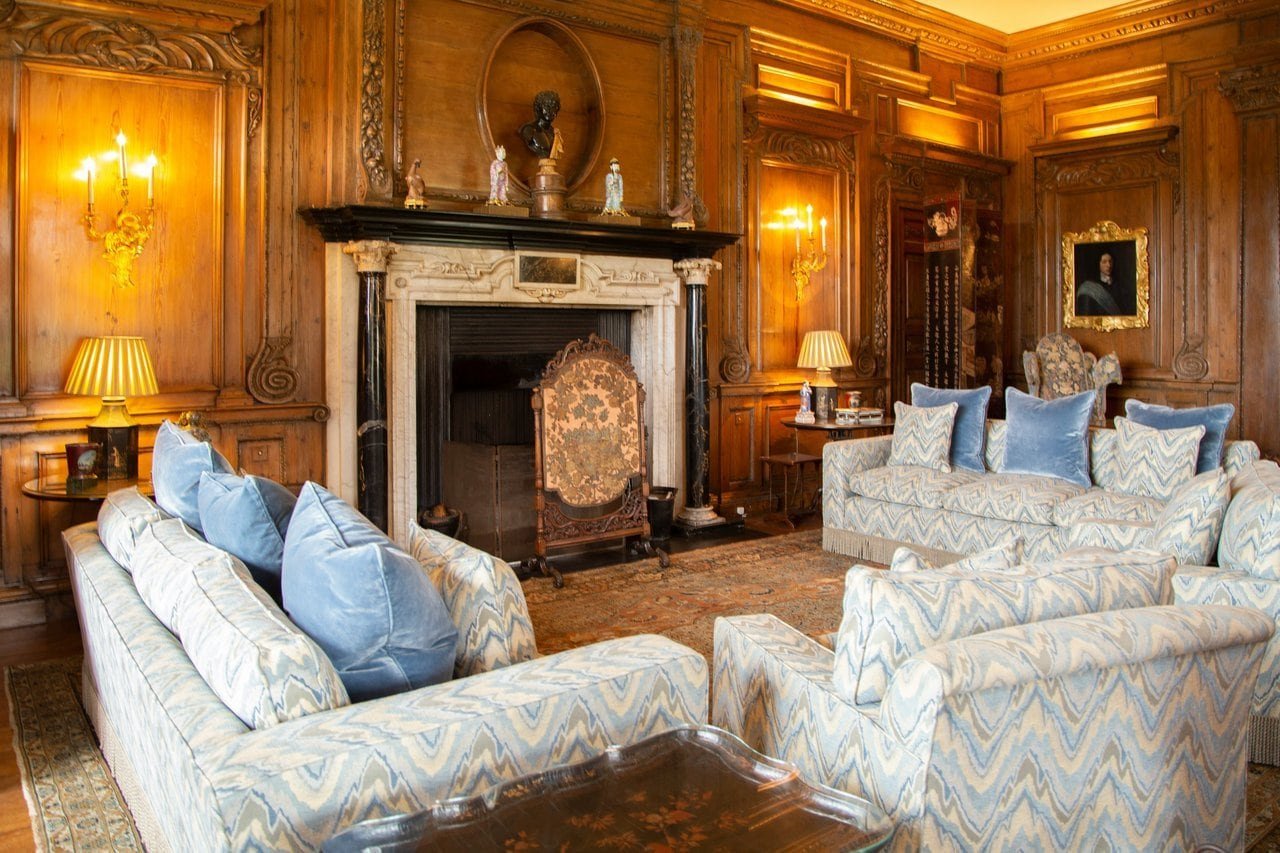
Rateau first paneled the Yellow Drawing Room in gray oak as a luncheon room. In 1938 Boudin hung its walls with yellow silk damask, and a Tiepolo was placed above the fireplace; the room became Lady Baillie’s favorite and, the Foundation says, the only one in the New Castle she kept for her own use during the Second World War. The Thorpe Hall Drawing Room is lined with pine paneling of the 1650s from Thorpe Hall near Peterborough, and the ceiling was lowered to fit it, the Foundation says; Thorpe Hall itself was built by Peter Mills in 1653-56 for Oliver St John (Historic England). Where the paneling stood at Thorpe Hall is disputed: the Foundation says the “great parlour”, while Thorpe Hall’s own list entry says its library paneling is now at Leeds.
Among the castle’s collections are 23 tapestries, more than a quarter of them from the sixteenth century (the Foundation). Since March 2026 the Foundation has owned The West Prospect of Leeds Castle, a painting dated by its architecture and its figures’ clothing to the mid-eighteenth century, whose Jacobean house matches the Smythes’ before Robert Fairfax’s Gothick alterations. The Foundation’s curator calls it “the earliest known topographical view of the Castle”, and it hangs in the Inner Hall.
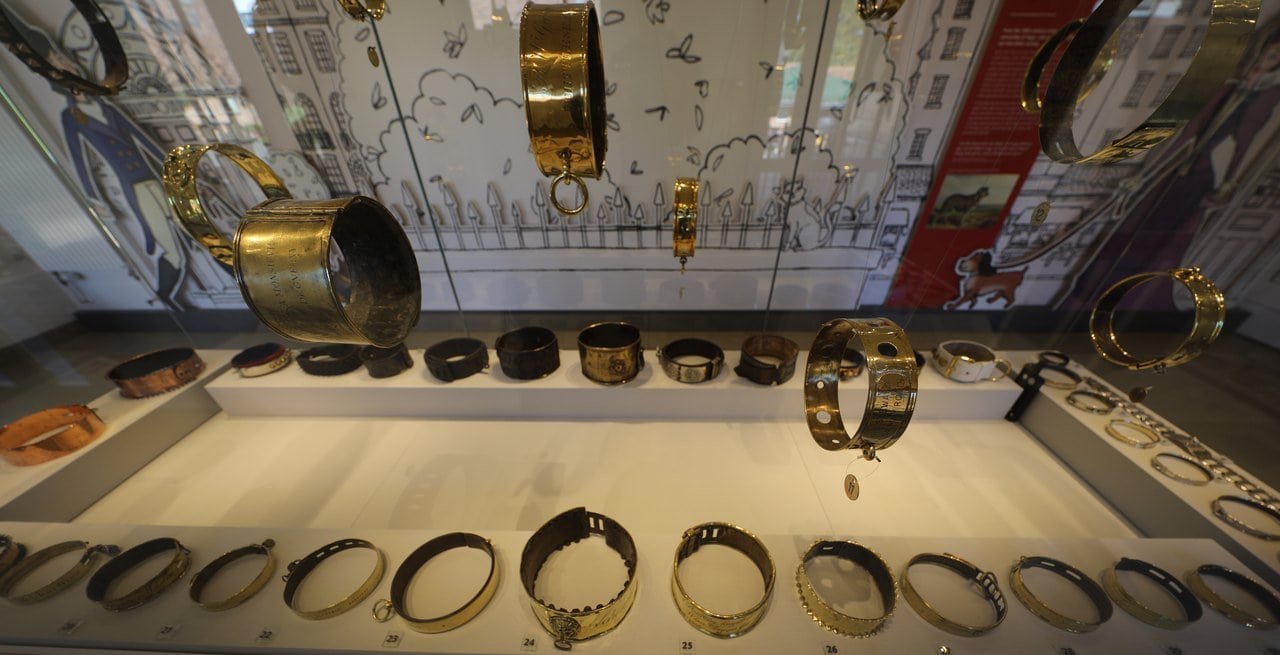
The Dog Collar Museum, in a single gallery, began with the collection Gertrude Hunt gave the Foundation in 1977 in memory of her husband, the historian John Hunt. Its earliest collar, the Foundation says, is a late-fifteenth-century Spanish iron collar for a herd mastiff, and later pieces run from sixteenth-century German collars with iron spikes to twentieth-century ones made of tires, beads and plastic. The Foundation says its curators are reviewing the collection and how it is shown, so the display may change.
The Park and Gardens
Historic England registers the park and gardens at Grade II* and sums them up as a park of medieval origin around a thirteenth-century moated castle, landscaped further in the early eighteenth century, significantly replanted in the early nineteenth and given ornamental gardens by Russell Page in the mid and late twentieth. By the register’s measure about 6 hectares of castle, gardens and water sit within about 140 hectares of park and woodland; the Foundation speaks of a 500-acre estate. The register finds no evidence that Lancelot “Capability” Brown, who worked at neighboring Leeds Abbey in 1771-72, ever did so at the castle. The same register describes the castle’s southwest front as opening onto an oval, grassed forecourt.
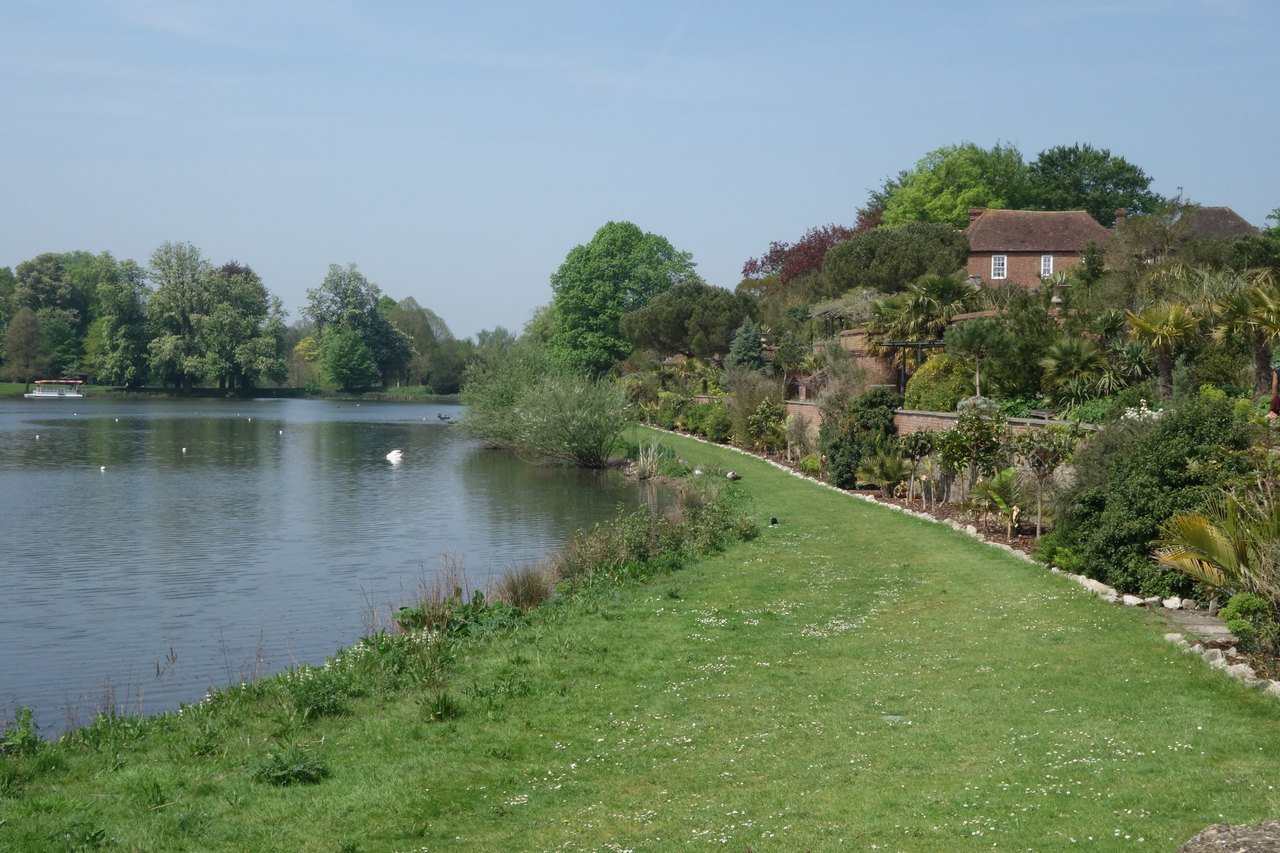
Beyond the dam, the Great Water, about 450 meters long, was formed for Lady Baillie as part of Russell Page’s mid-twentieth-century plans; the valley there could be flooded as an extra defense in the Middle Ages, but the lake a visitor sees is Page’s. A stepped cascade built by William Baskett in 1827 carries water from a pond into the canal of the Duckery, which Boudin and Page made for Lady Baillie in the 1960s. Some of the trees on the slopes above the River Len were planted to replace those lost in the storm of 1987.
The Gardens
The Foundation describes the Princess Alexandra Gardens, which run along the River Len, as a way to approach the castle, with daffodils, narcissi and anemones in spring, then azaleas and rhododendrons. Historic England’s register traces the valley’s ornamental planting to Lady Baillie in the 1920s and records that Russell Page made the valley a spring garden from about 1936. Today the Foundation divides the gardens into six parts, among them the Cedar Lake, the Oriental Garden, the Jungle Garden and the Winter Garden.
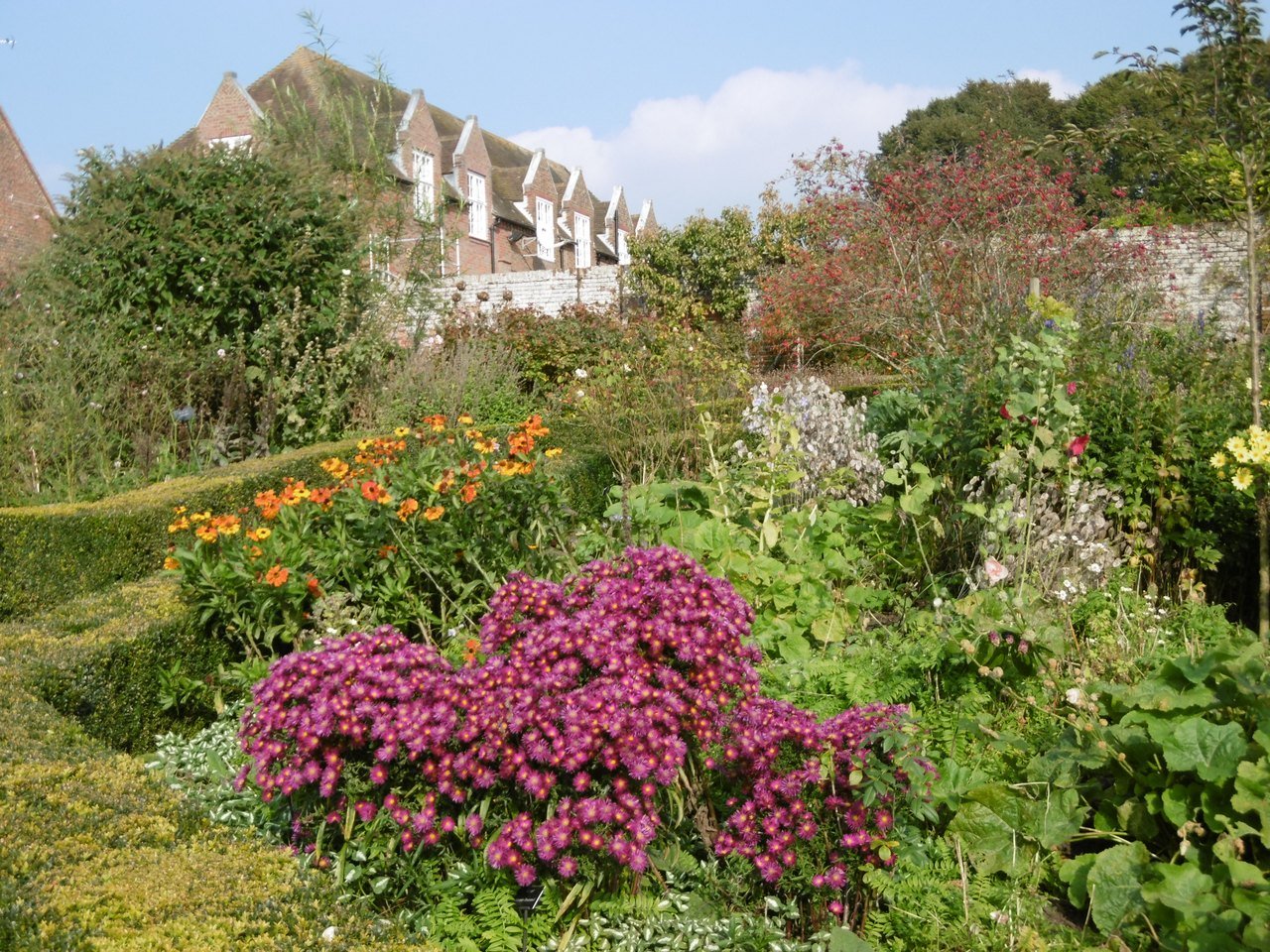
Russell Page also made the Culpeper Garden in 1980, on the site of the castle’s old kitchen garden; it takes its name from the family who owned Leeds in the seventeenth century. Historic England’s register describes geometric, box-edged beds planted with a mixture of English cottage-garden and exotic plants, and a row of twelve yews clipped into truncated pyramids along its main path. The Lady Baillie Mediterranean Garden Terraces, built and planted in 1998-99 on the site of mid-twentieth-century aviaries, were designed by the landscape architect Christopher Carter, the Foundation says, and face south over the Great Water.
The Maze and the Grotto
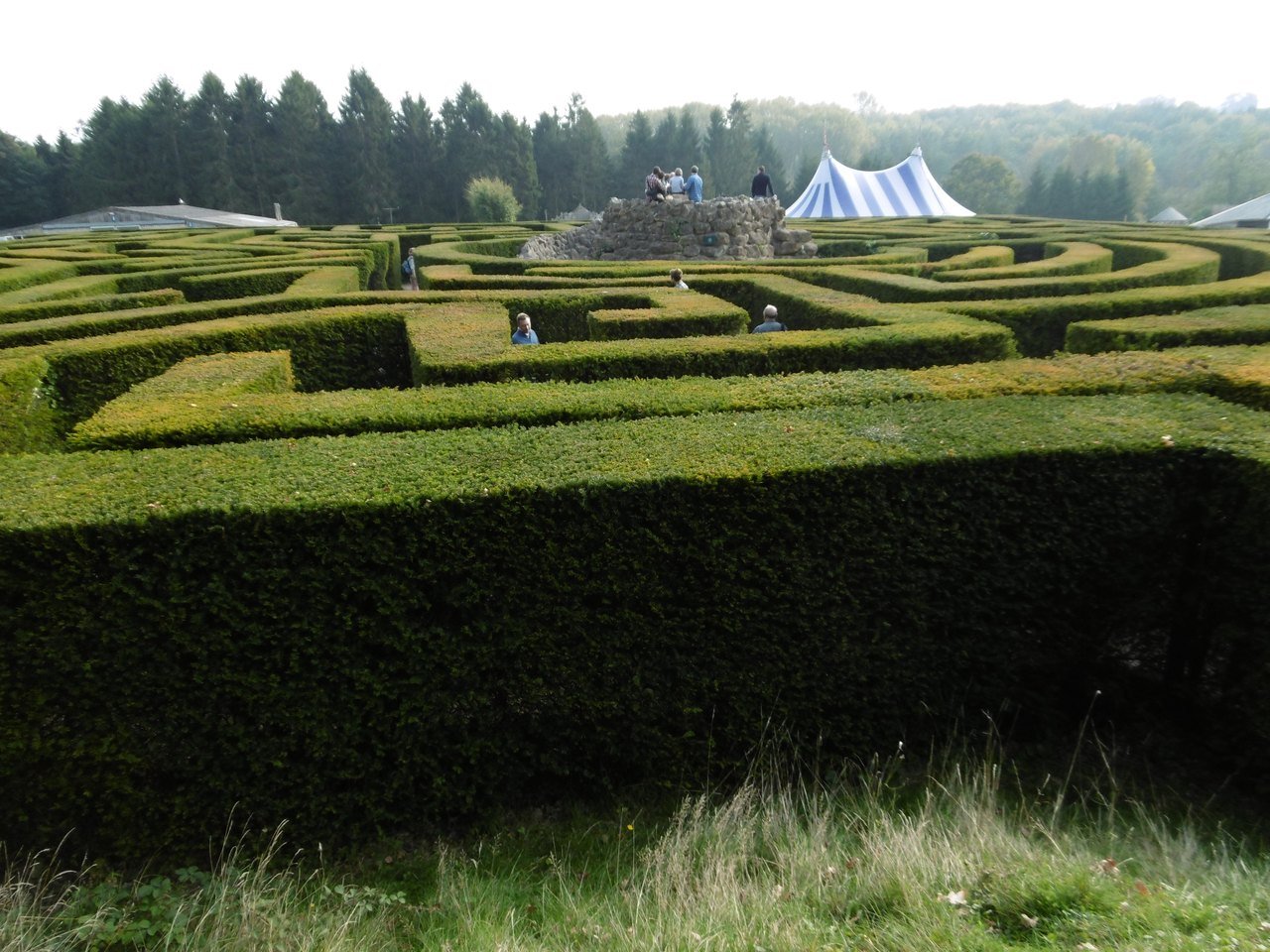
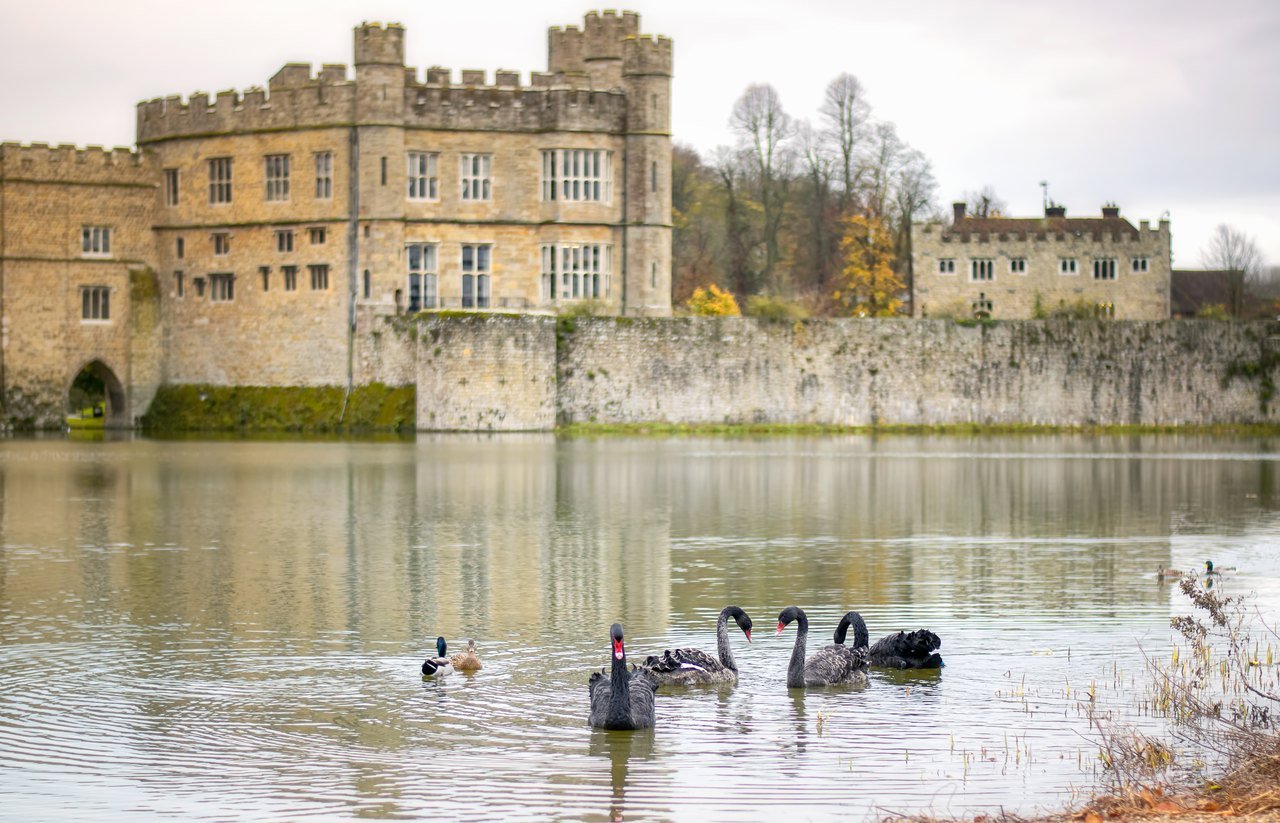
The maze of 2,400 yews was designed in 1987 and opened in 1988; the Foundation names Adrian Fisher as its designer. Its plan, set in a square, forms a queen’s crown, and from the mound at its center, or from the air, the pattern reads as circular. The Foundation puts the average time to solve it at about 20 minutes. Beneath the mound, down a flight of stone steps, lies a grotto of several rooms, decorated in stone, brick and minerals on mythological themes (Historic England). The Bird of Prey Centre stands behind the maze, and black, whooper and trumpeter swans live on the moat and the Great Water all year.
Visiting Leeds Castle
List the 8 castles on this map
- Leeds Castle — Kent, England
- Windsor Castle — Berkshire, England
- Dover Castle — Kent, England
- Framlingham Castle — Suffolk, England
- Bodiam Castle — East Sussex, England
- Kenilworth Castle — Warwickshire, England
- Tower of London — London, England
- Buckingham Palace — London, England
Prices, opening dates and hours are in the Admission table below.
Getting there
Leeds Castle is off junction 8 of the M20, 7 miles east of Maidstone by the Foundation’s figure, and brown and white tourist signs lead to it from the surrounding roads. The Foundation warns that satellite navigation may send drivers to a private entrance, so follow the brown signs once you reach the A20, or use the postcode ME17 1RG; the what3words address of the main entrance is spoiler.resembles.blogs. Parking is included in the admission ticket. Guests staying on the estate should follow the directions sent before their stay, which can differ.
Southeastern trains from London Victoria, about an hour and a quarter away, and from Ashford International stop at both Bearsted and Hollingbourne, on Sundays as well as during the week. Hollingbourne is the nearer, and the Foundation’s walking map puts it about half an hour on foot to the visitor center, with the castle further on through the grounds. National Rail lists no taxi provision at either station, so a taxi, the short option, has to be booked ahead. National Rail classes Bearsted as step-free to all platforms, while Hollingbourne, which is unstaffed, has step-free access only to the platform for trains toward London. Stagecoach’s 510 bus between Ashford and Maidstone comes into the castle grounds on Saturdays; on the other days it runs it stops outside the Mercure Maidstone Great Danes Hotel, about 12 minutes’ walk from the visitor center, the Foundation says.
National Cycle Route 17 follows the Pilgrims’ Way north of the castle, through the village of Hollingbourne. Bicycles are not allowed in the grounds, but there are cycle stands in the visitor car park. Visitors who arrive by train, bus or bicycle can claim a discount on tickets bought on site at the visitor center, though not on tickets bought online; the terms are in the Admission table.
Admission
| Ticket | Price |
|---|---|
| Explorer, adult (16+) | £34.50 online, £38.50 on site |
| Explorer, child (3-15) | £24.50 online, £28 on site |
| Explorer, Family 1 (1 adult and up to 3 children) | £87 online, £97 on site |
| Explorer, Family 2 (2 adults and up to 3 children) | £115 online, £128.50 on site |
| Explorer, visitor with a disability, adult (with a free carer) | £30 online, £35.50 on site |
| Explorer, visitor with a disability, child 3-15 (with a free carer) | £22 online, £24.50 on site |
| Ultimate Explorer, adult (16+) | £45.50 online, £49.50 on site |
| Ultimate Explorer, child (3-15) | £33 online, £36 on site |
| Ultimate Explorer, Family 1 | £114.50 online, £125.50 on site |
| Ultimate Explorer, Family 2 | £153.50 online, £166.50 on site |
| Ultimate Explorer, visitor with a disability, adult (with a free carer) | £41 online, £46.50 on site |
| Ultimate Explorer, visitor with a disability, child (with a free carer) | £30.50 online, £33 on site |
| Infants (under 3) | Free |
| Green Travel discount (arrival by train, bus or bicycle) | 20% off tickets bought on site at the visitor center with a same-day train or bus ticket, or on arrival by bicycle; not on online tickets, group or education rates; at the prices above, the discounted on-site price is lower than the online price |
| Black Swan Ferry or Elsie the Castle Train, per ride | £1.50 adult, £1 child, each way; under 3s free; card only (Ultimate Explorer includes 6 rides per person) |
| Hours, 20 November 2026 to 3 January 2027 | Grounds and gardens 10am-3:30pm (last entry 2:30pm); castle 10:30am-3pm (last entry 2:30pm); no multimedia guides; ferry not running |
| Hours, 4 January to 11 February 2027 | Weekends only (closed Monday to Friday); grounds and gardens 10am-5pm (last entry 3pm); castle 10:30am-3:30pm (last entry 3pm); ferry not running |
| Hours, 12 February to 21 March 2027 | Daily; grounds and gardens 10am-5pm (last entry 3pm); castle 10:30am-3:30pm (last entry 3pm) |
| Closed (castle and grounds) | Christmas Day, 25 December 2026 |
| Falconry displays, 20 November 2026 to 21 March 2027 | 2pm, weekends and school holidays only |
| Main car park opens | 9:45am |
| Checked | Checked at leeds-castle.com (Pricing & Tickets; Opening Times and Directions; Falconry Displays) on 20 November 2026 |
An Explorer ticket covers the castle, the gardens and parkland, the maze, the playgrounds, the falconry displays and the Queens with Means cinematic experience, and it is valid for repeat visits for 12 months. That validity excludes days when the estate is closed, and under the Foundation’s admission terms it does not extend to group or school bookings or to separately ticketed events. Tickets carry no timed entry slot and cannot be bought by phone; they can be bought on arrival, though online tickets cost less than the full on-site price. Each visitor with a disability may bring one carer free. The Ultimate Explorer adds six rides on the Black Swan Ferry, which runs seasonally, or on Elsie the Castle Train, which runs from the main entrance up to the castle all year, and a round of Adventure Golf; on a family ticket, each member of the family gets that allocation.
How long you need
The Foundation presents Leeds as a day out, with overnight stays on the estate as the way to extend it. The castle keeps a shorter day than the grounds, so visit the castle first and leave the gardens, maze and grounds for later. No guided tours run in normal opening hours, though staff in the rooms answer questions, and a multimedia guide is included with the ticket, except in the periods the Admission table notes. For lunch, the Foundation lists the Castle View Restaurant, which in the daytime serves only admission ticket holders and staying guests, food kiosks in the Stable Courtyard and a café at the maze, whose opening times vary by season.
The route through the castle is set. It starts at the castle entrance and runs through the Library and the Dining Room, then past the Private Dining Room to the Games Room, the Writing Room and a 1930s salon. Visitors then go upstairs, through rooms that tell Lady Baillie’s story, and come down the main staircase to the Drawing Rooms before finishing in the Servants’ Hall. The Dog Collar Museum, the gardens, the maze and grotto, the Bird of Prey Centre and the falconry displays, on the days the Admission table gives, are all on the same ticket, and the Princess Alexandra Gardens make the walk from the visitor center to the castle part of the visit.
Best time to visit
Weekdays outside the school holidays are quieter, the Foundation says. Spring brings daffodils, narcissi and anemones to the Princess Alexandra Gardens, followed by azaleas and rhododendrons, and the Foundation calls the Culpeper Garden a sensory delight in the summer months. The Black Swan Ferry does not run in winter. Events bring closures of their own: the whole estate closes for the fireworks weekend in November, and the castle alone closes while it is set up for Christmas and packed down afterward. In 2025 and 2026 the estate also closed on the day of its summer concert. Opening dates and hours for each season are in the Admission table.
Photography
The Foundation does not allow unauthorized drones or other remote-controlled aerial cameras, for the safety of visitors, the wildfowl and the birds of prey and for visitors’ privacy, and any drone shoot must be arranged with its marketing team in advance, by an operator with a valid license and public liability insurance; engagement, wedding and other special-occasion shoots, and commercial filming and photography, are also arranged with the Foundation ahead. The Foundation itself names three viewpoints. At the cascade in the Princess Alexandra Gardens, the stepped water makes a foreground for the Gloriette and the New Castle across the lawns beyond; the south-facing Mediterranean Garden Terraces look across the Great Water; and the three circular walks around the estate follow marker posts to views of the castle and grounds.
Accessibility
About 45 meters of cobblestones lie across the approach onto the castle island, and fire-safety rules allow at most two wheelchairs inside the castle at once. The main front door is step-free, and wheelchair users are escorted along an accessible route that starts in the Servants’ Hall and runs against the flow of visitors, so there may be a short wait. A platform lift between the Servants’ Hall and the corridor to the main route is 125 cm long and 80 cm wide and carries up to 225 kg, for passengers seated in their wheelchairs. Castle wheelchairs are available if a personal one does not fit, and electric mobility scooters are not allowed inside. The upstairs rooms are not accessible to wheelchair users: a steward can take a wheelchair user back to the Yellow Drawing Room to wait while companions go up, or show a film of the rooms.
Outside, a fully accessible mobility bus, free for visitors who need assistance, runs from near the ticket office through the day, except on special ticketed event days. Elsie the Castle Train cannot take wheelchairs. The Black Swan Ferry can carry up to three, though its ramp depends on the water level. At the gatehouse, which is fully accessible, there is an accessible toilet; the Dog Collar Museum is open to all visitors, and the toilets by the Boat House Café include an accessible toilet with an adult changing facility, opened with a RADAR key or by staff. Through the Princess Alexandra Gardens a wheelchair-accessible path runs for about 900 meters, with its steepest slope, a short stretch at 1 in 5, near the end. In the maze there is no step-free access to the mound or the grotto: 10 steps lead up to the mound, 24 down into the grotto and 12 back out. Pushchairs are not allowed inside the castle; there is a buggy park. The Foundation is working to become Dementia Friendly, hires out sensory packs from the visitor center and publishes a Quiet Places map. Only assistance dogs are admitted, because wildfowl roam the estate freely.
For guided day trips that include Leeds Castle, see GetYourGuide; for a hotel in or near Maidstone, see Booking.com. The castle’s own rooms, in the Maiden’s Tower and the Stable Courtyard, are booked directly with the Foundation.
Some links on this page are affiliate links, which means StoneKeep Atlas may earn a small commission, at no extra cost to you, if you book through them.
More Views of Leeds Castle
Common Questions
Why is Leeds Castle called Leeds when it is in Kent?
Leeds Castle takes its name from Leeds in Kent, the village beside which it stands, recorded in Domesday Book as Esledes; the Foundation explains the name as an Old English word for a slope or hillside. The castle itself lies in the parish of Broomfield and Kingswood, and its barbicans and dam partly in Leeds parish. The confusion with Yorkshire is old: in 1856 Thomas Forester, translating Orderic Vitalis, had to explain that this Leeds was not the Yorkshire place, whose Latin name is Loidis.
Who owns Leeds Castle? Is it National Trust or English Heritage?
Leeds Castle belongs to the Leeds Castle Foundation, an independent charity (registered charity 268354); it is neither a National Trust nor an English Heritage property. The Foundation is also a company, number 01172263 at Companies House. Its stated aim is to preserve the castle, its collections and its grounds for the benefit and enjoyment of the public; a secondary aim is to provide a place to discuss medical science and a forum for the arts. Admission tickets are issued in exchange for donations, so they can qualify for Gift Aid.
When was Leeds Castle built, and how much of it is medieval?
The Foundation dates the first stone castle to 1119, and a wooden castle of 857 belongs to tradition. Historic England dates the earliest standing fabric to the early-to-mid twelfth century and hedges even that: the Gloriette’s outer walls, and a low, pointed-vaulted cellar under the 1822 house, are “possibly” of that century. Most of what survives from the Middle Ages (the barbicans, gatehouse and outer wall) is thirteenth-century or later, and the main house dates from 1822-23.
Can you walk around Leeds Castle for free?
Yes, on the public footpaths that cross the Leeds Castle estate: the Foundation itself lists them in a statement deposited with Kent County Council, and one passes close to the castle south of the moat. Walkers on them see the castle without a ticket; the gardens, the castle and the attractions are inside paid admission. Stays on the estate include out-of-hours access to the grounds.
What movies were filmed at Leeds Castle?
Kind Hearts and Coronets (1949) used Leeds as Chalfont Castle. It stood in for Henry VIII’s palace in the BBC’s 1979 television production Henry VIII, and for the exteriors of Henry’s castle at Richmond in ITV’s Henry VIII (2003), according to the Kent Film Office. Filming and commercial photography on the estate are arranged with the Foundation in advance.
Who were the queens of Leeds Castle?
Six medieval queens held Leeds, as the Foundation counts them: Eleanor of Castile, Margaret of France, Isabella of France, Anne of Bohemia, Joan of Navarre and Catherine de Valois. Two queens between 1278 and 1437 did not: Edward III did not grant it to Philippa of Hainault, and by the Foundation’s chronology Richard II granted it to private holders after Anne’s death, not to Isabella of Valois. The Foundation’s multimedia-guide tour Queens with Means counts seven, adding Catherine of Aragon, for whom Henry VIII’s constable remodeled the castle.
Can you stay overnight at Leeds Castle?
Yes. The Foundation runs bed and breakfast in the Maiden’s Tower, which has five bedrooms, and in the Stable Courtyard, and on a limited number of dates it lets bedrooms in the castle itself. Stays include daytime entry to the castle, subject to availability, and out-of-hours access to the grounds. The Maiden’s Tower rooms are all on the upper floor, with no elevator, a five-minute walk from the accommodation parking. Book through the Foundation’s stays pages.
How do you get to Leeds Castle from London?
Evan Evans, Golden Tours and Premium Tours, the Foundation says, have run sightseeing coach tours to the castle from London and across the South East all year round. Without a tour, take a Southeastern train from London Victoria to Hollingbourne, the nearer of the castle’s two stations, or drive out on the M20; the Foundation puts the castle an hour from London by road.
Beyond Leeds Castle
Dover Castle, also in Kent, was in the same hands as Leeds in 1138, when Orderic Vitalis lists both among the fortresses of Robert, earl of Gloucester. Bodiam Castle, in East Sussex, is another castle standing in water. The Tower of London received Lady Badlesmere and her children after the siege of 1321, and Windsor Castle is a royal castle that is still a royal residence. The gatehouse and barbicans described above are set in context in our guide to the castle gatehouse, portcullis, drawbridge and barbican. Our guide to castles in England covers more of the country’s castles.
Conclusion
At Leeds Castle the water defenses, the barbicans, the gatehouse and the outer wall are medieval, most of them of the thirteenth century, and Colvin’s King’s Works reads the outer wall and the remodeled gatehouse as work of Edward I’s time, after he and Eleanor of Castile acquired the castle. In the Gloriette, medieval outer walls stand under a Tudor upper floor and a roof, courtyard front and rooms largely of the 1920s. Built in 1822-23 in the Tudor style, the New Castle is the main house, and the rooms a visitor walks through were remade for Lady Baillie between 1926 and the 1960s by Owen Little, Armand-Albert Rateau and Stéphane Boudin. The charity that received the castle at her death in 1974 still looks after all of it. The moat is home all year to black, whooper and trumpeter swans.
Principal Sources
- Ashbee, Jeremy. “Fine of the Month: July 2011. ‘Gloriette’ in Corfe Castle, 1260.” Henry III Fine Rolls Project. finerollshenry3.org.uk.
- Bignell, Alan. Lady Baillie at Leeds Castle 1927-1974. Leeds Castle Enterprises, 2002. archive.org.
- Brown, R. Allen, H. M. Colvin and A. J. Taylor. The History of the King’s Works, vol. II, The Middle Ages. HMSO, 1963 (second impression 1976), pp. 695-702. archive.org.
- Charity Commission for England and Wales. “Leeds Castle Foundation, registered charity 268354.” Register of Charities. register-of-charities.charitycommission.gov.uk.
- Cokayne, G. E. The Complete Peerage, new ed., vol. I. St Catherine Press, 1910, p. 372 (“Badlesmere”). archive.org.
- Companies House. “Leeds Castle Foundation, company 01172263” (company overview and filing history). find-and-update.company-information.service.gov.uk.
- Conway, Martin. “Country Homes: Leeds Castle I.” Country Life 34, no. 883 (6 December 1913), pp. 806-814. archive.org.
- Evelyn, John. Diary of John Evelyn, ed. William Bray, vol. II. Bickers and Son, 1879, pp. 188, 211-212. archive.org.
- Froissart, Jean. Chronicles of England, France and Spain, trans. Thomas Johnes, vol. II. William Smith, 1848, pp. 569-571, 693. archive.org.
- Geoffrey-Lloyd, Lord. Leeds Castle: A brief history of the castle of the queens of medieval England. Leeds Castle Foundation, revised edition, 1983 (first published 1976). archive.org.
- Hasted, Edward. “Parishes: Leeds.” The History and Topographical Survey of the County of Kent, vol. 5. Canterbury, 1798, pp. 478-502. british-history.ac.uk.
- Historic England. National Heritage List for England, entry 1000184: “Leeds Castle.” Registered park and garden, Grade II*. historicengland.org.uk.
- Historic England. National Heritage List for England, entry 1039919: “Leeds Castle.” Listed building, Grade I. historicengland.org.uk.
- Historic England. National Heritage List for England, entry 1060933: “Ruins of Barbicans and Dam at Leeds Castle.” Listed building, Grade I. historicengland.org.uk.
- Historic England. National Heritage List for England, entry 1126912: “Thorpe Hall.” Listed building, Grade I. historicengland.org.uk.
- Historic Royal Palaces. “Eleanor of Castile.” hrp.org.uk.
- History of Parliament Trust. “Smythe, Sir Richard (1563-1628).” The House of Commons 1604-1629, ed. Andrew Thrush and John P. Ferris. Cambridge University Press, 2010. historyofparliamentonline.org.
- Kent County Council. Register of Deposits, ref. 12/23: Leeds Castle Estate (Highways Act 1980, s. 31(6)). kent.gov.uk, via web.archive.org.
- Kent Film Office (Kent County Council). “Henry VIII (1979).” kentfilmoffice.co.uk.
- Kent Film Office (Kent County Council). “Henry VIII (2003).” kentfilmoffice.co.uk.
- Kent Film Office (Kent County Council). “Kind Hearts and Coronets (1949).” kentfilmoffice.co.uk.
- Leeds Castle Foundation. “Accessibility.” leeds-castle.com.
- Leeds Castle Foundation. “Bed & Breakfast.” leeds-castle.com.
- Leeds Castle Foundation. “Bird of Prey Centre.” leeds-castle.com.
- Leeds Castle Foundation. “Black Swan Ferry.” leeds-castle.com.
- Leeds Castle Foundation. “Castle Accommodation.” leeds-castle.com.
- Leeds Castle Foundation. “Castle Dining Room.” leeds-castle.com.
- Leeds Castle Foundation. “Castle Library.” leeds-castle.com.
- Leeds Castle Foundation. “Circular Walking Routes.” leeds-castle.com.
- Leeds Castle Foundation. “Did Henry VIII stay at Leeds Castle en route to the most spectacular event of the century in 1520?” 22 May 2020. leeds-castle.com.
- Leeds Castle Foundation. “Dog Collar Museum.” leeds-castle.com.
- Leeds Castle Foundation. “Earliest known painting of Leeds Castle goes on public display.” 7 May 2026. leeds-castle.com.
- Leeds Castle Foundation. “Eat, Drink and Shop.” leeds-castle.com.
- Leeds Castle Foundation. “Elsie the Castle Train.” leeds-castle.com.
- Leeds Castle Foundation. “Emergency Stonework 2025/26.” leeds-castle.com.
- Leeds Castle Foundation. “Falconry Displays.” leeds-castle.com.
- Leeds Castle Foundation. “FAQs.” leeds-castle.com.
- Leeds Castle Foundation. “Filming & Photography.” leeds-castle.com.
- Leeds Castle Foundation. “Green Travel Admission Tickets 20% Off Promotion: Terms and Conditions.” leeds-castle.com.
- Leeds Castle Foundation. “History of the Castle.” leeds-castle.com.
- Leeds Castle Foundation. “Lady Baillie Bedroom & Dressing Room.” leeds-castle.com.
- Leeds Castle Foundation. “Lady Baillie’s Story.” leeds-castle.com.
- Leeds Castle Foundation. “Leeds Castle hosts Royal visit from Patron HRH Princess Alexandra to launch new attraction.” 4 October 2022. leeds-castle.com.
- Leeds Castle Foundation. “Leeds Castle maze turns 30.” 8 August 2018. leeds-castle.com.
- Leeds Castle Foundation. “Maiden’s Tower Deluxe Double.” leeds-castle.com.
- Leeds Castle Foundation. “Multimedia Guide.” leeds-castle.com.
- Leeds Castle Foundation. “Opening Times and Directions.” leeds-castle.com.
- Leeds Castle Foundation. “Peaceful Escapes.” leeds-castle.com.
- Leeds Castle Foundation. “Pricing & Tickets.” leeds-castle.com.
- Leeds Castle Foundation. “Queens with Means.” Attraction page. leeds-castle.com.
- Leeds Castle Foundation. “Queens with Means.” Her Castle section. leeds-castle.com.
- Leeds Castle Foundation. “Reflecting on Leeds Castle’s Stonework Conservation Project: Scaffolding Tours, Meet the Mason Day and Community Engagement.” 27 May 2026. leeds-castle.com.
- Leeds Castle Foundation. “Terms & Conditions.” leeds-castle.com.
- Leeds Castle Foundation. “The Bath House.” leeds-castle.com.
- Leeds Castle Foundation. “The Castle.” leeds-castle.com.
- Leeds Castle Foundation. “The Castle Turrets Conservation Project.” leeds-castle.com.
- Leeds Castle Foundation. “The Culpeper Garden.” leeds-castle.com.
- Leeds Castle Foundation. “The Lady Baillie Mediterranean Garden Terraces.” leeds-castle.com.
- Leeds Castle Foundation. “The Maze & Grotto.” leeds-castle.com.
- Leeds Castle Foundation. “The Princess Alexandra Gardens.” leeds-castle.com.
- Leeds Castle Foundation. “The Rateau Archive Digitisation Project.” leeds-castle.com.
- Leeds Castle Foundation. “The Thorpe Hall Drawing Room.” leeds-castle.com.
- Leeds Castle Foundation. “Ultimate Explorer Ticket.” leeds-castle.com.
- Leeds Castle Foundation. “Wildlife.” leeds-castle.com.
- Leeds Castle Foundation. “Yellow Drawing Room.” leeds-castle.com.
- London Gazette, issue 11924 (3-7 November 1778), pp. 1-2. thegazette.co.uk.
- National Rail. “Bearsted station.” nationalrail.co.uk.
- National Rail. “Hollingbourne station.” nationalrail.co.uk.
- Network Rail. Electronic National Rail Timetable, Table 190, “London to Maidstone East and Ashford International,” editions of May-December 2025, December 2025-May 2026 and May-December 2026.
- Office of the Historian, U.S. Department of State. “Camp David Accords and the Arab-Israeli Peace Process, 1977-1979.” history.state.gov.
- Office of the Historian, U.S. Department of State. Foreign Relations of the United States, 1977-1980, vol. VIII, documents 268 and 273. history.state.gov.
- Orderic Vitalis. The Ecclesiastical History of England and Normandy, trans. Thomas Forester, vol. IV. Henry G. Bohn, 1856, pp. 200, 204. archive.org.
- Powell-Smith, Anna. “Leeds.” Open Domesday (Domesday Book, Kent 5,67). opendomesday.org.
- Scott Robertson, W. A. “Leeds Castle.” Archaeologia Cantiana 15 (1883), pp. 148-151. kentarchaeology.org.uk.
- Stubbs, William, ed. Chronicles of the Reigns of Edward I and Edward II, vol. II (Rolls Series 76). Longman, 1883, pp. 73, 262, 302. archive.org.
- Trusler, John. Chronology; or, the Historian’s Vade-Mecum. 8th ed. Printed for the author and sold by R. Baldwin, London, 1776. archive.org.
- Ulster University, CAIN. “Joint Statement by British and Irish Governments at Leeds Castle, 18 September 2004.” cain.ulster.ac.uk.
- Walk Wheel Cycle Trust (Sustrans). “Route 17.” sustrans.org.uk.
Image credits. Hero, the castle on its two islands: Photo: wirestock / Envato Elements; the Gloriette and the New Castle over a stone parapet: Photo: elenarostunova / Adobe Stock; a photochrom of the castle across the moat: Photochrom, Photochrom Print Collection, Library of Congress, public domain; an 1823 lithograph: Lithograph, British Museum, public domain; the castle from almost overhead: Photo: Roberto / Adobe Stock; the plan of 1869 printed in 1883: Archaeologia Cantiana via Internet Archive, public domain; the ruined barbican and its bridge arch: Photo: Adrian / Adobe Stock; the gatehouse from its bridge: Photo: Fulcanelli / Adobe Stock; the Maiden’s Tower and the New Castle across the moat: Photo: naturalv / Adobe Stock; the Gloriette and its bridge: Photo: xorge, CC BY-SA 2.0; the Banqueting Hall: Photo: Chensiyuan, CC BY-SA 3.0; Lady Baillie’s bedroom: Photo: Ad Meskens, CC BY-SA 4.0; the Library: Photo: Ad Meskens, CC BY-SA 4.0; the Thorpe Hall Drawing Room: Photo: Robert Anderson via Unsplash; the Dog Collar Museum: Photo: Geni, CC BY-SA 4.0; the cascade in the Princess Alexandra Gardens: Photo: Christine Matthews, CC BY-SA 2.0; the Culpeper Garden: Photo: Marathon, CC BY-SA 2.0; the Lady Baillie Mediterranean Garden Terraces: Photo: Peter Jeffery, CC BY-SA 2.0; the yew maze: Photo: Marathon, CC BY-SA 2.0; the New Castle and the Gloriette from the air: Photo: wirestock / Envato Elements; an aerial over the island: Photo: Joan / Adobe Stock; swans on the moat: Photo: Natalia Greeske / Adobe Stock; black swans on the moat: Photo: Zita Stankova / Adobe Stock; the castle from the park: Photo: Ben / Adobe Stock; the New Castle front from the approach: Photo: Nigel Walsh via Unsplash; a bedroom with leaf-patterned wallpaper: Photo: Graham Taylor / Adobe Stock; the barbican and mill ruins: Photo: Peter Jeffery, CC BY-SA 2.0. Source: The Old Water Mill - geograph.org.uk - 4957294, Wikimedia Commons; the Banqueting Hall fireplace: Photo: xorge, CC BY-SA 2.0. Source: Leeds Castle - IMG 3106 (13249852203), Wikimedia Commons; a bedchamber in the medieval manner: Photo: xorge, CC BY-SA 2.0. Source: Leeds Castle - IMG 3099 (13249843753), Wikimedia Commons; a bathroom in the medieval manner: Photo: xorge, CC BY-SA 2.0. Source: Leeds Castle - IMG 3102 (13250036604), Wikimedia Commons; the Gloriette’s fountain court: Photo: Tim Sheerman-Chase, CC BY 2.0. Source: Castle Courtyard with Fountain, Leeds Castle, Wikimedia Commons; the Dining Room: Photo: Ad Meskens, CC BY-SA 4.0. Source: Maidstone Leeds Castle Dining Room, Wikimedia Commons; the canopied bed in Lady Baillie’s bedroom: Photo: Ad Meskens, CC BY-SA 4.0. Source: Maidstone Leeds Castle Lady Baillie’s bedroom 01, Wikimedia Commons; the present chapel: Photo: Ad Meskens, CC BY-SA 4.0. Source: Maidstone Leeds Castle Chapel 01, Wikimedia Commons; a cellar: Photo: Ad Meskens, CC BY-SA 4.0. Source: Maidstone Leeds Castle Cellars 01, Wikimedia Commons; the Gloriette and the New Castle from the air: Photo: Barbara van Cleve, CC BY-SA 3.0. Source: Leeds Castle from the east, Wikimedia Commons; the Maiden’s Tower beside the drive: Photo: Paul Gillett, CC BY-SA 2.0. Source: Maiden’s Tower, Leeds Castle - geograph.org.uk - 3949060, Wikimedia Commons. Freely licensed images are resized to fit; any other change, such as a crop, is named in the credit.