
Ewloe Castle
Record: full guide not yet written. This page carries the verified record fields and the sources they rest on.
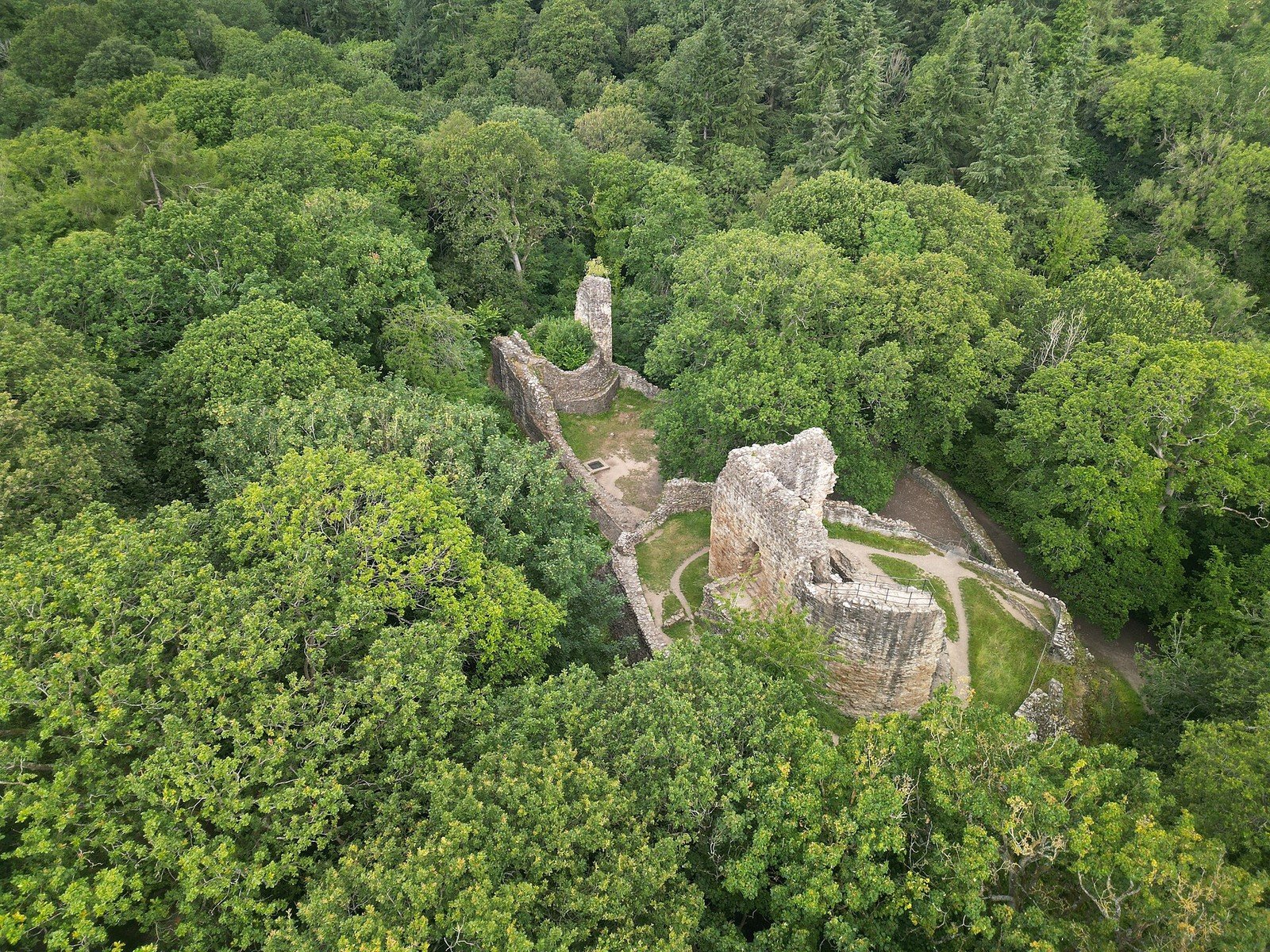
Ewloe Castle is a ruined castle of the princes of Gwynedd, set in a wooded hollow above the Wepre Brook near Ewloe in Flintshire. A D-shaped keep, the Welsh Tower, stands in its walled upper ward beside a lower ward with a round western tower. Sources disagree about which of two princes began the castle. Among the castles in Wales, Ewloe is one of the castles of the Welsh princes; the nearest castle with a full guide is Conwy Castle.

Quick Facts
| Location | In a wood above the Wepre Brook near Ewloe, community of Hawarden, Flintshire, Wales |
|---|---|
| Built | Thirteenth century; the date and the builder are disputed |
| Built for | Llywelyn ap Gruffudd, Prince of Wales (killed 1282), for at least the curtain and western tower; the D-shaped tower is credited to him by Cadw’s scheduling record and to Llywelyn ap Iorwerth, prince of Gwynedd (d. 1240), by Cadw’s page for the castle |
| Architectural style | Native Welsh castle “of typically Welsh design” (Cadw): a D-shaped keep in a walled upper ward, with a lower ward and a round western tower |
| Castle type | Castle |
| Condition | Ruin |
| Survival | Ruin |
| Authenticity | Largely original; no recorded English building after 1277; a little masonry reset in the West Tower and some modern visitor steps |
| Access | Interior open |
| Owner / managed by | In the care of Cadw |
| Heritage designation | Scheduled monument FL002 (Cadw); Grade I listed building 13 (Cadw) |
| Town & station | Ewloe; Shotton station, about 2.5 km, and Hawarden station, about 2.9 km, in a straight line (OpenStreetMap) |
| Open to public | Yes, all year |
| Official website | Cadw: Castell Ewloe |
History
Ewloe was a manor before it was a castle. J. E. Lloyd traced its tenure by the princes of Gwynedd from soon after 1146, when it fell into the hands of Owain Gwynedd, to 1246; Llywelyn ap Iorwerth was lord of Ewloe until his death in 1240, and his son Dafydd ap Llywelyn held it until his own death in 1246. Wilfrid Hemp described the wood as the scene of the successful ambush of Henry II in 1157: the king’s attack was aimed at Owain Gwynedd, encamped at Basingwerk, while Owain’s sons Dafydd and Cynan had taken up an advanced position in the wood. Hemp noted that Lloyd placed the ambush at Coleshill near Flint, and he saw no hint of a permanent fortified post in the wood at that time, though he read some features of the plan as suggesting that a mount-and-bailey castle came first. Coflein likewise calls an earlier earth-and-timber stronghold on the site possible. In Lloyd’s account, Henry III used the death of Dafydd ap Llywelyn to seize the whole country as far as the Conwy, and Ewloe came into the possession of the Crown. Roger de Montalt, hereditary steward of the earls of Chester, later annexed the manor to his lordship of Hawarden and turned its woods into a private park.
According to Cadw’s booklet, Llywelyn ap Gruffudd recovered the manor of Ewloe from the English in late 1256. For the medieval castle, the same booklet calls a report in the Chester Plea Rolls of 1311 “the only explicit documentary reference to the castle.” Made to Edward II by Payn Tibetot, justice of Chester, and printed by Hemp in 1928, the report says that Llywelyn ap Gruffudd ousted Roger and “afferma” a castle in the corner of the wood, which was still “in great part standing” in 1311. Its verb, afferma, is a form of the Anglo-Norman affermer, which can mean to strengthen or to establish and build. The English version that Hemp gave of the report reads “built,” while Cadw’s booklet says the report suggests that Llywelyn ap Gruffudd “restored the castle.” The report names Llywelyn ap Iorwerth too, as an earlier holder of the manor, but credits the castle only to Llywelyn ap Gruffudd.
So the document does not settle who began Ewloe, and the modern sources divide. Cadw’s page for the castle says the D-shaped tower “was probably built by Llywelyn ap Iorwerth (Llywelyn the Great) some time after 1210,” with the curtain walls and western tower added by Llywelyn ap Gruffudd. Cadw’s booklet says the evidence “now seems to favour Llywelyn ap Iorwerth as the first builder on the site,” and Cadw’s listing record calls the Welsh Tower early thirteenth-century work that may be his. Paul Davis wrote that the keep may date from around 1220 and was probably Llywelyn ap Iorwerth’s work. Cadw’s scheduling record instead describes “a medieval castle built around 1257 by Llywelyn ap Gruffudd,” which was the reading of Hemp and Lloyd in 1928. Both worked from the 1311 report, and Hemp judged it “more than probable that 1257 saw the building of the greater part of the castle.” Every one of them credits Llywelyn ap Gruffudd with work at the castle, and Cadw’s place page gives him the curtain and the western tower.
Ewloe fell to the English in 1277. D. J. Cathcart King found no record of a siege, and Cadw’s booklet says there is no evidence that the English undertook any work there after its capture. Hemp placed its fall before Edward I began his new castle at Flint in July 1277. Ewloe then became, in Lloyd’s phrase, “a bone of contention between the Montalts and the Crown.” Soon after 1277, Joan, widow of Robert de Montalt, claimed her dower third in the manor, but in 1284 the justice Reginald Grey called on her to give up the land she held there as parcel of the manor and, in Lloyd’s words, “indubitably the property of the Crown.” The king’s right was upheld, and throughout the fourteenth century Ewloe appears as a royal possession. In the Flintshire Ministers’ Accounts printed in 1913, Lloyd found the profits of its court, forest, mills and sea coal recorded as regular royal revenue from 1301 to 1328, and Hemp noted that the published accounts for those years never once mention the castle. Writing just before 1540, Leland, as Hemp quotes him, described “a ruinous castelet, or pile, at a place called Castel Yollo.” A witness in 1610 said that nothing stood but a small part of the south wall, an account Hemp judged “more precise than accurate.” By P. B. Davies-Cooke’s account of 1891, the manor stayed with the Crown until 1627; by July 1628 it belonged to Sir John North, who sold it to Colonel Thomas Davies, and Davies resold it on 20 June 1637 to his nephew, Robert Davies of Gwysaney. In 1922 the castle’s owner, P. T. Davies-Cooke of Gwysaney, transferred it to the custody of the Commissioners of H.M. Works, and the site was cleared that year.
What Stands Today
Ewloe Castle is “now largely ruinous” in the words of Cadw’s listing record. In Cadw’s description, “while the Welsh princes generally chose lofty vantage points for their fortresses, Ewloe sits in a hollow amid deep woodland.” The scheduling record says the castle commands a north-facing slope above two ravines but is overlooked from the south, where a substantial earthwork was built outside the ditch. Large ditches flank the site, and Davis describes the upper ward’s curtain carried down the rock sides of the encircling ditch as a revetment.
At the east end, the Welsh Tower stands free within the upper ward, which occupies a natural outcrop. Cadw’s scheduling record describes the tower as a rectangular keep with an apsidal end. In 1928 Hemp recorded that most of its southern half stood to its original height, while the northern half had gone to within a few feet of its foundations. The keep’s hall was on the floor above the basement, entered by an external stair. Cadw’s own accounts of the floors differ: its booklet says the keep “contained only one large room above a cellar,” while its listing record describes two floors over the basement. From the wall-walk around the apse, the scheduling record notes, a visitor can see the internal subdivisions of the basement and the large windows of the principal room at entrance level, with traces of a roof line above them, some way below the battlements. In Hemp’s reading, beam slots in the parapet held a timber fighting gallery.
A bridge on the northeast originally led straight into the upper ward, and the gap in the wall where it arrived is still visible, with steps to the wall-walk just to its south. Part of the outcrop facing the eastern ditch was given a glacis, a covering of smooth stone to deter missiles. A lower ward encloses a well, and at its west end stands the round West Tower, of two stories in Cadw’s listing record, though Hemp found nearly all of its upper part gone but for a fragment on the north side. Hemp found the West Tower and the lower ward’s curtain to be of one build, with a straight joint where the curtain was built up against the revetment of the upper ward. Davis wrote that the lower ward was rebuilt in stone slightly later than the curtain of the upper ward. In the course of the 1920s works, Hemp found no evidence that the stone fabric had been rebuilt or repaired in the Middle Ages, with one small exception: in the West Tower, the profile of a window seat built into the wall, which he read as a rebuilding or a change of plan during the work. A modern resetting of the masonry has emphasized one side of it, and Cadw says the monument has “a mix of modern and historic stone steps.”
Access
Ewloe Castle is in the care of Cadw and open all year, and visitors can walk inside the ruin. Cadw lists lay-by parking for five cars; the castle is reached across farmland, about 500 m from the roadside. Cadw grades the terrain as Level 3, moderate, and says there are roughly 40 to 50 modern steps of low risers. Dogs on short leads are welcome at the “ground floor levels” of the site. Shotton station is about 2.5 km away in a straight line. Times can change, so check Cadw’s Castell Ewloe page before you travel.
Principal Sources
- Anglo-Norman Dictionary. “affermer.” anglo-norman.net.
- Cadw. “Castell Ewloe.” cadw.gov.wales.
- Cadw. “Listed building 13: Ewloe Castle.” cadwpublic-api.azurewebsites.net.
- Cadw. “Scheduled monument FL002: Castell Ewloe.” cadwpublic-api.azurewebsites.net.
- Cadw. The Castles of the Lords and Princes of Wales. Cadw, undated, p. 10.
- Davies-Cooke, P. B. “Ewloe Castle.” Archaeologia Cambrensis, 5th series, vol. 8 (1891), pp. 1-7.
- Davis, Paul R. Castles of the Welsh Princes. Christopher Davies, 1988.
- Hemp, Wilfrid J. “The Castle of Ewloe and the Welsh Castle Plan.” Y Cymmrodor 39 (1928), pp. 4-19.
- King, D. J. Cathcart. Castles and Abbeys of Wales. HMSO, 1975.
- Lloyd, J. E. “Ewloe.” Y Cymmrodor 39 (1928), pp. 1-3.
- RCAHMW. “Ewloe Castle, NPRN 94447.” coflein.gov.uk.
Image credits. Hero, Ewloe Castle in its woodland from the air: Photo: Llywelyn2000, CC BY-SA 4.0. Source: Castell Ewlo, Sir y Fflint, Gorffennaf 2026 - Ewloe Castle, Flintshire, Wales; Built by the Welsh; July 2026 14, Wikimedia Commons; Ewloe Castle’s ruins among the trees: Photo: Rept0n1x, CC BY-SA 2.0. Freely licensed images are resized to fit; any other change, such as a crop, is named in the credit.