
Castles in Wales
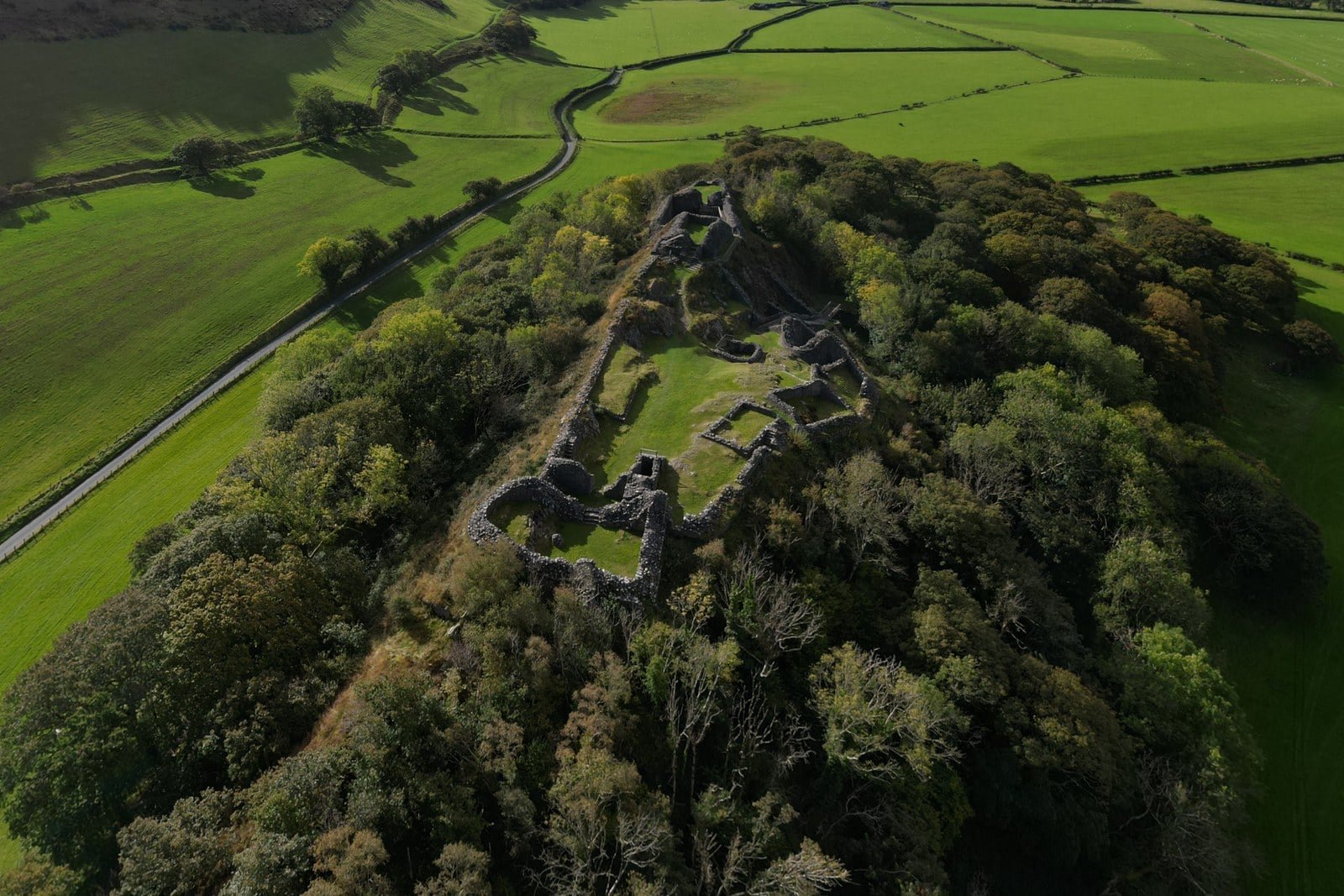
Ask who built the castles in Wales, and Cadw, which cares for many of them, answers in two sentences of its booklet The Castles of the Lords and Princes of Wales. Most of them, it says, “were built by the kings of England or the Anglo-Norman lords in their bid to extend control along or beyond the Welsh ‘March’ …” and then it adds: “But the Welsh were castle builders too.” That gives three hands behind the stone. There is the king, above all Edward I, whose campaigns of the 1270s and 1280s, and the building that followed them, left a line of royal castles across north-west Wales. There are the Marcher lords, Anglo-Norman barons who held land along the border and in the south. And there are the princes of Gwynedd, who raised castles of their own.
What follows reads all three as they stand today, above all from Cadw’s own records and visitor pages. Scheduling recognizes in law a monument of national importance, and listing a building of special architectural or historic interest, so a castle can carry a scheduling record, a listing record or both. The Royal Commission on the Ancient and Historical Monuments of Wales adds its entries on Coflein, the online database of the National Monuments Record of Wales.
Welsh Castles at a Glance
| Castle | Builder | What survives today | Principal area | Cared for by | Rail (Cadw) |
|---|---|---|---|---|---|
| Conwy Castle (Castell Conwy) | King | Curtain wall and eight round towers still standing; a full circuit of the battlements is walkable on restored stairs | Conwy | Cadw | Conwy |
| Caernarfon Castle (Castell Caernarfon) | King | Unfinished when major work stopped about 1330; walls and towers extensively restored from the nineteenth century | Gwynedd | Cadw | Bangor |
| Harlech Castle (Castell Harlech) | King | Roofless; inner curtain, corner towers and gatehouse stand high, outer ward walls reduced in height | Gwynedd | Cadw | Harlech |
| Beaumaris Castle (Castell Biwmares) | King | Unfinished; outer curtain at full height, inner towers and gatehouses at the height reached when work stopped about 1330 | Isle of Anglesey | Cadw | Bangor |
| Caerphilly Castle (Castell Caerffili) | Marcher lord | Much restored and rebuilt by the Bute family, chiefly in the twentieth century; leaning south-east tower left unrestored | Caerphilly | Cadw | Caerphilly |
| Dolbadarn Castle (Castell Dolbadarn) | Welsh prince | Roofless round tower; the curtain survives only as fragmentary ruins | Gwynedd | Cadw | Bangor |
| Dolwyddelan Castle (Castell Dolwyddelan) | Welsh prince | Keep stands roofed, with nineteenth-century battlements; west tower much ruined | Conwy | Cadw | Dolwyddelan (request stop) |
The survival column describes each castle as it stands now, in the words of the heritage records. Prices and opening hours change, so they live only in each castle’s own guide. The builder column follows the sources: a king of England, a Marcher lord or a Welsh prince. Each area is the principal area that Cadw’s scheduling record gives for the monument. The rail column gives the station that Cadw names in its own directions for each castle, which is not always the closest station on the map: measured in a straight line, Roman Bridge lies closer to Dolwyddelan Castle than the village’s own station does. For Harlech, Cadw’s directions give only a distance and a line, “200m/220yards, Shrewsbury-Machynlleth/Pwllheli route,” and the column names Harlech station, which is on that line. Dolwyddelan’s station is a request stop: to get off there, tell the conductor in good time, and to board, give the driver a clear hand signal as the train approaches. The last column names the body that cares for each castle, which is not the same thing as owning it.
Who Built the Castles of Wales
Why does Wales have so many castles? Cadw’s answer is about power rather than numbers: “The large numbers reflect the fragmentation of power and land in medieval Wales, when castles were built to assert authority and defend land in a period dominated by intermittent, often localised, warfare.” In that reading, a castle marked a claim to land and the will to hold it, and that is why three different kinds of builder stand behind the castles on this page.
For the king’s castles, Cadw states the purpose plainly. Edward I led two campaigns in Wales, in 1276-77 and 1282-83, and their aim, in Cadw’s words, was “to defeat the Welsh princes and bring Wales under English rule.” Cadw adds that “between 1276 and 1295 many castles were built or repaired.”
The Marcher lords were a different kind of builder. Cadw’s sentence sets them beside the kings: both were working to extend control along or beyond the March. On this page they are represented by Gilbert de Clare at Caerphilly, William fitz Osbern at Chepstow and William Marshal at Pembroke.
The princes built too, and Cadw gives the scale in a single sentence, counting fortresses: “out of more than 470 fortresses across Wales, fewer than 40 were definitely built by native hands.” Cadw’s booklet on the castles of the lords and princes says: “Castles were built by the Welsh lords and princes to defend their land from each other, from invasion, and, like the English, to protect important routes.” All three purposes matter, because the princes of Gwynedd fought their Welsh rivals as well as English kings. Llywelyn ap Iorwerth, known as Llywelyn the Great, was by Cadw’s account “the undisputed ruler of Gwynedd from 1201 to his death in 1240.” His grandson Llywelyn ap Gruffudd went further: in 1267, in the Treaty of Montgomery, Henry III formally recognized him as prince of Wales.
In December 1282, Arnold Taylor writes in his guide to Caernarfon for Cadw, Llywelyn ap Gruffudd was killed near Builth, and by 18 January 1283 the English had taken Dolwyddelan. As soon as Dolwyddelan was occupied, Taylor writes in The History of the King’s Works, steps were taken to dress its new garrison in camouflage for winter warfare in Snowdonia, and the king’s tailor supplied, among other things, some 80 yards of white Irish cloth and 57 pairs of white stockings. Castell y Bere fell on 25 April, and the capture of Dolbadarn, probably in May, denied Llywelyn’s brother Dafydd his last remaining stronghold. In the same year Edward I began Conwy, Caernarfon and Harlech. In 1294 the Welsh rose again, led by Madog ap Llywelyn, who took the title prince of Wales, and they overran Caernarfon, whose second building phase, Cadw’s scheduling record says, began after that revolt. That year, Cadw says, the English abandoned Castell y Bere during an uprising against their rule, and in 1295 work began at Beaumaris. Dolwyddelan and Dolbadarn in 1283, and Caernarfon in 1294, all have rows in a ledger of how castle sieges ended.
This page does not rank the castles, because builders and survivals are different questions from merit. Nor does it give a single figure for how many castles Wales has, because Wales’s own government sites give several different totals for different things. And it passes no verdict on the conquest of 1282-83: the sources describe what each side built and why, and so does this page. For the wider European story of which these castles are one part, see our history of castles.
The King’s Castles
Edward I’s castles in Wales belong to his two campaigns and the years after them, and Cadw’s records tie them again and again to Gwynedd, the land of the princes. By their scheduling records, Caernarfon was established to confirm the conquest of Gwynedd and Beaumaris completed a chain of fortifications around it. Conwy, Caernarfon, Harlech and Beaumaris have full guides on this site and are described below, and the same castles are inscribed together as a World Heritage Site.
Inscription together does not mean that each castle survives in the same state: as the accounts below show, Conwy and Caernarfon have come down to the present in quite different conditions.
Conwy Castle
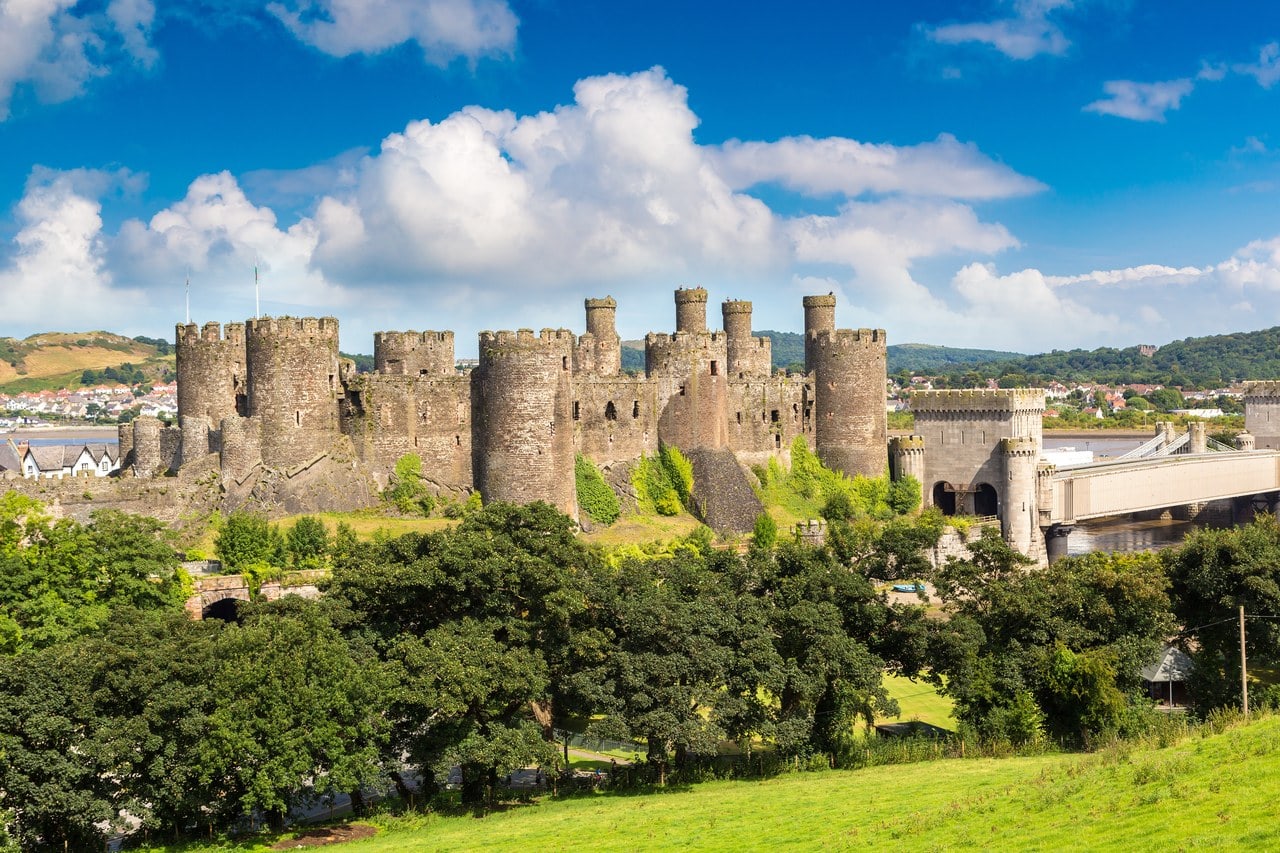
Cadw credits Conwy Castle to King Edward I and his architect Master James of St George, who built it with its town walls between 1283 and 1287. A single curtain wall with eight round towers encloses its two wards, and Cadw’s scheduling record gives that curtain a thickness of 3 meters (10 feet). Inside the curtain stand the royal apartments, which Cadw calls “the most intact set of medieval royal apartments in Wales,” though its World Heritage Site management plan notes that they are “without roofs and floors.” Two years after Richard II took refuge there in 1399, Cadw’s scheduling record says, supporters of Owain Glyndŵr captured the castle, in 1401. Cadw’s guidebook to Conwy sets the seizure on Good Friday, while the garrison was at prayer, when two rebels took the castle, in a phrase the guidebook quotes, “through the guile of a carpenter claiming to be about his usual job, who killed the two watchmen.”
Its walls and towers still stand. Cadw notes that, “Thanks to restored spiral staircases in its great towers you can walk a complete circuit around the battlements of Castell Conwy.” The stairs are modern restorations inside medieval towers, and they are what make the full round of the battlements possible. Because the castle and the town walls were one project, the walls of the town below are part of the same piece of royal building, and the castle is the place to begin reading them.
Caernarfon Castle
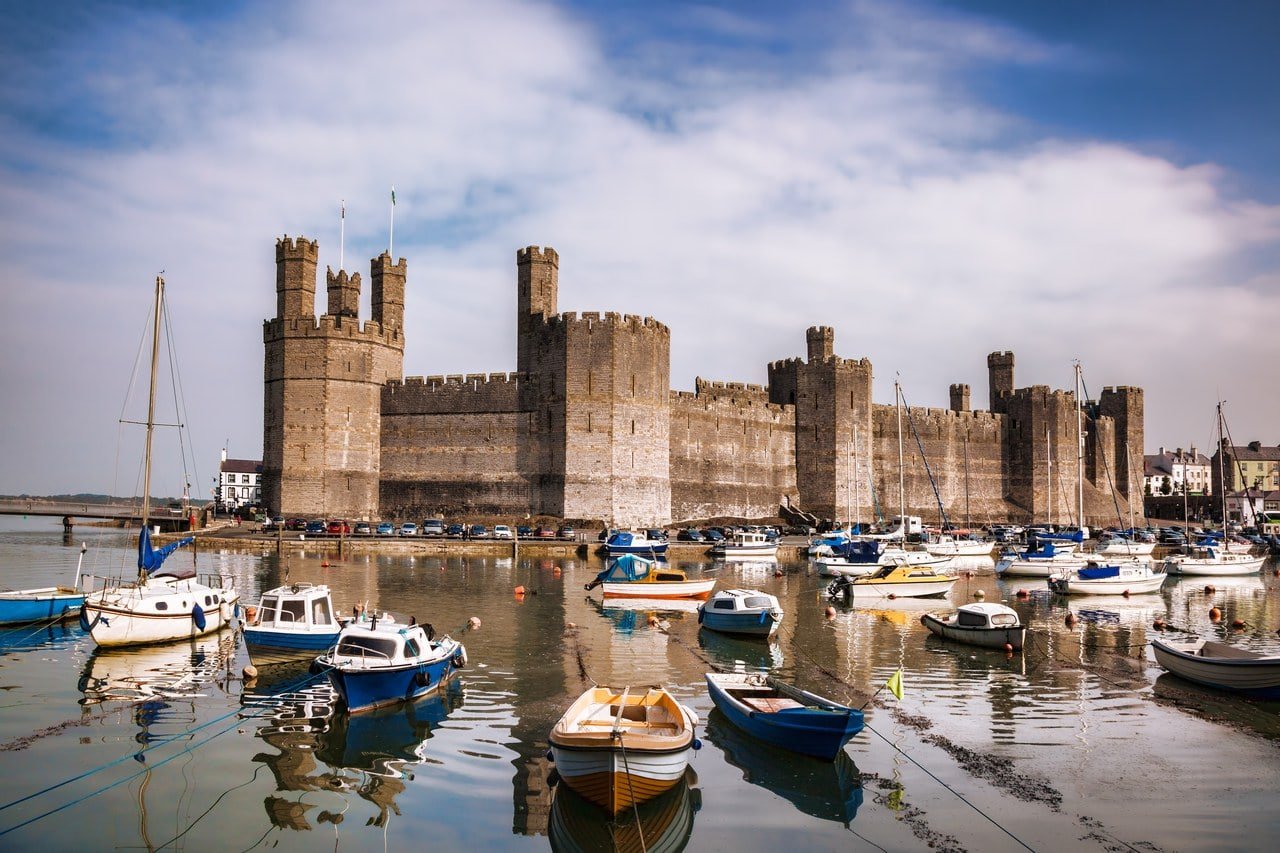
Cadw’s scheduling record says Edward I’s Caernarfon Castle and town “were established in 1283 to confirm his defeat of Llywelyn, Prince of Wales, and conquest of Gwynedd,” and adds that “As a result, Caernarfon became the centre of government for north Wales.” The Royal Commission records that the castle and the walled town were still incomplete by about 1330, when major work ended. Edward I’s son Edward of Caernarfon was born there on 25 April 1284 and formally created prince of Wales in 1301, and in 1969 the castle saw the investiture of Prince Charles as prince of Wales.
Where Conwy’s towers are round, Caernarfon’s are polygonal, and bands of differently colored stone run through its masonry. Cadw says that “the polygonal towers, eagle statues and multi-coloured masonry sent a more subtle message,” which Cadw and the Royal Commission’s Coflein record both read as an echo of the walls of Constantinople, though a 2022 Royal Commission blog post notes that castle historians “have been cautious” about a direct influence from those walls. The Eagle Tower carries three turrets, and on the west turret, Cadw’s record notes, a stone eagle “is still recognizable.” The Royal Commission’s record allows that the great hall may never have been built; Cadw’s visitor leaflet disagrees, calling it “once the heart of the castle, now only its foundations remain.” In the Royal Commission’s words, “From the nineteenth century the castle was extensively restored and the walls and towers renewed.”
Harlech Castle
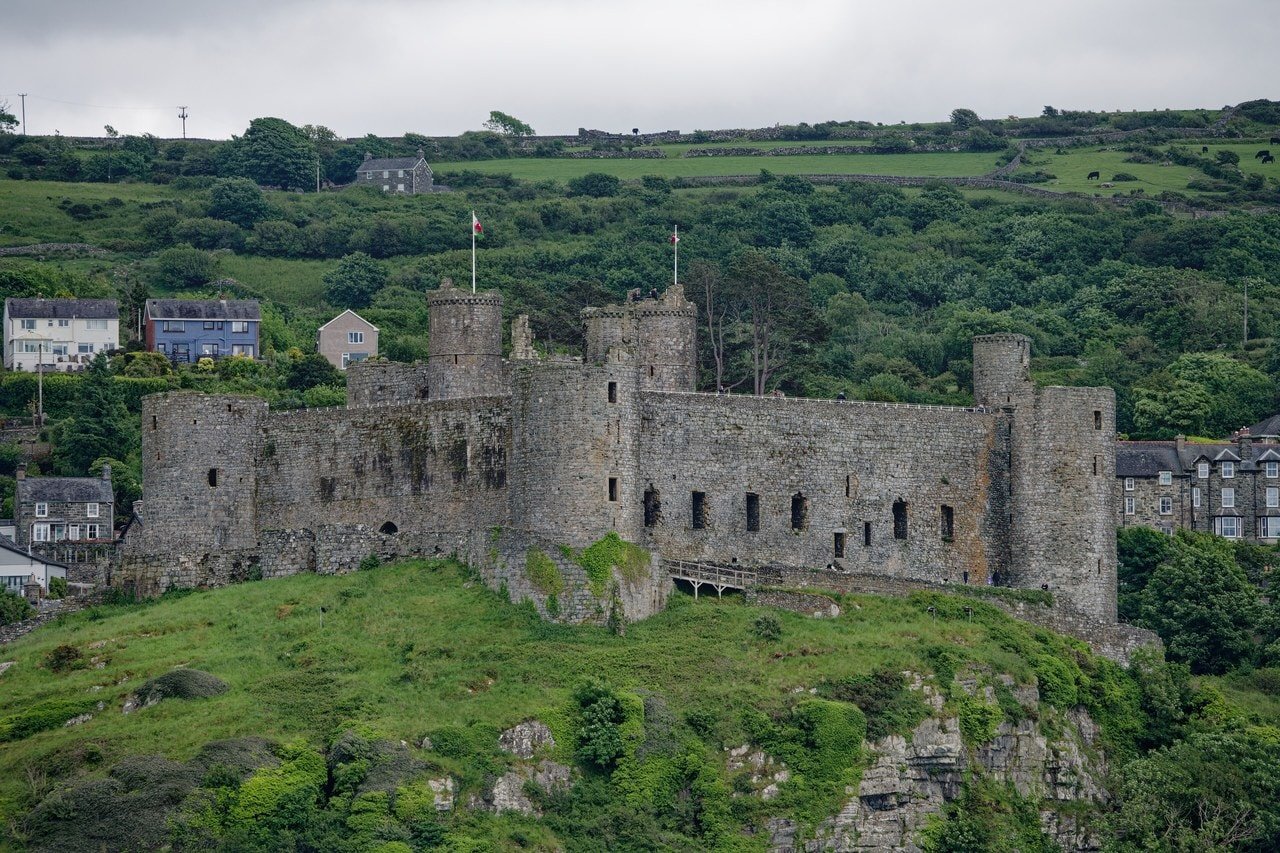
Harlech Castle was begun in 1283, and Cadw’s scheduling record says it “occupies a strategic site on a rocky outcrop with commanding views over the sea.” Master James of St George, master of the king’s works in Wales, directed the building, and in 1290 Edward made him the castle’s constable. In Madog ap Llywelyn’s rising of 1294-95, Harlech was cut off by land and kept supplied by sea. Owain Glyndŵr took it in 1404, after a long siege, and the record says it then served as “his residence and court from 1404 until 1409,” when English forces under Prince Henry, the future Henry V, retook it. The same record says that in the Wars of the Roses the castle was “held by the Welsh Lancastrians before surrendering to the besieging Yorkists,” and that in the Civil War it was “the last mainland British castle to hold out for King Charles I before finally being surrendered in 1647.”
Today the castle is roofless. The record calls it “of concentric type,” and Cadw’s place page sums up its plan as “walls within walls,” built, the record says, of local Rhinog Grit and yellow sandstone. Its inner curtain, corner towers and gatehouse still stand high, while the walls of the outer ward “have been reduced in height.” The great gatehouse faces the town on the east, and the sea that once reached the water gate at the foot of the rock now lies far off beyond the dunes.
Beaumaris Castle
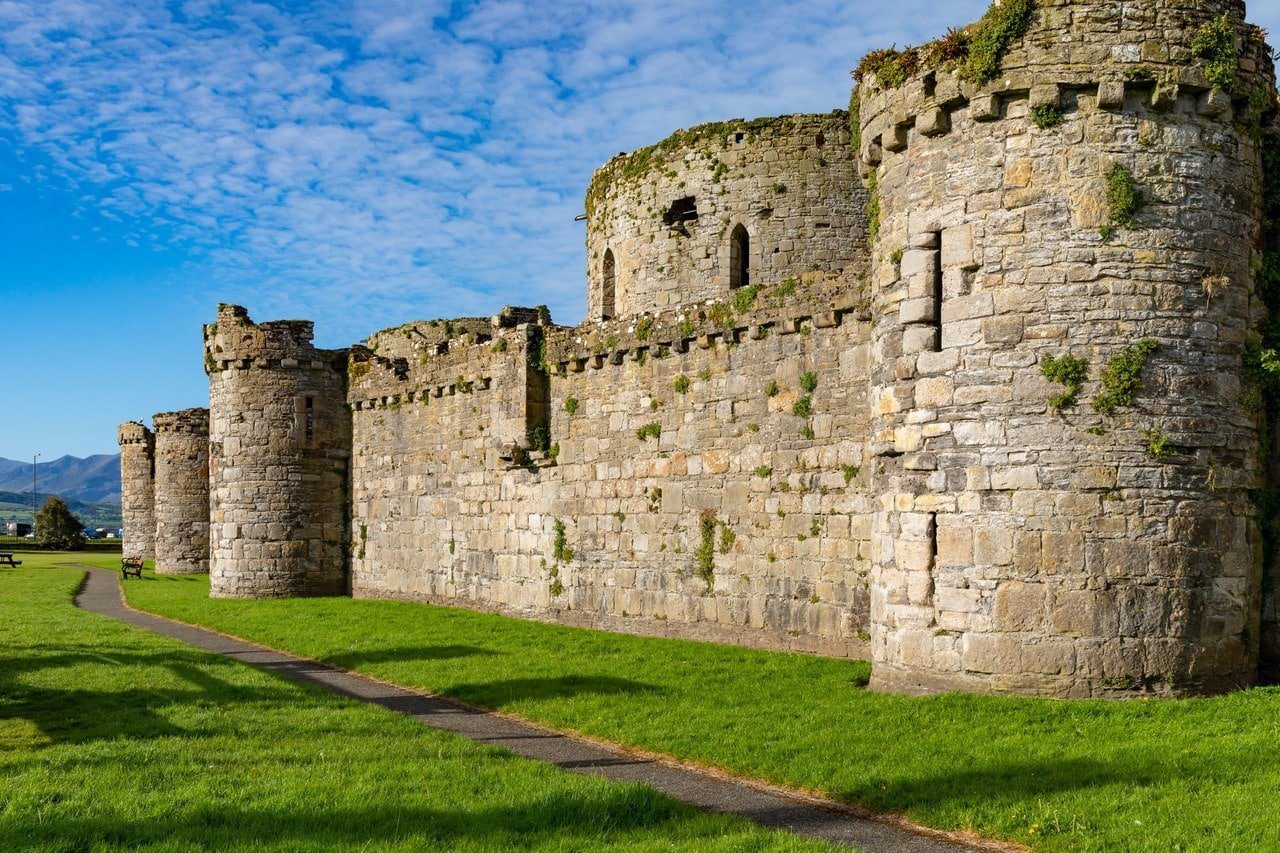
Beaumaris Castle came last. Cadw’s scheduling record says: “Begun in 1295, Beaumaris Castle was the last royal stronghold to be built by the King in Wales and completed the chain of fortifications with which he had begun to enclose Gwynedd in 1277.” The History of the King’s Works says that Edward began it “in order to control Anglesey and the Menai Strait,” and, as at Conwy, Cadw names Master James of St George as Edward’s architect. Cadw’s place page says that building work “had petered out by the 1320s.”
It was built on the concentric principle, which the record glosses as “walls within walls,” with four rings of defenses and, as first built, a wide moat with a dock so that the castle could be supplied directly from the sea. Cadw writes that “Even in its unfinished state Beaumaris Castle combines the beauty of its perfect symmetry with an overwhelming sense of ruthless power.” Unfinished it is: the walls of the outer ward stand at their full height, but the two gatehouses and the inner ward walls stand at the height they had reached when construction stopped, about 1330. The moat that once surrounded it survives on the north, the west and half of the south side, and the castle dock is no longer connected to the sea.
The Marcher Lords’ Castles
Cadw defines the March as “an area of land on the border between England and Wales.” Its lords were Anglo-Norman barons, and Cadw’s account puts most of the castles of Wales in their hands or the king’s. Pembroke and Chepstow, further down this page, belong with the Marcher lords’ castles too, and Castell Coch stands on the remains of a castle of the Clare lords of Glamorgan. The Clares also built the castle below, a few years before Edward I’s first campaign.
Caerphilly Castle
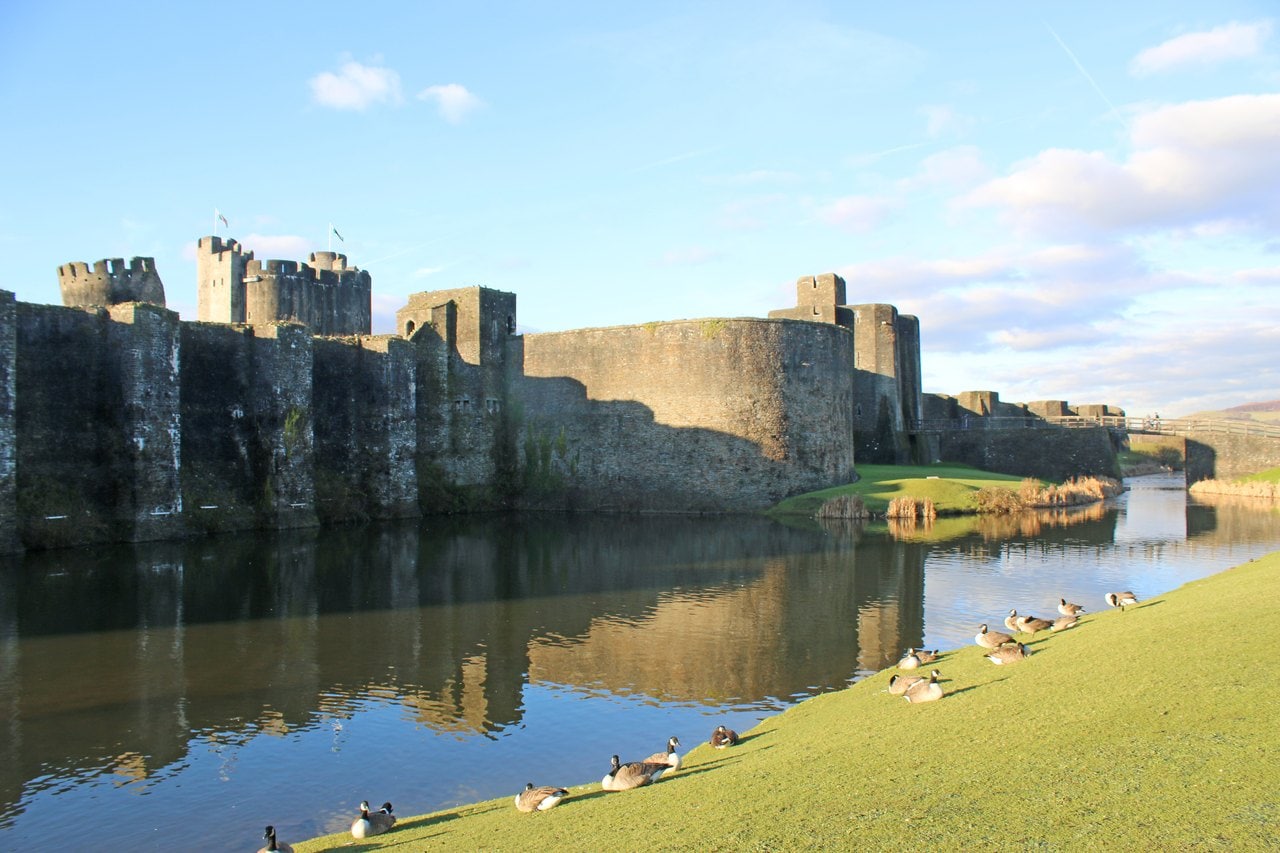
Caerphilly Castle was built by Gilbert de Clare, earl of Gloucester and Hertford and lord of Glamorgan, and Cadw’s listing record dates its original construction to between 1268 and 1271. Cadw’s scheduling record calls him “One of Henry III’s most powerful and ambitious barons,” and gives his reason: “His purpose was to secure the area and prevent lowland south Wales from falling into the hands of the Welsh leader Llywelyn ap Gruffudd, who controlled most of mid and north Wales.” So the castle was built by a Marcher lord against a Welsh prince.
The listing record says the castle “is built upon the principle of concentric fortifications, with an inner ward and middle ward surrounded by a moat, dams, two great lakes and outer defences.” It also calls Caerphilly “the largest medieval castle in Wales,” and says its concentric plan was “the precursor of the great Edwardian castles of N Wales.” Much of what stands has been restored and rebuilt by the Bute family. The listing record says restoration was begun by the third marquess, principally by reroofing the Great Hall, and that the full restoration was carried out by the fourth marquess, in a campaign the Royal Commission dates to 1928-39. Its leaning south-east tower, the listing record notes, was not restored by the Bute family. Cadw’s scheduling record puts it at 15 meters (about 50 feet) high, leaning 10 degrees from vertical, and says that “the cause, whether subsidence or Civil War slighting, is unknown.”
The Princes’ Castles
The princes of Gwynedd built for the three purposes Cadw names. Cadw’s scheduling record for Dolbadarn counts it as one of three castles that Llywelyn ap Iorwerth began “to defend the passes into Snowdonia,” together with Dolwyddelan and Castell y Bere, and the same record adds that Dolbadarn also guarded the cattle pastures of the area. Dolbadarn and Dolwyddelan have full guides on this site, and the castles of the Welsh princes have a page of their own. Cadw’s listing records credit both keeps, cautiously, to Llywelyn ap Iorwerth, yet the two follow different plans: round at Dolbadarn, rectangular at Dolwyddelan.
Dolbadarn Castle
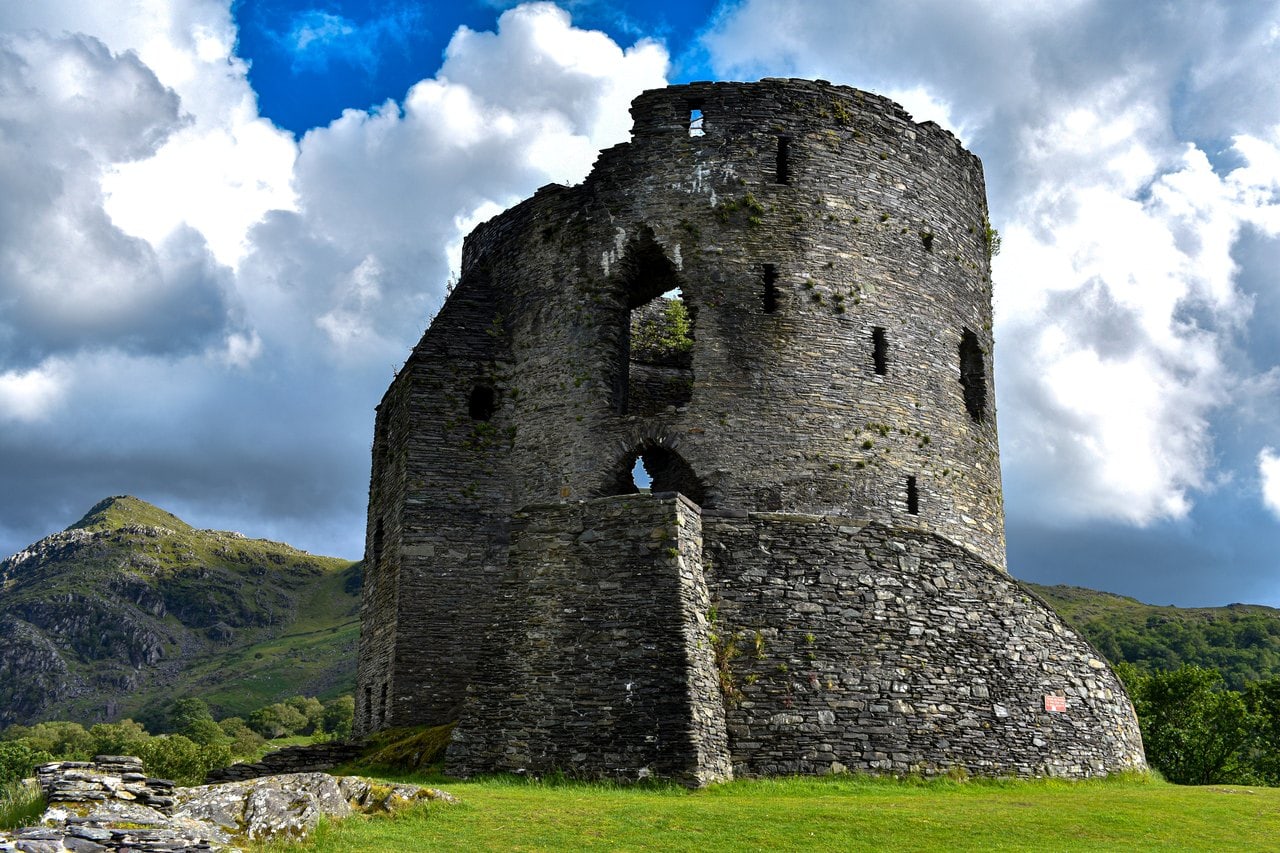
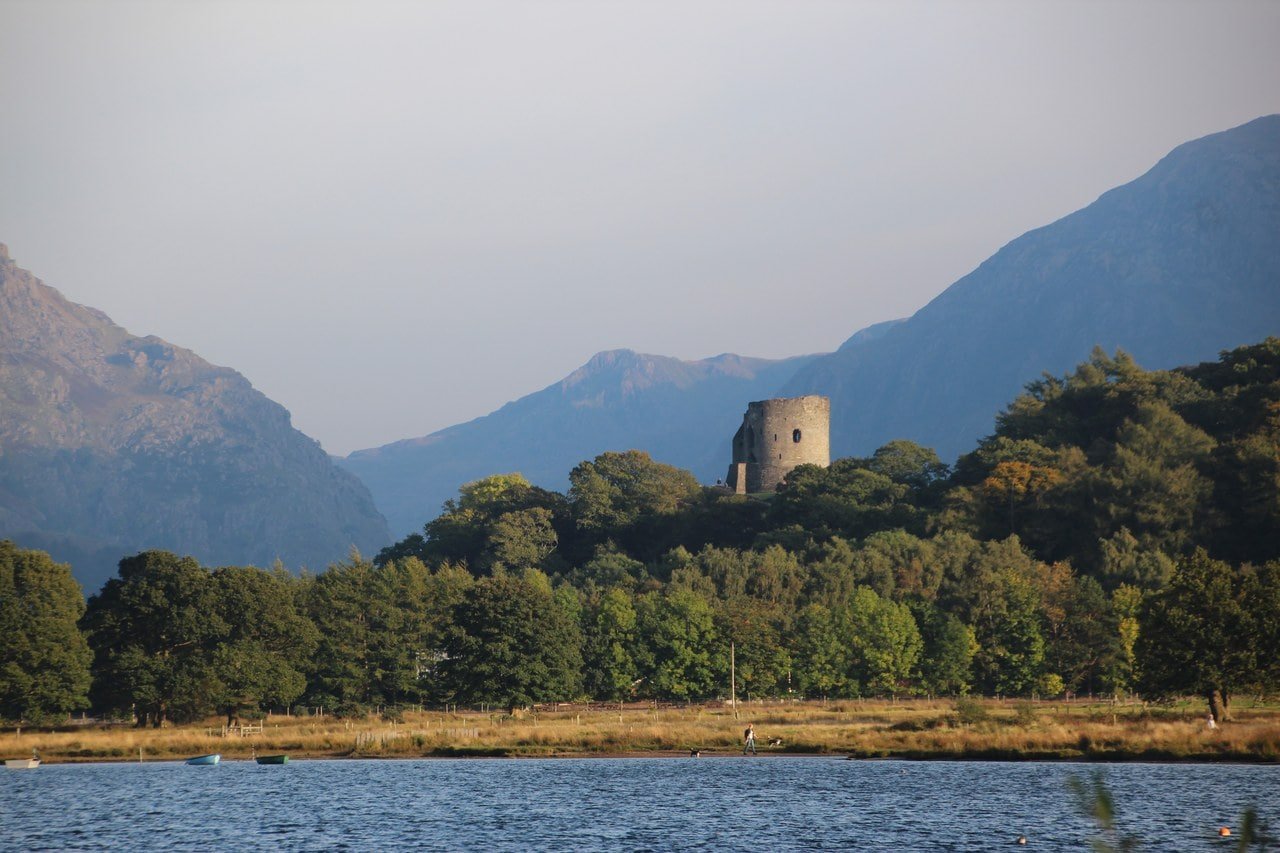
Cadw says Dolbadarn Castle was most likely built by Llywelyn ap Iorwerth, and that it stood watch over the route inland from Caernarfon to the upper Conwy Valley. Its heart is a round tower, about 15 meters (50 feet) high by Cadw’s figures, and its design was, Cadw suggests, “probably inspired by that of similar fortresses built by Llywelyn’s rivals in the borderlands of the southern Marches.” If so, the prince’s tower takes its model from the castles of his rivals in the southern March.
The tower is also where Cadw’s scheduling record places a prisoner, and it tells the story with a hedge: “It is probable that this tower was where Llywelyn ap Gruffudd kept his brother, Owain ap Gruffudd imprisoned for two decades, from 1255 to 1277.” Five centuries later, J. M. W. Turner painted the tower with soldiers guarding a kneeling prisoner below it, and the Royal Academy, which owns the picture, says he exhibited it there in 1800 with lines of poetry alluding to Owain. Cadw’s scheduling record adds that the castle passed into English hands after the defeat of Llywelyn ap Gruffudd in 1282. What survives is the tower itself, roofless, with the remains of its fireplaces and internal stair; the curtain wall around it survives only as fragmentary ruins.
Dolwyddelan Castle
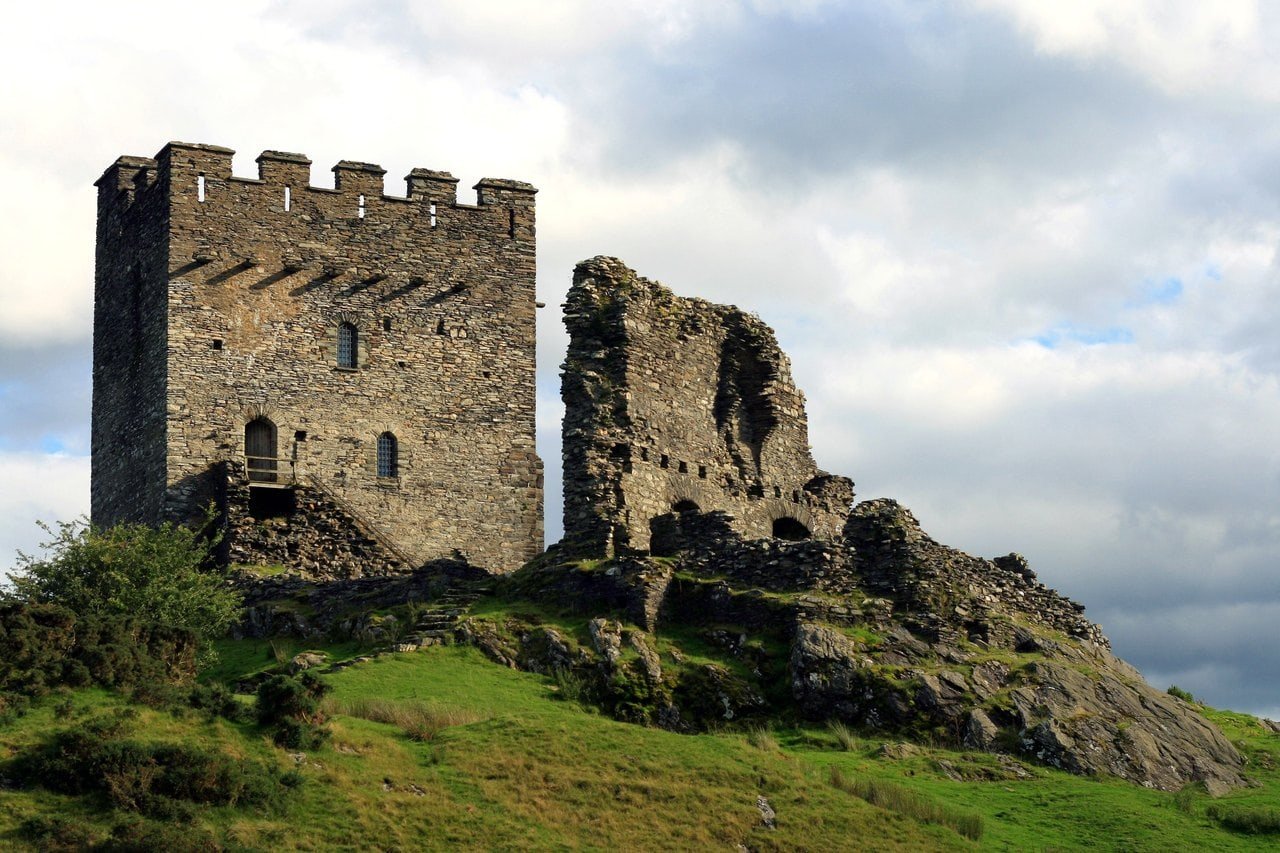
Cadw’s listing record for Dolwyddelan Castle credits Llywelyn ap Iorwerth with it: “it seems most probable that Llywelyn built the present castle, initially as a 2-storeyed keep between 1210 and 1240.” Cadw’s scheduling record also notes that “There is a tradition that the castle is the birthplace of Llywelyn Fawr,” Llywelyn the Great, but the listing record thinks an earlier motte castle, Tomen Castell, some 400 meters (about 1,300 feet) to the southeast, the likelier birthplace. The listing record dates the castle’s end as a princes’ castle: it “fell to the English under Edward I in January 1283.” Its scheduling record notes a later, brief tenant: Maredudd ab Ieuan, who took the lease in 1488 and re-occupied the castle for a short time at the end of the fifteenth century.
Its present look owes a good deal to the nineteenth century. The listing record dates a major restoration to 1848-50 under Lord Willoughby de Eresby, who repaired the keep and added a crenellated parapet, and the same record notes a renewed lead roof on the keep. So the keep stands roofed, with nineteenth-century battlements on a medieval body, while the west tower is much ruined and the curtain wall survives only in fragments. That west tower is English work, added after the castle fell in 1283 and, in the listing record’s words, “seemingly a ‘camera’, or solar”; the keep itself was later raised in height, though the records differ on when and by whom.
More Castles Across Wales
Pembroke was founded by the Normans in 1093, by Cadw’s record, and the same record says it “was never to fall to the Welsh.” In 1189 it came to William Marshal, who over the next thirty years turned an earth-and-timber castle into a stone one; his round keep, over 22 meters (72 feet) high by Cadw’s record, is still capped by its stone dome. The castle’s own history page says that Henry Tudor, the future Henry VII, was born there in 1457, “reputedly in the tower now known as the Henry VII Tower.” Much of what a visitor walks around is rebuilt. Cadw’s record says the defenses keep their original plan but, as they stand, are the end result of a systematic restoration in the nineteenth and early twentieth centuries, and it lists most of the curtain wall, the outer parts of the gatehouse and barbican and most of the Westgate and Henry VII towers as “rebuilt from footings,” though not the keep. Pembroke is run by a private charitable trust, not by Cadw.
Chepstow is earlier still. Cadw’s record says the castle was begun in 1067 by William fitz Osbern, earl of Hereford, and places it on a limestone promontory “on top of tall cliffs overlooking the river Wye.” William Marshal added its middle and lower baileys in the late twelfth century, and Roger Bigod remodeled the lower one a century after him. At the castle’s center stands the Great Tower, which the record calls “the oldest building in the castle” without naming its builder or giving it a year. It is a rectangle 36 meters (118 feet) long by 14 meters (46 feet) wide, and it contains reused building stone, in the record’s words “probably brought from the ruins of the Roman town Venta Silurum,” modern Caerwent.
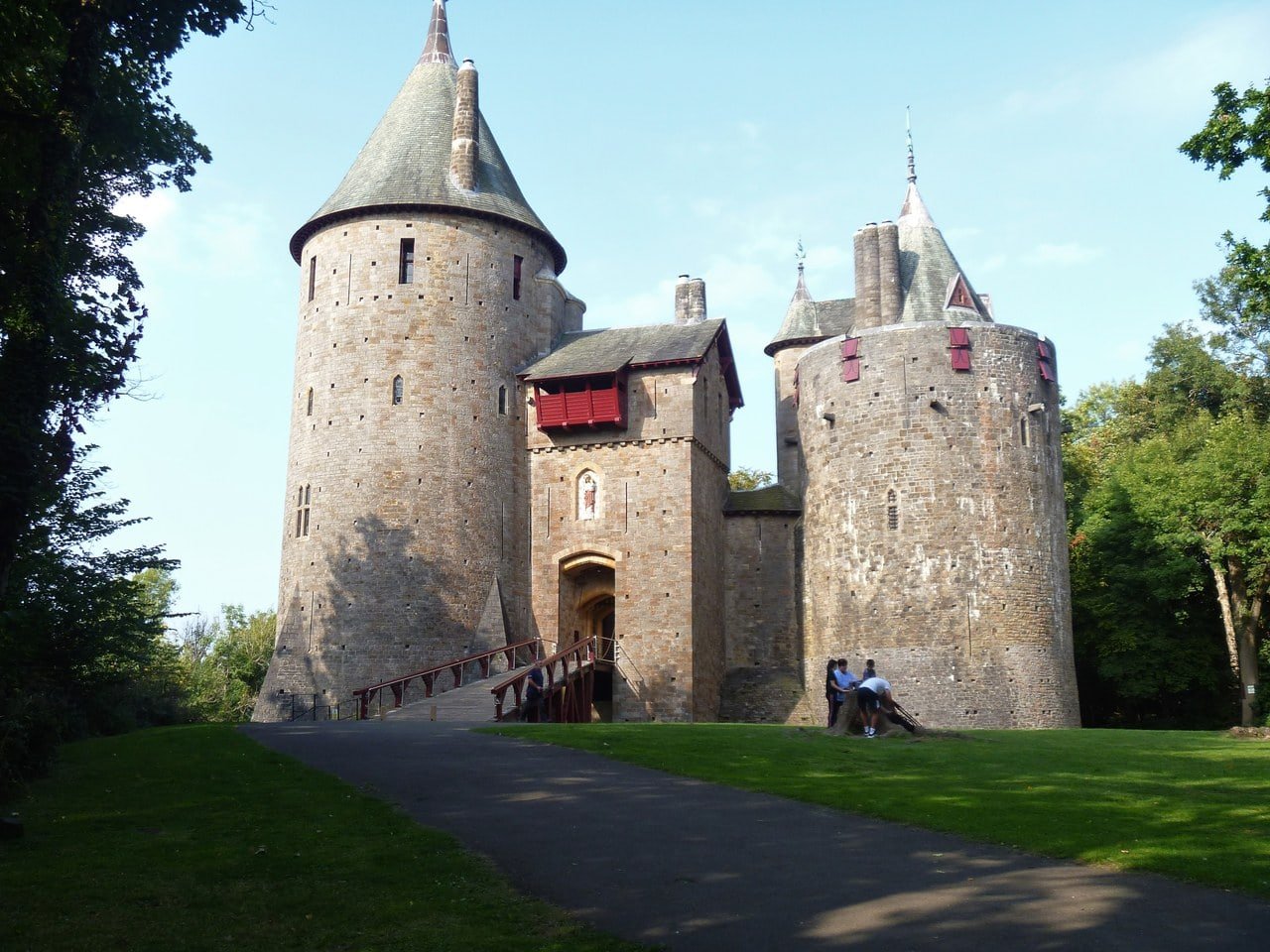
Castell Coch belongs to two centuries at once. From 1875, Cadw’s scheduling record says, the third marquess of Bute employed the architect William Burges to create what the record calls “the Gothic fairytale castle,” on the remains of a medieval stone castle that the Clare lords of Glamorgan developed “probably no later than 1290.” The curtain still incorporates sections of the original medieval masonry, and vaulted rooms survive beneath two of the towers. Above them, the Victorian castle is roofed, its towers capped with conical roofs and its interiors decorated. Cardiff Castle, which Cadw’s listing record traces to a motte built by William I around 1081 inside a Roman fort, was remade by the same pair: from 1868, the record says, the third marquess employed Burges to transform it into what the record calls “a High Victorian medieval fantasy,” and the fifth marquess gave the castle to the city in 1947.
Castell y Bere was probably begun by Llywelyn ap Iorwerth around 1221, by Cadw’s account, to protect Gwynedd’s southern frontier. Two of its towers are apsidal, rounded at one end, a form its scheduling record says it shares with other castles the Welsh built in the north. Its walls survive to very different heights along a long, narrow rock, the view from the air that opens this page. Edward I’s forces captured it in 1283 and the English “undertook some works,” in the words of Cadw’s booklet; a borough charter followed in 1284, and the scheduling record says that “no more is heard of either castle or borough after a siege during the Welsh rebellion of 1294.”
Criccieth, which Cadw titles Castell Cricieth, is in its scheduling record’s words “a native castle of Llywelyn Fawr, later altered by Edward I.” Its inner ward is attributed to Llywelyn ap Iorwerth and its outer ward to his grandson Llywelyn ap Gruffudd. At the entrance stands a twin-towered gatehouse that Cadw credits to Llywelyn ap Iorwerth, heightened under the English kings. The castle’s working life ended in 1404, when it fell and was burnt during Owain Glyndŵr’s rising, and Cadw’s visitor page says that the towers were “burnt red.”
Visiting Castles in Wales
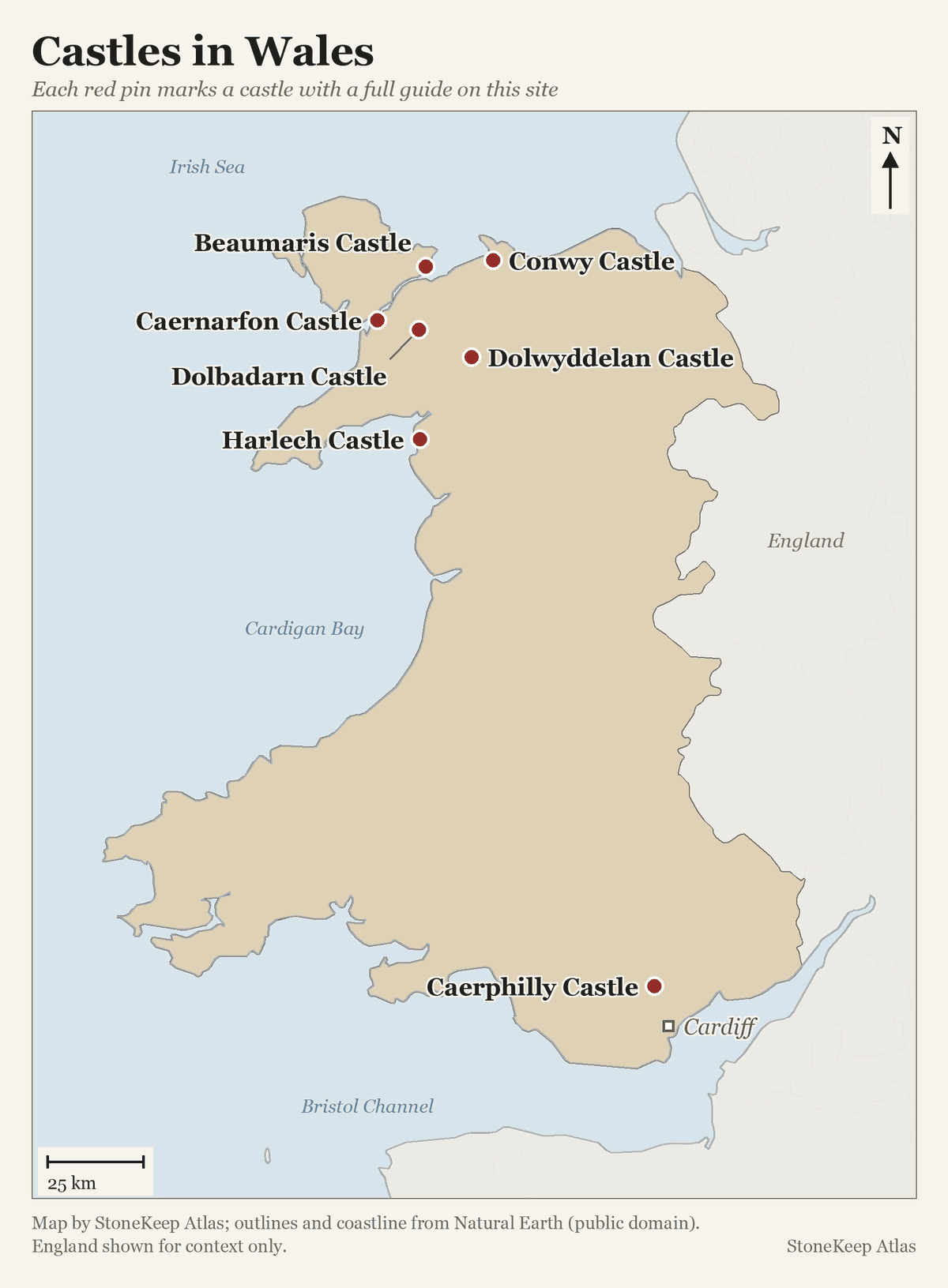
List the 7 castles on this map
- Conwy Castle — Conwy County Borough, Wales
- Caernarfon Castle — Gwynedd, Wales
- Harlech Castle — Gwynedd, Wales
- Beaumaris Castle — Isle of Anglesey, Wales
- Caerphilly Castle — Caerphilly County Borough, Wales
- Dolbadarn Castle — Gwynedd, Wales
- Dolwyddelan Castle — Conwy County Borough, Wales
The map above pins each castle that has a full guide on this site. Most of the northern castles sit close enough together to visit from a single base, Bangor for travelers without a car; Caerphilly, in the south, is better treated as a separate trip.
North Wales
Conwy, Caernarfon, Dolbadarn and Dolwyddelan all lie in north-west Wales, within about an hour of one another by road, on modeled driving times without traffic. Conwy and Caernarfon are walled towns as well as castle towns, so each deserves time beyond the castle gate. Both castles are open in every month of the year, so among these four, only Dolwyddelan’s interior keeps a season. Beaumaris lies across the Menai Strait on the Isle of Anglesey, a bus ride from Bangor; its guide has the details. Harlech stands on the coast farther south, above Tremadog Bay, with a station of its own on the line between Machynlleth and Pwllheli; its guide has the details too.
Dolbadarn and Dolwyddelan, the princes’ castles, stand on the routes into Snowdonia that Cadw’s record says they were begun to defend. Both are free to enter, on Cadw’s own pages, and Dolbadarn is open all year. Dolwyddelan is the one to plan around: its keep is open inside only from April to September, on Fridays, Saturdays, Sundays and bank holidays, and on every other day Cadw offers external viewing only.
The two princes’ castles also ask more of the walker. Dolbadarn is reached along farm tracks that steepen as you near the castle, and Dolwyddelan along a public right of way from a layby on the A470; Cadw asks visitors not to use the path via the farmhouse, which is private.
South Wales
Caerphilly lies in the south, about twenty minutes by train from Cardiff Central on the Rhymney Valley line, and Cadw gives Caerphilly station as its rail stop. Like Conwy and Caernarfon, Caerphilly is open in every month of the year. The castle shares a history with Castell Coch, which was raised on the remains of a castle of the same Clare lords.
Getting There
From London, direct Avanti West Coast trains from Euston run along the North Wales coast to Llandudno Junction and Bangor, taking about three hours to Llandudno Junction. Those trains do not call at Conwy, so change at Llandudno Junction for Conwy and for the Conwy Valley line, which serves Dolwyddelan. From Manchester, Transport for Wales trains follow the same coast line via Chester to Llandudno Junction in about two hours, and some continue along the coast to Conwy and Bangor; some of these trains start at Manchester Airport. Cadw gives Bangor as the rail station for both Caernarfon and Dolbadarn. From Bangor, buses run on to Caernarfon and to Llanberis, half a mile from Dolbadarn, and Traveline Cymru, the journey planner Cadw points visitors to, will plan the connection. Without a car, that makes Bangor a practical base for those two castles, with Llandudno Junction the place to change for Conwy and for Dolwyddelan.
One way to spend three days in the north from Bangor: a day for Caernarfon and Dolbadarn, each a bus ride away; a day for Conwy and its town walls; and a day for Dolwyddelan on the Conwy Valley line, changing at Llandudno Junction. If you want to go inside Dolwyddelan’s keep, make that day a Friday, Saturday, Sunday or bank holiday between April and September. A fourth day takes in Beaumaris, a bus ride from Bangor across the Menai Strait.
For the south, Great Western Railway runs direct trains from London Paddington to Cardiff, the fastest in about two hours. From Cardiff, Transport for Wales runs direct trains north to Llandudno Junction via Shrewsbury and Chester, a through journey of about four hours by rail that crosses England’s border counties on the way. That line is one way to link the two halves of a trip without a car.
Cadw and the Explorer Pass
Each castle with a full guide on this site is in Cadw’s care. For visitors planning several Cadw sites there is an Explorer Pass, in three-day and seven-day versions, for a single adult, two adults or a family, which Cadw defines as two adults and up to three children or grandchildren under 18. Conwy, Caernarfon, Harlech, Beaumaris and Caerphilly are among the sites Cadw lists as selling it, and so are Criccieth, Chepstow and Castell Coch. Dolbadarn and Dolwyddelan are not on the list. The three-day pass can be used on any three days within seven days of the first visit, and the seven-day pass on any seven days within fourteen. For repeat visitors, Cadw membership gives unlimited access to its historic places. Prices change, so check them on Cadw’s Explorer Pass page before you travel.
If you would rather go with a guide than plan the trains and roads yourself, GetYourGuide lists guided tours and day trips across Wales.
Some links on this page are affiliate links, which means StoneKeep Atlas may earn a small commission, at no extra cost to you, if you book through them.
Common Questions
How many castles are in Wales?
It depends on what is counted. Cadw says it looks after 44 castles, a count of the castles in its care rather than a census. The same Cadw page gives a total for Wales as a whole: 427. Visit Wales gives a wider split: over 600 castles ever recorded, of which more than 400 are still standing or in ruins. Those figures measure different things, so neither cancels the other. Our page on the country with the most castles sets them against the totals for other countries.
Conwy or Caernarfon Castle: how do they differ?
The clearest difference is time. The Royal Commission says Conwy’s castle was finished in 1287, “having taken a little over four years to complete.” At Caernarfon, Cadw says the whole project, a castle, town walls and a quay begun at once, “eventually took 47 years …” So one was finished quickly and the other was still being worked on decades later. They share a plan, though. In Cadw’s words, “At Caernarfon and Conwy, new towns were built within massive walls at the same time as the castles.”
Which castles in Wales are a UNESCO World Heritage Site?
The site’s full name is the Castles and Town Walls of King Edward in Gwynedd, and it was inscribed on the World Heritage List in 1986. It comprises four castles, Beaumaris, Caernarfon, Conwy and Harlech, together with the town walls of Caernarfon and Conwy.
Who looks after the castles in Wales?
Many are looked after by Cadw, which describes itself as “the Welsh Government’s historic environment service.” Its name, Cadw explains, “is a Welsh word meaning ‘to keep’ or ‘to protect’.” The four castles of the World Heritage Site, its management plan says, “are all cared for by Cadw on behalf of the Welsh Ministers,” which is care rather than ownership. Others have other keepers; Cadw’s booklet on Welsh lords’ and princes’ castles includes some owned by local authorities or in private hands, and the National Trust looks after Powis Castle.
Can you see castles in both north and south Wales on one trip?
Yes, but it is a long way between the two. Conwy to Caerphilly is about four hours by road, on modeled driving times without traffic, so it usually works better as a northern stay and a southern stay than as day trips from one base. Travelers without a car can link the two halves by train instead, as the section on getting there explains.
Which castles in Wales were built by Welsh princes?
Dolbadarn, Dolwyddelan, Castell y Bere and Criccieth are princes’ castles. So is Ewloe: Cadw says its D-shaped tower “was probably built by Llywelyn ap Iorwerth (Llywelyn the Great) some time after 1210,” with the curtain walls and a western tower added by Llywelyn ap Gruffudd “nearly 60 years later.” Cadw credits Llywelyn ap Gruffudd with Dolforwyn, built in 1273. In Deheubarth, Cadw’s booklet says Dinefwr likely owes its origin to Rhys ap Gruffudd, though much is later; it passed to Edward I in 1277 from its lord, Rhys Wyndod.
Beyond the Castles of Wales
The castles of Wales are one chapter in a longer European story, and several of our reference guides follow the parts of a castle across borders. Our types of castles explains how a concentric plan differs from a single curtain like Conwy’s. For the polygonal towers of Caernarfon and the round tower of Dolbadarn, see castle towers and turrets, and for the curtains and wall-walks that Conwy lets you walk, castle walls and battlements. How a gatehouse was turned into a trap for an attacker is the subject of how castle defenses worked, which also covers a quieter use at Caerphilly, where a chute over the gate passage could put out a fire set to smoke out the occupants of the gatehouse. For the long view of castle building across Europe there is our history of castles, and for how the totals for Wales compare with other countries, our page on the country with the most castles. Within Wales, how the princes built, and what became of their castles, is the subject of our page on the castles of the Welsh princes.
Conclusion
The castles of Wales make most sense when you ask who built each one and why. Edward I’s castles in the north-west belong to campaigns that Cadw says were fought to defeat the Welsh princes. The Marcher lords built along the March and in the south, and Caerphilly shows how far one of them would go to keep a Welsh prince out of the lowlands. The princes of Gwynedd built to defend their land from rivals and invaders and to guard the routes through it. Across all three groups, condition varies: some castles stand to full height, some have been restored or rebuilt, and some survive as fragments. From the prince’s round tower at Dolbadarn, above Llyn Padarn, to the king’s walls at Conwy, whose full circuit you can still walk, and the Marcher lord’s concentric castle at Caerphilly in its lakes, each still shows whose castle it was.
Principal Sources
- Ashbee, Jeremy. Conwy Castle and Town Walls. Cadw, 2007.
- Avanti West Coast. “Timetable book, 14 December 2025 – 16 May 2026.” avantiwestcoast.co.uk.
- Avanti West Coast. “Timetable, 12 to 16 October 2026.” avantiwestcoast.co.uk.
- Brown, R. A., and H. M. Colvin. “The King’s Works 1272-1485.” In H. M. Colvin, ed., The History of the King’s Works, vol. I. London: HMSO, 1963.
- Cadw. “About us.” cadw.gov.wales.
- Cadw. “Beaumaris Castle.” cadw.gov.wales.
- Cadw. “Cadw membership.” cadw.gov.wales.
- Cadw. “Caerphilly Castle.” cadw.gov.wales.
- Cadw. “Castell Caernarfon.” cadw.gov.wales.
- Cadw. “Castell Caernarfon visitor leaflet (Croeso).” PDF. cadw.gov.wales.
- Cadw. “Castell Coch.” cadw.gov.wales.
- Cadw. “Castell Conwy.” cadw.gov.wales.
- Cadw. “Castell Cricieth.” cadw.gov.wales.
- Cadw. “Castell Dolbadarn.” cadw.gov.wales.
- Cadw. “Castell Dolforwyn.” cadw.gov.wales.
- Cadw. “Castell Dolwyddelan.” cadw.gov.wales.
- Cadw. “Castell Ewloe.” cadw.gov.wales.
- Cadw. “Castell Harlech.” cadw.gov.wales.
- Cadw. “Castell y Bere.” cadw.gov.wales.
- Cadw. “Castles and Town Walls of King Edward in Gwynedd.” cadw.gov.wales.
- Cadw. “Castles and Town Walls of King Edward in Gwynedd World Heritage Site Management Plan.” cadw.gov.wales.
- Cadw. The Castles of the Lords and Princes of Wales. cadw.gov.wales.
- Cadw. “Castles of Wales.” cadw.gov.wales.
- Cadw. “Explorer Pass (3 and 7 day).” cadw.gov.wales.
- Cadw. “Listed building 13539: Caerphilly Castle.” cadwpublic-api.azurewebsites.net.
- Cadw. “Listed building 13662: Cardiff Castle.” cadwpublic-api.azurewebsites.net.
- Cadw. “Listed building 18253: Dolwyddelan Castle.” cadwpublic-api.azurewebsites.net.
- Cadw. “Listed building 21854: Dolbadarn Castle.” cadwpublic-api.azurewebsites.net.
- Cadw. “Listed building 25500: Harlech Castle.” cadwpublic-api.azurewebsites.net.
- Cadw. “More about Beaumaris Castle.” cadw.gov.wales.
- Cadw. “More about Castell Cricieth.” cadw.gov.wales.
- Cadw. “More about Castell Dolwyddelan.” cadw.gov.wales.
- Cadw. “More about Castell Harlech.” cadw.gov.wales.
- Cadw. “More about Castell y Bere.” cadw.gov.wales.
- Cadw. “Scheduled monument AN001: Beaumaris Castle.” cadwpublic-api.azurewebsites.net.
- Cadw. “Scheduled monument CN004: Conwy Castle.” cadwpublic-api.azurewebsites.net.
- Cadw. “Scheduled monument CN015: Criccieth Castle.” cadwpublic-api.azurewebsites.net.
- Cadw. “Scheduled monument CN040: Dolwyddelan Castle.” cadwpublic-api.azurewebsites.net.
- Cadw. “Scheduled monument CN066: Dolbadarn Castle.” cadwpublic-api.azurewebsites.net.
- Cadw. “Scheduled monument CN079: Caernarfon Castle.” cadwpublic-api.azurewebsites.net.
- Cadw. “Scheduled monument GM002: Caerphilly Castle.” cadwpublic-api.azurewebsites.net.
- Cadw. “Scheduled monument GM206: Castell Coch.” cadwpublic-api.azurewebsites.net.
- Cadw. “Scheduled monument ME023: Castell y Bere.” cadwpublic-api.azurewebsites.net.
- Cadw. “Scheduled monument ME044: Harlech Castle.” cadwpublic-api.azurewebsites.net.
- Cadw. “Scheduled monument MM003: Chepstow Castle.” cadwpublic-api.azurewebsites.net.
- Cadw. “Scheduled monument PE005: Pembroke Castle.” cadwpublic-api.azurewebsites.net.
- Cadw. “Understanding listing.” cadw.gov.wales.
- Cadw. “Understanding scheduling.” cadw.gov.wales.
- Cyngor Gwynedd. “Sherpa’r Wyddfa timetable.” sherparwyddfa.wales.
- Great Western Railway. “London to Cardiff.” gwr.com.
- Griffiths, Ralph A. The Principality of Wales in the Later Middle Ages: The Structure and Personnel of Government. I: South Wales, 1277-1536. Cardiff: University of Wales Press, 1972.
- National Rail. “Dolwyddelan Station.” nationalrail.co.uk.
- National Trust. “Powis Castle and Garden.” nationaltrust.org.uk.
- Pembroke Castle. “History.” pembrokecastle.co.uk.
- Pembroke Castle. “Pembroke Castle Trust.” pembrokecastle.co.uk.
- Royal Academy of Arts. J. M. W. Turner, Dolbadern Castle, North Wales (1800). royalacademy.org.uk.
- Royal Commission on the Ancient and Historical Monuments of Wales. “About.” Coflein. coflein.gov.uk.
- Royal Commission on the Ancient and Historical Monuments of Wales. “Caerphilly Castle.” Coflein. coflein.gov.uk.
- Royal Commission on the Ancient and Historical Monuments of Wales. “Caernarfon Castle.” Coflein. coflein.gov.uk.
- Royal Commission on the Ancient and Historical Monuments of Wales. “Conwy Castle.” Coflein. coflein.gov.uk.
- Royal Commission on the Ancient and Historical Monuments of Wales. “Magnus Maximus, ‘Yma o Hyd’, and the World Cup!” News blog, 2022. rcahmw.gov.uk.
- Taylor, Arnold. Caernarfon Castle and Town Walls. 6th ed. Cardiff: Cadw, 2004.
- Taylor, Arnold. Harlech Castle. 4th ed. Cardiff: Cadw, 2002.
- Taylor, Arnold. “The King’s Works in Wales, 1277-1330.” In H. M. Colvin, ed., The History of the King’s Works, vol. I. London: HMSO, 1963.
- Transport for Wales. “Harlech Station.” tfw.wales.
- Transport for Wales. “Timetable 4: Cardiff – Manchester – Chester – Llandudno Junction – Holyhead, December 2025.” tfw.wales.
- Transport for Wales. “Timetable 4: Cardiff – Manchester – Chester – Llandudno Junction – Holyhead, September 2026.” tfw.wales.
- Transport for Wales. “Timetable 8: Holyhead – Llandudno – Chester – Manchester, December 2025.” tfw.wales.
- Transport for Wales. “Timetable 8: Holyhead – Llandudno – Chester – Manchester – Liverpool, September 2026.” tfw.wales.
- Transport for Wales. “Timetable 12: Rhymney Valley – Caerphilly – Cardiff Central, December 2025.” tfw.wales.
- Transport for Wales. “Timetable 12: Rhymney Valley – Caerphilly – Cardiff Central, September 2026.” tfw.wales.
- UNESCO World Heritage Centre. “Castles and Town Walls of King Edward in Gwynedd.” whc.unesco.org.
- Visit Wales. “Is Wales the castle capital of Europe?” visitwales.com.
Image credits. Hero, Castell y Bere on its wooded rock from the air: Photo: Llywelyn2000, CC BY-SA 4.0, cropped. Source: Awyrlun o Gastell y Bere yn Hydref 2024 - Aerial image of Welsh castle Castell y Bere near Tywyn, Gwynedd, Wales 10, Wikimedia Commons; Dolbadarn across Llyn Padarn: Photo: Takver (John Englart), CC BY-SA 2.0; Locator map: Map by StoneKeep Atlas; outlines and coastline from Natural Earth (public domain); Conwy’s curtain wall and towers: Photo: Sergii Figurnyi / Adobe Stock; Caernarfon’s south front across the Seiont harbor: Photo: Tomas Marek / Adobe Stock; Harlech Castle on its rock: Photo: Tilman2007, CC BY-SA 4.0; The outer curtain and round towers of Beaumaris: Photo: worldimage / Adobe Stock; The buttressed south dam wall on Caerphilly’s east front: Photo: Jenny Thompson / Adobe Stock; Dolbadarn’s round tower from the enclosure: Photo: Lee / Adobe Stock; Dolwyddelan’s keep and west tower on their ridge: Photo: Jeff Buck, CC BY-SA 2.0; Castell Coch’s towers and conical roofs: Photo: Michael Dibb, CC BY-SA 2.0. Freely licensed images are resized to fit; any other change, such as a crop, is named in the credit.