
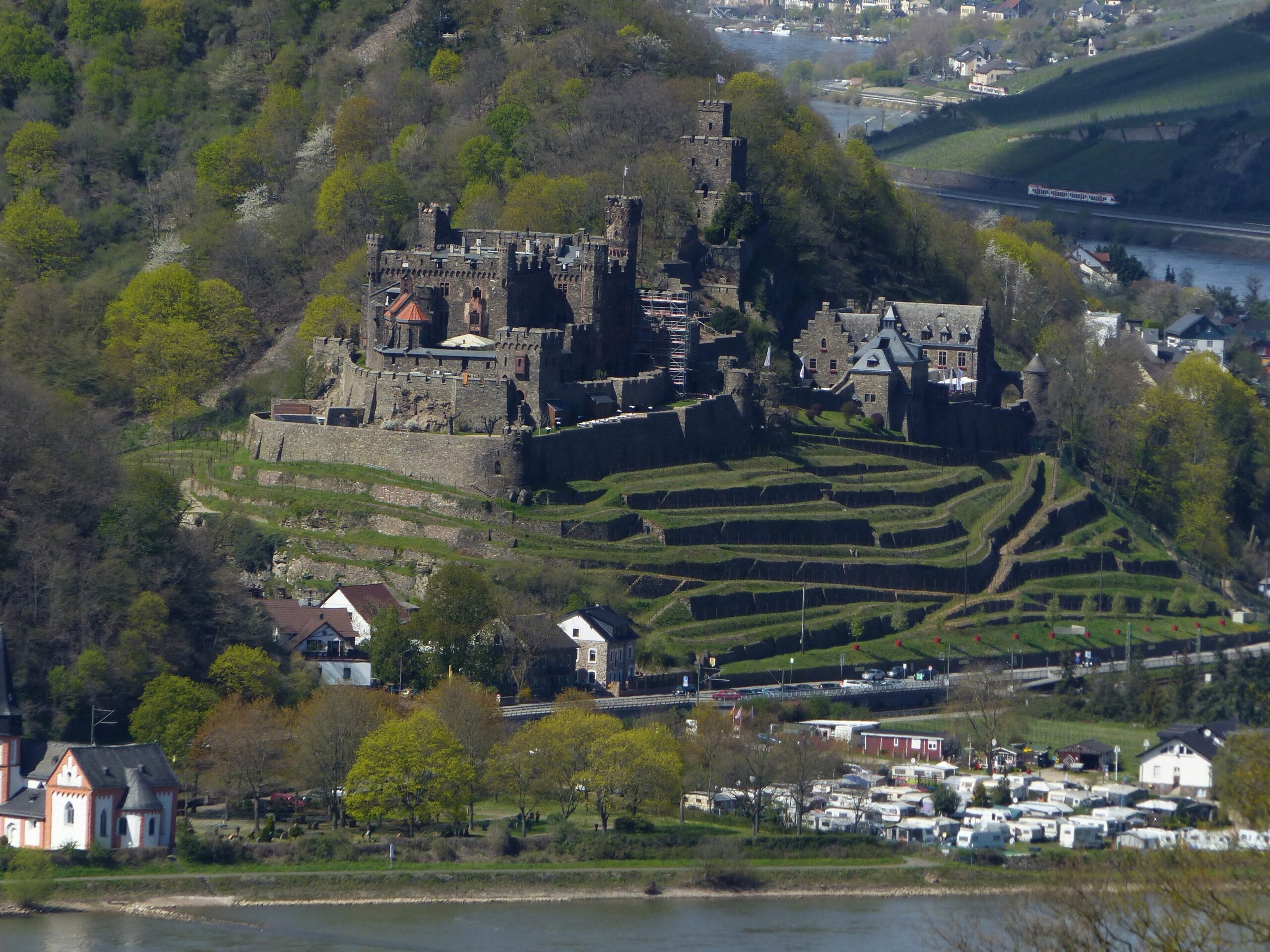
Reichenstein Castle
Reichenstein Castle is a paradox among the strongholds of the Upper Middle Rhine. Its silhouette (battlemented towers, neo-Gothic gables, an English Tudor flavour creeping into the windows) looks every inch a medieval fortress, yet almost everything visible above ground is younger than the Eiffel Tower. Medieval Reichenstein was twice destroyed: once by a king, once by a French army. What stands today on the rocky shoulder above Trechtingshausen is the work of an Italian-descended ironworks dynasty who, at the end of the 1890s, decided to wager their fortune on resurrecting a ruin.
That decision nearly bankrupted the family, and it produced what tourism writers like to call the last great Burgenromantik reconstruction on the Rhine. A century later, the same family has come back. A great-grandson of the 1898 patron has owned the castle since November 2014, and runs it as a museum, hotel, and restaurant.
Quick Facts
| Country | Germany |
| Region / State | Rhineland-Palatinate (Rheinland-Pfalz), western Germany |
| Nearest Town | Trechtingshausen (Bingen am Rhein) |
| Construction Period | First documented 1213; surviving medieval fabric (shield wall, ring-wall remnants) probably 1282-1344; final destruction 1689; Burgenromantik reconstruction 1899–1902/03 |
| Founder | Not recorded (an 11th-century foundation by the advocates of Reichsabtei Kornelimünster is suggested); Baron Dr. Nikolaus Kirsch-Puricelli (1899 reconstruction patron) |
| Architectural Style | Medieval Schildmauerburg on a rocky spur (fragmentary medieval fabric, probably 1282-1344); late-historicist neo-Gothic in an English Tudor manner (1899–1902/03), by architect Georg Strebel of Regensburg |
| Building Type | Burg — medieval rock-spur fortress, reborn around 1900 as an industrialist’s neo-Gothic country seat |
| Current Condition | Rebuilt in 1899-1902/03 and in active use; medieval substance survives in fragments of Schildmauer and outer ring wall, embedded within the late-historicist reconstruction |
| Open to Visitors | Yes, all year: museum daily, with shorter winter hours; 23-room boutique hotel year-round; Puricelli Restaurant on site |
| UNESCO Status | Within the Upper Middle Rhine Valley World Heritage Site (inscribed 2002, criteria ii, iv, v) |
| Heritage designation | Kulturdenkmal in the Rhineland-Palatinate state monument list: Denkmalzone “Burg Reichenstein” (GDKE, Denkmalverzeichnis Mainz-Bingen, Trechtingshausen; entries carry no number) |
| Official website | burg-reichenstein.com |
A Kornelimünster outpost on the Rhine
Reichenstein begins, like many medieval castles in the gorge, in obscurity. A 1135 charter records Trechtingshausen and the parish of St. Clemens as possessions of Reichsabtei Kornelimünster, the great Carolingian-founded abbey near Aachen. The abbey’s holdings on the Middle Rhine were managed at a distance through advocates (Vögte), and some researchers think a fortified seat for those advocates stood here as early as the 11th century; the European Castle Institute notes that the founding date is not recorded and that it is unclear whether the castle goes back that far or was founded later.
Reichenstein’s first incontestable documentary mention is 1213, when the castrum Richenstein appears in a record concerning its advocate, Gerhard of the Reinbode family of Bingen: the European Castle Institute’s database reads it as his removal, the Institut für Geschichtliche Landeskunde as the year he took over the castle’s administration. The following year, the lordship passed to the powerful Bolanden family, and from 1241 to a cadet branch (the Lords of Hohenfels), whose name became inseparable from the castle’s most notorious chapter.
Hohenfels were ambitious, well-connected, and prepared to lean on neighbors who were not. In 1245 the abbey transferred half-shares of its Reichenstein, Trechtingshausen, and Heimbach properties to the Archbishops of Mainz and Cologne, citing the family’s unlawful seizure as cause. In 1270 the abbey sold its distant estates, the castles of Reichenstein and Sooneck with them, in equal shares to the Mainz Cathedral Chapter and the Mariengredenstift; Philipp von Hohenfels consented only reluctantly in 1271 and accepted the Mainz church as feudal lord, and the Hohenfels kept the castle and used its position above the Rhine for what later imperial chronicles would brand Landfriedensbruch: breach of the imperial peace, the crime of robber knights.
Whether they robbed Rhine shipping or enforced unauthorized tolls is a question medieval historians still pick at. What is certain is that by 1282 their behavior had outrun any patron willing to defend them. King Rudolf of Habsburg, elected in 1273 and determined to restore order on the river, marched.
Destruction, prohibition, ruin
In 1282, Rudolf laid siege to Reichenstein together with neighboring Sooneck, the other Hohenfels stronghold. The Burgenwelt account suggests the garrison was starved into surrender rather than stormed; the Wormser Chronik records the siege in a few lines. Dietrich von Hohenfels’s helpers were beheaded in Trechtingshausen. In 1290 Philipp von Hohenfels sold the castle to the Count Palatine, Ludwig the Strict, who enfeoffed seven of his vassals with it. Rudolf’s siege of 1282, and the razing that followed it, also figure in our survey of how medieval castles fell.
That sale was illegal (the castle was a Mainz fief), and prompted decades of jurisdictional wrangling. More immediately, on the same 1290 imperial diet at Erfurt, Rudolf decreed that Reichenstein and Sooneck, both destroyed “by imperial right,” were never to be rebuilt. That prohibition stood for fifty-nine years; only in 1349 did Karl IV lift it.
By then control had passed permanently to the Archbishopric of Mainz. A 1344 arbitration awarded the castle to the see; thereafter Reichenstein served as the seat of an archiepiscopal Amtmann, with a rectangular residential tower added at the north-east corner of the inner bailey. To enforce the rebuilding ban from a safe distance (and to keep the increasingly assertive Pfalzgrafen on their side of the gorge), Mainz built a watchtower on the cliff opposite. That watchtower would later become Rheinstein.
For three and a half centuries the Mainz Reichenstein endured. It survived the late-medieval squabbles of the Rhineland, but it did not survive the French. In 1689, during the Nine Years’ War of the Palatine Succession, the troops of Louis XIV burned and undermined castle after castle along the Rhine. Reichenstein was reduced to walls and rubble. It would stay that way for almost exactly two hundred years.
Falkenburg interlude, then the iron-works baron
In 1834 a Prussian general bought the ruin. Franz Wilhelm August von Barfuß reroofed the surviving tower and renamed the place Falkenburg, after the kestrels (Turmfalken) that nested in its walls. In 1852 he and his descendants received royal permission to bear the surname “von Barfuß-Falkenburg.” The right lapsed in 1877 when the family sold.
A decisive sale, however, came at the end of 1898. A new owner was Baron Dr. Nikolaus Kirsch-Puricelli, an iron-works engineer from Luxembourg who had married into one of the Hunsrück’s great industrial dynasties. The Puricellis had migrated from Spurano on Lake Como to the Mosel-Trier region in the seventeenth century and on to the Palatinate from 1750. By the late nineteenth century they were sole owners of the Rheinböller Hütte, the iron foundry above Bad Kreuznach, and through Olga Puricelli (Nikolaus’s wife), the family fortune had concentrated in a single heir. Buying a ruined castle on the Rhine was, in that context, an act of self-display as much as investment. One Mittelrhein magazine has described the resulting work as “outshining even neighboring Burg Rheinstein of Prinz Heinrich von Preußen” in its ambition (the line is journalist Frank Zimmer’s in Mittelrheingold, and it captures, intentionally, the contrast between Hohenzollern royal patronage on one side of the Morgenbach and bourgeois-industrial nouveau-riche on the other).
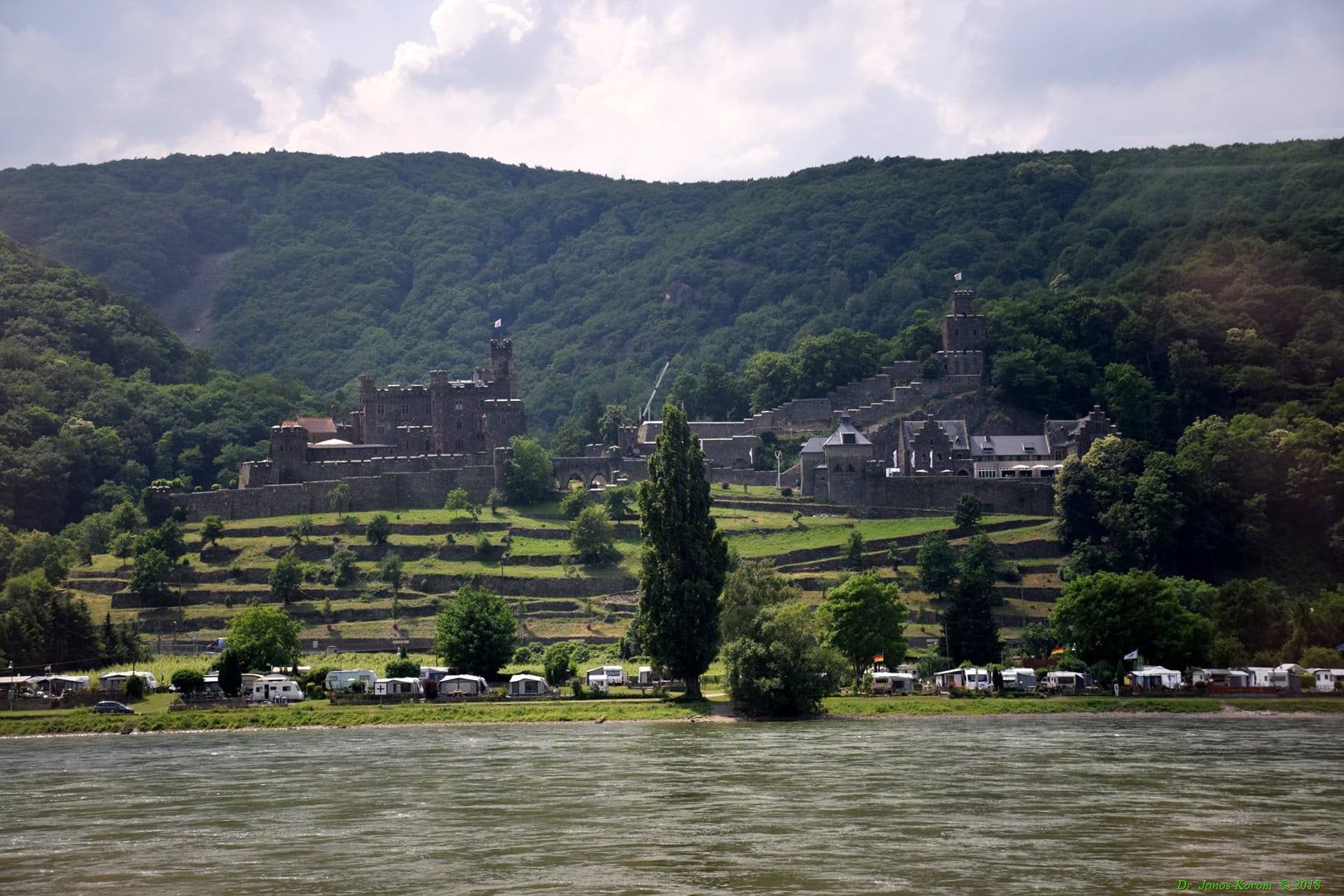
Construction began in 1899. The architect was Georg Strebel of Regensburg. Work was substantially complete by 1902 or 1903, and Reichenstein took its place at the late, theatrical end of the 19th-Century Romantic Revival that had been remaking the Rhine’s ruined castles since the 1820s.
Architecture: a Wilhelmine country house in armor
What Strebel built is a Wilhelmine country house in castle’s clothing. The European Castle Institute’s entry, by Jens Friedhoff and Reinhard Friedrich, is unsparing: “Bedingt durch tiefgreifende historistische Umgestaltungen … wurde die bauliche Entwicklung der 1689 zerstörten Burg verunklärt.” Identifying which masonry is medieval and which is 1900 takes a practiced eye.
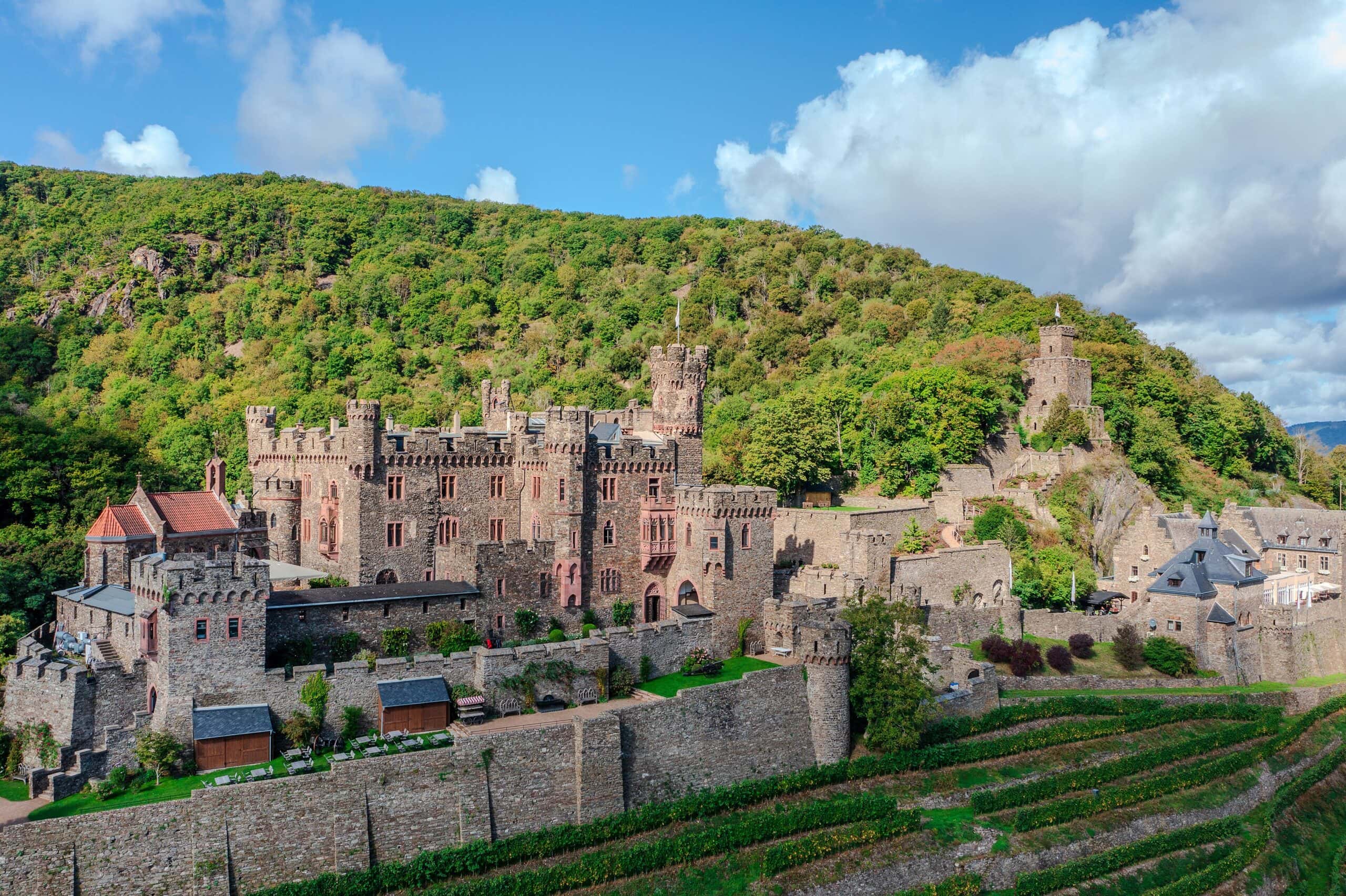
The medieval substance that does survive lies mostly in the rounded Schildmauer on the Rhine side (up to eight meters thick at the base and rising sixteen meters), with its Erkerturm, plus fragments of the outer ring wall. Two of the three corner towers in that outer ring still date in their lower courses from the 14th century. A 1629 view records a rectangular residential tower at the north-east corner of the inner bailey (the Mainz Amtmann’s lodgings), but it has not survived.
Almost everything else is Strebel’s. The three-story main building on the north-west, the chapel of St. Sebastian on the south edge with its inset polygonal choir, the tripartite economic range (carriage house, stable, press house) in the lower bailey, the Belvedere lookout tower above the complex: all are late-historicist. Interiors lean hard into the imagined late-medieval: carved beam ceilings, crenelated wall panelling imitating fittings from around 1500, a pointed-arch dining hall, a library oriel.
The setting itself does the rest of the work. Reichenstein is unusual on the Mittelrhein in not crowning a Bergrücken; it sits on a Felsvorsprung, an outcrop that drops almost directly to the Rhine. The Kirsch-Puricellis ran a private electricity supply to the property (the first house in the village to have it), and turned the silhouette into something the Rhine steamers could spot from a kilometer downstream.
The museum and the trophy collection
From around 1903 until 1936, the Kirsch-Puricelli family lived at Reichenstein. Olga Kirsch-Puricelli died in 1933; Nikolaus, who served as Luxembourg’s chargé d’affaires in Germany between 1925 and 1935, did not long outlive her. The castle’s own history dates its opening to the public to 1936, and the European Castle Institute’s record dates the museum to 1936/38. It reopened after 1945.
The collection that visitors meet today is unusual. The display of armor and weapons is conventional. Hunting trophies are not: around 1,200 antlers, horns, and mounted heads from four continents line the upper galleries, hung in the dense Wilhelmine manner that contemporary museum practice has otherwise abandoned. The bilingual German/English audio guide is recommended for visitors aged twelve and up; the chapel organ and the basement bowling alley (Kegelbahn) returned to working order in a 2016 restoration.
Visiting today
You can stay in the castle the iron baron Kirsch-Puricelli rebuilt from a robber-knights’ ruin. See our guide to Castle Hotels on the Rhine for the hotel and museum.
Reichenstein sits on the left bank of the Rhine in the village of Trechtingshausen, around four minutes by train north of Bingen am Rhein. The MittelrheinBahn (line RB26) stops at Trechtingshausen station; the castle is a five-to-seven-minute uphill walk from there along Burgweg. By car, the approach is from the B9 federal road that runs along the Rhine’s left bank; twenty free spaces serve guests at the gate, with a further fifty free spaces below on the B9 itself, and three free electric-vehicle charging stations are available. For third-party tours of the area, you can search GetYourGuide.
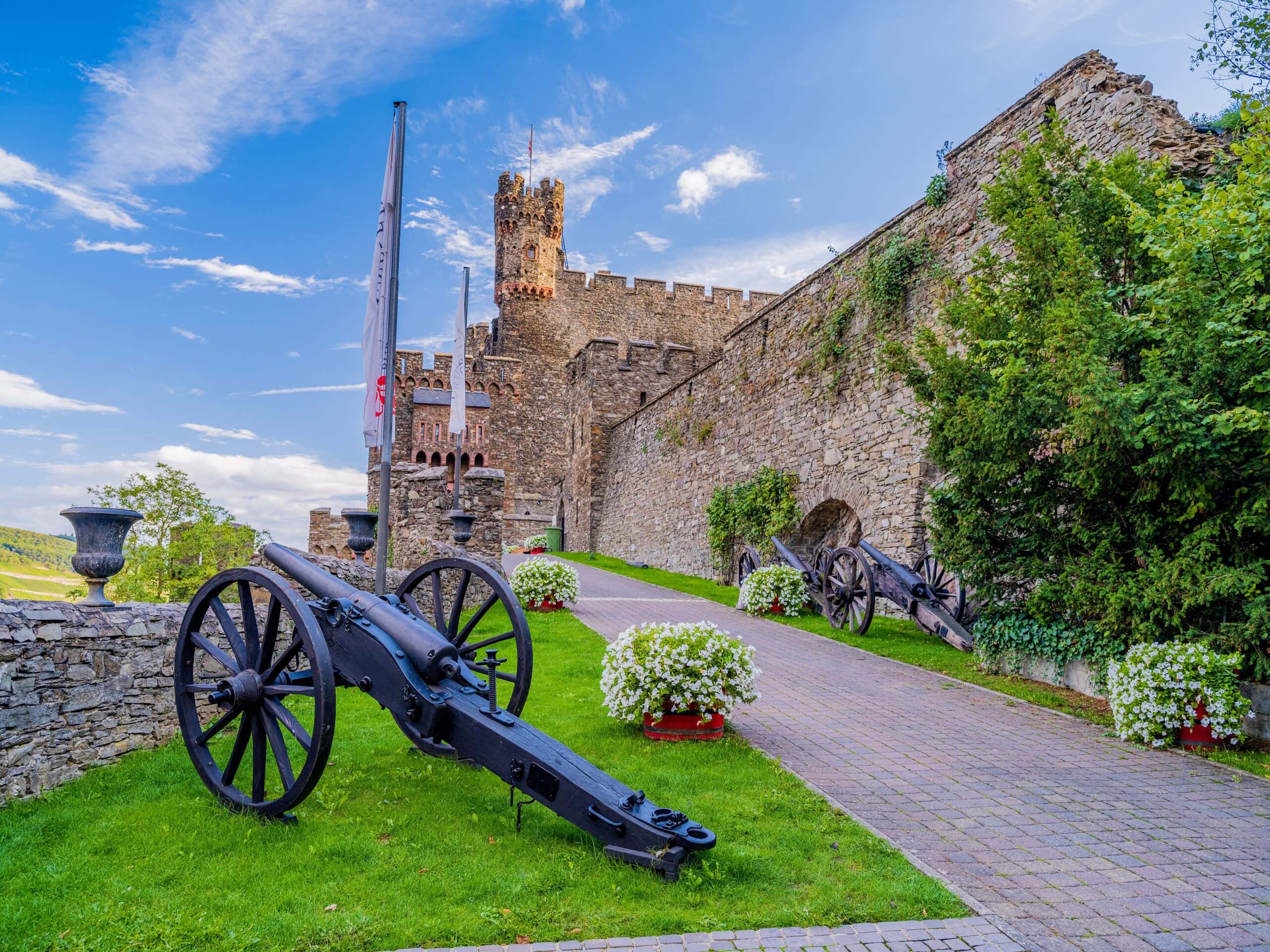
The museum is open daily all year, closing an hour earlier from November to March, with last admission an hour before closing; the hours are in the ticket table below. It is not wheelchair-accessible, and dogs are not permitted in the museum or its outdoor areas.
Admission
| Ticket | Price |
|---|---|
| Adult (14+) | €12.00 |
| Child, 5–13 | €6.00 |
| Under 5 | Free |
| 5-visit pass for two persons | Saves €30 (no time limit) |
| Museum hours, April to October | Daily 9:00-18:00 (last admission 17:00) |
| Museum hours, November to March | Daily 9:00-17:00 (last admission 16:00) |
Tickets are most reliably confirmed against the operator’s booking page at burg-reichenstein.com/museum. Hotel guests visit the museum free of charge.
The 23-room boutique hotel inside the castle (the operator describes it as “English country house” in style) opened at the end of 2015 and offers five categories of room, from Comfort doubles to two-level Galerie suites with panoramic Rhine views. The Puricelli Restaurant on site is listed in the MICHELIN Guide and Falstaff (no star, 85 points) and serves a regional, short-supply-chain menu drawing on the castle’s own kitchen garden.
A note on access in 2026: from March 20 to April 27, Deutsche Bahn is performing track-bed renewal between Bingen and Bacharach. Weekends in that window see the line fully closed with replacement buses; weekdays operate single-track with delays. Travelers in late March or April should consult bahn.de before booking. Anyone staying overnight can compare hotels in and around Bingen am Rhein.
Some links on this page are affiliate links, which means StoneKeep Atlas may earn a small commission, at no extra cost to you, if you book through them.
Common Questions
Who owns Reichenstein Castle?
It is privately owned, and once again by the family that rebuilt it. The Institut für Geschichtliche Landeskunde Rheinland-Pfalz records that the castle was sold in 1986. In November 2014 a great-grandson of Nikolaus Kirsch-Puricelli, who rebuilt it around 1900, bought it back. Today the museum, hotel and restaurant are run by Burg Reichenstein GmbH & Co. KG, a limited partnership whose imprint names Gebr. Puricelli Verwaltungsgesellschaft mbH as its general partner.
What can you see inside Reichenstein Castle?
Its rooms show how a wealthy industrialist family lived around 1900, with their historicist furnishings still largely intact. The Upper Middle Rhine World Heritage association lists the dining room with its ancestral gallery, the library, the card room, the music salon and a bedroom. In the oldest part, an Ofenhalle and an Eisenkammer show stoves, money chests and cast-iron Takenplatten from the Rheinböller ironworks, plates once set into the wall between kitchen and living room to pass on the fire’s heat. In the chapel stands an altarpiece inscribed 1556.
How do you get to Reichenstein Castle, and where do you park?
By car, leave the A61 at exit 49 (Bingen-Mitte) and follow the B9 toward St. Goar for about 10 kilometers to Trechtingshausen, then turn left into Burgweg. Parking is free, but the operator notes that the spaces in front of the gate can be closed off as a bus turning area when needed; from the lot on the B9 a footpath climbs to the castle in about five minutes. Hotel guests may drive up to reception to unload luggage. A taxi from Bingen (Rhein) Hauptbahnhof takes about ten minutes.
Can you get married at Reichenstein Castle?
Yes. The operator offers civil, church and symbolic ceremonies, the civil ones in cooperation with the Trechtingshausen registry office, and names four settings for them: the castle garden beside the old wall, the library, the chapel and the chapel courtyard. Up to 230 guests can celebrate indoors, depending on the layout, across three rooms, and the historic outdoor grounds hold several hundred. Weddings are expected to be accompanied by a professional wedding planner, and the operator offers help in choosing one.
Can you stay overnight at Reichenstein Castle?
Yes, in the castle hotel, and the operator runs a second address too: the Winzerhof Ross & Rose, a guesthouse with 11 rooms down in Trechtingshausen whose guests take breakfast in the Puricelli restaurant up at the castle. Staying in the castle brings one thing day visitors miss: in the evening, hotel guests may still enjoy the museum’s outdoor grounds, although the rooms inside are shut. Dogs are welcome in the hotel, if registered in advance, and in the restaurant, but not in the museum or its grounds.
How old is Reichenstein Castle?
The castle is first recorded in 1213, and its main medieval survivor is the shield wall, up to eight meters thick at the base and 16 meters high including its battlements. The Dehio handbook of German monuments, as reproduced by the Institut für Geschichtliche Landeskunde, dates the castle it belongs to either to soon after the 1282 destruction or to after Mainz acquired it in 1344, and reads the absence of arrow slits as favoring the earlier date. Dehio adds that the rest was heavily altered around 1900.
Beyond Reichenstein
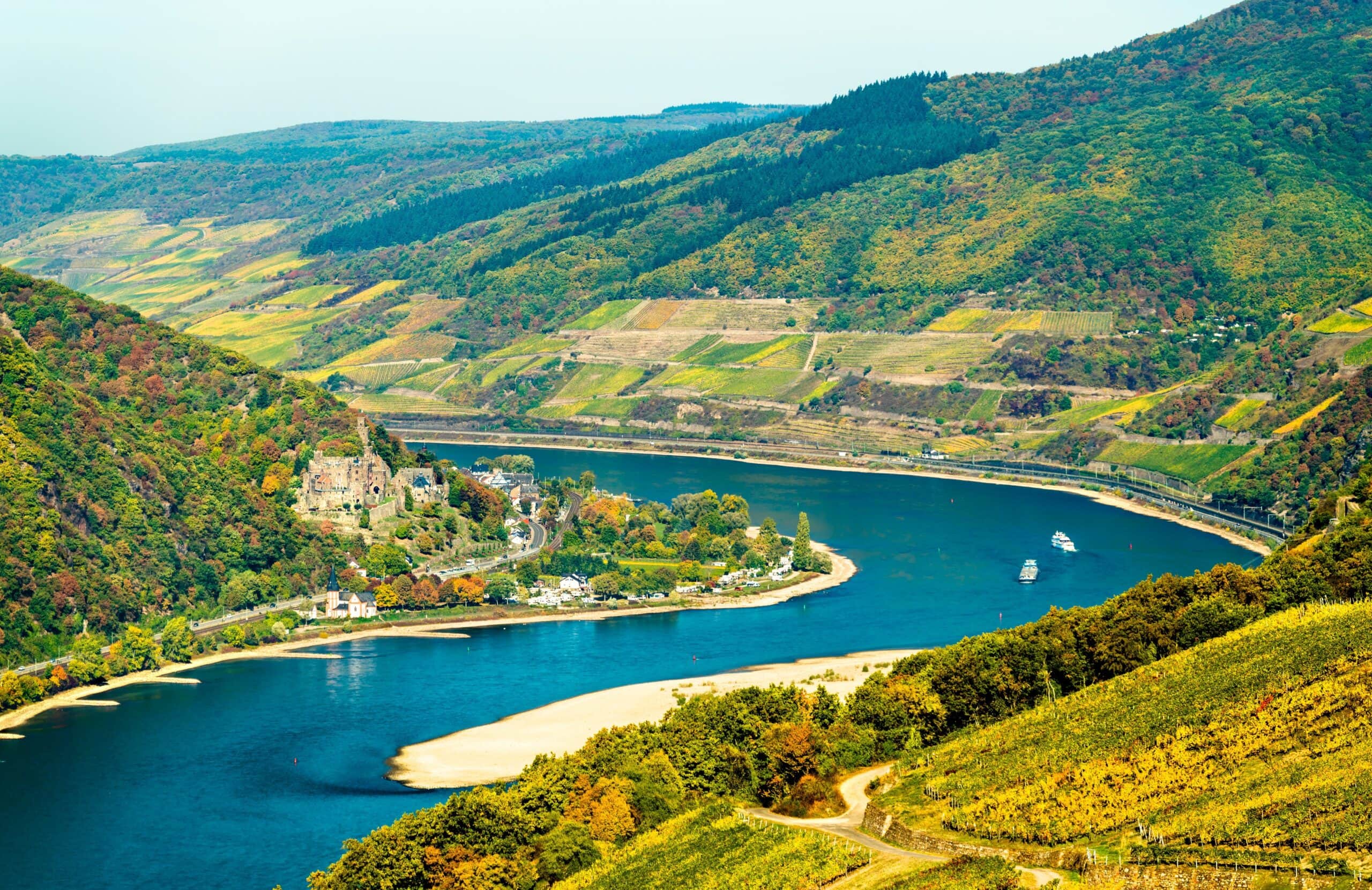
Reichenstein anchors a pair of left-bank castles barely two kilometers apart: a thirty-minute woodland walk through the Morgenbachtal (Reichenstein’s own gorge) brings you to Rheinstein, the Hohenzollern princely retreat that Reichenstein’s 1899 patrons were so determined to outshine. Continue downstream and the joint-princely castle of the four Hohenzollern brothers at Sooneck appears on the same bank within walking range. All three are members of the Castles of the Rhine Gorge cluster within the Upper Middle Rhine UNESCO World Heritage Site, and all three repay the patient traveler who threads them together with the 19th-Century Romantic Revival story of how the Rhine’s ruins came back from the dead.
Reichenstein’s 1282 slighting also anchors the political-economy argument developed in The Rhine as Contested Territory: Castles, Tolls, and the Collapse of Imperial Authority, which traces the Hohenstaufen collapse, the Interregnum-era toll-castle proliferation, and Rudolf I’s restrained reckoning that ended the Bolanden-Hohenfels lordship here.
Conclusion
Reichenstein is a 1900 building made to be read as a late-medieval one. Under it lies a medieval spur castle, first documented in 1213 and destroyed in 1282 and again in 1689; over it stands the reconstruction that Baron Nikolaus Kirsch-Puricelli commissioned from the Regensburg architect Georg Strebel between 1899 and 1902/03. It is also, nearly eighty years after the last Kirsch-Puricelli left, a private home of the founders’ descendants again, since a great-grandson bought it back in November 2014.
You can also spend the night here. Hotel Burg Reichenstein occupies the castle, and we feature it in our guide to the Castle Hotels in Germany, where you can sleep inside the walls.
Principal Sources
- Burg Reichenstein. burg-reichenstein.com.
- Friedhoff, Jens, and Reinhard Friedrich. “Reichenstein bei Trechtingshausen.” EBIDAT, Burgendatenbank des Europäischen Burgeninstituts, id 266. ebidat.de.
- Generaldirektion Kulturelles Erbe Rheinland-Pfalz. Denkmalverzeichnis Mainz-Bingen. Edition of May 14, 2025, p. 101, Trechtingshausen: “Burg Reichenstein südlich des Ortes auf Bergsporn über dem Eintritt des Morgenbachtals in das Rheintal” (Denkmalzone). gdke.rlp.de.
- Institut für Geschichtliche Landeskunde Rheinland-Pfalz. “Die Burg Reichenstein in Trechtingshausen,” with its “Baubeschreibung nach Dehio.” regionalgeschichte.net.
- Institut für Geschichtliche Landeskunde Rheinland-Pfalz. “Reichenstein.” Historisches Ortslexikon Rheinland-Pfalz. regionalgeschichte.net.
- Zweckverband Welterbe Oberes Mittelrheintal. “Burg Reichenstein.” welterbe-mittelrheintal.de.
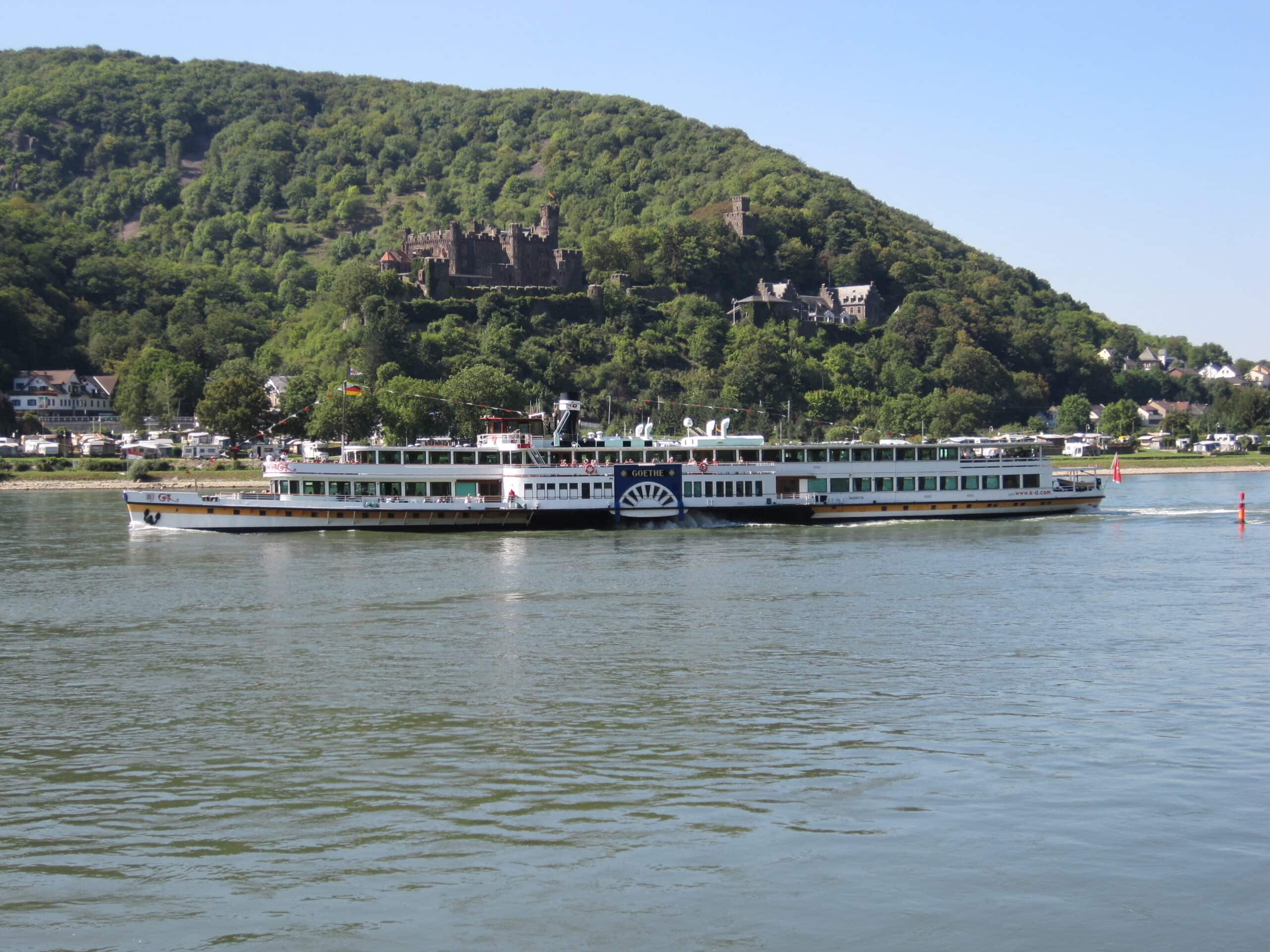
Image credits. Featured image — Reichenstein Castle from above Trechtingshausen, with the Belvedere tower at upper right and the outer ring wall enclosing the lower bailey: Whgler, CC BY-SA 4.0, via Wikimedia Commons. The Köln-Düsseldorfer paddle steamer Goethe passing below Reichenstein on the Rhine: Haffitt, CC BY-SA 3.0, via Wikimedia Commons. Reichenstein after the Strebel reconstruction: the three-story main building on the north-west, the corner towers of the outer ring wall, and the Belvedere tower above: János Korom Dr., CC BY-SA 2.0, via Wikimedia Commons. A 2025 aerial of Reichenstein: PopSpots, CC BY 4.0, via Wikimedia Commons. The approach to Reichenstein, with historic cannons on the lawn and the Schildmauer tower rising above the curtain wall: Poidabro, CC BY-SA 4.0, via Wikimedia Commons. Reichenstein in its UNESCO context: the castle anchors the left bank as the Rhine bends south-east toward Bingen, surrounded by the terraced vineyards of the Upper Middle Rhine Valley: Leonid Andronov / Adobe Stock. Freely licensed images are resized to fit; any other change, such as a crop, is named in the credit.