
Castles of Scotland
The castles of Scotland are not really one thing, and that is what makes them worth traveling for. A Scottish castle could be a royal fortress and a palace at once, a symbol of a dynasty and a family home, and very often a ruin and a resurrection in the same walls. The castles gathered here were not chosen because they are the largest or the most visited, though one of them is both. They were chosen because between them they show the full range of what a castle in Scotland could be: the black rock at the heart of the capital, the Renaissance court of the Stewart kings, a dynastic great house that may never have been completed, a broken Highland stronghold above Loch Ness, an island reconstruction rebuilt stone by stone, a cliff-top fortress that once hid a nation’s crown jewels from an invading army, and a clan seat on Loch Awe that ended its working life as a barracks. Read together, they are faces of a single idea.
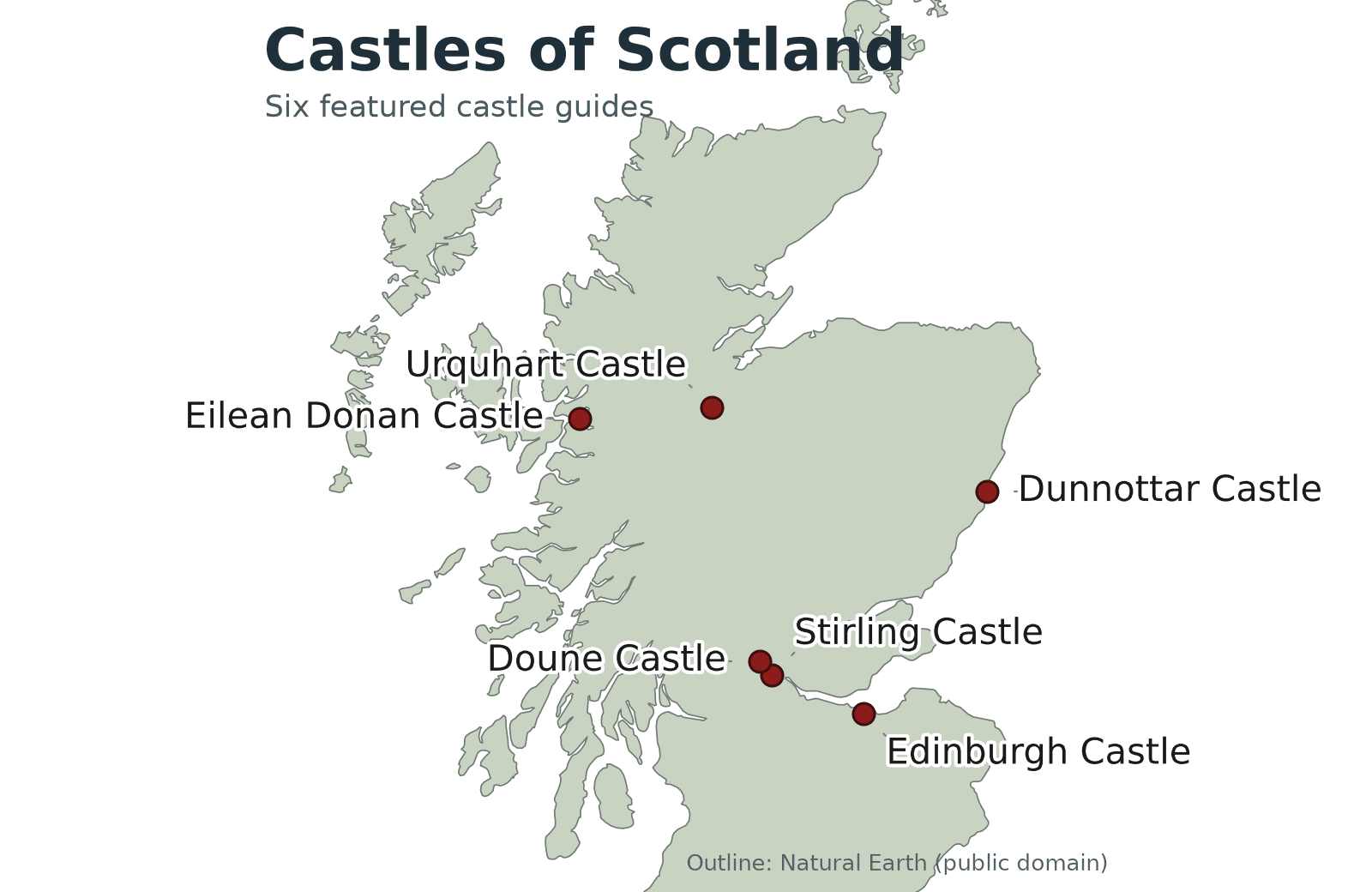
List the 8 castles on this map
- Edinburgh Castle — City of Edinburgh, Scotland
- Stirling Castle — Stirling, Scotland
- Eilean Donan Castle — Highland, Scotland
- Urquhart Castle — Highland, Scotland
- Doune Castle — Stirling, Scotland
- Dunnottar Castle — Aberdeenshire, Scotland
- Kilchurn Castle — Argyll and Bute, Scotland
- Dunrobin Castle — Highland, Scotland
The Castles of Scotland at a Glance
A handful of castles cannot stand in for a whole country, and these are not offered as the best. They are offered because between them they cover the range of what a Scottish castle can be, and because each one is close enough to a road or a railway that an ordinary visitor can actually reach it.
The first thing to settle is what you want from a castle, because Scotland’s divide sharply into two kinds and the difference decides your day. Edinburgh, Stirling and Eilean Donan are roofed, furnished and interpreted. You go inside, follow a route through rooms, and have the story told to you. Urquhart and Dunnottar are ruins held in careful stasis, where the walls stand to varying heights, the roofs are gone, and nothing is reconstructed. You supply the interiors yourself. Kilchurn goes a step further, since its interior is closed for conservation and the visit is a walk around the outside. Doune sits between the two, unroofed in parts but with a great hall and a lordly tower you can walk almost whole.
Neither kind is better, and a trip built entirely from one is poorer than a trip that mixes them. The intact castles give you objects, color and the texture of court life. Ruins give you something furnished rooms cannot, which is scale and weather and the plain fact of a wall that has outlasted everyone who argued over it.
Who looks after a place changes how you buy tickets and how far ahead you need to think. Edinburgh, Stirling, Urquhart, Doune and Kilchurn are in state care under Historic Environment Scotland, though Kilchurn charges nothing and is not ticketed at all. Eilean Donan and Dunnottar are privately held and ticketed separately, Dunnottar by the family who rescued it. That split matters mainly for the Explorer Pass, which covers the ticketed state sites and not the private ones.
Geography is the last constraint, and it is unforgiving. Edinburgh, Stirling and Doune sit within an hour of one another in the central belt and can be strung together comfortably. Urquhart is on Loch Ness, Eilean Donan is on the west coast at Kyle of Lochalsh, Dunnottar is on the east coast below Stonehaven, and Kilchurn is at the head of Loch Awe in Argyll. Those four point in four different directions, and no honest itinerary pretends otherwise.
| Castle | Region | What it is | Guide |
|---|---|---|---|
| Edinburgh Castle | Edinburgh | National fortress on a volcanic rock; the crown jewels and the capital’s oldest building | Full guide |
| Stirling Castle | Stirling | Renaissance palace-court of the Stewart kings, guarding the gateway to the Highlands | Full guide |
| Doune Castle | Stirling (Doune) | A great courtyard house of around 1400, perhaps never completed, and a favorite film location | Full guide |
| Urquhart Castle | Highland (Loch Ness) | A romantic Wars of Independence ruin above the loch, blown up in 1692 | Full guide |
| Eilean Donan Castle | Highland (Dornie) | The famous island castle, rebuilt whole between 1912 and 1932 | Full guide |
| Dunnottar Castle | Aberdeenshire (Stonehaven) | A cliff-top fortress on the North Sea that once hid the Honours of Scotland | Full guide |
| Kilchurn Castle | Argyll and Bute (Loch Awe) | A Campbell tower house with a barrack range of the 1690s; free, unticketed, and closed inside | Full guide |
Edinburgh Castle: the Fortress at the Heart of the Capital
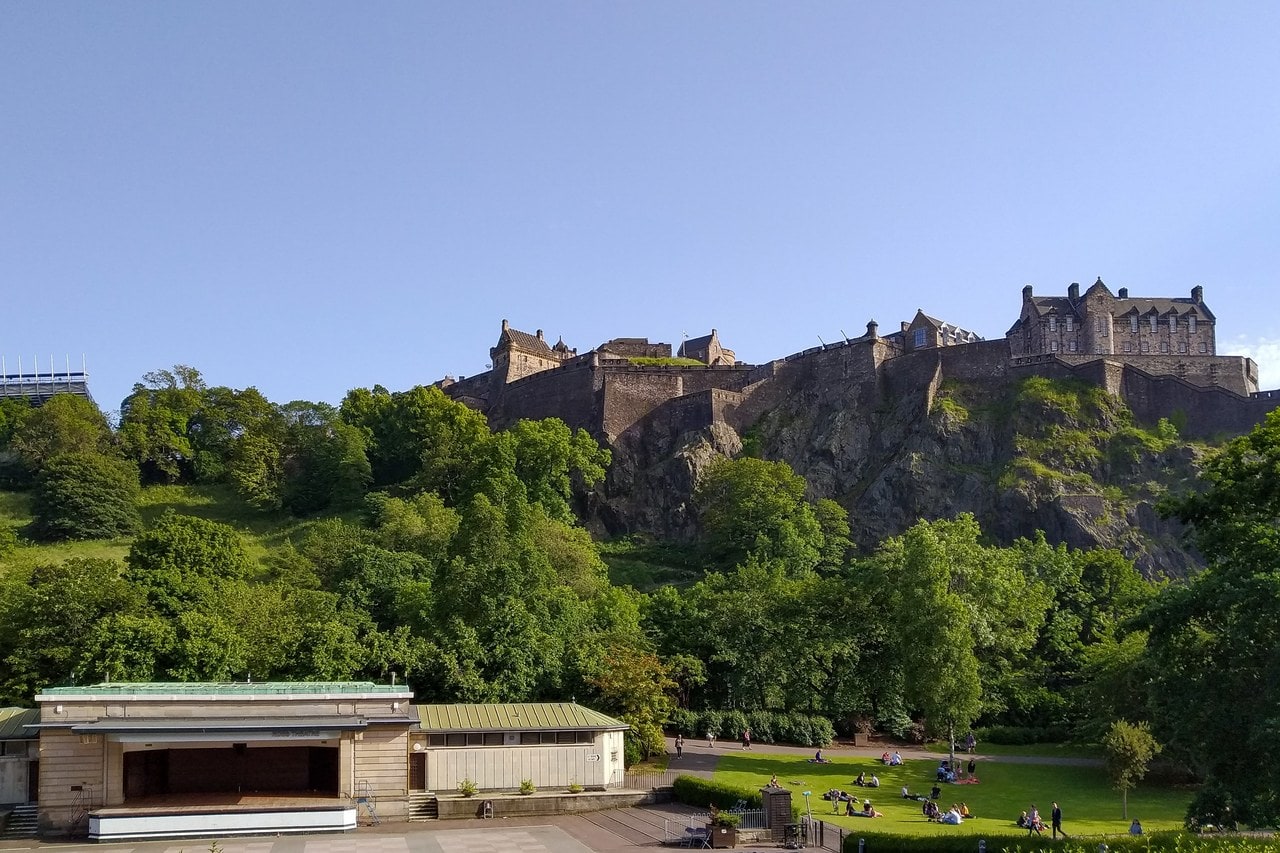
If a single castle stands for Scotland, it is Edinburgh, the dark fortress on its volcanic crag above the capital. It drew just over two million visitors in 2025, which makes it Scotland’s most-visited paid attraction, and it has been fought over for the better part of a thousand years while remaining a working army garrison to this day. Behind its ramparts sit the Honours of Scotland (the crown, the sceptre, and the sword of state), the oldest crown jewels in Britain, displayed in the Crown Room. Nearby stands St Margaret’s Chapel, a tiny Romanesque room from the twelfth century that is the oldest surviving building in the whole city. The castle is a layered thing, a rock that each century built on rather than replaced, and that accumulation is the point of it. This is the Scottish castle as national fortress: besieged, rebuilt, garrisoned, and never quite finished with. It is also the natural place to begin, both because it is the country’s front door for most visitors and because one of its treasures ties directly to the last castle in this guide.
Read the full guide: Edinburgh Castle.
Stirling Castle: the Renaissance Court of the Stewart Kings
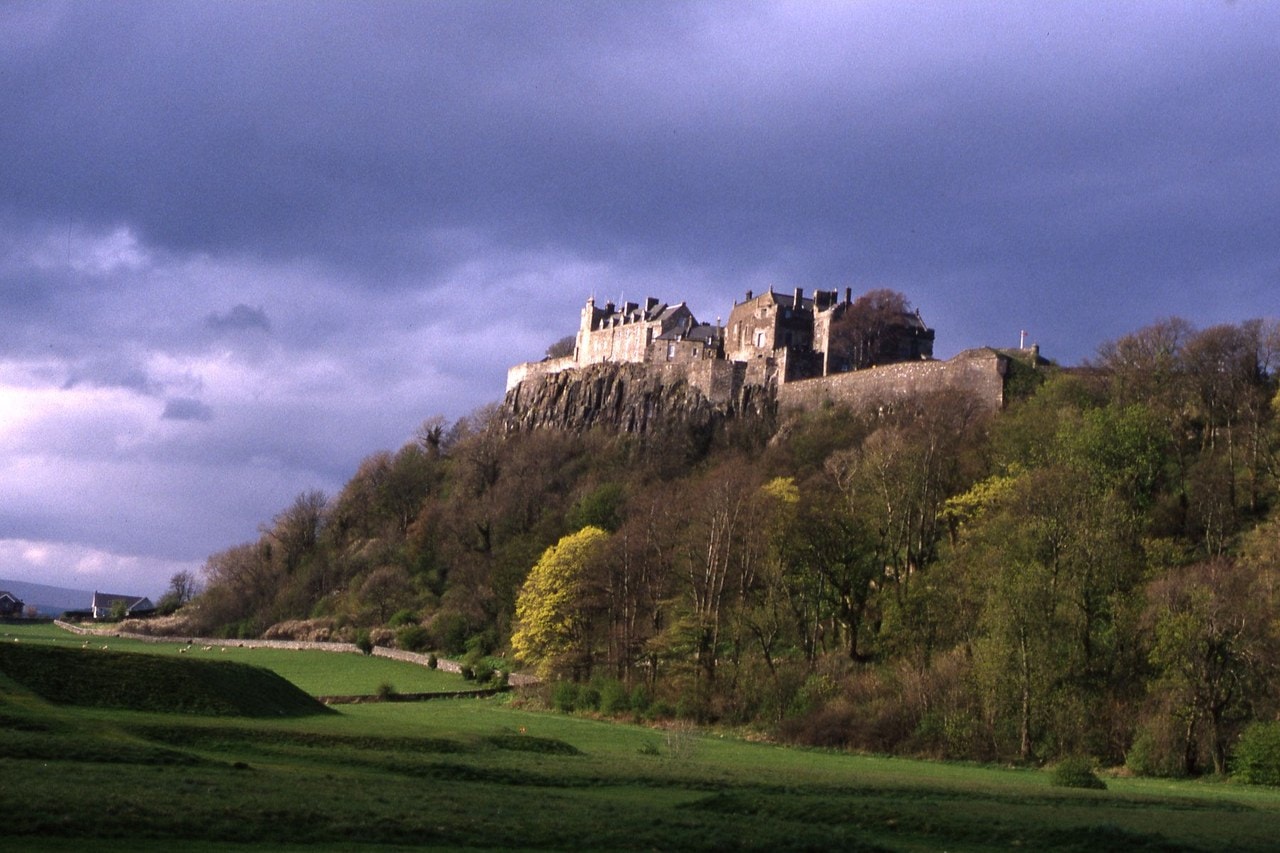
Forty minutes up the road, another great rock carries another royal castle, and Stirling is Edinburgh’s opposite number in almost every way. Where Edinburgh is a fortress that happened to house kings, Stirling is a palace that happened to be defensible. It sits at the waist of the country, guarding the lowest crossing of the River Forth and the gateway between Lowlands and Highlands, which is why the two decisive battles of the Wars of Independence were fought within sight of its walls. Its glory, though, is the Renaissance work of the Stewart kings. James IV raised a vast Great Hall, the largest medieval great hall built in Scotland, now rendered once more in the golden lime-harl it wore when new. His son James V added a Royal Palace whose lavishly re-created interiors, reopened in 2011, show a French-influenced court in full color, down to replicas of the carved oak Stirling Heads and a woven set of the Unicorn tapestries. Stirling is the Scottish castle as stage set for majesty, a place built to be seen and to impress, and it repays a slow visit more than almost any castle in the country.
Read the full guide: Stirling Castle.
Doune Castle: the Great House That May Never Have Been Finished
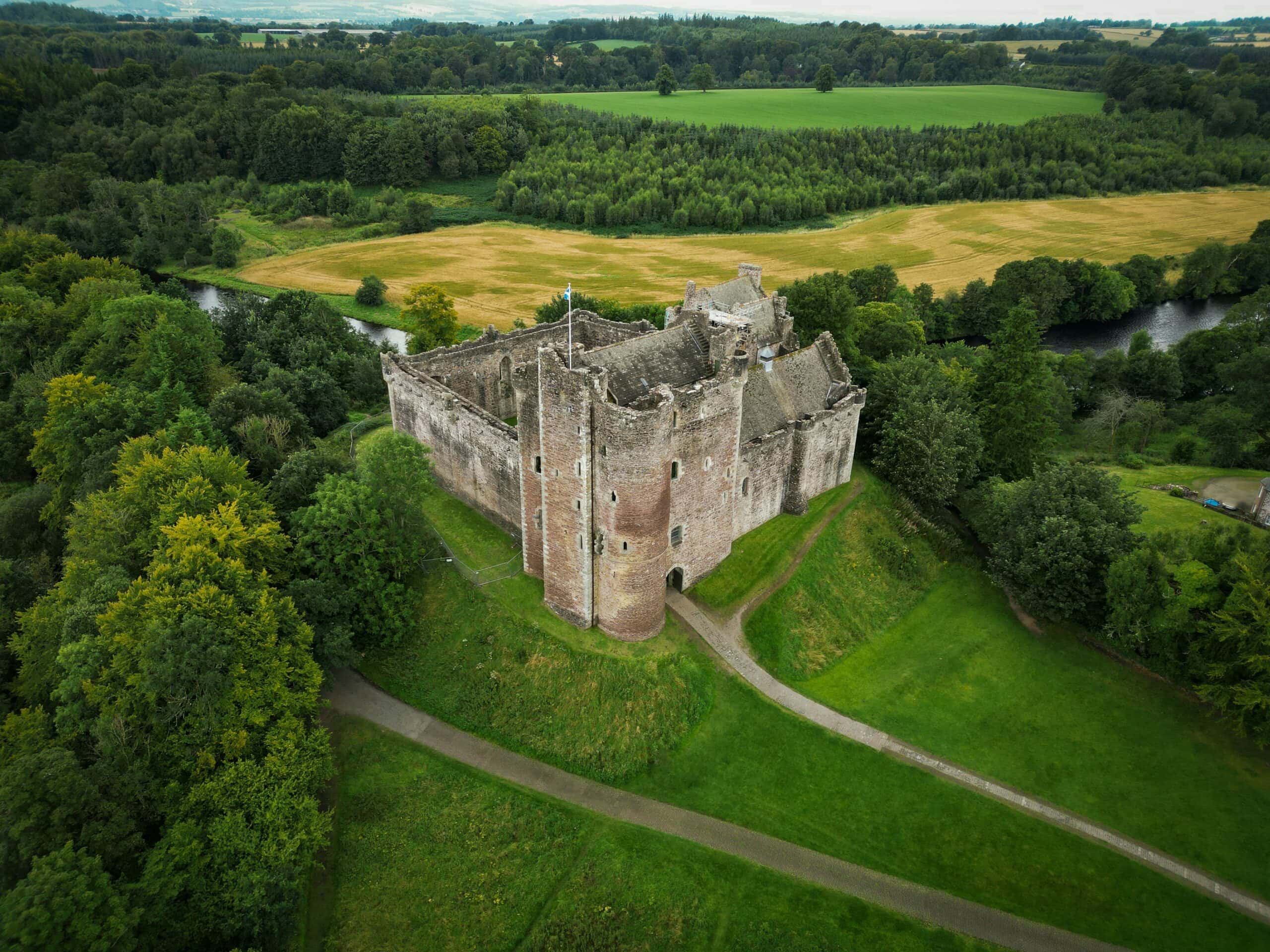
A short drive north-west of Stirling, on a quiet bend of the River Teith, stands a castle that is famous twice over and may never have been finished at all. Doune was built in a single sustained campaign around 1400 by Robert Stewart, first Duke of Albany, the man Historic Environment Scotland calls “Scotland’s uncrowned king”: younger brother of one monarch, Governor of Scotland for more than thirty years, and effective ruler of the country while the young James I was held prisoner in England. Albany planned a grand courtyard house with ranges on every side, and he died in 1420. Only the northern buildings stand today; along the empty south wall you can still read the tusking stones and the blind windows left for ranges that were planned. Whether those ranges were never raised, or were built and later taken down, Historic Environment Scotland says is unclear. The result is one of the best-preserved and most legible medieval castles in Scotland, a great hall and a lordly tower you can walk almost whole. Doune reads as the Scottish castle as unfinished ambition, the great house of a man who may have run out of time. It has also had a busy second life on screen, standing in for the castles of “Monty Python and the Holy Grail,” for Castle Leoch in “Outlander,” and for Winterfell in the unaired “Game of Thrones” pilot, a heritage its free audio guide, narrated by the late Terry Jones, wears with good humor.
Read the full guide: Doune Castle.
Urquhart Castle: the Broken Stronghold on Loch Ness
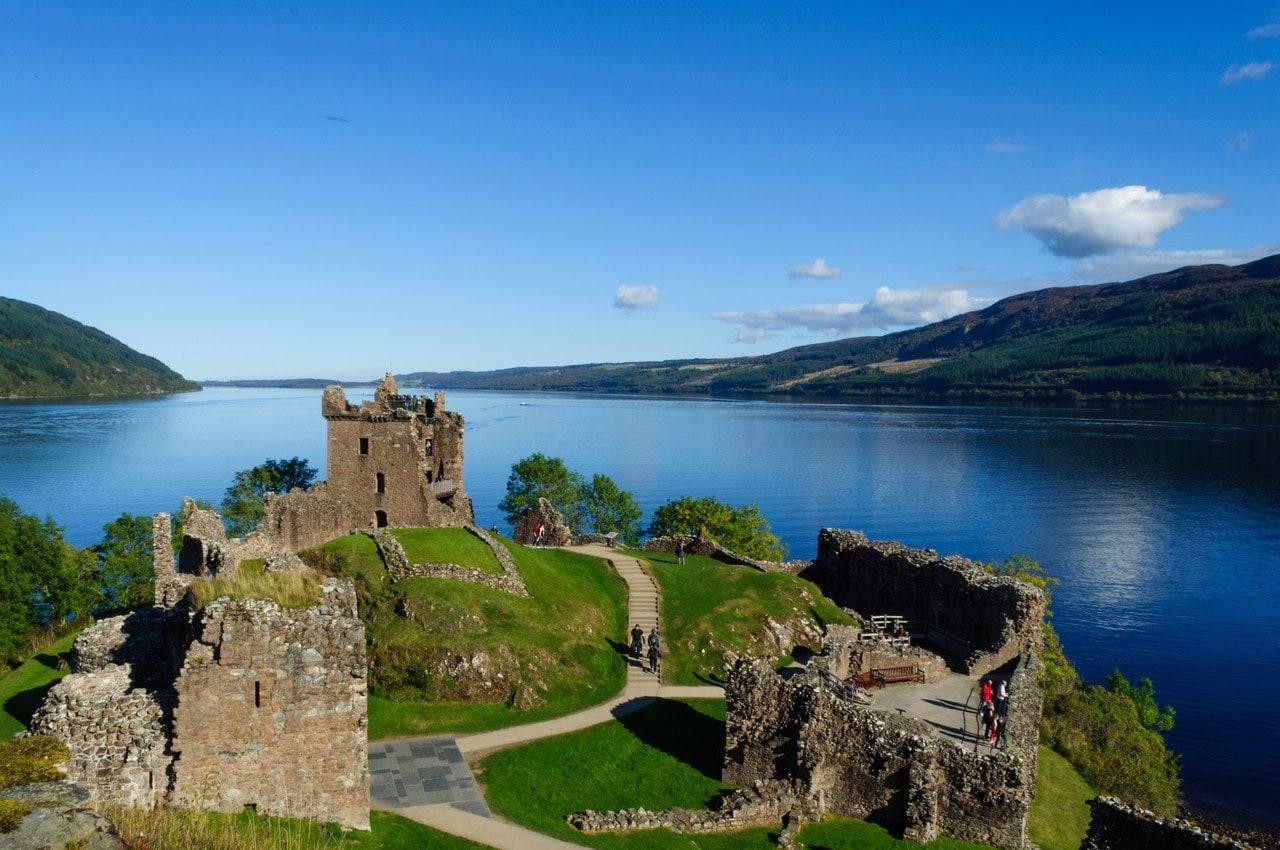
North again, into the Great Glen, the castles change character. Urquhart is a ruin, and a magnificent one, strung along a rocky promontory that juts into Loch Ness with the water on three sides. It guarded the glen through the long, grinding Wars of Independence, changing hands between Scots and English again and again across the decades either side of 1300, and its landmark today, the five-storey Grant Tower, rose later as its lairds tried to hold a frontier that would not stay quiet. What ended it was not a siege but a demolition: a government garrison blew the castle up in 1692 rather than let it fall into Jacobite hands, and it has been a romantic wreck above the loch ever since. The setting does the rest. Urquhart is where the country’s most famous legend and its real history meet, since the earliest tale of a beast in these waters comes from a sixth-century life of Saint Columba, the very story Historic Environment Scotland tells its visitors on the way in. Here is the Scottish castle as fought-over frontier post, and the loch behind it is unforgettable.
Read the full guide: Urquhart Castle.
Eilean Donan Castle: the Island Castle Rebuilt from Ruin
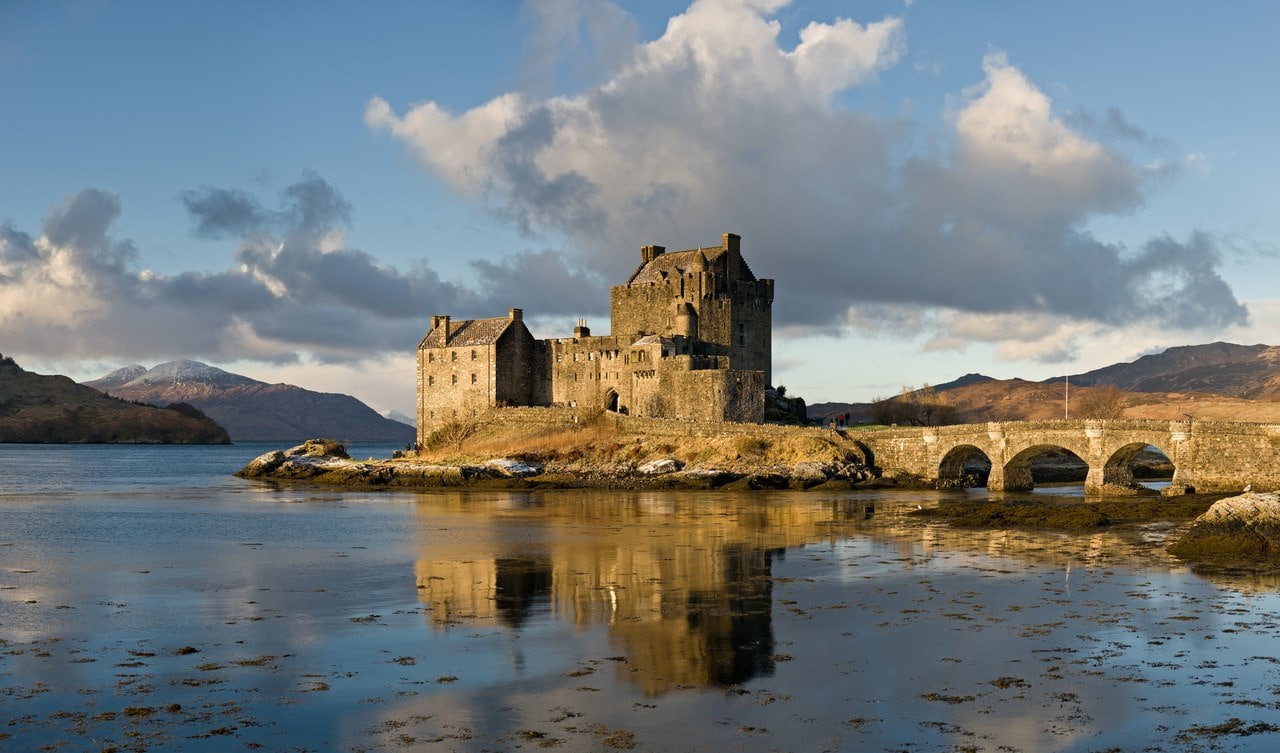
Out to the west coast, where three sea lochs meet at the village of Dornie, sits the castle that more people would recognize than could name: Eilean Donan, on its little tidal island, reached by an arched stone bridge. It is one of the most photographed buildings in Scotland, and almost everything about the picture is younger than it looks. The medieval castle here was destroyed in the Jacobite rising of 1719, when a small Spanish garrison holding it for the cause was bombarded by Royal Navy frigates and the wreck was blown up with its own gunpowder. For two centuries it lay in ruins. What stands today is a twentieth-century reconstruction, raised between 1912 and 1932 by Lieutenant Colonel John MacRae-Gilstrap on the surviving ground plan of the old castle, a labor of love that took twenty years and restored a castle his own Clan MacRae had guarded, as the Mackenzies of Kintail’s hereditary keepers, for centuries. It is honest to say so, and it makes the place more interesting, not less: Eilean Donan is the Scottish castle as an act of memory, a vanished stronghold called back into being because a family and a nation could not bear to leave it gone. It remains in the care of the Conchra Charitable Trust.
Read the full guide: Eilean Donan Castle.
Dunnottar Castle: the Cliff-Top Fortress and the Crown Jewels
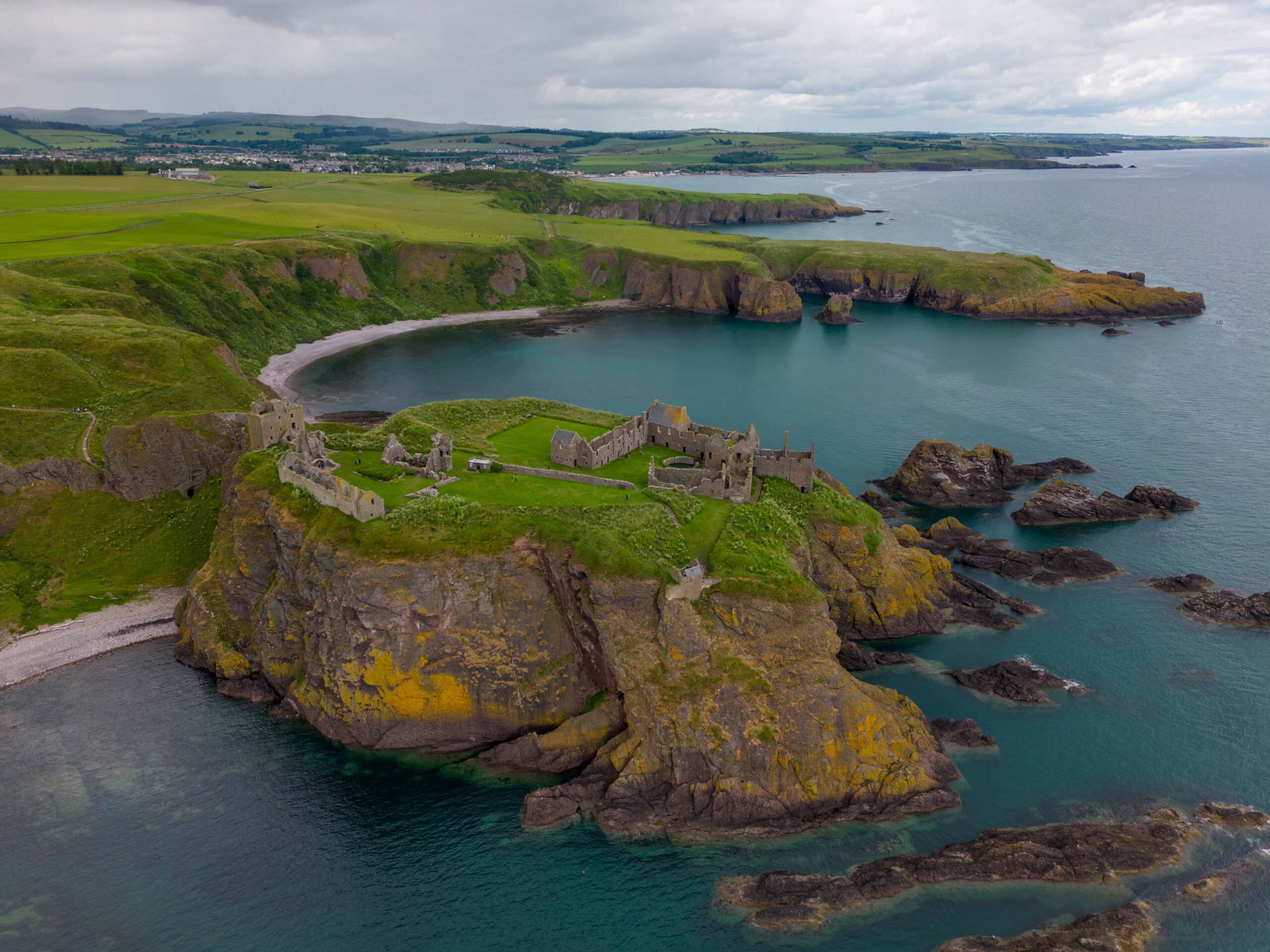
Dunnottar sits on the far side of the country, on the North Sea coast just south of Stonehaven, and it is the most dramatic of them all. It spreads across a flat-topped headland ringed by cliffs that fall some fifty meters to the sea on almost every side, joined to the mainland by nothing but a narrow neck of rock. William Wallace is said to have stormed it during the Wars of Independence, and centuries later it became a grim Covenanter prison. But its greatest hour was its finest act of defiance. In 1651 and 1652, while Oliver Cromwell’s army overran Scotland, the Honours of Scotland (the same crown, sceptre, and sword now shown at Edinburgh) were carried here for safekeeping and held through a long siege, and then smuggled out under the noses of the besiegers and hidden until the danger passed. That is the thread that binds this guide together: the crown jewels you can see behind glass in the capital survive because a cliff-top fortress two hundred miles away refused to give them up. Dunnottar is the Scottish castle as last redoubt, a ruin whose broken towers still command the sea. It is privately owned and open to visitors, and the walk out to it is part of the experience.
Read the full guide: Dunnottar Castle.
Kilchurn Castle: the Clan Seat That Became a Barracks
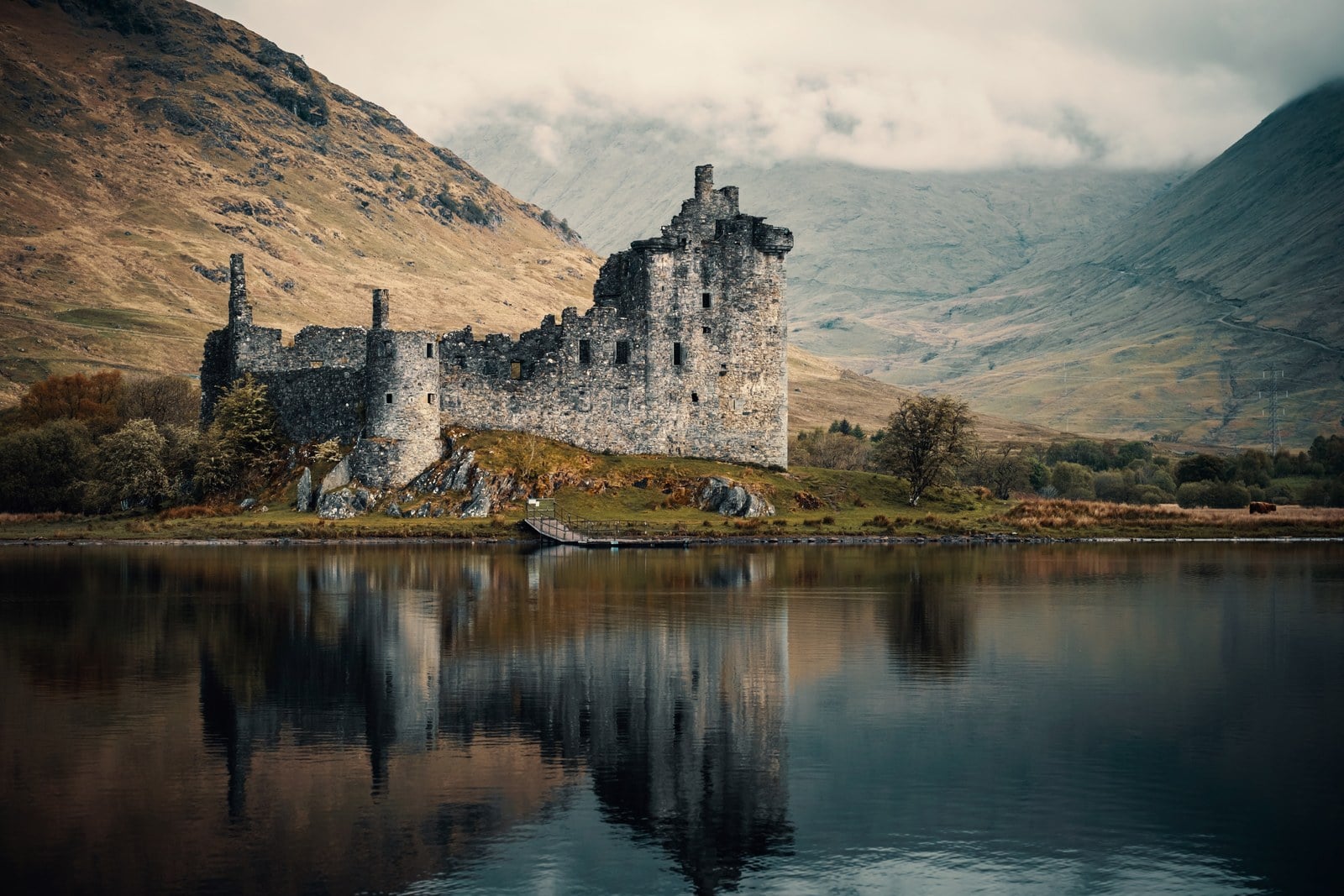
Kilchurn sits at the head of Loch Awe in Argyll, roofless on a low green peninsula that the water still floods from time to time, and at present you cannot go inside it at all. The interior is closed for conservation, Historic Environment Scotland has published no reopening date, and the visit is a walk up to the building and around the outside, free, at any time of year. What you walk around is two castles wearing one silhouette. A tower house was raised here in the middle of the fifteenth century by Sir Colin Campbell, first laird of Glenorchy, and it served as the power base of a family that would become one of the strongest in the West Highlands. The three tall round towers that dominate every photograph are not medieval at all. They belong to a reconstruction begun in 1690 by John Campbell, first Earl of Breadalbane, who added a barrack range along the north curtain while resisting the government’s attempt to garrison his own castle. Historic Environment Scotland’s verdict on the result is one sentence: “Little use was ever made of this barrack accommodation.” Within a lifetime the building was roofless, and by the end of the eighteenth century it had been leased to fishermen who used it to salt and preserve their catch. Getting there is a walk of about two kilometers there and back from an unsigned roadside pull-off, across farmland that floods.
Read the full guide: Kilchurn Castle.
Dunrobin Castle: the Great House Wearing a Castle’s Name
Dunrobin is the odd one out in this guide, and that is why it belongs in it. Almost every other castle here is a ruin or a state monument; Dunrobin is a family’s house, still privately owned, and the only one you can reach by a railway station built for the castle itself. What a visitor meets is a French-roofed mansion of the 1840s above terraced gardens on the Sutherland coast, and hardly any of it looks medieval, because hardly any of the medieval work is on the outside. Historic Environment Scotland’s listing describes the whole building as “all encasing 14th century square tower”: a fourteenth-century tower, two seventeenth-century ranges and a wing of 1788 to 1795, wrapped inside a Victorian envelope and glimpsed from one passage of windows indoors.
Set against Edinburgh’s fortress rock or Dunnottar’s cliff, Dunrobin shows what became of the castles nobody ever abandoned. They turned into houses, and their owners turned into landlords. Improvements begun on the Sutherland estate about 1807 led, in the same authority’s words, to the unpopular Highland clearances, and the family’s monument still stands on the hill above Golspie. Our full guide to Dunrobin Castle covers the architecture, the clearances and the request-stop station in detail.
From Fortress to Palace: How Scotland’s Castles Changed
A castle is not one idea held still for five hundred years. It is a building type that kept being asked to do different jobs, and the castles here happen to line up almost as a sequence.
The first job was holding ground. Every one of these sites was chosen for the same unromantic reason: a rock, a loch shore, a river crossing, a headland with water on three sides. Earliest work at all of them is defensive, and where it survives it is thick and short of windows. Castle Sween in Argyll, which Historic Environment Scotland calls the oldest standing castle on the Scottish mainland that can be dated with confidence, makes the point plainly. Built probably in the 1100s, its curtain wall runs two meters thick and eight meters high, and apart from the entrances it is almost blind. Nobody was thinking about the view.
The second job was display, and it arrived with money and a settled dynasty. Stirling shows the change more clearly than anywhere else in Scotland, because the Stewart kings built there in sequence and the buildings still stand next to one another. James IV added the Great Hall around 1503. James V built the Royal Palace around 1540. James VI commissioned the Chapel Royal in 1594. Three generations, three buildings, and a fortress that has quietly become a court. Doune belongs to the same impulse a century earlier: Robert Stewart, first Duke of Albany, acquired it in 1361 through his marriage to Margaret Graham, Countess of Menteith, and what stands today reflects his governorship between 1386 and 1420, a great house built by a man running the country.
Then gunpowder arrived and the job changed again, this time toward absorbing damage rather than deflecting it. Edinburgh’s answer is visible from Princes Street. After the Lang Siege of 1571 to 1573 wrecked the medieval defences, the rebuilt castle gained the Half Moon Battery, a broad curved gun platform designed to take artillery fire and return it. It is not a prettier shape than what it replaced. It is a thicker one.
A last job is symbolic, and it is the one these castles still perform. A building that no longer defends anything and houses nobody has to justify itself some other way, and these do it by being visited. That is a real function, not a lesser one, but it explains why so much of what you see at any Scottish castle is a decision taken in the last two hundred years about what to keep, what to rebuild, and what to let stand as a ruin.
Wrecked by Their Own Side: the Castles and the Wars of Independence
The most common question about Scotland’s castles is why so many of them are ruins. Part of the answer is ordinary, that roofs fail and quarrying neighbours help themselves. The more interesting part is that some of the greatest were destroyed on purpose, by the Scots.
A castle in the early fourteenth century was not a patriotic object. It was a machine for holding territory, and it worked for whoever held it last. An English garrison in a Scottish castle controlled the country around it, and every castle Robert I took was a castle that could be taken back. His answer was to make them unusable.
Edinburgh is the clearest case. In 1314 Thomas Randolph took the castle by scaling the rock itself at night, one of the celebrated feats of the wars. What followed is the part that gets left out of the story. Historic Environment Scotland records that the king then ordered Edinburgh Castle to be destroyed, to prevent it from being retaken by the English. The prize was not garrisoned. It was demolished.
Stirling went the same way in the same year. It had changed hands repeatedly, and Bannockburn was fought in 1314 in part over its relief. After the battle, in Historic Environment Scotland’s words, Robert the Bruce had the castle’s defences destroyed to prevent it falling into enemy hands again. Stirling would change hands again regardless, and only returned to Scottish control for good with its recapture in 1342.
Set that policy beside a landscape and the ruins start to make sense. The country was fought over for decades by armies too small to garrison everything they captured, and the rational move for the side with fewer men was to deny the ground rather than hold it. Scotland’s castles were not only broken by enemies. A good number were broken by their own kings, deliberately, as a strategy, and rebuilt afterward by whoever could afford to.
That is also why so many Scottish castles read as layered rather than whole. Edinburgh and Stirling as you see them today are largely later buildings standing on sites that were cleared more than once. Medieval fabric surviving at both is the fabric that survived a policy of destruction, not the fabric that was lucky.
Ruin, Romance and Rebuilding: the Last Three Hundred Years
The wars that made these castles ended, and the castles kept being destroyed anyway. The difference is that later destructions were tidy, administrative, and better documented.
Urquhart went in 1692. It had held a government garrison through the unrest that followed the exile of James VII, and when the last soldiers marched out they blew up the towering gatehouse so that the castle could never again be a military stronghold. The rest followed on its own. Part of the Grant Tower came down in a violent storm in 1715, and the site decayed on the loch shore for the better part of two centuries.
Eilean Donan went in 1719, and more comprehensively. Three Royal Navy frigates, the Flamborough, the Worcester and the Enterprise, bombarded the castle during the Jacobite rising of that year. Captain Herdman of the Enterprise led the final assault, and government forces used the Jacobite gunpowder they found inside to blow up what the bombardment had left. What stood afterward was rubble on a tidal island, and it stayed that way for nearly two hundred years. Dunnottar was not blown up so much as stripped: sold in 1717, it was reduced to a shell with anything of value carried off.
Then the mood changed, and this is the turn that produced the castles you can visit. Attitudes shifted through the 1800s, and Historic Environment Scotland puts the shift well for Urquhart: attitudes changed through the 1800s, and the castle came to be seen as “a noble ruin in a majestic setting.” A ruined castle stopped being a liability and became a thing worth keeping. Urquhart passed into state care in 1913 and is now among the most visited castles in Scotland.
Two of these castles went further than preservation. At Eilean Donan, Lieutenant Colonel John MacRae-Gilstrap bought the island in 1911 and the restoration began the following year under the architect George Mackie Watson, with Farquhar MacRae as local clerk of works, following the surviving ground plan of the earlier castle. Work was completed in 1932. The castle on every shortbread tin in Scotland is, in its present form, younger than the aeroplane. At Dunnottar, Lord and Lady Cowdray bought the ruin in 1919 and began an extensive program of conservation and restoration that stabilized the site and reopened it to the public. The estate remains in the same family.
Those two approaches are worth holding side by side, because they represent a genuine choice. Eilean Donan was rebuilt into a building you can live in. Dunnottar was held as a ruin and made safe. Neither is a fake and neither is untouched, and knowing which you are looking at is most of what it takes to read a Scottish castle honestly.
Beyond These Castles
These are a beginning, not a boundary. Scotland’s castles run to the thousands, and a collection this size can only sketch the shape of them, leaving out whole regions and whole kinds of castle: the tower houses of the Borders, the great Aberdeenshire houses of the north-east, and the island fortresses of the Hebrides. As StoneKeep Atlas adds Scottish guides, this hub will grow with them, and the map above will fill in. For now, the castles here are chosen to be complementary rather than exhaustive: no two of them are the same kind of place, and each one rewards a full day. If you have time for only one, let it be the one whose story moves you most, whether that is the fortress, the palace, the ruin, or the rock above the sea.
Castle Sween, on the Argyll coast, is a different kind of visit again: little interpreted, hard to reach, and the oldest standing castle on the Scottish mainland that anyone can date with confidence.
Planning a Scottish Castle Trip
A little planning goes a long way with Scottish castles, because they are not all run by the same people. Five of the castles in this guide (Edinburgh, Stirling, Urquhart, Doune, and Kilchurn) are in the care of Historic Environment Scotland, the national heritage agency, and if you plan to see several the Historic Scotland Explorer Pass is worth pricing up: it gives access to dozens of Historic Scotland sites over a run of consecutive days and can pay for itself in a couple of the big castles. Kilchurn is the odd one out there, because it is not ticketed at all and neither membership nor a pass makes any difference. The pass does not cover the other two either. Eilean Donan is run by a family charitable trust and Dunnottar is privately owned, so each charges its own admission and neither is on the pass. Geography matters just as much. Edinburgh, Stirling, and Doune sit close together in the central belt and make an easy two- or three-day loop, while Urquhart, Eilean Donan, and Dunnottar are long drives apart in three different directions, and are best folded into a wider Highland or coastal trip rather than rushed. Most do not strictly need a car, either: Edinburgh and Stirling sit on the main rail network, Dunnottar is a short walk from Stonehaven on the Aberdeen line, and even the Highland pair are reachable by Scottish Citylink coaches, which stop near Urquhart on Loch Ness and at Dornie below Eilean Donan. Kilchurn is the exception, because Loch Awe station sits under a kilometer away as the crow flies but no published walking route connects it to the castle’s approach track. A car simply makes stringing them together easier. Late spring and early autumn give the best light and the thinnest crowds; the big castles are busiest at midday, so arrive early. One date to plan around is August, when Edinburgh fills for the Festival, the Fringe, and the Military Tattoo: exhilarating, but book the capital far ahead if you go then. And if you would rather wake up inside the history than drive home from it, Scotland has a deep tradition of castle stays, from turreted country-house hotels to whole fortresses you can book for yourself, which we cover in our guide to staying in a castle in Scotland.
If you are visiting more than two or three state-run sites, the Explorer Pass is worth understanding before you buy individual tickets. Issued by Historic Environment Scotland, it runs for fourteen consecutive days from a start date you choose, admitting you once to each of more than sixty properties. The number varies by season, with around sixty sites open in summer and around thirty through the winter. Of the castles here it covers Edinburgh, Stirling, Urquhart and Doune. It does not cover Eilean Donan or Dunnottar, which are privately run and ticketed separately, and Kilchurn needs no ticket at all, so a trip built around all of them will involve a pass, separate bookings, and one castle you simply walk up to.
Season changes these places more than it changes most European castles. Winter brings shorter opening at the smaller sites and genuine weather to the exposed ones, and coastal ruins in particular are transformed by it: Dunnottar in a gale is a different proposition from Dunnottar in July, better in every way except comfort. Summer brings the opposite problem at Edinburgh, which is the busiest paid attraction in the country and is at its worst in the middle of an August day.
Book Edinburgh ahead for a timed slot whatever the season. Stirling rewards arriving early. Urquhart, Dunnottar and Eilean Donan all involve walking on uneven ground, and Dunnottar involves a steep descent and climb that no amount of enthusiasm makes step-free.
Common Questions
How many castles are in Scotland?
Nobody can tell you, and anyone who gives you a confident round number is repeating someone else, which is true of every other country we have checked as well. Totals in the low thousands circulate widely, but they trace to press coverage rather than to any primary count. The reason is definitional: the figure depends entirely on whether you include tower houses, mottes that are now only earthworks, fortified halls, and vanished sites known from documents alone. Scotland’s national record of the historic environment catalogues sites rather than publishing a tidy castle total. There are a great many, and the exact count is a question about categories rather than about Scotland.
Why are there so many castles in Scotland?
Because the country was contested for centuries, at several scales at once. There were the wars with England, fought across the same handful of strategic sites again and again. There was the long reach of the crown into the Highlands and Islands, which needed strongholds to enforce it. And there was lordship itself: a defensible stone house was the ordinary form of aristocratic building in Scotland long after it had become unusual elsewhere. Add a policy of deliberately destroying captured castles during the Wars of Independence, and you get both the quantity and the high proportion of ruins.
What is the oldest castle in Scotland?
Castle Sween in Argyll, probably built in the 1100s. Note both caveats in Historic Environment Scotland’s phrasing for it: standing, and mainland. Older fortified sites exist, and several castles claim continuous occupation from earlier, but claims of that kind are usually about a site rather than about surviving stone.
How many days do you need to see Scotland’s castles?
Three days covers the central belt properly, with Edinburgh, Stirling and Doune within an hour of one another. A week lets you add one direction beyond it, either Loch Ness or the west coast or the Aberdeenshire coast, but not all three. Two weeks is the point at which the castles here become comfortable rather than forced.
Can you stay in a castle in Scotland?
Yes, and Scotland has more genuine castle accommodation than anywhere else in Britain, from hotel rooms in converted country houses to whole castles let for a week. That is a separate subject with its own practicalities, and we cover it in our guide to castle stays in Scotland.
Many Castles, One Nation
Set side by side, these castles tell Scotland’s story better than any one of them could alone. Edinburgh is the fortress the nation was ruled from; Stirling is the palace it was crowned in; Doune is the great house of the man who ruled without a crown; Urquhart is the frontier it was fought over; Eilean Donan is the ruin it could not bear to lose; Dunnottar is the rock that saved its crown; and Kilchurn is the clan seat that ended its working life as a barracks. Between a volcanic crag in the Lowlands and a sea-stack in the north-east lie a thousand years of building, breaking, and rebuilding, which is really the whole history of a small country that was never quite conquered. Start with whichever one calls to you, and let it lead you to the next.
This hub gathers our full StoneKeep Atlas guides to Edinburgh Castle, Stirling Castle, Doune Castle, Urquhart Castle, Eilean Donan Castle, and Dunnottar Castle, and Kilchurn Castle.
Principal Sources
- Adomnan of Iona. Life of St Columba (via Historic Environment Scotland). Urquhart Castle.
- Association of Leading Visitor Attractions (ALVA). “2025 Visitor Figures”. alva.org.uk.
- Dunnottar Castle. “History.” dunnottarcastle.co.uk.
- Dunnottar Castle (Dunecht Estates). “History” and “Visit” (the “160 foot rock” that carries the cliff height). dunnottarcastle.co.uk.
- Eilean Donan Castle. “History.” eileandonancastle.com.
- Eilean Donan Castle. “Timeline.” eileandonancastle.com.
- Historic Environment Scotland. “Castle Sween: History.” historicenvironment.scot.
- Historic Environment Scotland. “Doune Castle: History.” historicenvironment.scot.
- Historic Environment Scotland. “Edinburgh Castle: History.” historicenvironment.scot.
- Historic Environment Scotland. “Explorer Pass.” historicenvironment.scot.
- Historic Environment Scotland. “Historic Scotland Explorer Pass.” historicenvironment.scot.
- Historic Environment Scotland. “See Scotland’s ‘Crown jewels’ in 3D.” historicenvironment.scot. The carrier for the Honours as the oldest crown jewels in Britain and for their removal from Dunnottar during the siege.
- Historic Environment Scotland. “Stirling Castle: History.” historicenvironment.scot.
- Historic Environment Scotland. “Urquhart Castle: History.” historicenvironment.scot.
- Historic Environment Scotland. Edinburgh, Stirling, Doune, and Urquhart place pages, and the designation records (SM90130, SM90291). historicenvironment.scot.
- Simpson, W. Douglas. Dunnottar Castle. 1966.
- The Conchra Charitable Trust. “History” and “Timeline.” eileandonancastle.com.
This guide draws on the standard literature of Scottish castellated architecture, including W. Douglas Simpson and the RCAHMS inventories, alongside the operators’ own sites. Opening hours and admission prices change with the season; confirm the current details on each castle’s official website before you travel.
Image credits. Locator map by StoneKeep Atlas; country outline from Natural Earth (public domain). Edinburgh Castle: Matti Blume, CC BY-SA 4.0. Stirling Castle: Colin Park, CC BY-SA 2.0. Doune Castle: Johnny Briggs via Unsplash. Urquhart Castle: MG Photography / Adobe Stock. Eilean Donan Castle: Diliff, CC BY-SA 3.0. Dunnottar Castle: Robin / Adobe Stock. Kilchurn Castle: Jon Ingall / Adobe Stock. Freely licensed images are resized to fit; otherwise unaltered.