
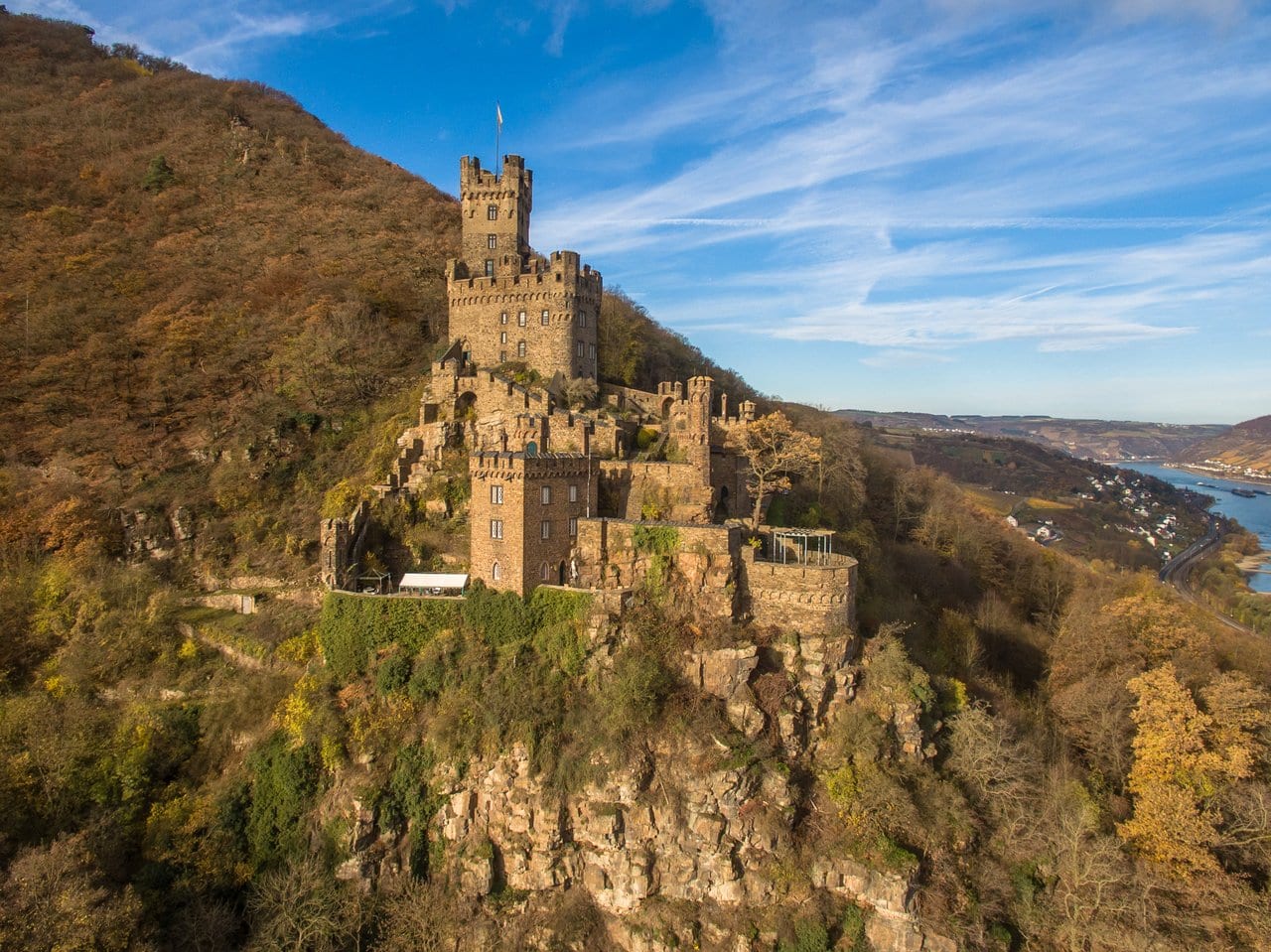
Sooneck Castle
Most Rhine castles were built once and broken once. Sooneck Castle was broken twice, by two different states, for the same reason; rebuilt a third time by people who admired exactly the thing it had originally been destroyed for. It began as a robber-knights’ eyrie above the river’s worst bottleneck, was besieged, destroyed and outlawed by a German king, clawed its way back, was flattened again by a French army, and then, in the most Romantic century of all, was bought by the Prussian royal house and turned into a chivalric daydream.
The castle on its ridge above Niederheimbach today is a museum of nineteenth-century taste pretending to be a museum of the Middle Ages. That is not a criticism; it is the point. Sooneck Castle is one of the clearest places on the Rhine to watch a robbers’ nest become a fairy tale; to see who did the rewriting, and why.
Quick Facts
| Name | Sooneck Castle (Burg Sooneck; also Saneck, Sonneck) |
| Location | Above Niederheimbach, left bank of the Rhine, Rhine Gorge, Rhineland-Palatinate, Germany |
| First documented | 1271 (sold by Kornelimünster Abbey to the Archbishop of Mainz) |
| Destroyed | 1282 by King Rudolf I of Habsburg (rebuilding banned); again 1689 by French troops of Louis XIV |
| Rebuilt | Mid-14th century under Mainz; comprehensively in the 1840s–1861 by the Prussian royal house |
| Architect of the 19th-c. rebuild | Carl Schnitzler (Prussian military architect) |
| Current owner / use | State of Rhineland-Palatinate (GDKE); museum, leased and operated by the Hecher family |
| UNESCO | Upper Middle Rhine Valley World Heritage Site, since 2002 |
| Heritage designation | Kulturdenkmal in the Rhineland-Palatinate state monument list: Denkmalzone “Burg Sooneck” (GDKE, Denkmalverzeichnis Mainz-Bingen, Niederheimbach; entries carry no number) |
| Coordinates | 50.0194, 7.8249 |
| Official site | burg-sooneck.com |
The eyrie above the Bingen reach
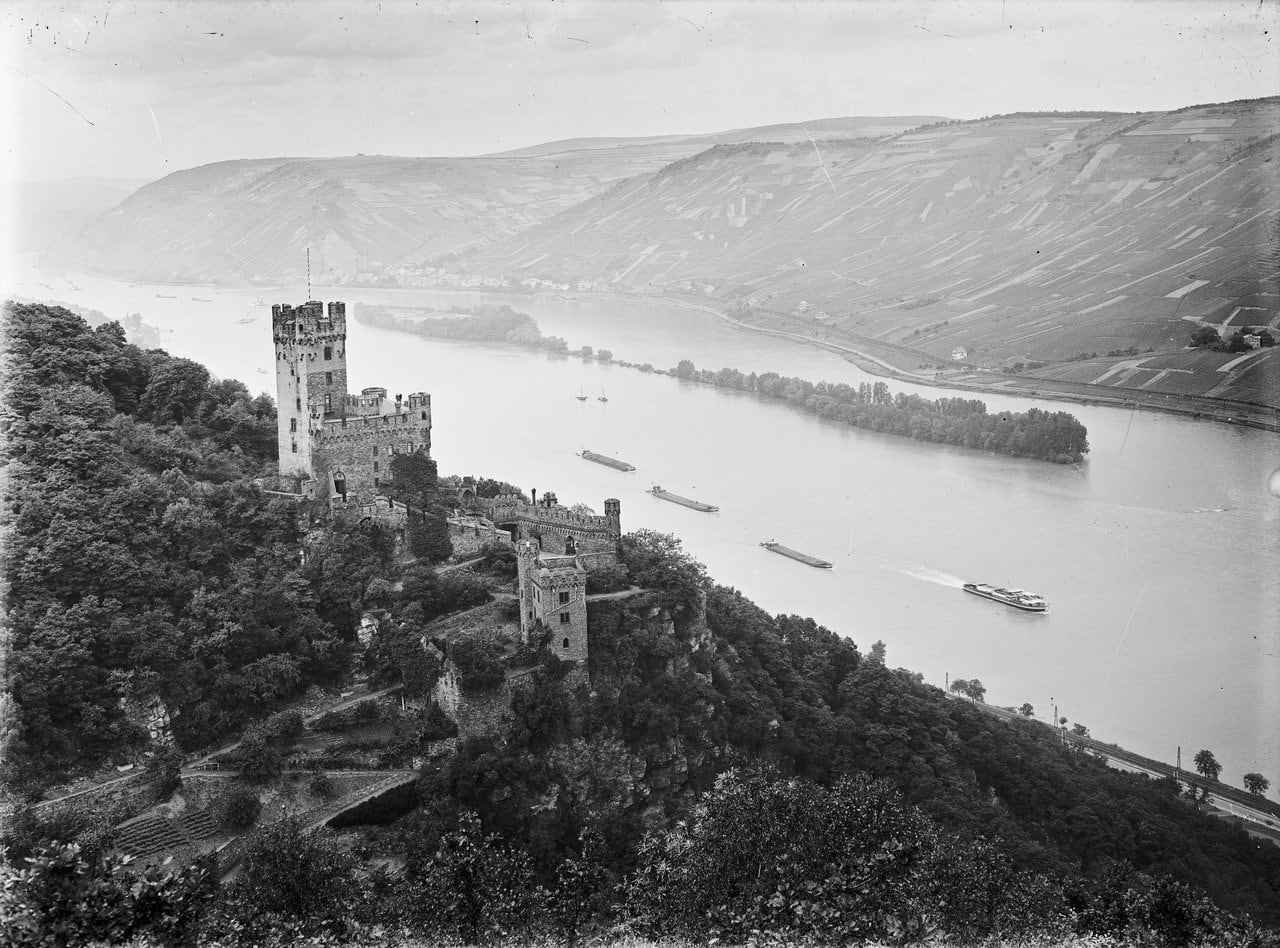
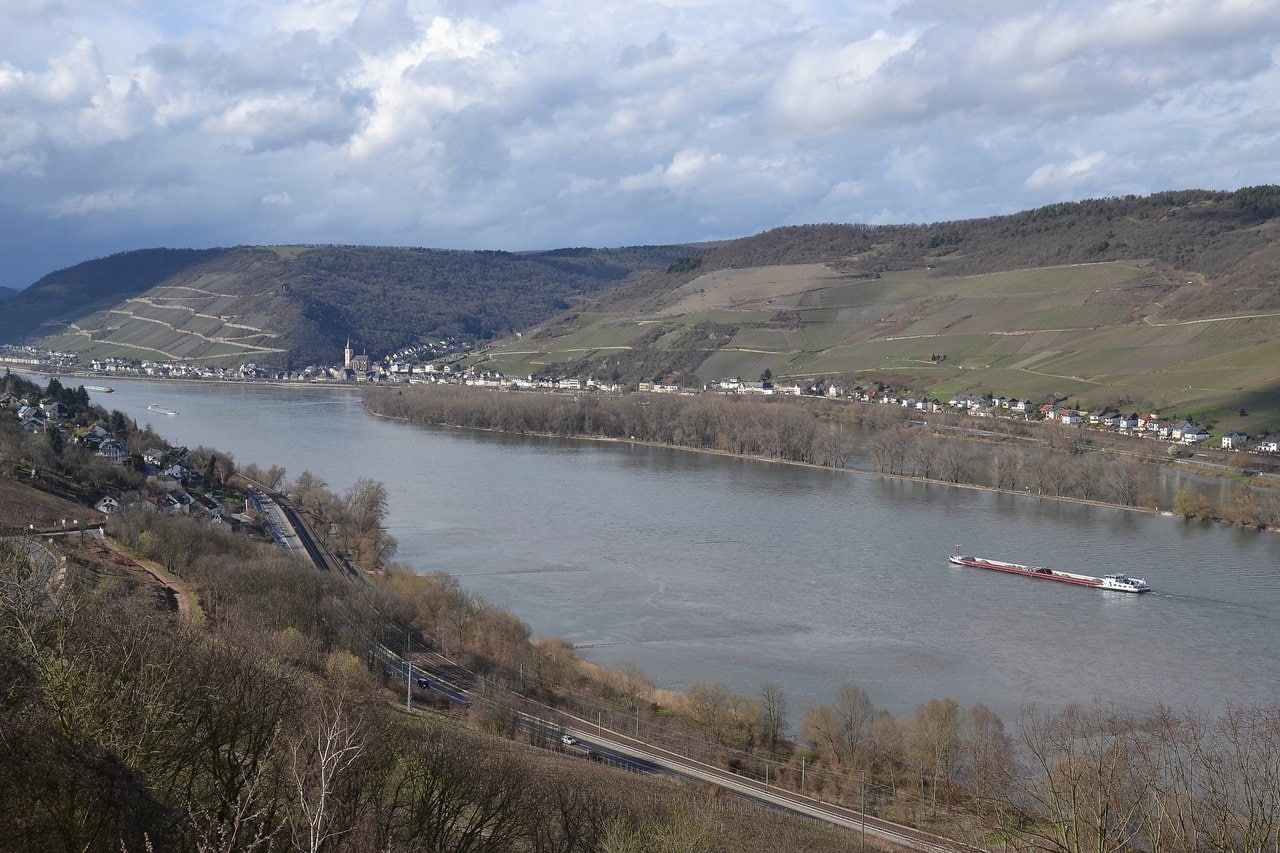
Sooneck sits on a steep spur on the left bank, just above the stretch of river where the Rhine narrows toward Bingen and the old reefs of the Binger Loch. It is the kind of position that medieval lords did not build for defense so much as for leverage: a castle here looks down on every boat that has to slow for the narrows. The name probably comes from the Soonwald, the forest at its back; the rose terraces and the storybook silhouette came much later.
The first firm documentary trace is 1271, when Kornelimünster Abbey near Aachen (which had held land in this stretch since Carolingian times) sold the place, then written Sanecke, to Archbishop Werner of Mainz. (A popular tradition pushes the castle back to the eleventh century, but there is no record to support it.) Long before that sale, the day-to-day castle was run by the lords of Hohenfels, who held it as the abbey’s Vögte, its protective bailiffs. The arrangement was identical to the one a short way upstream at Reichenstein, and it failed in exactly the same way. Men paid to guard the river instead taxed it for themselves. By the 1270s Philipp and then Dietrich von Hohenfels were running Sooneck as what the chronicles bluntly call a robber nest, levying their own tolls and plundering merchant traffic, and ignoring the fact that the property had legally passed to Mainz.
Rudolf von Habsburg breaks the nest
Towns tried first. The League of Rhenish Towns is recorded as having besieged Sooneck and Reichenstein together around 1254 to choke off the robber-knights’ tolls, although historians now treat the detail of those mid-century sieges as part-documented, part-presumed. What is not in doubt is that the merchant cities could harass the problem but not end it. Ending it took a king.
The Rhine’s robber barons were not a folklore exaggeration; they were a tax problem serious enough to draw the Crown. When Rudolf I of Habsburg took the German throne in 1273, restoring order on the imperial rivers was one of his signature projects, and the castles of the Bingen reach were among his targets. In 1282 his troops besieged and destroyed Sooneck. Rudolf then did something more pointed than simply slighting the walls: he forbade the castle to be rebuilt at all, and he made a point of restating the ban explicitly in 1290. Sooneck was not just defeated; it was legally abolished. Its siege of 1282 sits in our survey of how castle sieges ended, among those followed by a razing.
This is the hinge of the whole story, and it is why Sooneck and Reichenstein belong together: the same king broke both castles in the same campaign for the same reason. Sooneck’s legend industry later supplied a satisfying morality tale, the robber lord Siebold, who blinded a captured archer and was killed by the blind man’s last crossbow shot, but the legend is Wilhelm Ruland’s nineteenth-century romance, not the record. The record is duller and harder: a king deciding that a particular rock was not allowed to have a castle on it. No phantom appears in the morality tale either, and our reference on haunted castles records that the state authority’s own history page for Sooneck carries no Geist, no Spuk and no Gespenst.
Second life, second ruin
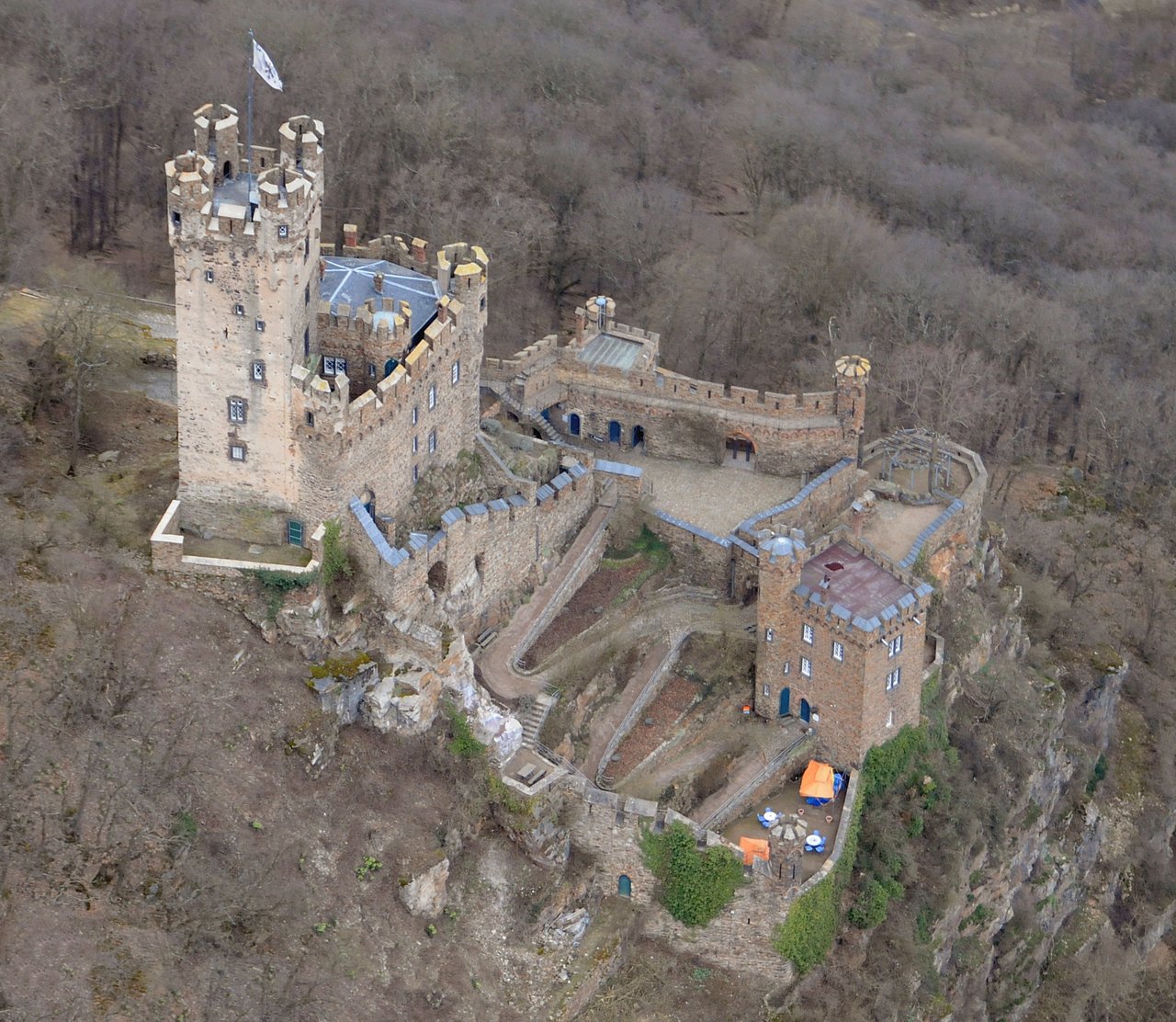
The ban held for two generations, then dissolved the way most medieval prohibitions did, through politics. Once the property and its bailiwick had passed firmly to the Electorate of Mainz, the imperial veto became inconvenient to the right people. In April 1346 Archbishop Heinrich III of Mainz enfeoffed his marshal, the knight Johann von Waldeck, with Sooneck; King Charles IV formally lifted Rudolf’s old ban in 1349, and Johann then began rebuilding the castle. The keep and the residential range beside it, with their corner turrets, the genuinely medieval bones still legible in the structure, belong to this mid-fourteenth-century campaign.
After Johann von Waldeck’s death the castle passed to several heirs at once and became a Ganerbenburg, a castle held jointly by branches of a kindred who were obliged, repeatedly and not always sincerely, to swear castle-peace with one another. Through marriage the Waldecks and the Breidbach zu Bürresheim family became entangled; when the Waldeck line died out in 1553 the Breidbachs held Sooneck alone, and when they faded the castle faded with them. It was already in poor repair when, in 1689, French troops of Louis XIV worked their way along the left bank during the War of the Palatine Succession and destroyed it, as they destroyed nearly every castle on that side of the river. In 1774 the Mainz cathedral chapter handed the ruin to villagers from Trechtingshausen, who did the most practical thing imaginable with a dead castle: they planted vineyards in it.
The ruin the Prussian princes wanted
By the early nineteenth century a derelict Rhine castle was no longer a liability but a desirable object, and the most enthusiastic collectors of them were the Hohenzollerns. In April 1834 the Prussian crown prince (the future King Friedrich Wilhelm IV) bought the ruin of Sooneck from the community that had inherited it. The castle’s operator and the Institut für Geschichtliche Landeskunde say his brothers Wilhelm, Carl and Albrecht bought it with him; the state heritage authority names the crown prince alone. Around 1840 the main building was still a well-preserved ruin, lacking only its roofs and floors. It was the third Rhine ruin the Prussian royal house took in hand, after Friedrich’s cousin’s Rheinstein and the crown prince’s own Stolzenfels.
The motive was neither strategic nor, for the most part, residential. The Prussian kings ruled the Rhineland after 1815 as a new and not entirely welcome power, and rebuilding its ruins as Romantic showpieces let them present themselves as the river’s natural heirs. Sooneck’s specific assignment was the most modest of the three. Stolzenfels became a palace; Sooneck was to be a hunting seat where the king could meet his brothers in the Soonwald, away from the court. The instruction to the builder is famous and revealing: “everything very simple, in the sense of a royal hunting lodge.”
Rebuilt as a chivalric daydream
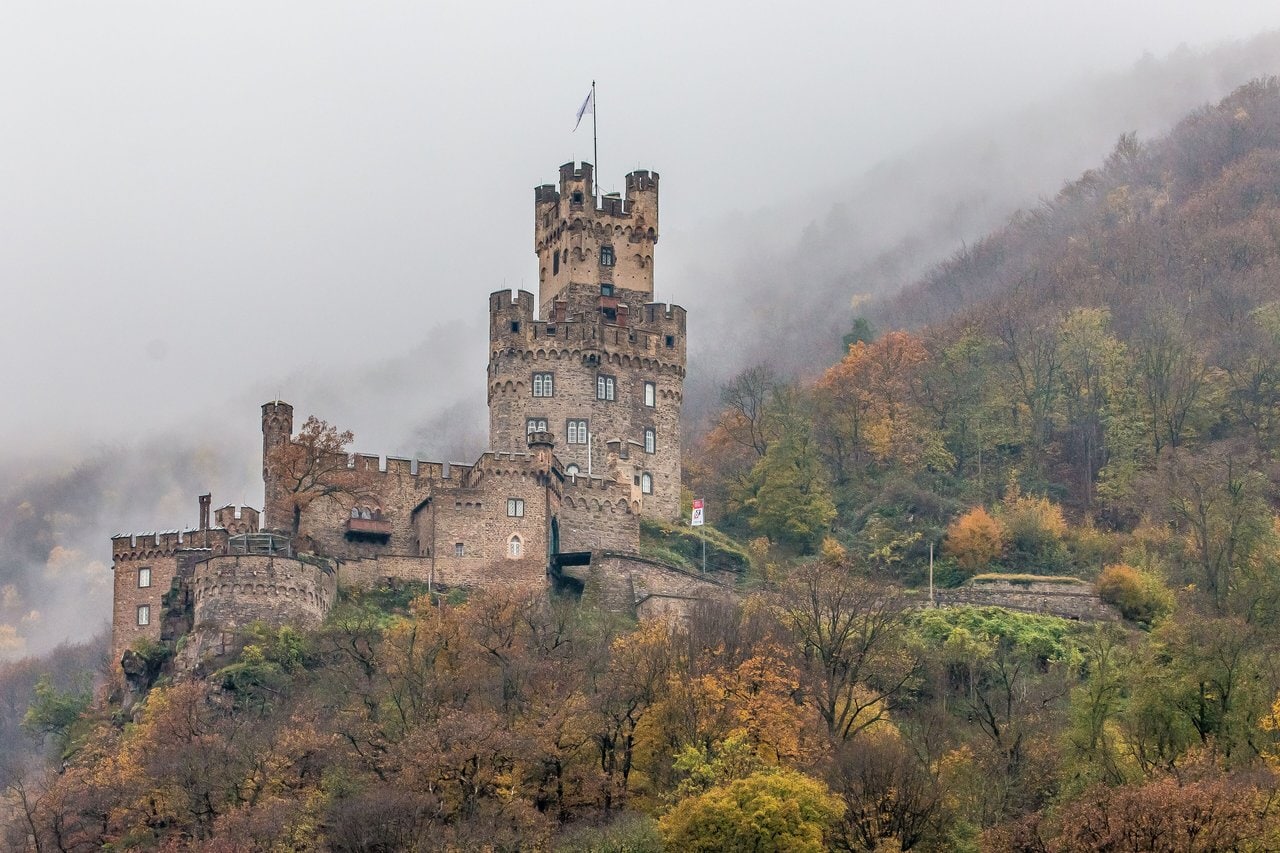
The reconstruction ran through the 1840s and was completed in 1861, to designs by the Prussian military architect Carl Schnitzler. Its guiding rule was that the Middle Ages should be the model for making the surviving structure habitable again: the fourteenth-century fabric was kept where it stood and dressed, not swept away, and Romantic-historicist additions filled the gaps. What is genuinely old is still legible if you know where to look: the square keep with its four polygonal corner turrets and the residential range beside it are the fourteenth-century core, and the round Talturm down the slope marks the medieval southwestern gate. Almost everything that reads as “castle” between them (the connecting ranges, the battlemented romance of the silhouette) is Schnitzler. The Prussian royal crest set over the north gate (not the medieval entrance, which lay on the other side) is the rebuild quietly signing its own work.
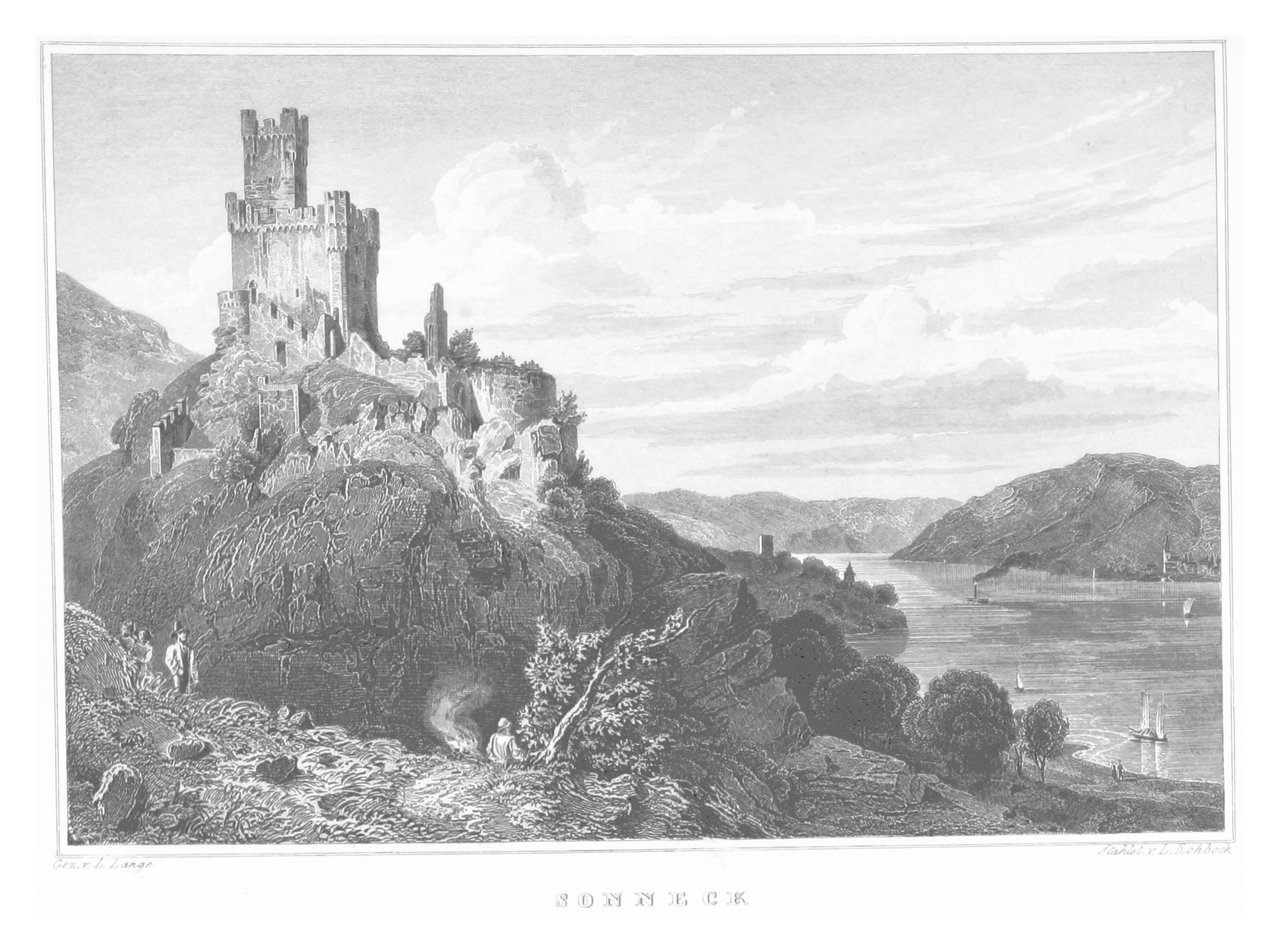
Then the daydream stalled. The revolutions of 1848, lasting disagreements within the royal family, and finally Friedrich Wilhelm IV’s illness and death meant the hunting lodge was almost never used as one; later Hohenzollerns rarely stayed. The accidental result is the castle’s real value to a visitor: a Rhine-Romantic interior that was furnished and then largely left alone, neo-Gothic and Biedermeier rooms, arms and armor, and a dense hang of paintings. (After looting in the Second World War the rooms were re-dressed in part with furniture brought from Stolzenfels, quietly reuniting two of the same royal project.) Since around 1990 the second upper floor has held the Koeth-Wanscheid Foundation’s collection of Rhine views, noble portraits, and eighteenth- and nineteenth-century furniture, and the old seventeenth-century bastion terraces below the walls are now the rose gardens that give Sooneck its picture-postcard reputation.
Visiting Sooneck Castle
Sooneck Castle is owned by the State of Rhineland-Palatinate, scientifically managed by the Generaldirektion Kulturelles Erbe (GDKE), and leased and run as a museum by the Hecher family, the same family that operates Burg Rheinstein a few kilometers upstream. Visitors explore the castle on their own with a tour leaflet, and the operator suggests allowing about 45 minutes; the castle keeps a museum season, not year-round hours. Large rucksacks and bags are not allowed inside and can be left at the ticket desk, pushchairs stay at the entrance, and dogs on a lead are welcome outdoors but not indoors. For third-party tours of the area, you can search GetYourGuide.
The castle closes for the winter, and its opening can be delayed at short notice, as it was in 2026 by urgent safety work on the masonry. Check the operator’s site, burg-sooneck.com, for the current opening dates before traveling. The figures below are the most recent published rates.
Admission
| Visiting (when open) | Detail |
|---|---|
| Season | Closed for the winter until March 19, 2027; the 2027 season opens on March 20. 2026: June 13 to November 1, after urgent safety work on the masonry delayed the opening; in 2024 and 2025 the season ran from late March to early November, with the castle closed in winter |
| Hours (in season) | Daily, 10:00-18:00 (last entry 17:00), as announced for the 2027 season. Self-guided with a tour leaflet; free handouts in English, French, Dutch and Italian at the ticket desk |
| Admission (most recent published) | Adults €6.50; children 5-14 €5.00; family (1 adult + 1 child) €10.00; family (2 adults + 2 children) €20.00; groups of 20 or more, adults €5.50 and children €4.00 (as published by the operator, November 2026) |
| Getting there | Niederheimbach station on the left-bank line, then a signposted footpath upstream of about 30 to 40 minutes (the state heritage authority gives about 30, the operator about 40); Bingen–Rüdesheim boat landing at Niederheimbach; by car via the B9 with a parking lot below the castle |
| Access note | As a historic site it is not wheelchair accessible |
Sooneck also has an unusual modern tenant. Since 2015 the GDKE, the regional development agency, and the Rhein-Zeitung have installed a “Burgenblogger” each year, a writer who lives at Sooneck and the Koblenz fortress of Ehrenbreitstein from summer into autumn and reports on life in the castle and the valley. It is the rare Rhine castle whose nineteenth-century rooms are also, periodically, somebody’s desk.
One practical point sets Sooneck apart from the right-bank castles in 2026. Niederheimbach lies on the left bank, served by the left-bank Rhine line; the long DB InfraGO corridor closure that disrupts the right-bank railway through the second half of 2026 (the one that complicates reaching Burg Katz and Burg Maus across the river) leaves Sooneck’s left-bank line running, though Deutsche Bahn says some left-bank services run slightly less often to make room for freight. Anyone staying overnight can compare hotels in and around Bingen am Rhein.
Some links on this page are affiliate links, which means StoneKeep Atlas may earn a small commission, at no extra cost to you, if you book through them.
Common Questions
Who owns Sooneck Castle?
Since 1918 the castle has been state property, according to the state heritage authority, and today it belongs to the State of Rhineland-Palatinate. According to the operator, all building work is overseen by the Generaldirektion Kulturelles Erbe (GDKE), while the GDKE’s Direktion Burgen Schlösser Altertümer has scholarly charge of the historic rooms and their furnishings. The Hecher family holds the castle on a lease and runs its museum, castle shop and refreshments.
Did the Prussian royal family ever live at Sooneck Castle?
Rarely, according to the state heritage authority. It records that Friedrich Wilhelm IV, king of Prussia since June 1840, resolved in 1842, on a Rhine journey with his brothers Wilhelm, Carl and Albrecht, to turn the still well-preserved ruin into a hunting lodge for private stays. The building took so long, the authority’s 2025 visitor leaflet adds, that only his brother Carl was able to use the finished rooms.
Where do you park for Sooneck Castle?
Below the castle. Its address, which most navigation systems know, is Soonecker Straße 1, 55413 Niederheimbach, and the operator’s directions take drivers through a newer housing area and the vineyards to the parking lot. From there a paved footpath 300 meters long, with only a gentle slope, leads to the castle; the state heritage authority puts the walk at about ten minutes. Large backpacks and bags are not allowed inside the castle and can be left at the ticket desk.
Can you hike or cycle to Sooneck Castle?
Yes. According to the state heritage authority, the castle lies on the RheinBurgenWeg hiking trail and on the Rheinradweg, the Rhine cycle route. Walkers arriving at Niederheimbach by train or by boat keep upriver and follow the signposts. Hikers who want only a short stop are offered seats in front of the castle gate, and food and drink brought along can be eaten in the picnic area there; eating and drinking are not permitted in the viewing area itself.
Is Sooneck Castle good for children?
Yes, with a game of their own. According to the operator, every child’s admission includes a treasure hunt in which young visitors help the castle lady Anna Soon and the knight Sir Eck find eight golden keys, learning the castle’s history on the way, with a wooden medallion as the reward. Separately, the state heritage authority’s Geister-Pass, a ghost-themed stamp game for castles and palaces, sends families looking for the room where Fritzi confided her secret to the tight-lipped Willi. Strollers can be left at the castle entrance.
Can you take photos at Sooneck Castle?
Yes, for private purposes. Under the operator’s house rules, photography and filming are allowed for private use only, and any other use needs the express permission of the castle administration. Drones are strictly banned over the entire castle grounds, for the safety of visitors and to protect wild birds. The operator’s own tip for a seat in its garden is the rose Rondell, which has a view as far as Bacharach.
Beyond Sooneck
Sooneck is best understood next to its neighbors. A short way upstream toward Bingen stands Reichenstein Castle, the other abbey-bailiff castle that turned robber and was broken in the same 1282 campaign, Sooneck’s twin in crime and punishment. Beside it Rheinstein Castle shows the Rhine-Romantic rebuild in its purest private form, while Stolzenfels Castle is the grander Prussian project against which Sooneck’s deliberate plainness is meant to be read. Further down the gorge, Pfalzgrafenstein and Gutenfels preserve the working machinery of the Rhine toll the robber knights had only ever parodied. For the whole sweep (how a single river accumulated so many castles and so many afterlives) see the regional overview of the castles of the Rhine Gorge.
Sooneck was the plainest of the Prussian royal house’s Rhine rebuildings; the full program (Rheinstein, Stolzenfels, Sooneck and Hohenzollern) is set out in the Prussian Royal Castles hub.
Conclusion
Sooneck Castle has been destroyed twice and rebuilt twice. King Rudolf I’s troops besieged and destroyed the robber knights’ castle in 1282; it was rebuilt under Mainz in the mid-fourteenth century, after Charles IV lifted the ban on rebuilding in 1349; and French troops of Louis XIV destroyed it again in 1689. The Prussian royal house bought the ruin in 1834, and Carl Schnitzler’s reconstruction, completed in 1861, made it the simple royal hunting lodge Friedrich Wilhelm IV had asked for, a lodge that was almost never used as one. The keep and the residential range retain their fourteenth-century core, and the rose gardens stand on the old seventeenth-century bastion terraces. For Castles of the Middle Rhine, a downriver guide to twelve castles on the Mittelrhein, see the regional roundup.
Principal Sources
- Burg Sooneck – Sagenhaft! (Familie Hecher). “Burg Sooneck.” burg-sooneck.com.
- Generaldirektion Kulturelles Erbe Rheinland-Pfalz. Denkmalverzeichnis Mainz-Bingen. Edition of May 14, 2025, p. 69, Niederheimbach: “Burg Sooneck südlich des Ortes an der Gemarkungsrenze mit Trechtingshausen (oberhalb der B 9)” (Denkmalzone). gdke.rlp.de.
- Generaldirektion Kulturelles Erbe Rheinland-Pfalz, Direktion Burgen Schlösser Altertümer. Burg Sooneck: malerisch, träumerisch, verführerisch. Visitor leaflet, March 2025. tor-zum-welterbe.de.
- Generaldirektion Kulturelles Erbe Rheinland-Pfalz, Direktion Burgen Schlösser Altertümer. “Burg Sooneck.” gdke.rlp.de.
- Institut für Geschichtliche Landeskunde Rheinland-Pfalz. “Burg Sooneck.” regionalgeschichte.net.
- Kulturerbe Mittelrhein. “Sooneck.” tor-zum-welterbe.de.
- Kulturerbe Mittelrhein. “Sooneck: Eintrittspreise und Anreise.” tor-zum-welterbe.de.
- Kulturerbe Mittelrhein. “Sooneck: Geschichte.” tor-zum-welterbe.de.
- Kulturerbe Mittelrhein. “Sooneck: Informationen.” tor-zum-welterbe.de.
- Ranke, Leopold von. “Friedrich Wilhelm IV.” Allgemeine Deutsche Biographie 7 (1878). deutsche-biographie.de.
- Rathke, Ursula. Burg Sooneck. Guidebook 8. Mainz: Verwaltung der staatlichen Schlösser Rheinland-Pfalz, 1995.
- Staatliche Burgen, Schlösser und Altertümer in Rheinland-Pfalz. Burgen, Schlösser, Altertümer Rheinland-Pfalz. Regensburg: Schnell & Steiner, 2003.
- Thon, Alexander. “Städte gegen Burgen: Tatsächliche und mutmaßliche Belagerungen von Burgen am Mittelrhein durch den Rheinischen Bund 1254-1257.” Jahrbuch für westdeutsche Landesgeschichte 34 (2008): 17-43.
- UNESCO World Heritage Centre. “Upper Middle Rhine Valley.” No. 1066, inscribed 2002. whc.unesco.org.
Image credits. Featured image, Sooneck Castle on its rocky spur: Phantom3Pix, CC BY-SA 4.0, via Wikimedia Commons. Sooneck above the Rhine in the early 20th century: Joseph Knippenberg / Rheinisches Bildarchiv Köln (rba 225306), CC BY-SA 3.0. The castle plan from above: Pudelek (Marcin Szala), CC BY-SA 3.0, via Wikimedia Commons. Late-autumn mist over Sooneck: Gary Bembridge, CC BY 2.0, via Flickr. Poppel’s 1852 steel engraving: Johann Poppel, public domain. The view from the rose Rondell: Derzno, CC BY-SA 4.0, via Wikimedia Commons. Freely licensed images are resized to fit; any other change, such as a crop, is named in the credit.