
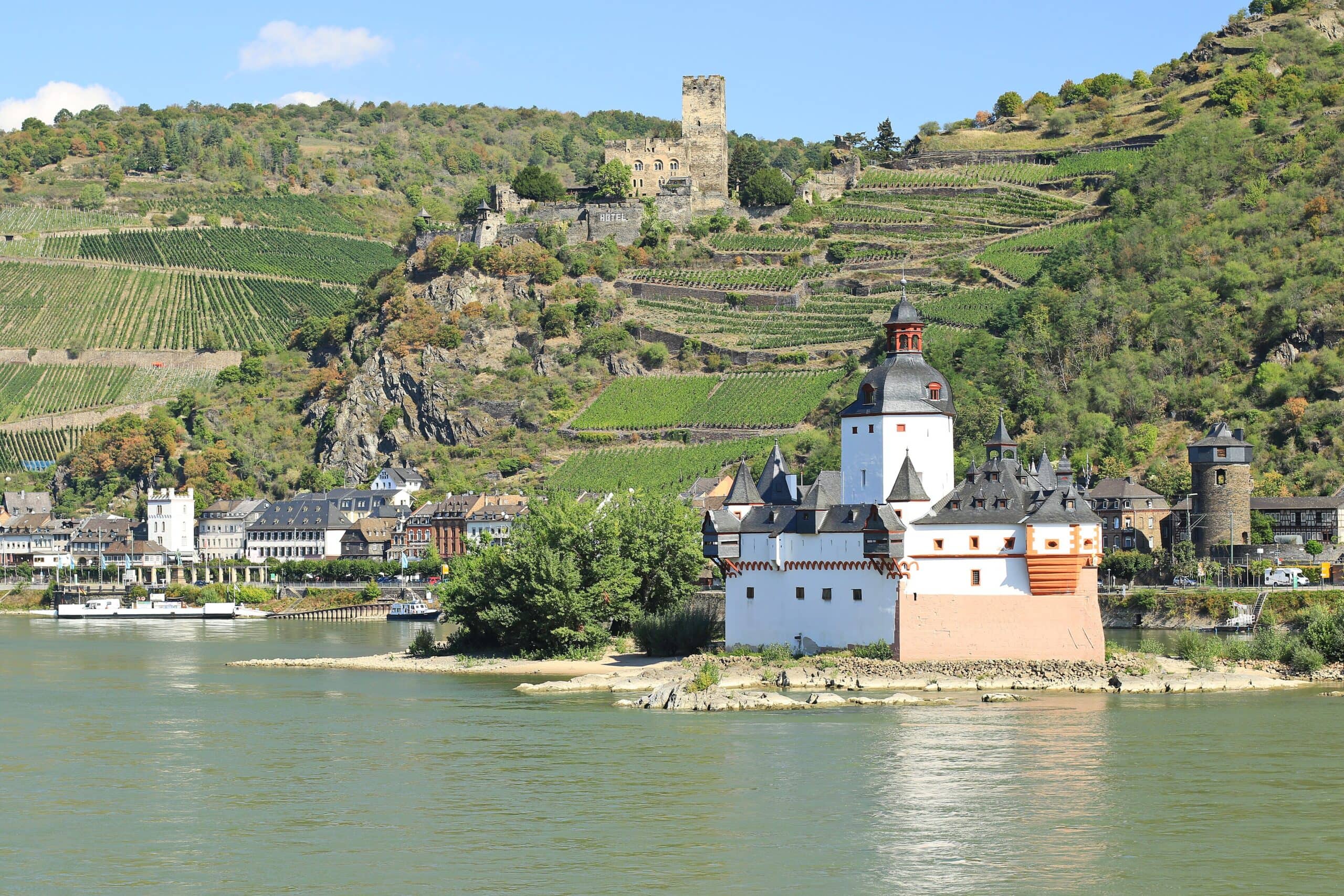
Pfalzgrafenstein Castle
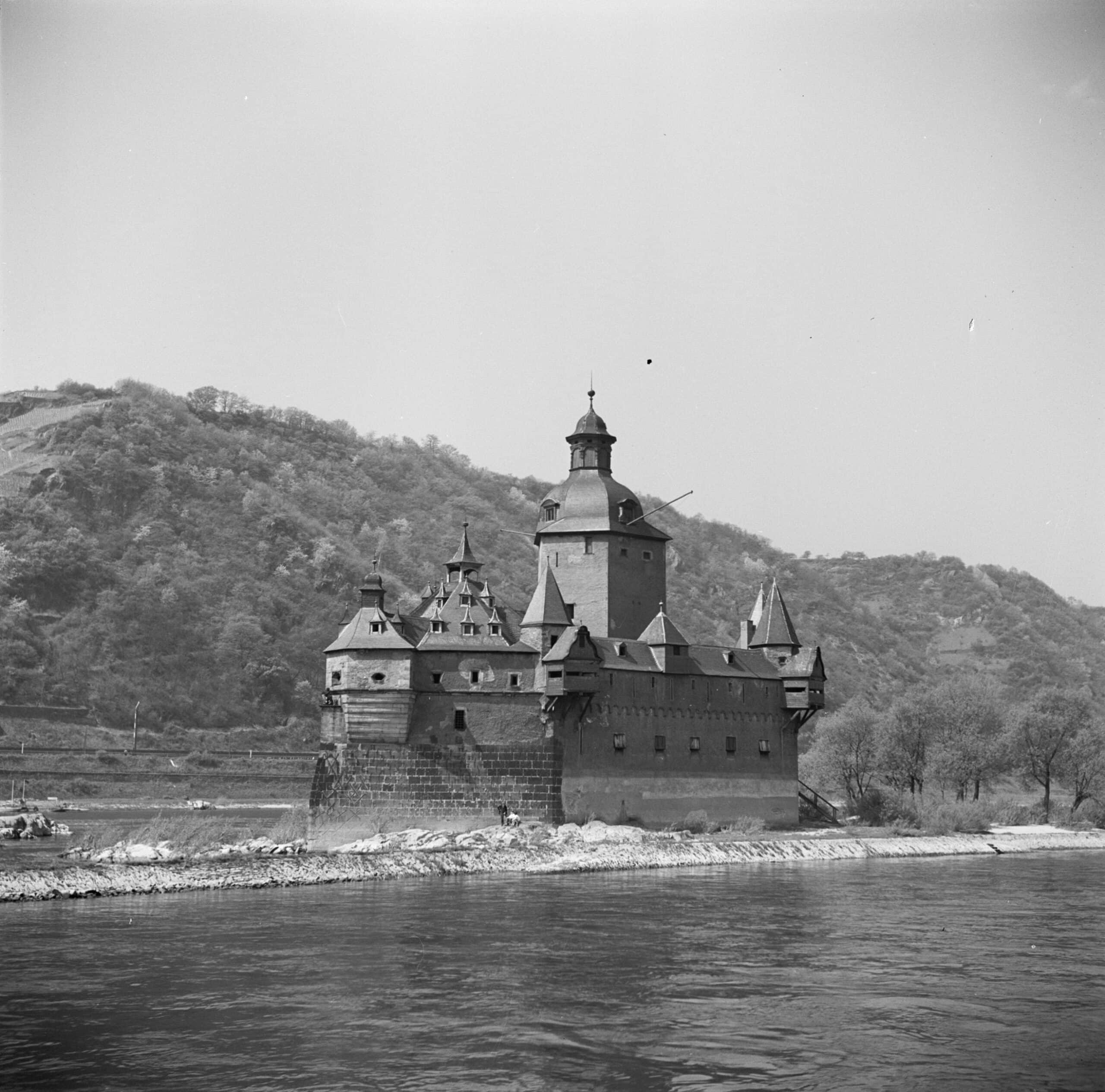
Pfalzgrafenstein Castle is the one castle on the Upper Middle Rhine that never had to surrender, because it was never built to be lived in. It stands on the rock island of Falkenau in the middle of the river at Kaub (110 meters from the right bank, 160 from the left), a five-sided tower wrapped in a ship-shaped wall whose pointed prow still faces upstream into the ice. The French writer Victor Hugo saw a vessel eternally at anchor; the Europäisches Burgeninstitut sees the same thing for a structural reason, describing the whole island as working like a well-fortified ship in the water.
It was a Zollburg (a toll castle), and that single fact explains everything about it: why a pope wanted it pulled down, why it was never a residence, and why, with the Marksburg and the Alte Burg at Boppard, it is one of the few Rhine castles that war, ice, and flood never managed to destroy. Read against the robber-knight castles upstream that the crown leveled, Pfalzgrafenstein is the late-medieval Rhine toll system at its most successful: a contested levy backed by enough territorial power to outlast every authority that questioned it.
Quick Facts
| Country | Germany |
| Region / State | Rhineland-Palatinate (Rheinland-Pfalz), western Germany — Upper Middle Rhine Valley |
| Nearest Town | Kaub (passenger ferry only; rail on the Koblenz–Wiesbaden line) |
| Construction Period | Pentagonal keep 1326–1327; ring wall 1338–1342; ice-breaker bastion 1606–1607; Baroque tower cap 18th century (sources differ on the year) |
| Founder | Ludwig IV of Bavaria (“Ludwig the Bavarian”), Pfalzgraf bei Rhein and later Holy Roman Emperor |
| Architectural Style | Medieval island toll fortress with 17th-century artillery works and an 18th-century Baroque tower cap |
| Building Type | Burg — an island Zollburg (toll castle); never a residence |
| Current Condition | Intact — complete and largely unaltered; never destroyed; restored 1970–1974 and 2005 |
| Open to Visitors | Yes — seasonally, by passenger ferry from Kaub (subject to river levels) |
| UNESCO Status | Within the Upper Middle Rhine Valley World Heritage Site (inscribed 2002) |
| Heritage designation | Kulturdenkmal in the Rhineland-Palatinate state monument list: “Pfalzgrafenstein auf der Felseninsel Falkenau im Rhein” (GDKE, Denkmalverzeichnis Rhein-Lahn-Kreis, Kaub; entries carry no number) |
| Official website | tor-zum-welterbe.de |
A toll the pope tried to abolish (1277–1327)
The story begins not with a castle but with a purchase. In 1277 the Rhenish Pfalzgraf Ludwig II of the House of Wittelsbach bought the town of Kaub, the hill castle of Gutenfels above it, and, most valuably, the right to levy a Rhine toll, from Philipp von Falkenstein, an imperial chamberlain of the Bolanden-Falkenstein line; further instruments completed the transfer by 1291. His descendant Ludwig IV, “the Bavarian,” reactivated the toll around 1320 and kept its revenue for himself.
In 1324 Pope John XXII at Avignon excommunicated Ludwig: over his contested election as German king against Frederick the Fair, not over the toll. But the toll provoked an ecclesiastical reckoning of its own. In 1326–1327, in what the regional record calls a sudden move, Ludwig had a five-sided tower raised on the Falkenau rock to enforce the levy, and in 1327 the pope wrote to Count Robert von Virneburg and urged the archbishops of Mainz, Trier, and Cologne to remove the toll and destroy the “turris fortissima.” They never did. The tower not only survived; it was enlarged.
The stone ship takes shape (1338–1607)
The lone tower became a fortress in stages, each one a response to the river as much as to any enemy. Between 1338 and 1342 a ring wall went up around it: roughly 12 meters high, up to 2.6 meters thick, with a covered wall-walk, enclosing a long hexagon about 51 by 21 meters that takes up almost the whole island. Its southern point, like the keep’s, was set against the current, so that drifting winter ice struck a wedge rather than a flat face. A perpetual Burgfrieden of 1339 gives the first written naming of “Burg Pfalzgrafenstein” and passed it to the Heidelberg branch of the Wittelsbach house.
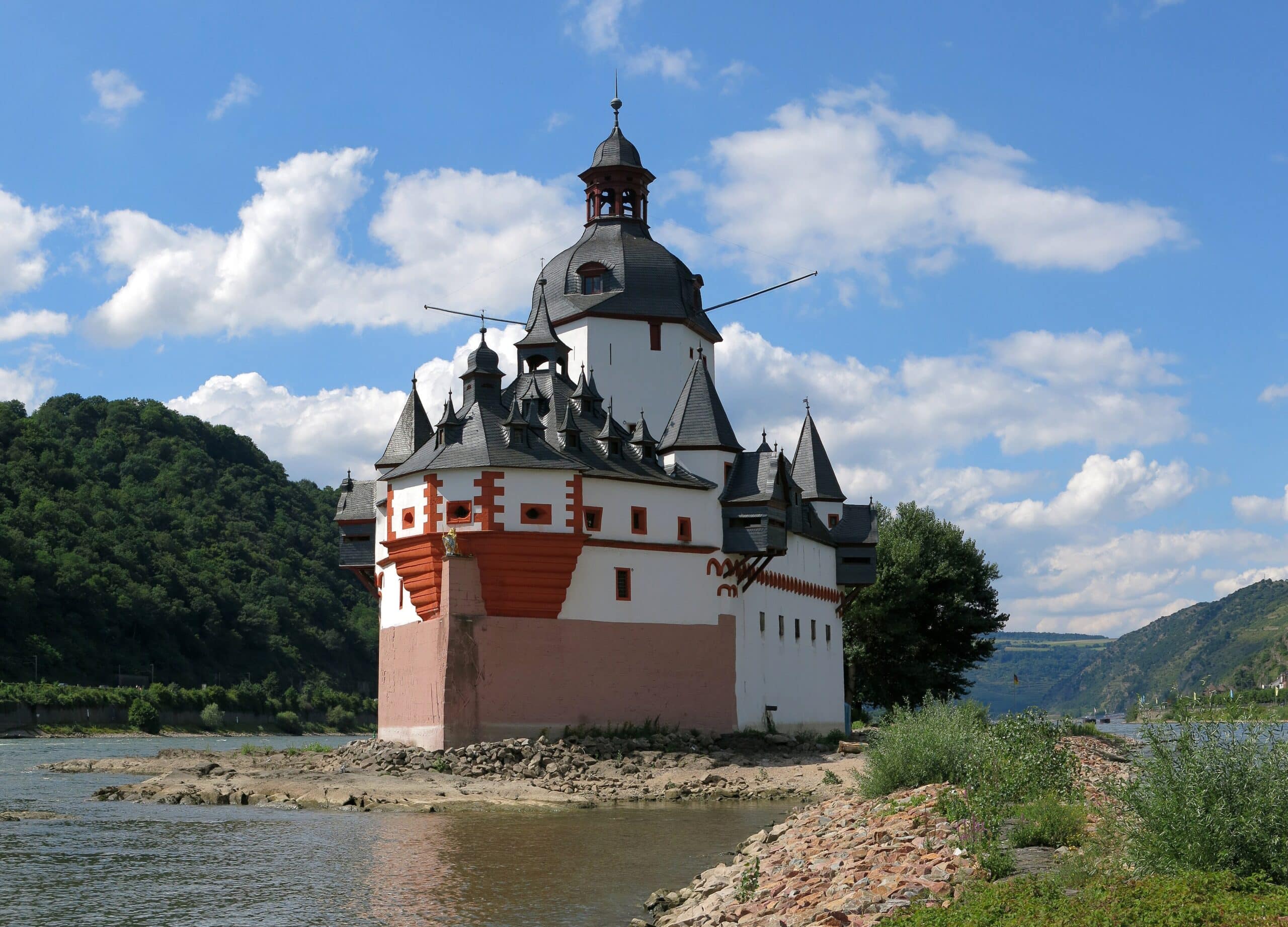
The decisive change came in 1606–1607. Elector Frederick IV of the Palatinate, whose family by then held the castle, reinforced the ice-battered upstream point with massive ashlar masonry, clamped it with iron, and set a gun platform on top. From that moment the silhouette read as a ship sailing against the stream: the image visitors photograph today. The ring wall received loopholes for hand firearms and an inner gallery on arcades; Pfalzgrafenstein was among the first Middle Rhine castles rebuilt for gunpowder rather than crossbows. In 1658 projecting slate-clad lookout oriels were added to flank the walls, and they survive here as an unusually complete example of the type.
Sieges that failed (1504 to the 18th century)
Although it was built only to make ships stop and pay, Pfalzgrafenstein was drawn into several wars. In 1504, during the War of the Succession of Landshut, the castle held out with Kaub and Gutenfels through a 39-day siege by Landgrave William II of Hesse and emerged unscathed; the Hessians withdrew after heavy losses. In 1620, during the Thirty Years’ War, Spanish forces occupied it for roughly a decade, but it was taken without a fight, the garrison allowed to leave freely after a brief exchange of fire at Kaub on the bank.
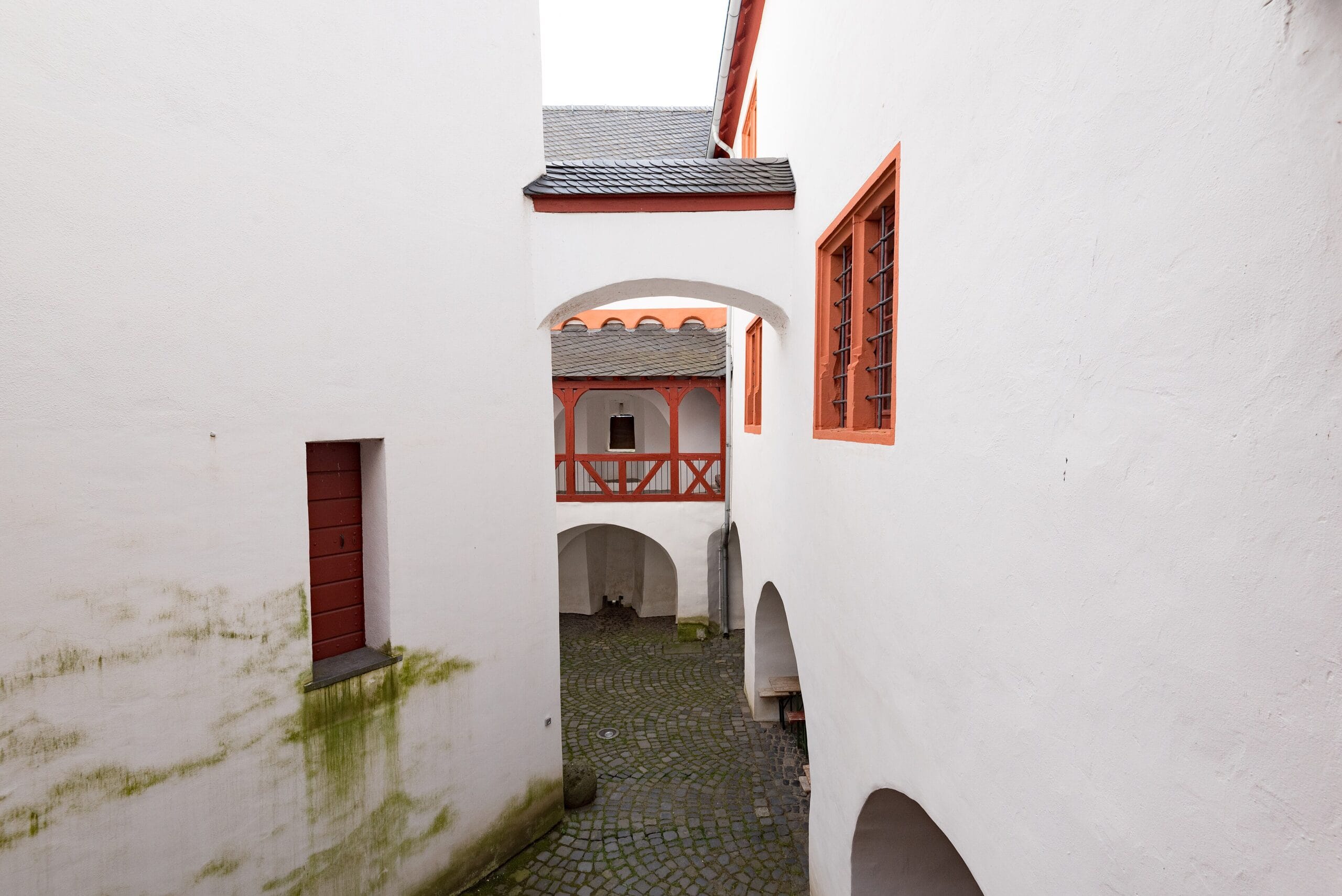
The castle’s defenses were never tested by storm because its position did the work: rocky reefs and the rapid known since the 15th century as the Wildes Gefähr made the wider left channel impassable, funneling all river traffic through the narrow gap between the island and the fortified town. Siege engines could not get at it. The last additions were emphatic rather than defensive: in the eighteenth century the keep received its octagonal Baroque cap with an open lantern, which the sources date differently: the castle’s operator to the years of the War of the Spanish Succession (1701-1713), the European Castle Institute to 1714, KuLaDig to the Baroque roofs set on after a fire of 1734, and the Institute of Historical Regional Studies in Mainz to after the middle of the century, attributing it to the Palatine court architect Franz Wilhelm Rabaliatti. It is this silhouette that completes the “stone ship” today.
Blücher crosses the Rhine (1803–1867)
In 1803, in the Napoleonic reshuffling of the German map, the castle passed to the Duchy of Nassau. A decade later it had its single most consequential moment: not as a fortress, but as a foothold. On the night of the New Year 1813/1814, during the Wars of Liberation, the Prussian field marshal Gebhard Leberecht von Blücher crossed the Rhine at Kaub with the Army of Silesia. Russian engineers anchored a pontoon bridge in two segments on the island itself (seventy-one canvas pontoons in all), while Kaub river pilots ferried the vanguard across in skiffs. Some fifty to sixty thousand troops, around fifteen thousand horses, and 182 guns crossed over several days in pursuit of Napoleon after Leipzig. Blücher’s headquarters was a Kaub tavern that has housed the Blüchermuseum since 1913.
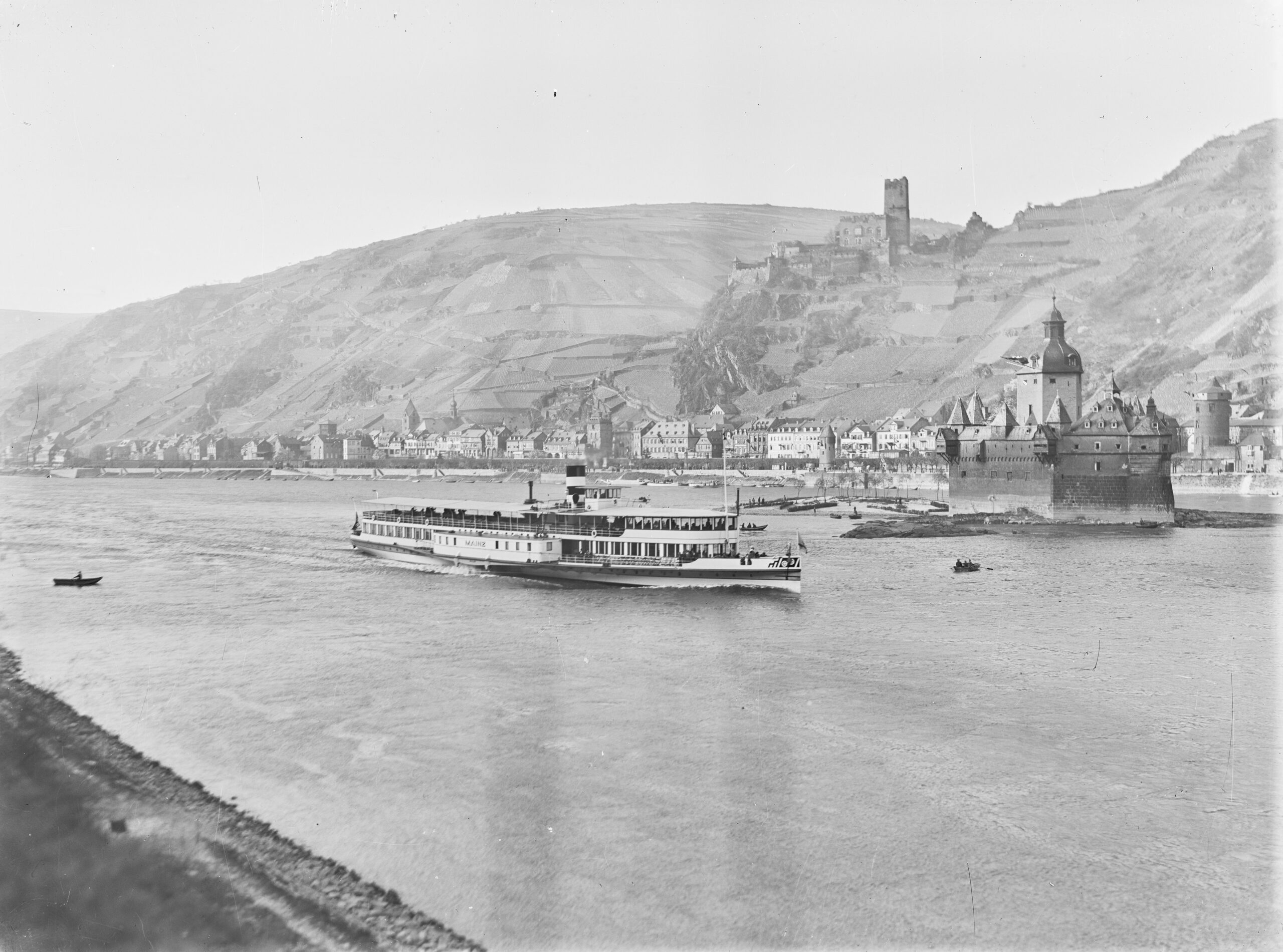
The toll itself outlived the empire that had once disputed it. Only in 1866, after the Austro-Prussian War made both banks Prussian, did control pass to Prussia; the last toll officials left the island in 1867, ending more than five centuries of levy. Pfalzgrafenstein then served quietly as a navigation signal station for Rhine shipping into the 1960s before passing to the state of Rhineland-Palatinate as a monument.
Why it survived: power, not permission
Pfalzgrafenstein is most revealing when set beside the castles it does not resemble. A short way upstream, Reichenstein and Sooneck were besieged and destroyed by King Rudolf I of Habsburg in 1282 and forbidden to rebuild, punished as the seats of Raubritter, knights running tolls no authority had granted them. Pfalzgrafenstein levied a toll a pope and three archbishops actively wanted destroyed, and it was never touched. The difference was not a cleaner piece of paper. In 1326 Ludwig’s own title was contested (a doubly elected, excommunicated king), and in strict law the new toll was no better sanctioned than theirs.
What Pfalzgrafenstein had instead was power. The Wittelsbach Pfalzgrafen had spent fifty years assembling a closed grip on this stretch of river: the toll rights bought from the Falkensteins, the hill castle of Gutenfels, the walled town of Kaub, and the Pfalz itself, together a barrier no vessel could run without paying. Ludwig acted at once as the Pfalzgraf who owned the toll and as the king who could colorably license it, and in 1339 he passed the castle to the Heidelberg branch of his house, the line that in 1356 received the exclusive Palatine electorship. The Golden Bull of that year confirmed the electors’ right to their Rhine tolls, and what force had held since 1326 finally became settled law. Our article on the Rhine as contested territory traces the same development: a toll first held by force became lawful because a territorial prince stood behind it long enough for the Golden Bull to confirm it. Pfalzgrafenstein is the clearest surviving case of that prince winning.
Visiting Pfalzgrafenstein Castle
Pfalzgrafenstein can only be reached by the small passenger ferry from Kaub, and only when the Rhine cooperates; the ferry cannot dock when the river runs high, roughly above four meters on the Kaub gauge. Kaub has a station on the Koblenz–Wiesbaden right-bank line, a few minutes’ walk from the wharf, but that line is closed for a full reconstruction in the second half of 2026, with replacement buses only (the dates are in the admission table below), so check Deutsche Bahn before relying on the train. There are no toilets and no services on the island by design; public, barrier-free toilets are at the Pegelhaus car park in Kaub. As a historic island site it is, regrettably, not wheelchair accessible. Allow about an hour for the castle and ferry together, and pair it with the Blüchermuseum in Kaub. For third-party tours of the area, you can search GetYourGuide.
The castle opens from February to November: at weekends and on public holidays at either end of that season, and from Thursday to Sunday and on public holidays in the main months between. It is closed in December and January, and the river can close it on any day. Admission includes the passenger ferry; prices, hours and the castle’s current status are in the table below. Anyone staying overnight can compare hotels in and around Kaub.
Some links on this page are affiliate links, which means StoneKeep Atlas may earn a small commission, at no extra cost to you, if you book through them.
Admission
| Ticket | Price (2026) |
|---|---|
| Adult | €8.00 |
| Concession | €7.00 |
| Child / youth (6–17) | €4.00 |
| Child under 6 | Free |
| Family ticket 1 (1 adult, up to 4 children) | €8.00 |
| Family ticket 2 (2 adults, up to 4 children) | €16.00 |
| Group, per adult (10+) | €7.00 |
| Group, per child or young person (6-17), school groups included | €4.00 |
| Audio guide card, rented at the castle ticket desk | €1.00 |
| Hours, February 1 to March 14 | Saturdays, Sundays and public holidays, 10:00-16:00; last ferry to the island and last admission 15:00 |
| Hours, March 15 to October 31 | Thursday to Sunday and public holidays, 10:00-17:00; last ferry and last admission 16:00 |
| Hours, November 1 to 30 | Saturdays, Sundays and public holidays, 10:00-16:00; last ferry and last admission 15:00 |
| Closed | December and January |
| Status on November 5, 2026 | Closed until further notice because of low water (since at least early October 2026) |
| Passenger ferry from Kaub | Every half hour from 10:00 to 16:00, last departure 15:00 in November, February and March; returns on demand every half hour |
| Passenger ferry phone | +49 173 5261189, during castle opening hours |
| Rail, right-bank line through Kaub | Closed for reconstruction July 10 to December 12, 2026 (Deutsche Bahn); replacement buses only |
Common Questions
Can you go inside Pfalzgrafenstein Castle?
Yes, and you can explore it on your own, with an orientation map in English and French or an audio guide rented at the castle ticket desk. Inside the keep, the KuLaDig heritage database counts six floors still linked by a spiral stair, and the operator’s Geister-Pass (ghost pass) quest for families sends children up the 36-meter main tower. Dogs, other than guide and assistance dogs, may not come inside.
How do you get to Pfalzgrafenstein Castle?
Only by the passenger ferry from Kaub, which runs while the castle is open; the last boat out to the island is also the last admission. It leaves from beside the Kaub car-ferry landing, by the gauge tower on the right-bank B42, about five minutes’ walk from Kaub station, and drivers park between the B42 and the railway embankment. From the left bank, the Kaub car ferry, which carries foot passengers as well as vehicles, crosses from the B9 between Bacharach and Oberwesel.
Is Pfalzgrafenstein Castle closed when the Rhine is high or low?
Yes, at both extremes. The operator’s rule is that the castle stays closed when the Rhine runs very high or very low: at those levels the passenger ferry from Kaub, the only way out to the island, stops running. Low water can therefore close it just as high water can. Drivers coming from the left bank face a second limit, since the Kaub car ferry also suspends service at very low water and has a high-water limit of its own.
Why is Pfalzgrafenstein called a toll castle?
Because it was built to guard the Rhine toll at Kaub. Its operator calls it a guard station for the lucrative toll office in the town and says its ring wall carried corner towers for spotting the ships that owed duty, making it the link between the fortified towns of Kaub and Bacharach: together, the Palatinate’s strongest military and territorial power base on the Middle Rhine. In Kaub, the Blüchermuseum records, the Zur Stadt Mannheim inn lodged mostly skippers waiting for leave to pass the toll station.
Who owns Pfalzgrafenstein Castle?
The state of Rhineland-Palatinate. Pfalzgrafenstein is one of the state-owned monuments in the care of its heritage agency, the Generaldirektion Kulturelles Erbe (GDKE), through the agency’s directorate for castles, palaces and antiquities, Burgen, Schlösser, Altertümer. Besides day visits, the castle offers group tours and a costumed living-history tour, Auf der Zollburg im Rhein, of about 90 minutes, both booked ahead.
What is Kaub known for?
Besides Pfalzgrafenstein and Gutenfels, for the Rhine crossing of Blücher’s Army of Silesia in the first week of 1814. Blücher reached Kaub on New Year’s Eve 1813, at about four in the afternoon, and made his headquarters in the Zur Stadt Mannheim inn, a Baroque house that Johann Daniel Kilp had the Palatine court architect Franz Wilhelm Rabaliatti build in 1780. Since January 17, 1913, its front house has held the Blüchermuseum, run by the town, and much of the furnishing survives, from canvas wall hangings to tiled stoves.
What does a ticket to Pfalzgrafenstein Castle include?
Admission covers the passenger ferry crossing to the island. An audio guide costs extra at the castle ticket desk, and group tours and the costumed tour are priced on their own. The Kaub car ferry from the left bank is not part of the ticket: it has its own operator, the Fährgemeinschaft Kaub, and its own fares. There is no food or drink on the island, though the operator points to places to eat nearby.
Beyond Pfalzgrafenstein
Pfalzgrafenstein is one stop on the densest castle stretch in Europe, and it reads best in company. For the full corridor, see the guide to the castles of the Rhine Gorge. The most instructive neighbors are the ones that frame its argument: the Marksburg at Braubach, the other never-taken Rhine castle and a legitimate comital toll; Reichenstein and Sooneck, the slighted robber-knight seats that show what happened when no prince stood behind the levy; and Rheinstein and Stolzenfels, the archbishops’ Rhine strongholds: the church’s answer to exactly the toll Pfalzgrafenstein collected. Downstream, the vast bastioned ruin of Rheinfels shows the opposite fate: a Rhine fortress that power could not save.
Conclusion
Pfalzgrafenstein is, in the end, a building that was never meant to be loved and has become one of the most photographed objects on the river anyway. It was a tollbooth with iron-clamped walls, built by an excommunicated king in defiance of pope and archbishops and never lived in, and it survived seven centuries of war, ice, and politics for the same reason it was built: a prince with the power to enforce a contested toll stood behind it long enough for the law to catch up. The pope wanted it gone in 1327; it is still there, still shaped like a ship, still pointing its prow at a current that no longer threatens it. Few monuments on the Rhine state their own meaning so plainly.
The little toll castle’s survival through six centuries features in our history of the sieges that defined Germany.
Principal Sources
- Backes, Magnus. Burg Pfalzgrafenstein und der Rheinzoll. Führungshefte der Edition Burgen, Schlösser, Altertümer Rheinland-Pfalz 11. Regensburg: Schnell & Steiner, 2003.
- Blüchermuseum Kaub. “Geschichte.” bluechermuseum-kaub.de.
- Custodis, Paul-Georg, and Ulrich Krings, revised by Christoph Boddenberg and Karl Peter Wiemer. “Burg Pfalzgrafenstein bei Kaub.” KuLaDig, Kultur.Landschaft.Digital. Rheinischer Verein für Denkmalpflege und Landschaftsschutz, 2014 and 2015. kuladig.de.
- Dehio, Georg. Handbuch der deutschen Kunstdenkmäler: Rheinland-Pfalz, Saarland. 2nd ed., revised by Hans Caspary et al. Munich: Deutscher Kunstverlag, 1984.
- Fährgemeinschaft Kaub eGbR. “Home / Kontakt,” “Tarif” and “Sonstige Informationen.” faehre-kaub.de.
- Frank, Lorenz. “Die Baugeschichte des Pfalzgrafenstein bei Kaub am Rhein.” Burgen und Schlösser 47, no. 3 (2006): 143-153.
- Friedrich, Reinhard. “Pfalzgrafenstein.” EBIDAT, Burgendatenbank des Europäischen Burgeninstituts (Deutsche Burgenvereinigung). ebidat.de.
- Generaldirektion Kulturelles Erbe Rheinland-Pfalz. Denkmalverzeichnis Rhein-Lahn-Kreis. Edition of November 5, 2026, p. 51, Kaub: “Pfalzgrafenstein auf der Felseninsel Falkenau im Rhein”. gdke.rlp.de.
- Generaldirektion Kulturelles Erbe Rheinland-Pfalz, Direktion Burgen, Schlösser, Altertümer. “Burg Pfalzgrafenstein,” “Geschichte,” “Eintrittspreise und Anreise” (also archived May 2025), “Informationen,” “Angebote und Programm” and the leaflet Burg Pfalzgrafenstein (February 2025), tor-zum-welterbe.de; and “Kulturdenkmäler,” gdke.rlp.de.
- Institut für Geschichtliche Landeskunde an der Universität Mainz. “Pfalzgrafenstein.” regionalgeschichte.net.
- Sebald, Eduard. “Der Pfalzgrafenstein und die Kauber Zollstelle im Kontext der Zoll- und Territorialpolitik der Pfalzgrafen bei Rhein.” Burgen und Schlösser 47, no. 3 (2006): 123-135.
Visitor information, opening hours, and 2026 admission are drawn from the operator, Generaldirektion Kulturelles Erbe Rheinland-Pfalz (Burgen, Schlösser, Altertümer), tor-zum-welterbe.de, retrieved May 16, 2026.
Image credits. Featured image: Kora27, CC BY-SA 4.0, via Wikimedia Commons. In-article images, in order: Jörg Braukmann, CC BY-SA 4.0; Tilman2007, CC BY-SA 4.0; Joseph Knippenberg, Rheinisches Bildarchiv (rba_225546_kni), CC BY-SA 3.0; Willem van de Poll, Nationaal Archief, CC0 — all via Wikimedia Commons. Freely licensed images are resized to fit; any other change, such as a crop, is named in the credit.