
Fairytale Castles in France: 8 Châteaux That Look Like the Storybook
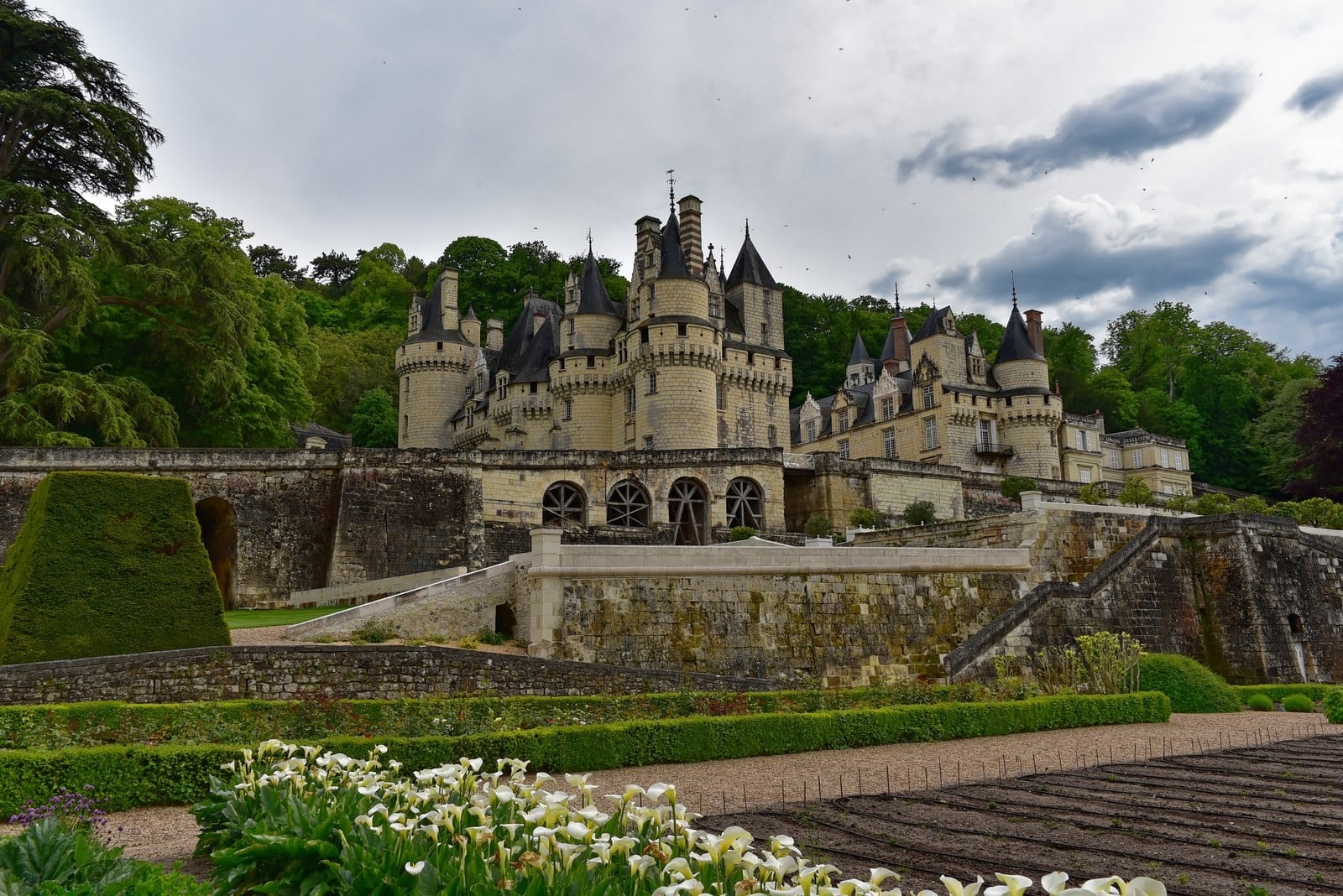
Fairytale castles in France are older than the fairytales. The turreted rooflines, the towers doubled in still water, the white walls rising from a forest clearing: this picture was cut in Loire limestone during the Renaissance, three hundred years before the Brothers Grimm, before Walt Disney, and before Bavaria built the castles that now carry the storybook name abroad. This guide gathers eight French chateaux that deliver the storybook look most completely, from a Sleeping Beauty castle on the edge of a Touraine wood to a pink fortress raised again on the crest of the Vosges.
One rule governs the selection, and it is visual: these are the chateaux that look like the illustration, whatever their real age. Two families meet on this page. Five are Renaissance originals, the buildings that invented the silhouette when French kings and their financiers traded grim medieval keeps for pleasure palaces of turret and pinnacle. Three are Romantic reconstructions, ruins rebuilt across the nineteenth and early twentieth centuries by patrons who had read the same poems and studied the same paintings. When Germany’s kings later wanted fairytale castles of their own, their architects looked to the massed towers of the Loire; the image was French first.
This is a gallery, not a ranking. Our national guide to the chateaux of France weighs history, architecture, and visitor experience across the whole country, while this page asks a narrower question: which castles deliver the picture. Here are the eight, arranged not by geography but by those two families, opening with the one chateau that is a fairy tale by name.
The Eight at a Glance
| Castle | Region | Built / rebuilt | Storybook signature | Getting there |
|---|---|---|---|---|
| Ussé | Touraine (Indre-et-Loire) | 15th-16th century | Perrault’s Sleeping Beauty castle, a forest of turrets | Rigny-Ussé, near Chinon; Tours ~40 km |
| Chambord | Loir-et-Cher | begun 1519 | The most fantastical roofline in France | ~15 km east of Blois, off the D33 |
| Chenonceau | Indre-et-Loire | 1512-1521; bridge 1556-1577 | The chateau that bridges a river | Chenonceaux, rail from Tours |
| Azay-le-Rideau | Indre-et-Loire | 1518-1527 | A Renaissance house mirrored in the Indre | Azay-le-Rideau, ~26 km SW of Tours |
| Chaumont | Loir-et-Cher | c. 1468-1511 | Feudal round towers on a bluff over the Loire | Chaumont-sur-Loire, between Blois and Amboise |
| Pierrefonds | Oise (Hauts-de-France) | rebuilt from 1857 | Viollet-le-Duc’s dream of the Middle Ages | ~15 km SE of Compiègne; Paris ~80 km |
| Haut-Kœnigsbourg | Bas-Rhin (Alsace) | rebuilt 1900-1908 | A pink fortress on the Vosges crest | above Orschwiller, near Sélestat |
| Chantilly | Oise (Hauts-de-France) | rebuilt 1875-1885 | Towers mirrored in a moat, north of Paris | Chantilly, ~40 km north of Paris by train |
Ussé: The Castle That Is a Fairy Tale by Name
Château d’Ussé is the only castle on this page that arrives with its own fairy tale attached. By long tradition the white château above the Indre is the Sleeping Beauty castle: Charles Perrault, so the story goes, looked up at its forest of turrets and pointed roofs and set La Belle au bois dormant among them. No document proves he ever visited, and the château sells the legend cheerfully, with a Perrault trail winding through its attics. The building beneath the story is real enough, a fifteenth-century keep dressed over the next two hundred years in Renaissance and classical fashions, still privately owned and lived in by the de Blacas family. Seen from the terraced gardens with the wood pressing up behind it, Ussé is exactly the castle the illustrators draw.
Chambord: The Roofline That Became a Legend
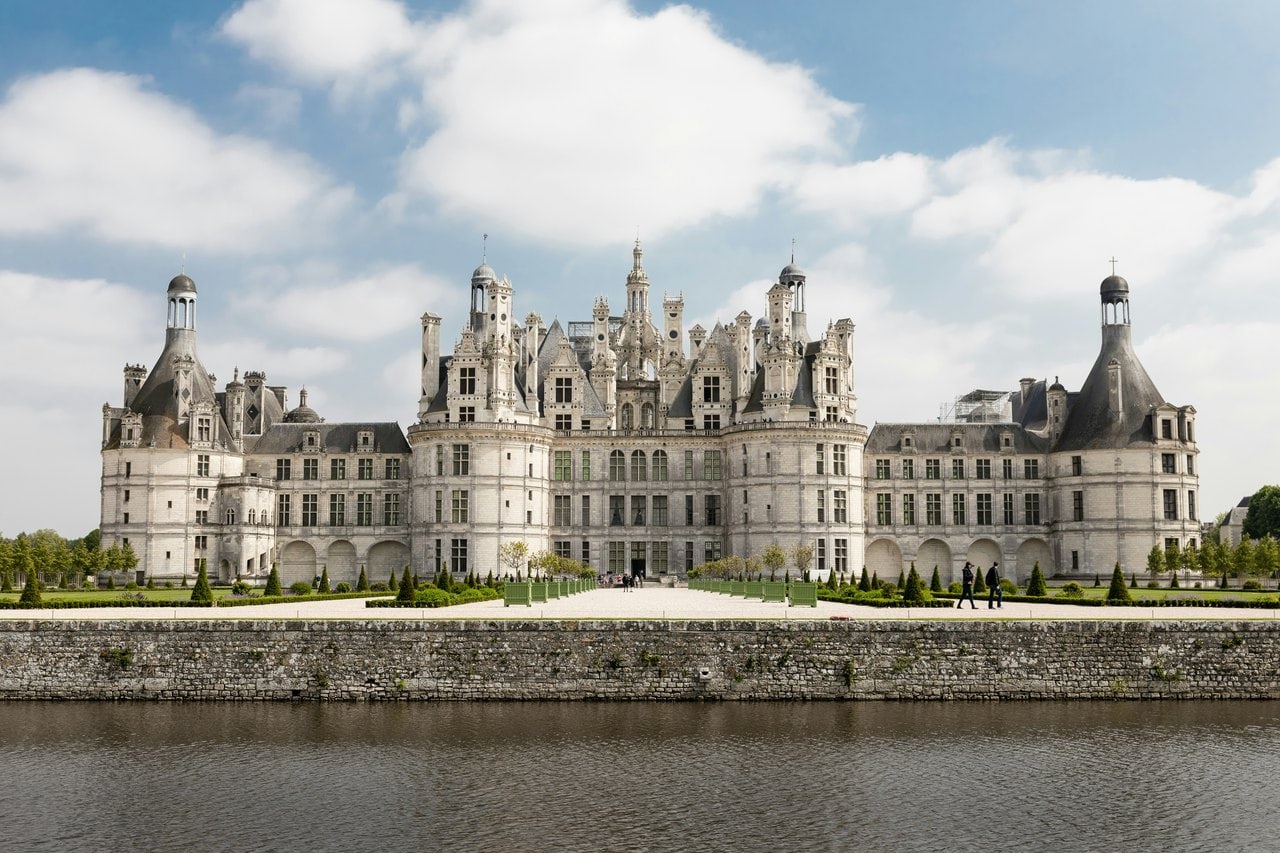
If one building taught the world what a French castle should look like from a distance, it is Château de Chambord. Begun in 1519 for François I as a hunting seat at the edge of the Sologne, it carries a roofscape so crowded with chimneys, turrets, gables, and a central lantern tower that visitors have compared it to the skyline of a whole town. The double-helix staircase at its heart is often linked to Leonardo da Vinci, who spent his last years a day’s ride away; the château’s own historians call it an influence rather than a design. That fantasy has traveled far. Disney’s animators have named Chambord as a model for the Beast’s castle in Beauty and the Beast. Inscribed within the Loire Valley World Heritage Site, Chambord drew over 1.1 million visitors in 2023, more than any château in France except Versailles.
Chenonceau: The Château That Bridges the River
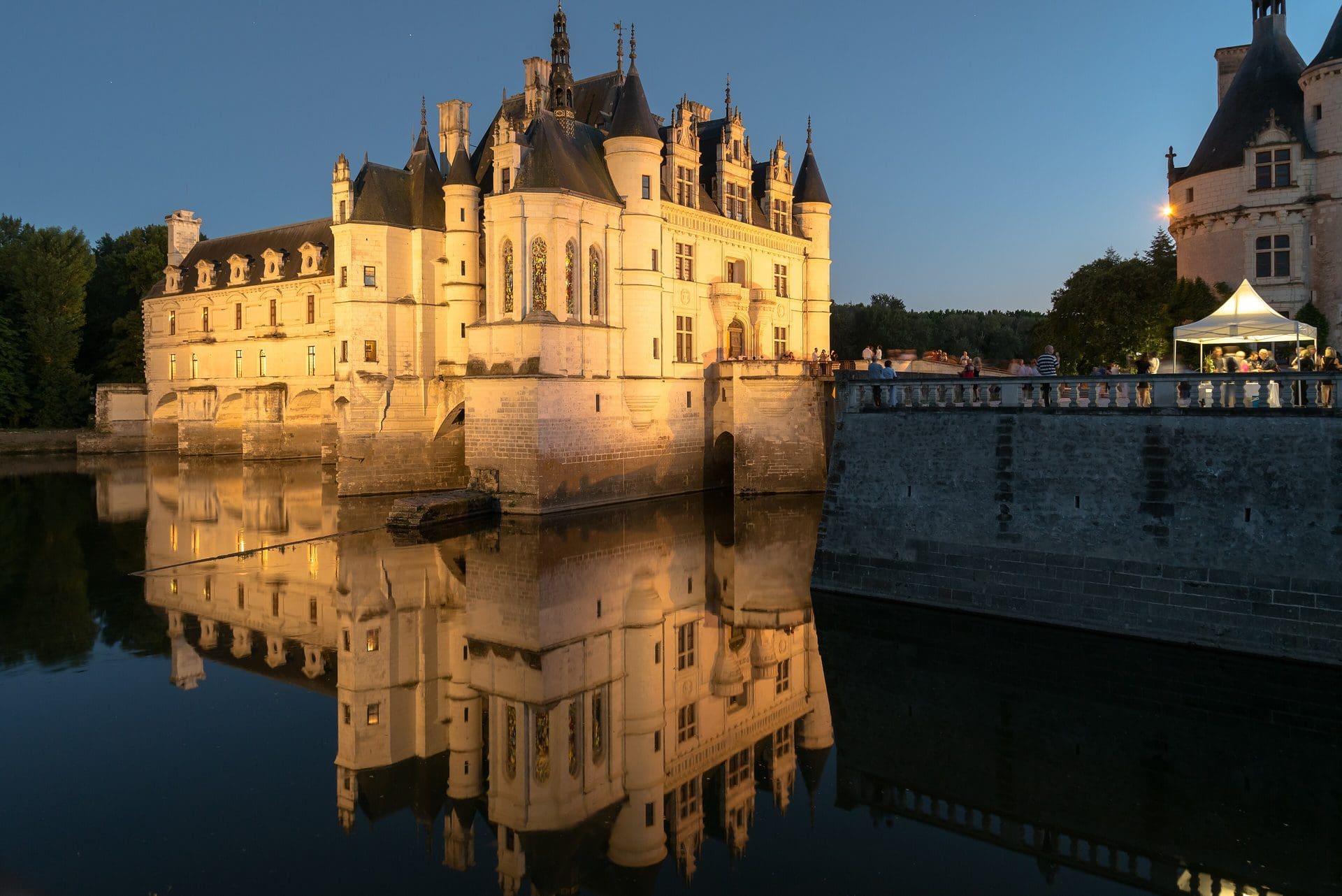
No French castle sits on the water quite like Château de Chenonceau, which reaches across the River Cher on a row of arches with a long gallery hung above the current. That picture was built in stages by a succession of women, which is why the château is known as the Château des Dames, the Ladies’ Castle. Katherine Briçonnet completed the original house by 1521 on the piers of an old mill; Diane de Poitiers commissioned the bridge across the Cher from Philibert de l’Orme in the 1550s; and Catherine de’ Medici, having reclaimed the château for the crown, topped that bridge with a two-story gallery, the work of Jean Bullant, in the 1570s. What they left is the most photographed reflection in the Loire, a building that appears to float on its own river.
Azay-le-Rideau: The Mirror on the Indre
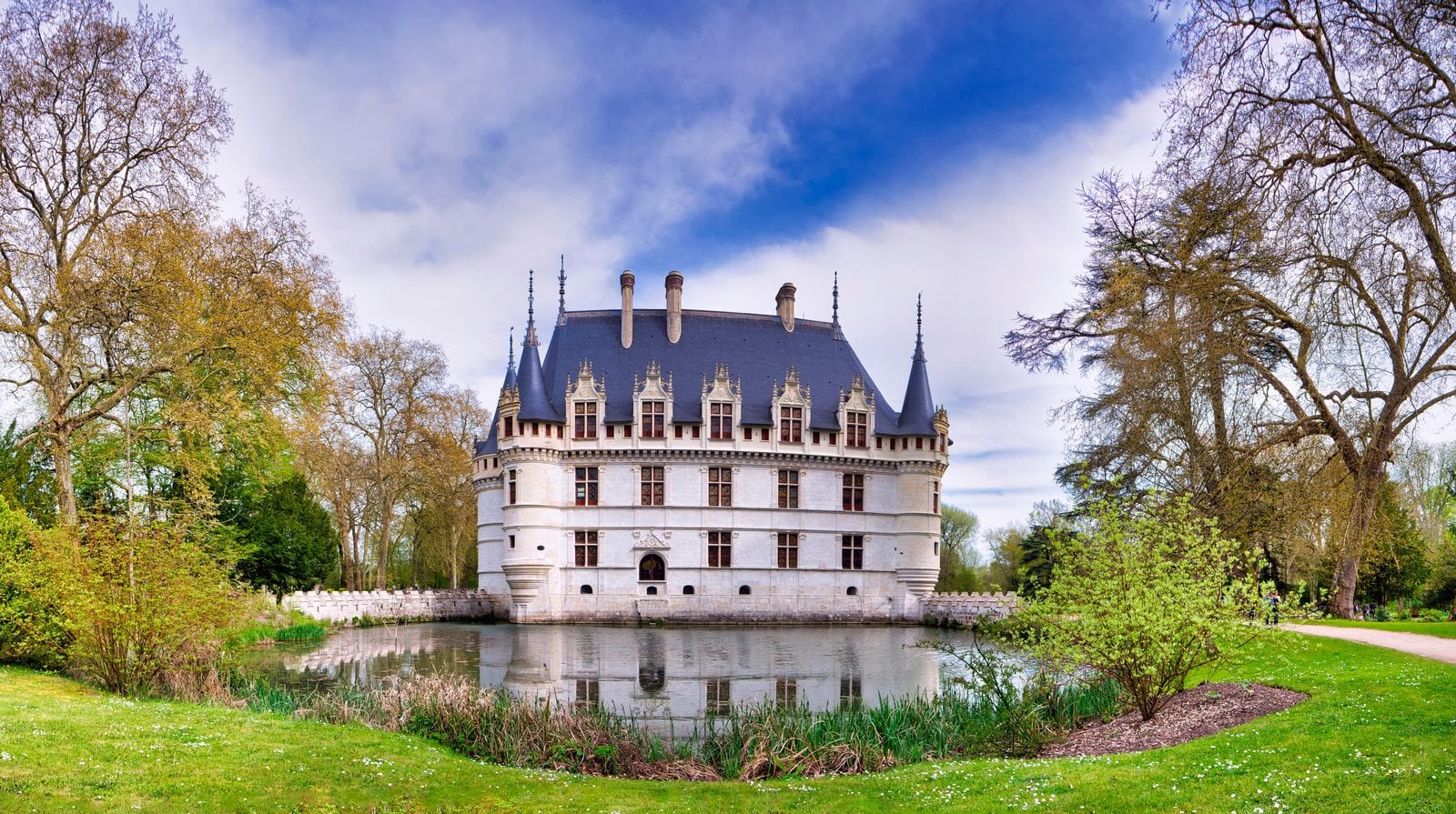
Château d’Azay-le-Rideau is a jewel small enough to take in at a glance, and it was built to be seen doubled in water. Gilles Berthelot, a royal financier under François I, raised it between 1518 and 1527 on an island in the Indre, its pale facades and slate roofs climbing straight from a channel that returns the whole building upside down. Berthelot enjoyed it barely a decade: when his cousin fell in a great financial scandal, he fled, and the king seized the unfinished house. Restored by the Centre des monuments nationaux between 2015 and 2017, it wears fresh slate and clean stone today and draws about 300,000 visitors a year. Of all the Renaissance originals, Azay states the storybook formula most purely, a turreted house afloat on its own reflection.
Chaumont: The Feudal Silhouette
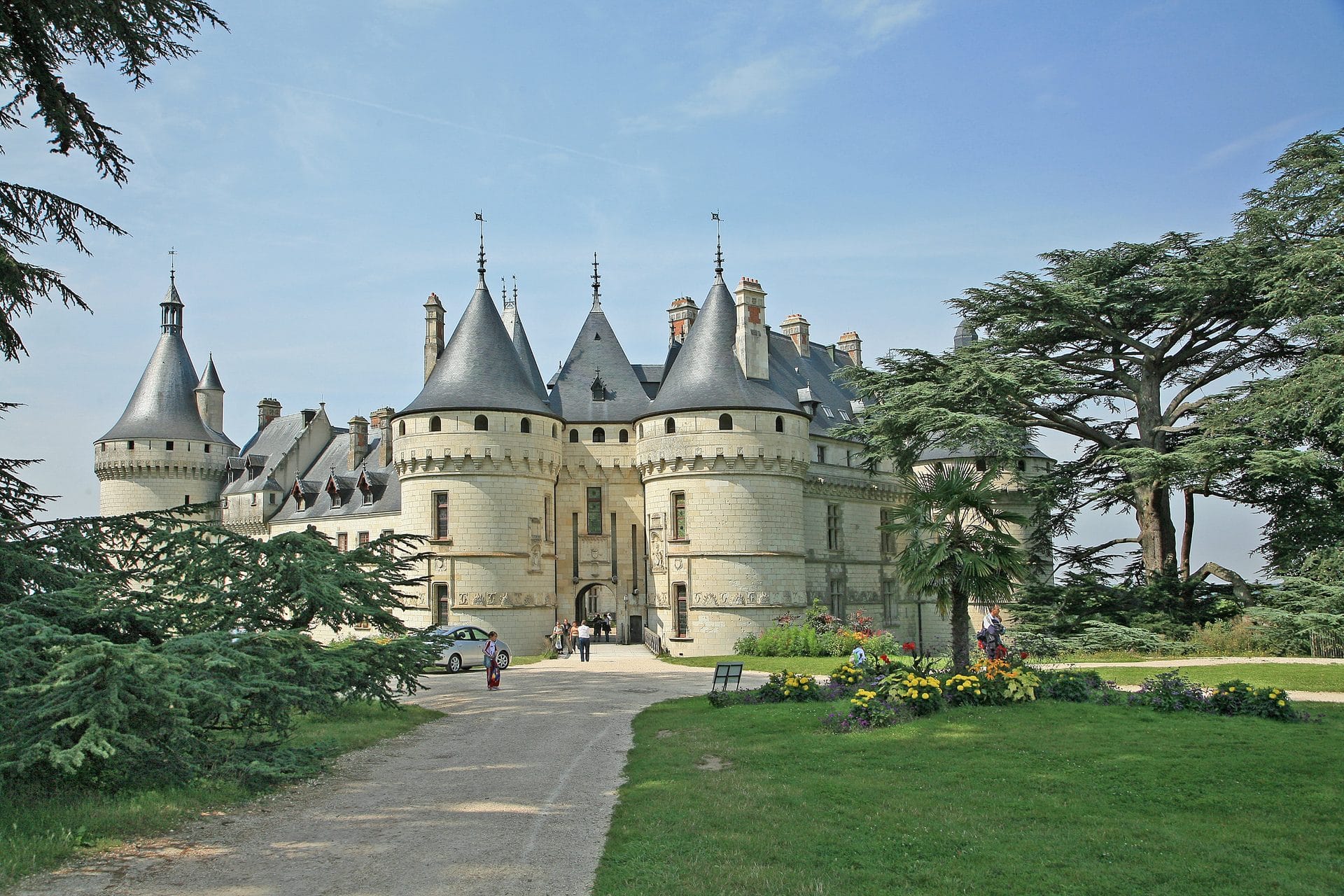
Where the other Loire châteaux soften into Renaissance grace, Château de Chaumont-sur-Loire keeps its medieval muscle, and that is the point. Rebuilt by the Amboise family between roughly 1468 and 1511 on a bluff above the south bank of the Loire, it meets the approaching visitor with a drawbridge, round towers, and a machicolated gateway before a single Renaissance flourish appears inside. Catherine de’ Medici owned it, and in 1559, after the death of Henri II, she recovered Chenonceau as crown property and handed Chaumont to the king’s mistress, Diane de Poitiers, in exchange. The estate belongs today to the Centre-Val de Loire region and hosts an International Garden Festival each summer. From the river road below, that turreted skyline on its wooded height is the storybook castle in its oldest and most defensive form.
Pierrefonds: Viollet-le-Duc’s Dream of the Middle Ages
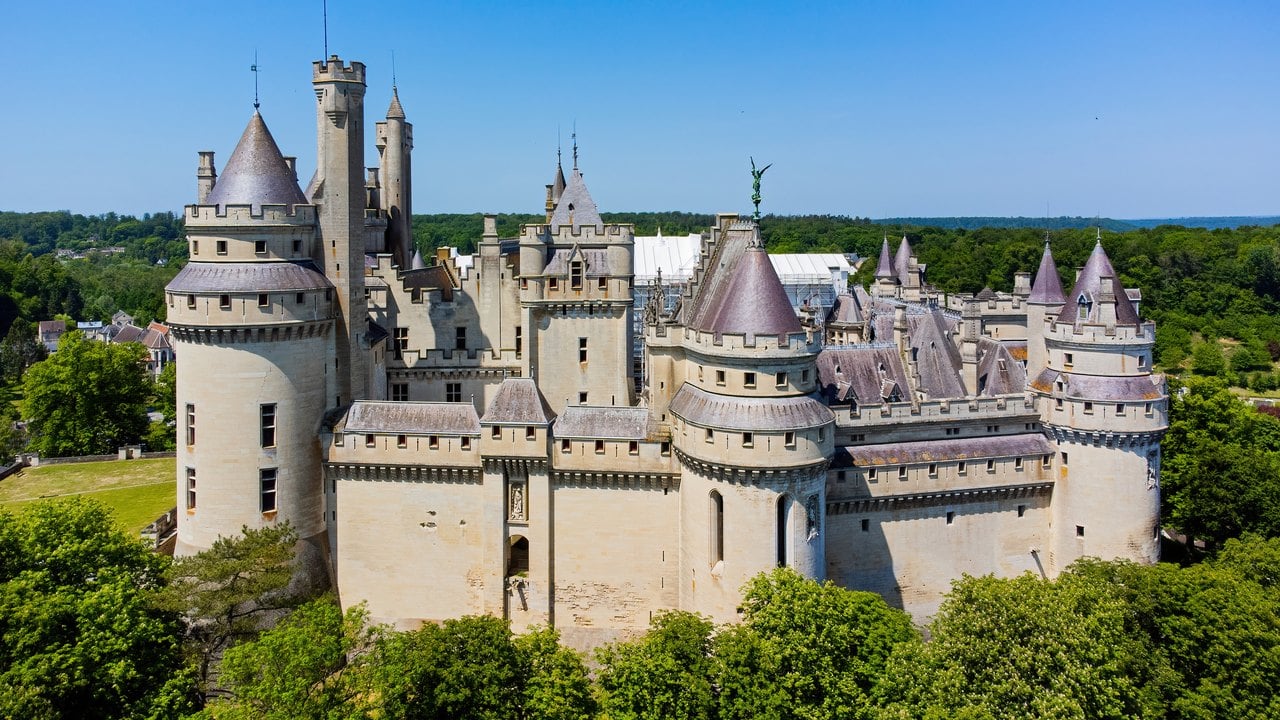
With Pierrefonds the collection crosses from the Renaissance originals to the reconstructions that revived their image. Château de Pierrefonds is a medieval castle that is mostly younger than the camera. A great fortress rose here around 1397 for Louis d’Orléans, was dismantled on Richelieu’s orders in 1617, and lay broken for two centuries until Napoléon III handed the site to Eugène Viollet-le-Duc. From 1857, across some three decades and past the architect’s death in 1879, Viollet-le-Duc rebuilt it not as it had been but as the nineteenth century dreamed the Middle Ages should look: soaring roofs, painted halls, ranks of statuary. Historians treat the result as an interpretation rather than a restoration, and film crews have treated it as the Middle Ages itself, from Besson’s Jeanne d’Arc to the BBC’s Merlin. It is the most complete fairy tale in the collection, because it was built to be one.
Haut-Kœnigsbourg: The Fortress on the Crest
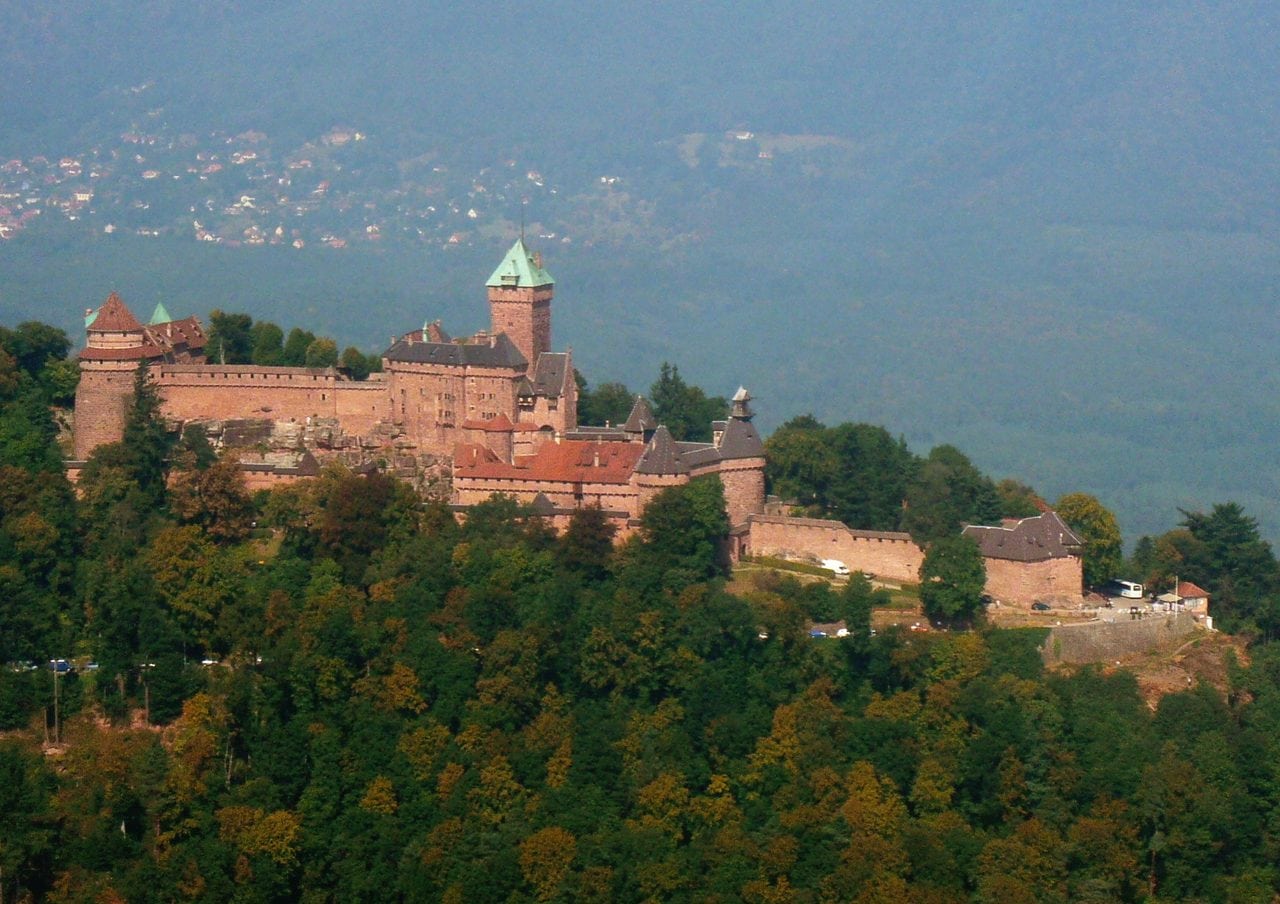
Alsace keeps its storybook castle on a mountaintop. Château du Haut-Kœnigsbourg stands at 757 meters on a crest of the Vosges, its pink-sandstone walls and great keep commanding the whole Alsace plain toward the Rhine. A stronghold held this summit from the twelfth century until Swedish troops burned it in 1633, during the Thirty Years’ War, after which it stayed a ruin for more than two centuries. Between 1900 and 1908 the German architect Bodo Ebhardt rebuilt it for Kaiser Wilhelm II, then ruler of annexed Alsace, restoring the fortress to its prestige of around 1500. Purists have argued ever since about how much Ebhardt invented; the silhouette he left, riding its ridge above the vineyards, is one of the most-visited monuments in France, with nearly 600,000 visitors in 2023. Few castles announce themselves so completely from so far away.
Chantilly: Towers on the Water, North of Paris
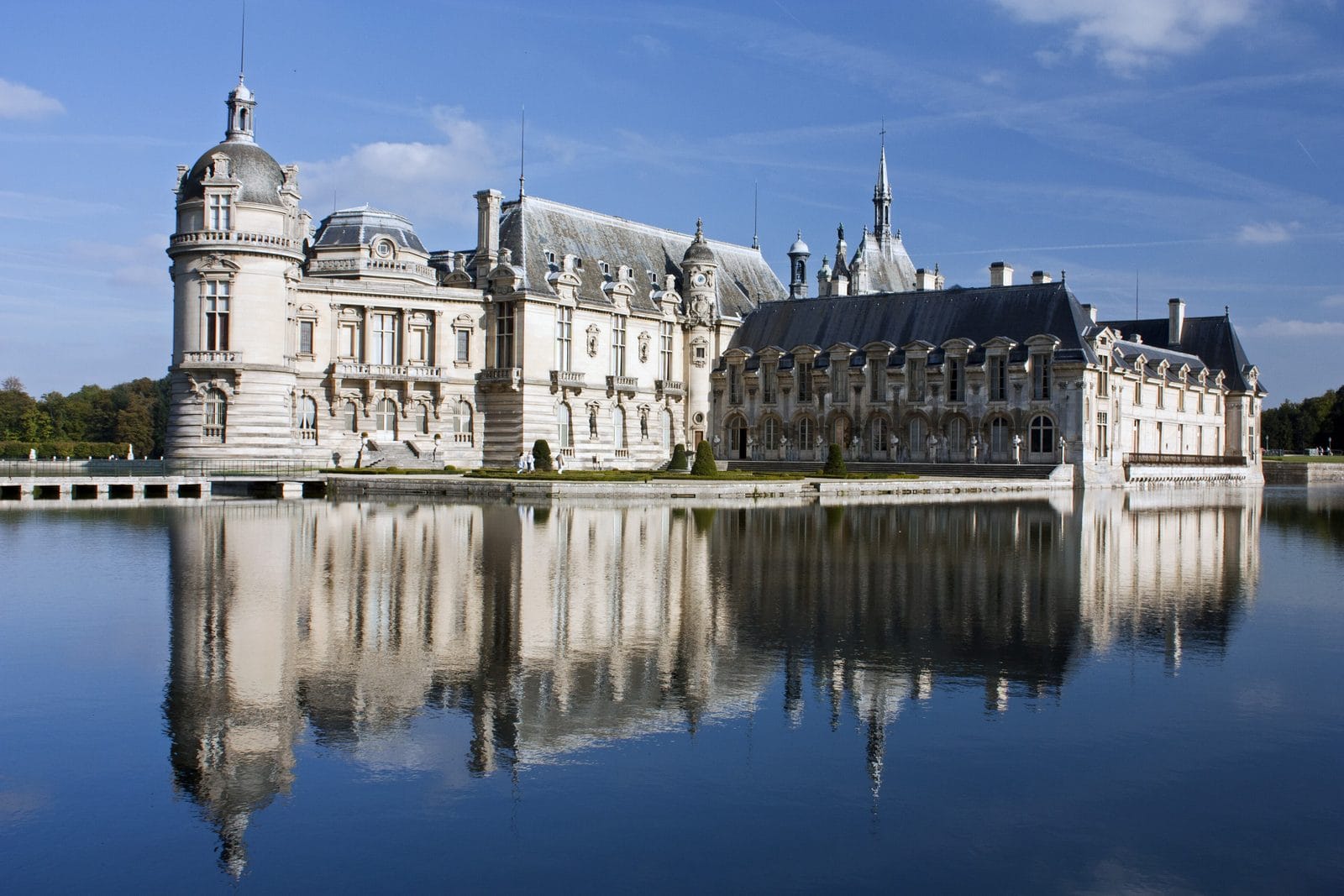
Closest to Paris, and the match of any Loire château for sheer reflection, Château de Chantilly rises from ornamental basins in a park laid out by André Le Nôtre. Two buildings stand joined here: the small Renaissance château of the 1560s, built by Jean Bullant for the Constable Anne de Montmorency, and the grand château beside it, demolished in the Revolution and rebuilt between 1875 and 1885 by Honoré Daumet for Henri d’Orléans, Duc d’Aumale. The duke filled it with paintings and left the whole domain to the Institut de France, so his galleries survive intact as the Musée Condé, which holds the second collection of old master paintings in France after the Louvre. Seen across the water, its towers and pinnacles doubled in the still surface, Chantilly is a storybook castle that happens also to be one of the country’s great museums.
Beyond the Storybook: What Did Not Make the List
Because the test here is the picture, several of France’s most important châteaux are deliberately absent. Versailles and Vaux-le-Vicomte are the summits of French classicism, but their grandeur is horizontal and orderly, the opposite of vertical storybook fantasy; they overwhelm rather than enchant. Cheverny is a flawless symmetrical residence, the model Hergé drew for Tintin’s Marlinspike Hall, yet it reads as a stately home rather than a fairy tale. The closest call is Carcassonne, whose ramparts Viollet-le-Duc reimagined a few years before he touched Pierrefonds; it certainly looks the part from a distance, but a walled war-city belongs to a different genre, all defense and no dream. Each is a great visit, and each answers a different question than this page asks.
Planning a Fairytale Castles Trip in France
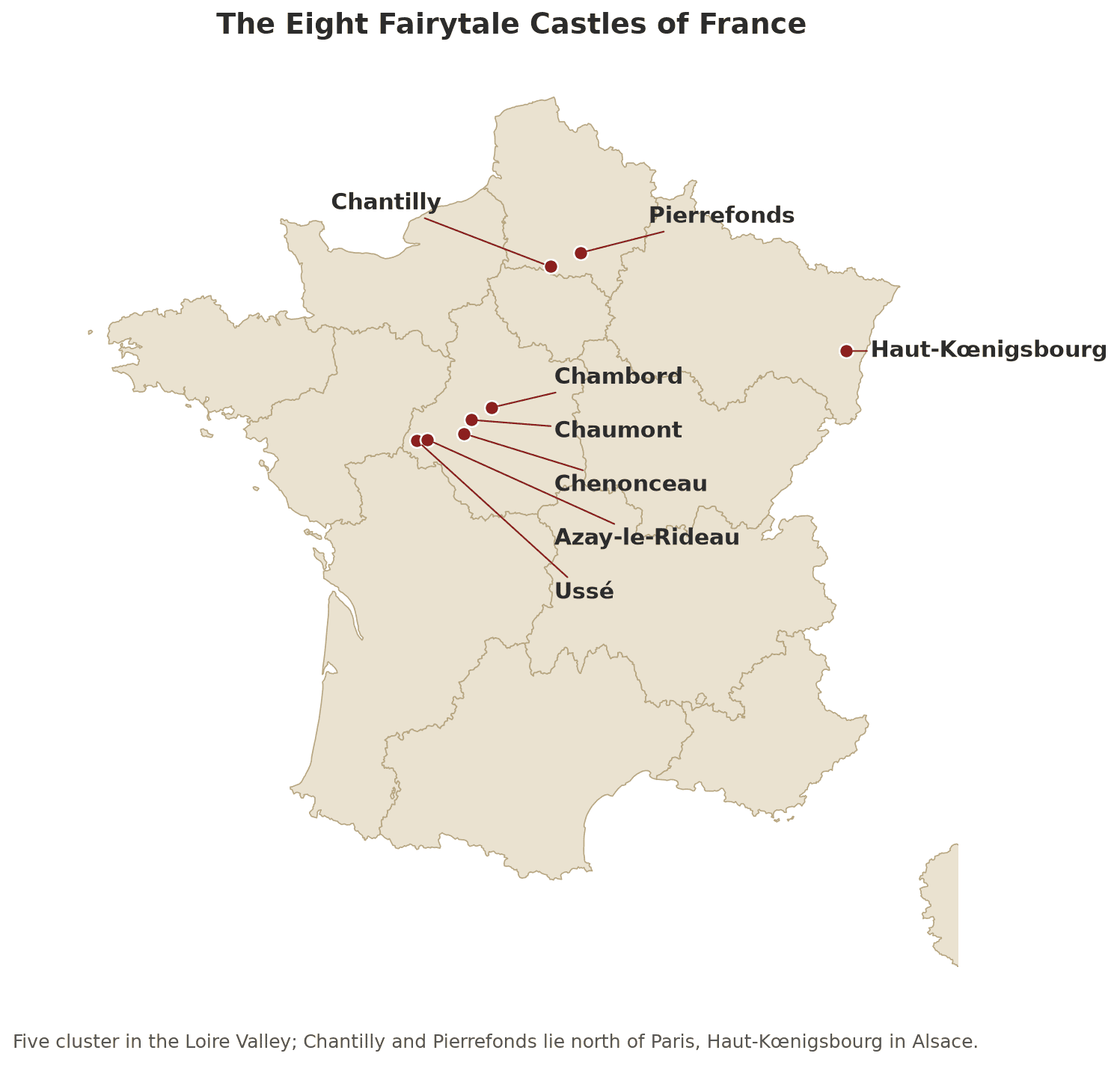
The eight sort into three easy trips. The five Loire châteaux, Ussé, Chambord, Chenonceau, Azay-le-Rideau, and Chaumont, cluster within an hour of Tours or Blois and combine into a two- or three-day drive through Touraine and the Blésois. Pierrefonds and Chantilly sit north of Paris in the Oise, close enough to pair on a single day out from the capital. Haut-Kœnigsbourg stands apart in Alsace, a natural stop on any tour of the Route des Vins between Sélestat and Colmar.
For the storybook picture itself, timing helps. The water reflections that define Chenonceau, Azay-le-Rideau, and Chantilly read best in the still light of early morning or the hour before sunset, before any breeze breaks the mirror. Chaumont is at its most theatrical when its International Garden Festival is running, across summer and into early November, and Haut-Kœnigsbourg rewards an autumn visit, when the Alsace vineyards below it turn gold. Drivers can string the five Loire châteaux together freely; travelers without a car will find Chenonceau, Azay-le-Rideau, and Chantilly the easiest reached by train, while Ussé and Chambord effectively ask for a car.
Skip-the-line tickets and guided day tours for these châteaux, including the popular Loire castle trips from Tours and Paris, are on GetYourGuide’s France page. For overnight bases in Tours, Blois, Compiègne, or the Alsace wine towns, compare hotels and guesthouses on Booking.com.
Some links on this page are affiliate links, which means StoneKeep Atlas may earn a small commission, at no extra cost to you, if you book through them.
Conclusion
The fairytale castles of France are not copies of a storybook; they are its source. Kings and financiers cut the first turreted silhouettes into the Loire five centuries ago, Romantics rebuilt the ruined ones into something dreamier still, and the image traveled out across Germany, to Hollywood, and into every child’s picture book. Some of these châteaux are genuine Renaissance survivors and some are nineteenth-century inventions, but from the far side of the moat that distinction dissolves. Begin with the chateaux of the Loire Valley for the heart of the collection, or with our national guide to the chateaux of France for the whole sweep; if you only want the picture, this page is the itinerary.
Principal Sources
- Domaine national de Chambord, official site (chambord.org) and 2023 attendance report; UNESCO World Heritage Centre, “The Loire Valley between Sully-sur-Loire and Chalonnes” (list 933).
- Château de Chenonceau, official visit guide and history (chenonceau.com); POP/Mérimée notice PA00097654.
- Centre des monuments nationaux: Château d’Azay-le-Rideau (azay-le-rideau.fr) and Château de Pierrefonds (chateau-pierrefonds.fr), official histories; Ministère de la Culture, Histoire des arts.
- Domaine régional de Chaumont-sur-Loire (domaine-chaumont.fr), history and International Garden Festival pages.
- Château du Haut-Kœnigsbourg, Collectivité européenne d’Alsace official site (haut-koenigsbourg.fr).
- Château de Chantilly / Domaine de Chantilly, Institut de France (chateaudechantilly.fr); POP/Mérimée notice PA00097714.
- Château d’Ussé official site (chateaudusse.fr); POP/Mérimée notice PA00098034.
- StoneKeep Atlas castle guides for all eight members, each with its own Principal Sources drawing on operator sites and national monument records.
Image credits. The eight fairytale castles map: StoneKeep Atlas (own work), regional outlines from france-geojson, public domain; Château d’Ussé above the Indre (featured image): Uwalthie Pic Project / Adobe Stock; Château de Chambord, north front: Dorian Mongel via Unsplash; Château de Chenonceau reflected in the Cher: Ant°AM, CC BY-SA 4.0, via Wikimedia Commons; Château d’Azay-le-Rideau in its water mirror: via Adobe Stock; Château de Chaumont-sur-Loire entrance front: W. Bulach, CC BY-SA 4.0, via Wikimedia Commons; Château de Pierrefonds from the air: via Adobe Stock; Château du Haut-Kœnigsbourg on its spur: Wrtalya, CC BY-SA 4.0, via Wikimedia Commons; Château de Chantilly reflected in its lake: Daniel Villafruela, CC BY 3.0, via Wikimedia Commons. Freely licensed images are resized to fit; otherwise unaltered.